
Do you need German to study in Germany? You can study without it, but only on an English-taught course, and those are mostly at master’s level. If you’re applying for a bachelor’s straight from school in Kenya, or for a course taught in German, you’ll almost certainly need German, often at an advanced level. And even on an English-taught course, German shapes your part-time job, your housing search and your chances of staying to work.
This guide explains which courses need which language, the exact certificates German universities and the German Embassy in Nairobi accept, where you can take those tests in Kenya and what they cost, and how long it takes to get from no German to the level you need. For the full picture of studying in Germany, start with our guide to studying in Germany from Kenya.
Do you need German to study in Germany?
It depends on the language of your course, not on Germany itself. Every German degree program sets its own language of teaching, and that decides which test you take.
| Program type | What you need to prove | Typical level |
|---|---|---|
| Taught in German | German | C1 for most bachelor’s and master’s programs |
| Taught in English | English | About B2, shown by IELTS, TOEFL or similar |
| Taught in both | Both languages | Set by each program |
If a program teaches in both languages, you must prove both. TUM, for example, says that when a program requires German and English, you submit proof of each.
The German Embassy in Nairobi then checks language again at the visa stage. It usually wants German or English at B2, depending on the language of your course, unless the university has already tested you and says so in your admission letter.
Bachelor’s or master’s: where English-taught courses are
English-taught courses are far more common at master’s level. Most bachelor’s programs at German public universities teach in German. If you’re a Form Four leaver hoping to study in English, your choices will be narrow. Many Kenyans take a different path: a bachelor’s in Kenya, then an English-taught master’s in Germany.
You can check the language of any program on Hochschulkompass, the official database of the German Rectors’ Conference, which lets you filter by teaching language.
English-taught programs: what you need to prove
English proof is set program by program, not by the university as a whole. Two master’s programs at the same university can ask for different scores, and some accept your Kenyan degree as proof while others don’t.
The scores universities ask for
Darmstadt University of Applied Sciences (h_da) shows how much programs vary. Its English requirements page lists, among others:
| h_da master’s program | IELTS | TOEFL iBT | Does an English-taught bachelor’s count? |
|---|---|---|---|
| Electrical Engineering and IT | 6.5, no band below 6 | 88 | No |
| Business Administration (MBA) | 6.5 | 88 | Not listed |
| Mechatronics | 6.0 | 80 | Not listed |
| Expanded Media | 5 to 6.5 (B2 overall) | 72 to 94 | Yes, with a medium of instruction certificate |
An IELTS of 6.5 with no band below 6.0 clears most programs. Aim for that if you’re taking the test anyway.
Does a Kenyan degree taught in English count?
Sometimes. Some programs accept a medium of instruction certificate, a letter from your Kenyan university confirming your degree was taught in English. At h_da, the Expanded Media and the Animation & Game master’s programs accept that kind of proof. The Electrical Engineering master’s says school English isn’t enough and wants a test score.
Your KCSE English grade is less likely to help. TUM says school grades can no longer serve as English proof, and its master’s programs never accept them. Some bachelor’s programs at other universities still do, so check each one.
Ask your Kenyan university’s registrar for a medium of instruction letter early. It’s cheap, and if a program accepts it, it saves you the cost of a test.
What the embassy needs
The visa stage has its own rule. If you studied in English in Kenya, the German Embassy in Nairobi usually won’t ask for a separate English certificate, provided your admission letter explicitly says the university accepted that. If the letter is silent, bring an IELTS or TOEFL result. The embassy lists IELTS and TOEFL among the certificates it accepts in Kenya.
How long your result lasts
Some programs only accept recent results. At h_da, the Electrical Engineering and Animation & Game programs want certificates no more than two years old. TUM says it doesn’t check temporary validity dates on certificates. Confirm the validity rule for your program before you book a test.
German-taught programs: the certificates you need
For a degree taught in German, universities want proof that you can follow lectures and write exams in German. That usually means level C1 or above, and they accept a short list of certificates set by the education ministers of the German states. TUM, for example, points applicants to that national list.
Bochum University of Applied Sciences shows what this looks like in practice. For most of its bachelor’s programs, it accepts these certificates:
| Certificate | Level Bochum asks for (most bachelor’s programs) |
|---|---|
| TestDaF | 4 in all four parts (4×4) |
| DSH | DSH 2 |
| telc | C1 Hochschule |
| ÖSD | C1 |
| Goethe-Zertifikat | C2 |
| DSD | DSD II |
| Studienkolleg final exam | Accepted |
Notice the Goethe line. Bochum wants the Goethe C2 certificate, not C1, for most bachelor’s programs. Many universities follow the same pattern, so don’t assume a Goethe C1 will get you into a German-taught degree.
Some programs ask for less. Bochum’s architecture bachelor’s, for example, accepts B2 certificates. Requirements differ even within one university.
What these tests are
- TestDaF is a standardized university-entrance test. Each of four parts (reading, listening, writing, speaking) gets a level from 3 to 5, and most universities want at least 4 in every part.
- DSH is an exam set by individual German universities, usually taken in Germany. DSH 2 is the level most programs ask for.
- telc C1 Hochschule is a C1 exam built for university study.
- Goethe-Zertifikat exams run from A1 to C2, and you can take them in Nairobi.
If you’re coming through a Studienkolleg, its final exam includes German and counts as your language proof.
The visa still needs proof
Even after admission, the German Embassy in Nairobi checks your German at the visa stage. It usually asks for B2 shown by a recognized certificate, unless your admission letter says the university has already tested your German.
German for the routes before a degree
Many Kenyans need German long before they start a degree, because the routes that lead into a degree ask for it. Here’s what each route asks for, from official pages:
| Route | German you need | Who sets it |
|---|---|---|
| Studienkolleg entrance exam | B1, plus at least 400 lessons if you don’t hold a B1 certificate | University of Kassel |
| Studienkolleg M course for medicine | At least B2 | Otto von Guericke University Magdeburg |
| Studienbrücke (Goethe-Institut Kenya) | B1.3 to apply | Goethe-Institut Kenya |
| Vocational training (Ausbildung) visa | B1 for qualified training, otherwise usually A2 | German Embassy Nairobi |
| DAAD EPOS on a German-taught course | B1 when you apply, DSH 2 or TestDaF 4 before the course starts | DAAD |
| A spouse joining you | Basic German (A1), with some exceptions | Residence Act, section 30 |
A note on the Studienkolleg
The Studienkolleg itself teaches in German, and it builds your German toward the final exam. But you need B1 to sit most entrance exams. If you’re starting from zero after Form Four, plan for a year or more of German classes before you apply.
A note on EPOS
For German-taught EPOS courses, DAAD’s scholarship includes a six-month German course in Germany before you start. But DAAD warns that you can’t pass the required DSH or TestDaF without at least B1 first, even with that course. So start German in Kenya if an EPOS course you want is taught in German. For English-taught EPOS courses, DAAD asks for IELTS band 6 or a TOEFL iBT of 80, though some courses expect more.
Where to take recognized tests in Kenya
You can take most of the tests German universities and the embassy accept without leaving Kenya.
German: the Goethe-Institut in Nairobi
The Goethe-Institut Nairobi runs Goethe-Zertifikat exams from A1 to C2. Its 2026 exam fees are lower if you’re one of its own students:
| Exam | Fee for Goethe students | Fee for external candidates |
|---|---|---|
| Start Deutsch 1 (A1) | KSh 15,000 | KSh 19,000 |
| Goethe-Zertifikat A2 | KSh 17,000 | KSh 21,000 |
| Goethe-Zertifikat B1 | KSh 19,000 | KSh 25,000 |
| Goethe-Zertifikat B2 | KSh 20,000 | KSh 26,000 |
| Goethe-Zertifikat C1 | KSh 21,000 | KSh 27,000 |
The B1, B2 and C1 exams are split into modules, so if you fail one part, you can retake just that module for a lower fee. Budget for a second attempt anyway, in case you need one. Our cost of studying in Germany guide includes the test in its first-year budget.
The Goethe-Institut also lists TestDaF among its exams. Contact the institute for TestDaF dates in Nairobi, since TestDaF is one of the certificates German-taught programs accept.
German courses in Nairobi
The Goethe-Institut Nairobi teaches in-person courses from A1 to B2. Each runs for 12 weeks and starts in January, May, September or October. You can choose intensive (two hours each weekday), super-intensive (four hours each weekday) or Saturday-only courses, and fees run from KSh 34,000 to KSh 49,000 a course. Its course list also includes intensive C1 and C2 courses, and the institute offers online courses as well, so you can reach C-level German through the Nairobi institute. If you already speak some German, you take a placement test first.
How long it takes to get from A1 to B2
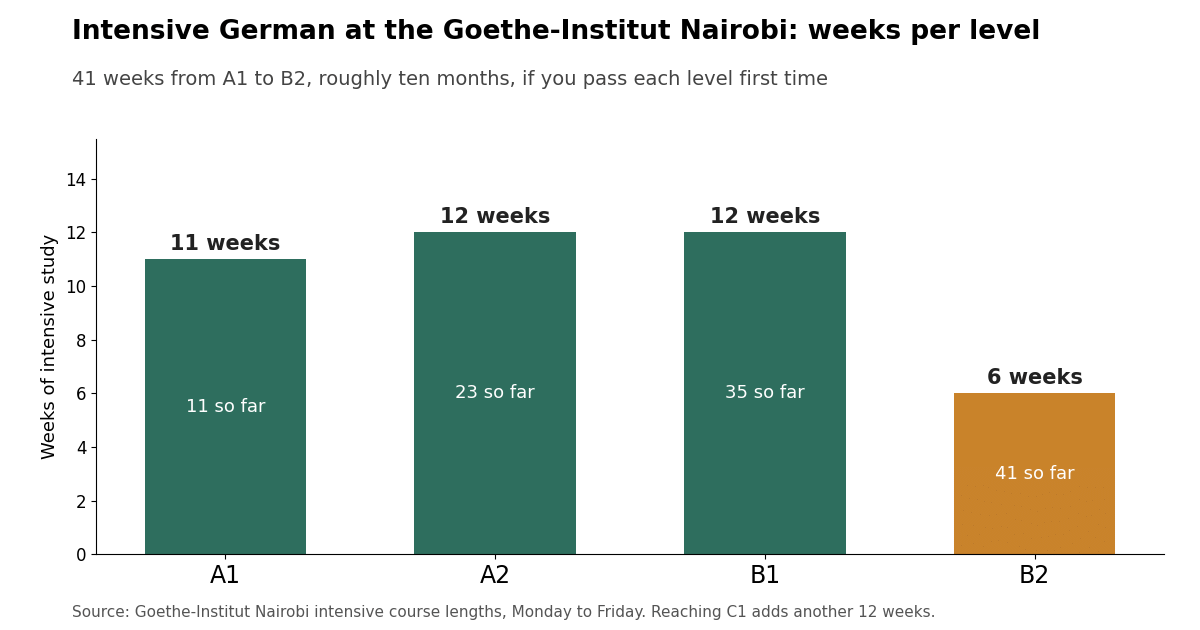
Plan in months, not weeks. The Goethe-Institut Nairobi lists how long each intensive level takes, meeting Monday to Friday:
| Level | Teaching units | Length |
|---|---|---|
| A1 | 132 | 11 weeks |
| A2 | 144 | 12 weeks |
| B1 | 156 | 12 weeks |
| B2 (B2.1 and B2.2) | 90 | 6 weeks |
| C1 | 120 | 12 weeks |
| C2 | 132 | 12 weeks |
Going from zero to B2 takes about 41 weeks of intensive study, roughly ten months, if you pass each level first time. Reaching C1, which most German-taught degrees need, adds another 12 weeks.
Saturday-only courses cover the same levels more slowly, so expect it to take noticeably longer if you’re working or still in school.
English: IELTS and TOEFL
The British Council runs IELTS at nine centers in Kenya: Nairobi, Eldoret, Mombasa, Kisumu, Nyeri, Nakuru, Meru, Kisii and Kakamega. You can take it on a computer at a test center, or online from home. IELTS fees are set by the British Council and change often, so none are listed here; the booking page shows the current price.
TOEFL is also accepted by most German universities and by the embassy. Whichever you choose, check that the program on your list accepts it, and whether it wants the at-home version or a test center result.
Why German still matters on an English-taught course
An English-taught master’s covers the classroom. Everything outside it happens mostly in German, and that affects your money and your future plans.
- Part-time work. Most student jobs in shops, cafes and offices use German. Without it, your choice of jobs is much narrower, which matters when your budget relies on topping up the blocked account.
- Housing and paperwork. Rental contracts, the address registration office and the foreigners office mostly work in German.
- Finding a job after you graduate. You get up to 18 months to look for work after your degree. The Federal Employment Agency says many employers expect at least basic German and that English alone is often not enough. Hochschule Bremen’s career service puts it more bluntly, calling German the first priority for a job search.
- Regulated jobs. For jobs such as doctor, nurse or teacher, German is required by law.
Even if your course is in English, start German in Kenya. Reaching A2 or B1 before you fly costs far less in Nairobi than in Germany, and it makes your first months much easier.
Quick answers
Do you need German to study in Germany as a Kenyan?
Only if your course is taught in German, and then you’ll usually need C1. On an English-taught course you prove your English instead, but basic German before you fly still makes life easier.
Can I study in Germany in English?
Yes, mostly at master’s level. Most bachelor’s programs at public universities teach in German. Check the teaching language of each program on Hochschulkompass.
What IELTS score do I need for Germany?
It depends on the program. At h_da, scores range from IELTS 5 to 6.5. An overall 6.5 with no band below 6.0 clears most master’s programs.
Can I use my Kenyan degree instead of IELTS?
Sometimes. Some programs accept a medium of instruction letter from your Kenyan university. If yours does, make sure your admission letter says so, because the embassy checks it at the visa stage.
Is a Goethe B2 enough for a German-taught degree?
Usually not. Most German-taught programs ask for TestDaF 4×4, DSH 2, telc C1 Hochschule or Goethe C2. B2 is often the level the embassy asks for at the visa stage, not the level universities need.
Where can I take a German exam in Kenya?
At the Goethe-Institut in Nairobi, which runs Goethe-Zertifikat exams from A1 to C2. A full B2 exam costs KSh 20,000 for its own students and KSh 26,000 for external candidates.
How long does it take to learn German to B2?
About ten months of intensive weekday courses at the Goethe-Institut Nairobi, if you pass each level first time. Saturday-only courses take longer.
More guides in this series
- Study in Germany from Kenya: the complete guide
- KCSE and Kenyan degree requirements for German universities
- German student visa from Kenya: the Nairobi process step by step
- Scholarships in Germany for Kenyan students
- DAAD EPOS scholarship for Kenyans
This article is general information only. Language rules differ between programs and change often. Check the language page of each program you apply to, and the German Embassy Nairobi’s visa page, before you book a test.