
Until June 2026, a student with a Swedish study permit could work as many hours as they liked. That ended on 11 June 2026. A bachelor’s or master’s student who gets a new permit now has a limit of 15 hours of work a week during the semesters. Under the same rules, the Migration Agency also expects better exam results and gives you 30 days to report your address. So if you’re planning your money around a part-time job, the Sweden student residence permit you get in 2026 or 2027 isn’t the one your seniors had.
This guide works out the full cost of studying in Sweden in the order you’ll really live it, from choosing a program to setting up a home, with a cost table in Swedish kronor (SEK) for each stage and a total at the end.
Rules and fees change often, so check each figure on the official page we link before you pay. Where no official page gave us a number, the table marks it as our estimate. All our sources are official Swedish government or university pages, in English.
The Cost of Studying in Sweden Calculator
Every cost in this guide is built into the calculator below, from the application and permit fees to tuition, living money and setup. Pick what you’ll study, tick the boxes that fit you, and add a partner or children if they’re coming too. Then choose Low end, Middle or High end for the costs you can’t control. The Summary tab shows your first-year total, and Phase 1, 2 and 3 list every line behind it.
The figures come from official Swedish pages checked in October 2026, but fees and rules change often. Treat this as a budgeting tool, and confirm every figure on the official pages under “Where the numbers come from” before you pay.
Your situation
Show costs in your own currency
Estimated cost for your first year
SEK 0
The 2026 rule changes every applicant should read first
Most Sweden guides online were written before these changes, so start here.
- 11 June 2026, new study permit rules. The Swedish Migration Agency (Migrationsverket), the government office that decides on your permit, brought in the 15-hour weekly work limit, higher credit targets and a duty to report your address within 30 days. If your permit was granted before that date, these rules apply to you from your next extension.
- 1 June and 16 June 2026, new work permit rules. The general minimum salary for a work permit is now SEK 34,470 a month, which is 90 percent of the median salary. Swedish graduates skip it on their first application.
- 2026 maintenance figure. The money you need to show rose to SEK 10,656 a month for applications made in 2026, up from SEK 10,584 in 2025.
- 1 October 2026, family members. A partner or child who stays for one year or less now needs comprehensive health insurance of their own.
- Autumn 2027, family members who study. Jönköping University explains that a family member who wants to study at bachelor’s or master’s level will pay application and tuition fees from autumn 2027.
- 2027 to 2028 tuition. At Chalmers, most master’s programs go from SEK 80,000 to SEK 95,000 a semester from the 2027 to 2028 year.
Step 1: Pick a program that keeps your options open after graduation
The Migration Agency decides what you can do after you graduate, based on your level of study and how long your program was. Sweden has no special graduate work visa. You can apply for a permit to look for work. Or, with a job offer, you can apply straight for a work permit. Both depend on passing every course.
Work rights after you finish, level by level
After a bachelor’s or master’s degree you can get a permit to look for work, or to look into starting a business, for up to one year. Since 11 June 2026, the Migration Agency gives doctoral graduates a job-seeking permit of at least 12 months and at most 18 months. Sweden calls the three levels “cycles”: a bachelor’s is the first cycle, a master’s the second and a PhD the third.
| Level of study | Time you can get to look for work after you finish | What else to know |
|---|---|---|
| Bachelor’s degree (first cycle) | Up to 12 months | You need to pass the whole program. The permit can’t outlast your passport |
| Master’s degree (second cycle) | Up to 12 months | Same rule. A one-year master’s counts, since it’s at least two semesters |
| Doctoral studies (third cycle) | 12 to 18 months | Doctoral students can also reach permanent residence after three years in a row on research or doctoral permits |
| Higher vocational program | None through this route | The Migration Agency says these programs don’t count |
| Single courses shorter than two semesters | None through this route | Two semesters of higher education in Sweden is the minimum for most switches |
For the job-seeking year, you show again that you can support yourself at SEK 10,656 a month, and you pay the SEK 1,500 application fee again.
Details students often get wrong
Read these before you accept an offer.
| The detail | What it means for you |
|---|---|
| Deadline for the next permit | For both the job-seeking permit and the graduate work permit, you must apply before your current permit expires. A late last grade is fine, since you can add the certificate later. A missed date isn’t |
| One failed course | The job-seeking permit needs the full program completed with every course passed, so a thesis that slips into the next semester can push you past your permit end date |
| Credit targets | Credits measure your study load, and a full year is 60. From 11 June 2026, a full-time student needs 37.5 credits in the first year and 45 credits a year after that. Fall short and the Migration Agency can withdraw your permit or refuse to extend it |
| Short programs | As a general rule, you can switch to another permit inside Sweden only after you complete a program of at least two semesters. Jönköping University is stricter and says you need your degree certificate in hand, or you must leave and apply from home |
| Age | None of the Migration Agency pages we read set an upper age. Applicants under 18 use paper forms instead of the online service |
| The salary exemption | You skip the SEK 34,470 minimum only on your first work permit application. When you extend, the salary rule may apply to you like anyone else |
| Doctoral students | The 15-hour cap and the credit targets are written for first-cycle and second-cycle students, and doctoral students pay no application fee and no tuition |
If any of this is unclear for your program, ask your university’s international admissions office.
“My course is only taught in Swedish. What now?”
It happens. You find the exact program you want, then you notice the language line. Uppsala’s Bachelor’s Programme in Business and Economics is one example, since it’s taught in Swedish and asks for knowledge of Swedish. For programs like that, you need Swedish at the level of the upper secondary course Swedish 3. The University of Gothenburg explains that you can prove it with the TISUS test, which works a bit like IELTS or TOEFL, or through Komvux or SFI classes if you already live in Sweden.
Gothenburg’s free Swedish courses for international students only cover beginner to intermediate level, so they won’t take you to Swedish 3 on their own. If you’re starting from zero, we’d search universityadmissions.se for an English-taught program in the same field and learn Swedish alongside it. You can always aim for a Swedish-taught master’s later, once your Swedish is strong.
Can a second program give you more time?
Studying one program after another doesn’t add up into a longer job-seeking permit. You get one permit to look for work after your studies, and the page doesn’t say you can hold it twice, so a second bachelor’s won’t buy you a second year.
Moving up a level is different, from a bachelor’s to a master’s or from a master’s to doctoral studies. Since 1 June 2026, someone holding a job-seeking permit can also apply for a doctoral or research permit without leaving Sweden, as long as the application goes in before the old permit expires.
One detail is easy to miss. If you’ve finished at least two semesters, you may work without the 15-hour limit for the rest of your study permit, but only if you don’t apply for a new bachelor’s or master’s study permit. Start a new program at the same level, and the 15-hour limit applies to you again.
Step 2: Win a place and pay the first installment
Each university decides who gets a place, but you apply to most of them through University Admissions in Sweden, the national office that runs applications, and you pay one fee for the whole round. The Migration Agency won’t start on your permit until you’ve paid the first part of your tuition.
Is the university real? Use the UKÄ list
The Swedish Higher Education Authority (UKÄ), the government office that oversees universities, lists about 50 higher education institutions in Sweden, grouped as universities, university colleges, art schools and independent education providers. If a school isn’t there, ask hard questions before you pay anything.
Then search for the program on universityadmissions.se, and look at the Migration Agency’s list of institutions that can give a two-year study permit. It includes Lund, Uppsala, Stockholm, KTH, Chalmers, Karolinska Institutet, Jönköping University and many more. Students elsewhere get a permit of up to one year at a time.
Sweden has no national cap on international students, and we found no limit on fee discounts. You don’t need any extra approval from a Swedish office before you apply.
One application, one fee, two rounds
The application fee is SEK 900, paid once for each semester, however many programs you choose. You won’t get it back, and there’s no waiver, even if you hope to win a scholarship. Citizens of EU and EEA countries and Switzerland don’t pay, and neither do exchange students and doctoral students.
For autumn 2027, Stockholm University lists these first-round dates:
- University Admissions opens applications on 16 October 2026 and closes them on 15 January 2027.
- The fee and your documents are due on 1 February 2027.
- Results come out on 1 April 2027 for master’s applicants and 8 April 2027 for bachelor’s applicants.
A second round closes on 15 April 2027, but if you need a permit, use the January round.
Pay by card if you can. University Admissions says bank transfers are slower and often cost more, and that exactly SEK 900 must arrive after all bank charges. If your bank takes a cut and only SEK 870 arrives, University Admissions may not process your application. And if you pay late, it treats the whole application as late, even if your documents were on time.
Documents for University Admissions
Each program sets its own entry rules, but most ask for your passport page, your degree certificate and full transcript (or final school results for a bachelor’s) and proof of English. Some master’s programs also want a statement of purpose, a CV or a portfolio. Read your country’s instructions on universityadmissions.se, because some countries send papers straight from the school or exam board. Ask early for translations and copies, since some offices take weeks.
The selection results letter and the first tuition installment
Your offer comes as a Notification of Selection Results, which is just the official offer letter. The Migration Agency wants to see that you’re finally admitted to full-time studies on site in Sweden, and at many universities the same letter also proves your health insurance.
The university then invoices you for the first semester. You’re only finally admitted once that payment arrives, and the university tells the Migration Agency directly. University Admissions says the permit process doesn’t start until the first installment is paid, so pay soon after you accept.
Lund University sends autumn invoices in late March or April and wants payment by 20 May, or you lose your place. Chalmers takes no installments within a semester, so you pay the full semester fee in one go. Jönköping University splits a three-year bachelor’s into six payments and a two-year master’s into four. Sweden doesn’t use a separate “place deposit”, because your first installment does that job.
Refunds if the Migration Agency says no
Every university handles refunds a bit differently. At Lund University a refused permit counts as a special reason for a refund, but the university keeps a non-refundable SEK 7,000 for the first semester, plus bank charges. It doesn’t cover exchange rate losses, and it only sends money back to the account it came from.
Jönköping University keeps a SEK 7,500 administrative fee and bank charges, and treats a refusal after 30 June as a special reason. A decision that simply comes too late is generally not a reason for a refund there. So a refused student can lose SEK 7,000 to 7,500 plus transfer costs, far more than the permit fee itself.
Phase 1 costs: admission
| Item | Typical cost in SEK | In your local currency | Why it is on this list |
|---|---|---|---|
| English test, one sitting | SEK 2,000 to 3,500 | Our estimate. The test owners set IELTS and TOEFL prices, and they differ by country | |
| University Admissions fee | SEK 900 to 1,800 | SEK 900 per semester. The higher figure is for a student who applies in two semesters | |
| Certified translations and copies | SEK 0 to 3,000 | Our estimate. Only if your papers aren’t in English or Swedish | |
| Courier for papers sent by your school | SEK 0 to 800 | Our estimate. In some countries the issuing body sends results itself | |
| Card or bank charges on the fee | SEK 0 to 300 | Our estimate. A transfer needs to deliver the full SEK 900 after charges | |
| First tuition installment | SEK 0 here | You pay it now, but we count it with the year’s tuition in Phase 2 so it isn’t added twice | |
| Phase 1 subtotal | SEK 2,900 to 9,400 | Sum of the rows above |
Step 3: The Sweden student residence permit application
The Migration Agency decides on your permit, which is called a residence permit for studies at higher education. You apply after you get your selection results and pay the first installment, and most students apply online. The fee is SEK 1,500 for an adult and SEK 750 for a child, paid by Visa or Mastercard when you submit, and you won’t get it back if you’re refused. We found no announced change to it.
A few pay nothing, such as citizens of Japan and holders of certain scholarships from Sida, the EU or the Swedish Institute, but only when the scholarship also pays living costs, not tuition alone. The permit lasts one or two years, depending on your university, and never longer than your studies or your passport. If it covers your whole program, the Migration Agency adds two extra weeks at the end.
What goes into the online application
The Migration Agency lists these items for a first-time student:
- Copies of your passport, including the pages with your photo and details
- Your admission letter, showing you’re finally admitted to full-time study in Sweden
- Proof that you’ve paid the first tuition installment, which the university sends for you
- Proof that you can support yourself for the whole permit period
- Proof of health insurance if your studies last less than one year
- Copies of your family members’ passports, if they come with you
Every document needs to be in Swedish or English. Translations must be certified, and you send a copy of the original with them. Full-time means 30 credits a semester, and distance learning doesn’t qualify for a permit at all. The page we read lists no police certificate or medical exam for students.
Proof of funds in Sweden: SEK 10,656 a month, in your own account
The Migration Agency calls this the maintenance requirement, which just means the money you need to live on, and most Sweden applications go wrong here. For applications made in 2026 you must show at least SEK 10,656 for each month of your permit, and the money has to cover the entire period you apply for. Tuition doesn’t count toward this figure, because you’ve already paid the first installment.
In practice:
- A one-year permit needs 12 times SEK 10,656, which is SEK 127,872.
- A two-year permit needs 24 months, which is SEK 255,744.
- A partner adds SEK 4,440 a month and each child adds SEK 2,664 a month.
- If the university or an exchange body gives you free housing, the amount drops by SEK 4,736 a month, and free food lowers it by SEK 2,960.
Check the date, too. The Migration Agency sets a new figure each calendar year (SEK 10,584 for 2025, SEK 10,656 for 2026), so if you apply in spring 2027, check for a 2027 figure before you move your money. Sweden isn’t alone in this, and our guide to the cost of studying in Italy shows how much a single year’s change can add.
“My dad has the money in Nairobi. Can I use his statement and a letter?”
No. The Migration Agency wants the funds in an account that belongs to you and that only you, and any partner coming with you, can use. It also doesn’t accept sponsor letters from private individuals. So a parent’s statement, however large, doesn’t work for an adult student. Your father needs to move the money into your account first. Only applicants under 18 may rely on their guardians’ accounts.
A sponsor letter only works from an organization, such as a government, an employer or a scholarship body. That letter needs to say who the sponsor is, how much they pay, when and for how long, what part covers living costs, and any conditions, such as passing exams to keep the money. If a sponsor pays tuition only, you still need your own living money on top.
If the savings are in a family business account, move them into the student’s account early, and keep the papers that show where the money came from.
“My fixed deposit matures in October, but my course starts in August. Does it count?”
It doesn’t. The Migration Agency won’t accept locked or frozen funds that you can’t use during the permit period, and it doesn’t accept credit, shares or microfinance assets either. An overdraft facility won’t help you. If your savings are in a fixed deposit, move the cash into your own account once you can withdraw it, and before the bank prints the statement.
The statement itself has rules. Your bank must issue it no more than four months before your permit start date, and it should show the account holder’s name, the bank’s name, the issue date, the balance and the currency. If your country needs central bank approval before money can leave, include that approval too.
A scholarship letter, a study loan or grant certificate from home, or an employment certificate with payslips also works. A scholarship or loan letter has to name you, the amount, the period, the payment plan and the part meant for living costs. A job offer alone isn’t enough.
Three mistakes show up again and again. A parent moves the money into the student’s account a few days before the bank prints the statement, with no paper trail, so keep the transfer slips. The statement gets printed too early and is more than four months old by the start date. Or the student shows exactly SEK 127,872, then pays the visa fee, the flight and the insurance from the same account. Keep a buffer on top.
Health insurance: FAS+, the population register and the one-year line
It depends on how long your permit lasts. If it’s more than one year, you register in the Swedish Population Register when you arrive and use public healthcare like other residents. If it isn’t, you need comprehensive insurance for your whole stay, covering emergency and other care, hospital stays, emergency dental care and a medically needed trip home.
Stockholm University insures its fee-paying students at no extra charge through FAS+, the Swedish state’s insurance for fee-paying students, which Kammarkollegiet runs, so ask your own university whether it does the same. It says the Migration Agency accepts FAS+ as comprehensive cover, and your Notification of Selection Results can serve as your insurance certificate. FAS+ starts two weeks before your studies, covers your trip to Sweden and lasts until two weeks after you finish.
But FAS+ pays for emergency medical and dental care only, so planned treatment may not be covered. Its cover for your belongings is limited, and it doesn’t cover your family. Stockholm University strongly recommends private insurance for family members for at least their first six months. Since 1 October 2026, a family member staying one year or less must have comprehensive insurance in any case.
Once you’re registered as a resident, care isn’t free, but it’s capped. In Västerbotten region, for example, 1177 (the public health service’s information site) says a patient pays no more than SEK 1,450 in patient fees in any 12-month period. A missed appointment there costs SEK 550, so cancel in time.
English scores Sweden accepts
Universities set the English level for each program, usually English 6, which is the level of a Swedish upper secondary school. University Admissions sets the matching test scores, and the Migration Agency doesn’t test your English again. For English 6 you need IELTS Academic 6.5 overall with no section under 5.5, or TOEFL iBT, PTE Academic or a Cambridge C1 certificate at the listed level. A few master’s programs want English 7, which means IELTS 7.0 with no section under 6, so check the program page.
Two details changed in 2026. TOEFL moved to a new scale, so results from 21 January 2026 need a total of 4.5 on the new scale of 1 to 6, with no section under 4. Older results still use the old 90-point rule. And University Admissions doesn’t accept IELTS General Training, only IELTS Academic.
“I studied in English at the University of Lagos. Do I still need IELTS?”
Probably not, if you’re applying for a master’s. A bachelor’s degree from one of 18 listed African countries, including Ghana, Kenya and Nigeria, meets the English rule for a master’s. But a letter from your university saying you studied in English is usually not enough on its own. It’s the degree that counts. Indian, Pakistani and Bangladeshi applicants should read the country instructions on universityadmissions.se, because school results from some countries count and others don’t.
“My cousin worked 20 hours a week in 2024. Can I do the same?”
Not if your permit is new. If the Migration Agency grants your permit on or after 11 June 2026, you may work up to 15 hours a week during the academic year. The limit doesn’t apply in June, July and August. It also doesn’t cover work that’s part of your education, student union work, administration for your university, or research at your university.
At Jönköping University, what counts is when you did the work, not when you were paid. A big payslip in October for work done in August is fine. Extra shifts in October aren’t. Working more than 15 hours can cost you your permit or your extension.
“I don’t speak Swedish. Will I find a job while I study?”
Maybe, but don’t count on it. Lund University says typical student jobs, like working in a shop or a café, generally require some Swedish, and that competition for part-time work is tough. Karlstad University is blunter. It says part-time work is limited, most jobs require knowledge of Swedish, and students shouldn’t plan on a job to support themselves.
Lund suggests contacting companies directly, talking to teachers, guest lecturers and alumni, and using its career portal. Students with earlier work experience have had an easier time. So start a Swedish course in your first semester, and build your budget so the first year works with no job at all.
Fingerprints, the embassy and how long you’ll wait
After you submit online, most applicants do a digital passport check in an app. Students who need a visa for Sweden, including those from Kenya, Nigeria, Ghana, India, Pakistan and Bangladesh, also have to give fingerprints and a photo at a Swedish embassy or consulate-general, then collect their residence permit card there before they travel. Mind you, not every Swedish embassy handles migration cases, so check which one serves your country before you book a bus or flight to it. You name the embassy in your application, and paper applications go in at an embassy in your country of residence.
“My invoice came in April. Will my permit be ready by August?”
It might be tight. The Migration Agency gives no fixed processing time, but its page says 75 percent of recent cases were decided within three months, and you can’t pay for priority. It handles cases in order, and complete files move faster. In our reading, many applications arrive between April and July, after spring invoices, though that’s not an official figure. Pay in April and three months takes you to July, close to an August start. That’s why the January round and early payment matter.
KTH reminds students that the permit must be issued before you enter Sweden. You can’t arrive on a tourist visa and sort it out later. If your case seems stuck, contact the Migration Agency and tell your university’s admissions office too.
Phase 2 costs: student visa
| Item | Typical cost in SEK | In your local currency | Category | Why it is on this list |
|---|---|---|---|---|
| Residence permit fee | SEK 1,500 | Standard | Set by the Migration Agency for adults, and you won’t get it back if you’re refused | |
| First year of tuition | SEK 90,000 to 270,000 | Standard | The low end is Stockholm University’s yearly fee for humanities, social science and law. The high end is two semesters of architecture and design at Chalmers from 2027 | |
| Living money shown for a one-year permit | SEK 127,872 | Standard | 12 months at SEK 10,656. It stays yours and pays your rent and food. Double it for a two-year permit | |
| Insurance top-up for gaps | SEK 0 to 1,500 | Often missed | Our estimate. FAS+ covers emergencies only, and some students add private cover | |
| New passport or renewal | SEK 500 to 1,500 | Often missed | Our estimate. Your permit can’t be longer than your passport | |
| Police certificate and medical exam | SEK 0 | Often missed | The Migration Agency page for students doesn’t ask for either, so don’t pay an agent for them | |
| Certified translation of bank and loan papers | SEK 0 to 2,000 | Often missed | Our estimate. Only if your papers aren’t in English or Swedish | |
| Bank charges and exchange margin on large transfers | SEK 2,000 to 10,000 | Often missed | Our estimate for moving tuition and living money. When you send SEK 200,000 or more, small percentages add up | |
| Travel to the embassy for fingerprints | SEK 0 to 5,000 | Often missed | Our estimate. Not every embassy handles permits, and some students cross a border to reach one | |
| Bank letters and central bank approval | SEK 0 to 500 | Often missed | Our estimate. Some countries need approval before money can leave | |
| Phase 2 subtotal | SEK 221,872 to 419,872 | Includes tuition and the living money you keep |
Step 4: Landing in Sweden and the first month
Two government offices decide most of your first month: the Migration Agency and the Swedish Tax Agency. Some of their tasks have legal deadlines, so get them done early.
What to have with you at passport control
To enter Sweden you show your residence permit card with a valid passport. Keep your Notification of Selection Results, your tuition receipt, your bank statement or scholarship letter, your proof of insurance (for FAS+, usually the selection results letter), your housing contract or first night’s address, and your degree certificate and transcripts in your hand luggage too.
If you travel with cash or similar assets worth EUR 10,000 or more, you must tell Swedish Customs. You can do it online before you travel, and it costs nothing. There’s no upper limit, but large sums are safer in a bank.
Four deadlines and tasks for your first month
Report your address within 30 days. If the Migration Agency granted your permit on or after 11 June 2026, tell it your Swedish address within 30 days of entering Sweden. If your university uses Ladok, the student records system, you can report it there. Or you can call the Migration Agency. Every later move needs reporting within 30 days too, and once you’re in the population register, you report moves to the Swedish Tax Agency instead.
Register with the Tax Agency if you stay over a year. If your permit lasts more than one year, contact the Swedish Tax Agency (Skatteverket) to join the Population Register and get a personal identity number. That’s the number Swedish authorities and companies use to identify you, and you need it for healthcare. You must visit a state service center in person with your passport, your permit card, proof of your studies and your full address, including the four-digit apartment number, and your name needs to be on the door or the mailbox. The Migration Agency warns that without registration you may have to pay for healthcare yourself.
Start the bank account early. Uppsala University says a personal identity number makes it much easier to open a bank account, that it can take a few weeks, and that students on a one-year master’s generally can’t get one. You also need BankID, Sweden’s digital ID, to use Swish, the phone app people in Sweden use to pay each other. On top of that, some banks ask for a Swedish ID card, which costs SEK 400. Bring a Visa or Mastercard with enough money for your first two or three months.
Count your credits from week one. The Migration Agency measures the 37.5-credit target against the period on your permit. If a course goes badly, talk to your study counselor straight away.
If your stay is under a year, Stockholm University explains that you can ask for a coordination number instead. It works for some purposes, but it isn’t the same as a personal identity number.
Renting a room without losing money
Scammers target students who are looking for housing, so go slowly here. Most look first at university housing and student foundations, then at second-hand rentals, which means renting from someone who rents the place themselves.
Lund University says some international student groups get a housing guarantee, and its own rooms cost SEK 26,000 to 54,000 for a full semester, with electricity, water, heat and furniture included. You pay a deposit and a one-time cleaning charge when you accept, and the university refunds the deposit after you move out. The University of Gothenburg estimates SEK 4,000 to 7,500 a month for a student room and SEK 6,000 to 10,000 for a small apartment.
Renting from a private person? In a second-hand rental the rent should be fair and reasonable. Konsumentverket, the Swedish Consumer Agency, says a furnished apartment may cost up to 15 percent more than the main tenant’s own rent, and that a regional Rent and Tenancies Tribunal can order back up to two years of rent you overpaid. Ask to see the main tenant’s rent, and get everything in writing.
Most rental scams look the same. The “landlord” is abroad, in a hurry, wants a large payment up front, and has no Swedish bank account. Lund University warns students to read the advice on avoiding fraudsters before paying any deposit or rent. Never pay before you’ve signed a contract and checked that the person really lives at or owns the address, and never share your BankID.
You may still need bedding and kitchen items, even in a furnished room. Home insurance is worth a look, because FAS+ covers belongings only up to a set amount. A monthly student transport pass in Gothenburg costs SEK 645. And if you come from a warm country, a proper winter coat, boots and gloves aren’t optional by November.
Phase 3 costs: arrival and setup
| Item | Typical cost in SEK | In your local currency | Category | Why it is on this list |
|---|---|---|---|---|
| One-way flight to Sweden | SEK 5,000 to 12,000 | Standard | Our estimate. Book early, since August is the busy month for students | |
| Hostel or hotel before your room is ready | SEK 0 to 6,000 | Standard | Our estimate. Zero if your university room starts on your arrival day | |
| Airport to your city | SEK 100 to 600 | Often missed | Our estimate. Train and bus fares vary by airport | |
| Rental deposit | SEK 0 to 10,000 | Often missed | Our estimate. Lund University housing takes a deposit and refunds it after you leave | |
| First month of rent | SEK 0 extra | Standard | You already showed it as part of the SEK 127,872 for the permit, so we don’t add it again | |
| One-time cleaning charge | SEK 0 to 1,500 | Often missed | Our estimate. Lund charges one but doesn’t publish the amount | |
| Home insurance | SEK 0 to 1,500 | Often missed | Our estimate for a year. FAS+ property cover is limited | |
| Bedding, kitchen items and small furniture | SEK 500 to 4,000 | Often missed | Our estimate. Lower if your room is furnished | |
| Winter clothes and boots | SEK 1,500 to 5,000 | Often missed | Our estimate, for students from warm countries | |
| Phone plan and first transport pass | SEK 600 to 1,500 | Often missed | Gothenburg lists SEK 645 for a student pass and at least SEK 400 for phone and internet | |
| Swedish ID card | SEK 0 to 400 | Often missed | Some banks ask for one, and it costs SEK 400 | |
| Student union membership | SEK 0 to 400 | Often missed | Our estimate. Optional, but it can give you housing and discount access | |
| Phase 3 subtotal | SEK 7,700 to 42,900 | Sum of the rows above |
Adding it up: the full first-year cost of studying in Sweden
| Phase | Typical cost in SEK | In your local currency |
|---|---|---|
| Phase 1, admission | SEK 2,900 to 9,400 | |
| Phase 2, student visa | SEK 221,872 to 419,872 | |
| Phase 3, arrival and setup | SEK 7,700 to 42,900 | |
| Total | SEK 232,472 to 472,172 |
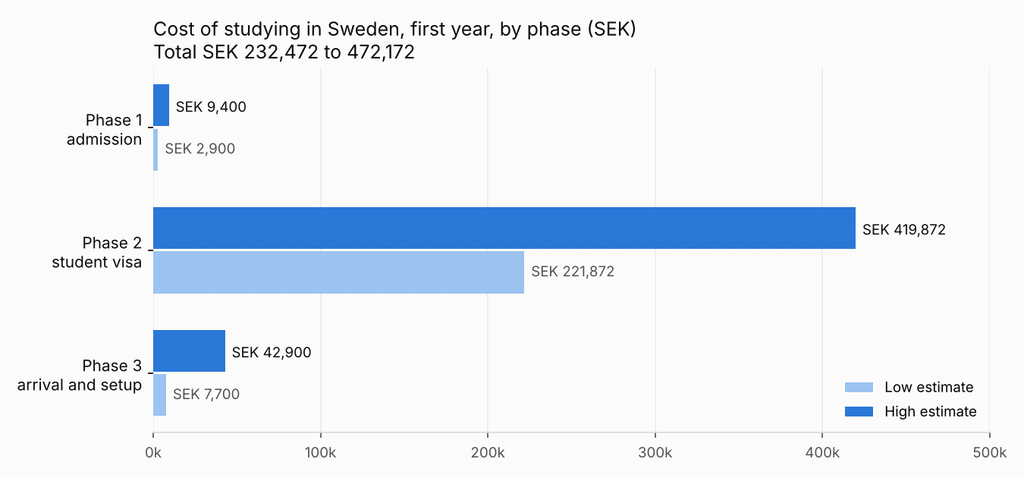
Cost of studying in Sweden in the first year by phase: admission SEK 2,900 to 9,400, student visa SEK 221,872 to 419,872, arrival and setup SEK 7,700 to 42,900
How much of that money is really gone
That total looks frightening, but you don’t lose most of it.
The SEK 127,872 of living money stays yours, because you spend it on your own day-to-day costs for the year. Take it out and the total drops to SEK 104,600 to 344,300. First-year tuition of SEK 90,000 to 270,000 goes to the university, and while you can’t avoid it, it pays for your teaching and your qualification, not paperwork. Take that out too and SEK 14,600 to 74,300 is left. Your landlord should also return a rental deposit of up to SEK 10,000 at the end of your lease, as long as you leave the room clean and undamaged.
What remains, about SEK 14,600 to 64,300, is the money that’s truly lost to charges: the application and permit fees, the English test, translations, bank charges and exchange margins, the embassy trip, the flight and the setup costs. Most of the high end comes from our estimates for transfers, flights and winter clothes.
These figures cover one year only. A two-year master’s needs a second year of tuition, and with a one-year permit, a second SEK 1,500 extension fee. A family adds SEK 4,440 a month for a partner and SEK 2,664 for each child to the money you show, plus their own permit fees and, for stays of a year or less, insurance. The job-seeking permit after graduation costs another SEK 1,500 and needs fresh proof of living money for up to a year. And if the Migration Agency refuses your permit, the SEK 7,000 to 7,500 the university keeps from your refund becomes a real loss.
Yearly tuition at Swedish universities
Tuition is the part of the cost of studying in Sweden that changes most from one program to the next, because every Swedish university sets its own fees, program by program, and University Admissions gives no national range. These are real examples from official university pages, not an average.
| Level and university | Yearly tuition | Notes |
|---|---|---|
| Bachelor’s, Uppsala University, Business and Economics | About SEK 99,000 | SEK 297,000 in total over three years. This program is taught in Swedish |
| Bachelor’s and master’s, Stockholm University | SEK 90,000 to 140,000 | Humanities, social science and law at the low end, science at the high end |
| Bachelor’s, Jönköping University, 2027 to 2028 | SEK 120,000 to 190,000 | Business at the low end, prosthetics and orthotics at the high end |
| Master’s, Jönköping University, 2027 to 2028 | SEK 120,000 to 170,000 | Education and health at the low end, engineering at the high end |
| Master’s, Chalmers, 2027 to 2028 | SEK 190,000 to 270,000 | SEK 95,000 or 135,000 a semester, up from SEK 80,000 and 105,000 |
| Master’s, KTH Royal Institute of Technology | About SEK 192,500 | SEK 385,000 for most two-year programs, so roughly half each year |
| Doctoral studies, all universities | SEK 0 | Doctoral students pay no tuition and no application fee |
Engineering, science and design cost the most. Some universities have also set higher fees for 2027 to 2028 than for 2026 to 2027, so check the year printed on any fee you read. If tuition worries you most, set these figures beside our guide to the cost of studying in Germany, because a cheaper fee means little until you add the living money and the setup costs.
Read this before you send any money
- Check the institution first. Find it on the UKÄ list and find the program on universityadmissions.se before you pay the SEK 900.
- Apply in the January round and pay the first installment early, because the Migration Agency doesn’t move your file until the university reports your payment.
- Move the living money into your own name, and time the statement so it’s no more than four months old at your permit start date.
- Plan to earn little, and protect your credits (37.5 in year one, then 45 a year).
- Compare whole countries, not tuition alone. Our guides to the cost of studying in France and the cost of studying in Japan follow the same three phases, so the totals line up side by side. That comparison tells you far more than any fee page does.
Questions students ask about studying in Sweden
What is the total cost of studying in Sweden for one year?
On our figures, the first year comes to SEK 232,472 to 472,172, but that headline number misleads people. SEK 127,872 of it is living money that stays yours, and the tuition pays for your degree. So the part truly lost to charges is about SEK 14,600 to 64,300.
How much bank balance do I need for a Sweden student visa?
For 2026 applications, SEK 10,656 for each month of your permit, so SEK 127,872 for one year, in an account in your own name. Tuition is separate, and you pay it before you apply.
Is studying in Sweden free for international students?
Not for most students from outside the EU, EEA and Switzerland. They pay a SEK 900 application fee and tuition of about SEK 90,000 to 270,000 a year in our examples. Doctoral students pay no fees.
How long can I stay in Sweden after my master’s?
You can apply for a permit to look for work for up to one year after you complete a bachelor’s or master’s degree. Apply before your study permit expires, and show that you can support yourself. If you find a job, you don’t need to meet the SEK 34,470 minimum salary on your first work permit.
Everything above is general information about Swedish study permits, and it isn’t immigration advice for your own case. Swedish permit rules, fees and money figures changed several times in 2026, so check every detail on the Swedish Migration Agency’s website and on your university’s pages before you pay. Sweden has no public register or license for immigration consultants. The title advokat is protected and is supervised by the Swedish Bar Association, so if you want regulated legal advice, look for a lawyer who is a member there, and be wary of any agent who promises you a permit.