
Germany doesn’t charge tuition at most public universities, so a scholarship there works differently from one in the US or UK. What you need is a monthly stipend that pays your rent, food and insurance, and that also shows the embassy you can support yourself.
This list covers 22 scholarships in Germany for Kenyan students, from the big DAAD programs to the political foundations most Kenyans have never heard of. We checked every one on the funder’s own page or in the official DAAD scholarship database. For each, you’ll see who it’s for, how much it pays a month, what language you need and when to apply.
Not every scholarship here is open to you from Kenya today. Several foundations take only students who are already enrolled at a German university. We mark those clearly, because they’re still worth knowing about for your second year.
How scholarships in Germany for Kenyan students work
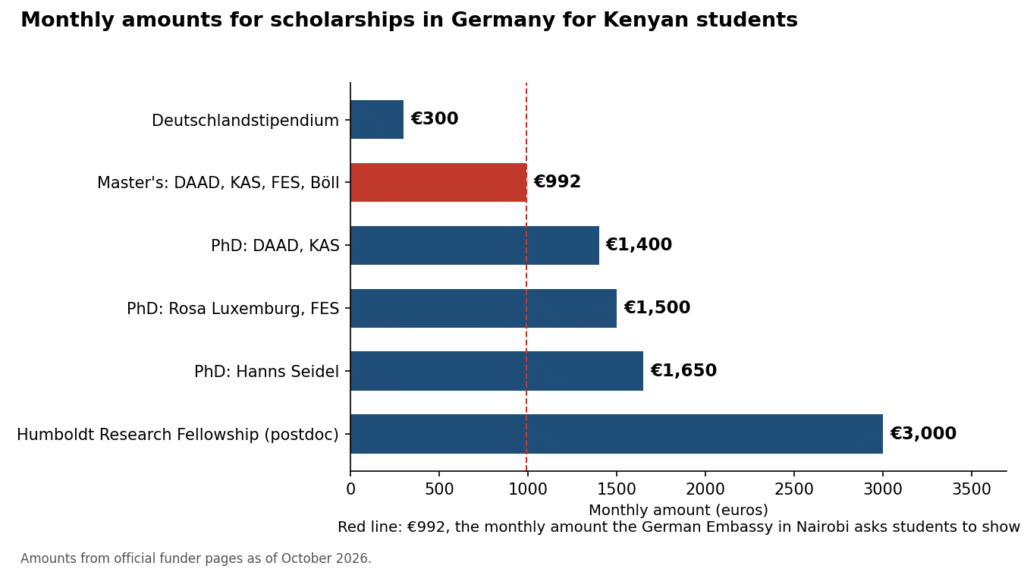
Most German scholarships pay you a fixed amount every month. For master’s students, the common rate is €992 a month. That isn’t a random number. It matches the amount the German Embassy in Nairobi asks every student to prove for a visa, so a scholarship at that rate covers your visa money in full.
For PhD students, the DAAD rate is €1,400 a month, and some foundations pay €1,500 or more. Researchers who already hold a PhD can get far more, up to €3,000 a month or above.
What “fully funded” means in Germany
When we call a scholarship fully funded in this list, we mean it pays a monthly stipend of at least €992. Most of them also add some of these:
- Health insurance payments
- A travel allowance for your flight
- A paid German course before your degree starts
- A rent top-up or family allowance in some cases
Partial awards still matter
Some awards on this list pay less, like the €300 Deutschlandstipendium. They won’t carry you alone, but they stack on top of savings or a part-time job. If you’re studying in a state that charges tuition, such as Baden-Württemberg, or on some programs in Bavaria, a tuition waiver can save you thousands of euros a year.
If a scholarship pays less than €992, the embassy will want you to cover the gap with a blocked account. We explain how in our German student visa guide.
All 22 scholarships at a glance
Use this table to shortlist, then read the full entry below. “From Kenya” means you can apply while you’re still living in Kenya. “After enrolling” means you need to be studying (or admitted) at a German university first.
| # | Scholarship | Level | Monthly amount | When you can apply | Deadline |
|---|---|---|---|---|---|
| 1 | DAAD EPOS | Master’s, PhD | €992 (master’s), €1,400 (PhD) | From Kenya | Set by each course |
| 2 | DAAD Helmut Schmidt Programme | Master’s | Full DAAD scholarship | From Kenya | Set in the yearly call |
| 3 | DAAD Doctoral Programmes in Germany | PhD | €1,400 | From Kenya | Set yearly, portal opens June 1 |
| 4 | DAAD Bi-nationally Supervised Doctorates | PhD | €1,400 while in Germany | From Kenya | Set yearly, portal opens June 1 |
| 5 | DAAD Research Grants (short stays) | PhD, postdoc | €1,400 | From Kenya | Set yearly |
| 6 | Erasmus Mundus Joint Masters | Master’s | €1,400 | From Kenya | Set by each program |
| 7 | Humboldt International Climate Protection Fellowship | Professionals | €2,500 to €3,000 | From Kenya | Feb 1, 2027 |
| 8 | Humboldt Research Fellowship | Postdoc | €3,000 to €3,600 | From Kenya | Calls open Mar 15, Jul 15, Nov 15 |
| 9 | Konrad Adenauer Foundation | Master’s, PhD | €992 (master’s), €1,400 (PhD) | From Kenya | July 15 |
| 10 | Heinrich Böll Foundation (master’s) | Master’s | €992 plus tuition up to €10,000 a year | With a German admission | Mar 1, Sep 1 |
| 11 | Heinrich Böll Foundation (PhD) | PhD | Not published online | With a German PhD admission | Mar 1, Sep 1 |
| 12 | Rosa Luxemburg Foundation (PhD) | PhD | €1,500 plus €100 | With a German PhD admission | Oct 1 |
| 13 | Rosa Luxemburg Foundation (study) | Bachelor’s, master’s | Not published online | With a German admission | Check with the foundation |
| 14 | Friedrich Ebert Foundation (students) | Bachelor’s, master’s | €992 | After enrolling | Rolling |
| 15 | Friedrich Ebert Foundation (PhD) | PhD | €1,500 | With a German PhD admission | Rolling |
| 16 | Friedrich Naumann Foundation | Master’s | Not published online | After enrolling | Check with the foundation |
| 17 | Hanns Seidel Foundation (PhD) | PhD | €1,650 plus €100 | After enrolling | Jan 15, Jul 15 |
| 18 | KAAD (Catholic) | Master’s, PhD, postdoc | Not published online | From Kenya | Set by the Kenyan partner committee |
| 19 | Max Planck doctoral programs (IMPRS) | PhD | Paid job contract | From Kenya | Varies, IMPRS-IS: Nov 15, 2026 |
| 20 | Deutschlandstipendium | Bachelor’s, master’s | €300 | With a German admission | Set by your university |
| 21 | DAAD STIBET grants (run by universities) | All levels | Set by your university | After enrolling | Set by your university |
| 22 | TUM tuition waivers and TUM scholarship | Bachelor’s, master’s | Tuition covered, plus €500 to €1,800 a semester | With a TUM admission | Before each semester |
Amounts are from official pages as of October 2026. Foundations can change their rates each year, so always confirm on the funder’s page before you apply.
DAAD and German government scholarships for Kenyans
These are the biggest and best-known awards. All of them accept applications from Kenya.
1. DAAD EPOS (Development-Related Postgraduate Courses)
EPOS is the scholarship most Kenyan professionals aim for. It funds master’s and some PhD programs at German universities in fields linked to development, like public health, engineering, agriculture, economics and environmental management.
- Pays: €992 a month for master’s and €1,400 for PhD, plus insurance and a travel allowance
- You need: a bachelor’s degree, usually four years, with results in the top third of your class, at least two years of related work experience after graduating, and a degree no older than six years
- Language: IELTS or TOEFL for English courses. For German courses, at least B1 when you apply, and the scholarship pays a six-month German course first
- How to apply: you apply to the course, not to DAAD, and you can rank up to three courses
The EPOS entry in the DAAD database has the full rules. We cover it step by step in our DAAD EPOS guide.
2. DAAD Helmut Schmidt Programme
This is a full master’s scholarship for future leaders in public policy and governance. It runs at seven partner programs, including Public Policy at Erfurt, Development Studies at Passau and Peace and Conflict Studies at Magdeburg. The Helmut Schmidt Programme page says it’s open to graduates from developing and emerging countries, and it includes up to six months of German classes in Germany.
- You need: a first degree and some work experience. How much experience depends on the program, from a few months at Passau to two years at Osnabrück
- Check first: the DAAD country list for the current call. Kenya was on DAAD’s 2020 country list, but the list can change between calls
3. DAAD Research Grants: Doctoral Programmes in Germany
This one funds a full PhD in Germany for up to four years. It pays €1,400 a month plus €460 a year for research costs. Your last degree should be no more than six years old. You’ll need a German supervisor who agrees to take you on before you apply.
4. DAAD Bi-nationally Supervised Doctoral Degrees
If you’re already doing a PhD at a Kenyan university, this lets you split it between Kenya and Germany. Kenya is on the eligible country list. It pays €1,400 a month for your time in Germany, for 7 to 24 months in total.
5. DAAD Research Grants for short stays
These short research grants fund 2 to 12 months in Germany for PhD students, or 2 to 6 months for postdocs. Your PhD should have started no more than three years before the deadline. They pay €1,400 a month.
6. Erasmus Mundus Joint Masters
Erasmus Mundus is funded by the EU, not Germany, but many programs include a German university. You study in two or more countries and graduate with a joint degree. The EU sets the scholarship at €1,400 a month for the full program, and it’s meant to cover travel, visa, settling in and living costs. You apply directly to each program, and each one sets its own deadline.
7. Humboldt International Climate Protection Fellowship
For professionals working on climate, not for fresh graduates. Kenya is on the eligible list. You need a bachelor’s degree from the last 12 years plus at least two years of climate-related work, or a master’s plus one year. It funds one year in Germany at €2,500 to €3,000 a month. The current call closes on February 1, 2027.
8. Humboldt Research Fellowship
This is for researchers who already hold a PhD. It’s open to all nationalities and pays €3,000 a month for postdocs and €3,600 for experienced researchers. The foundation runs three calls a year, and each call closes once it gets 800 applications. The next call opens on November 15, 2026.
A note on the Georg Forster Fellowship, which you’ll see on older lists: the Humboldt Foundation has stopped taking applications while it redesigns the program, so we’ve left it out.
Political foundation scholarships
Germany’s political foundations are funded by the government, and each one is linked to a political party. They pay well, but they want more than good grades. You’ll need to show community work, student leadership or activism that fits the foundation’s values. Most also need German at B2 or higher, even for English-taught degrees.
9. Konrad Adenauer Foundation (KAS)
KAS is one of the few foundations you can apply to straight from Kenya, and Kenya is on its country list. It’s linked to Germany’s center-right CDU.
- Pays: €992 a month for master’s, €1,400 for PhD, plus insurance help
- You need: a first degree for master’s or PhD, excellent results and German at B2
- Deadline: July 15 every year, at noon
10. Heinrich Böll Foundation (master’s)
Böll is linked to the Green Party. Its master’s award for international students is one of the most generous in Germany: €992 a month, plus up to €10,000 a year toward tuition, a health insurance allowance and German course fees.
- You need: an admission to a full-time master’s in Germany, very good grades, German at B2 (or DSH 1), and proof of social and political engagement
- Good news for Kenyans: Böll gives priority to applicants from developing countries who still live at home when they apply
- Deadlines: March 1 and September 1
11. Heinrich Böll Foundation (PhD)
The same foundation funds doctoral candidates in any subject. You need admission to a PhD at a German university, early work done on your project, and German at B2. Deadlines are also March 1 and September 1.
12. Rosa Luxemburg Foundation (PhD)
Linked to the left-wing Die Linke party. Its international PhD scholarship pays €1,500 a month, plus €100 for mobility, for up to three years. You need a German PhD admission and supervisor, German at B2, and social engagement. Applicants from developing countries who still live at home get priority. The deadline is October 1.
13. Rosa Luxemburg Foundation (study)
The foundation’s study scholarship is open to foreign nationals with at least an admission to a German university. You need German at B2 and you must be in Germany to study. The page doesn’t publish the amount or an international deadline, so contact the foundation before you plan around it.
14. Friedrich Ebert Foundation (students)
FES is linked to the center-left SPD. Its scholarship for international students pays €992 a month plus health insurance. The catch: you must already be enrolled in Germany, and you need strong German (C1, DSH 2 or TestDaF 4) even if your course is in English.
15. Friedrich Ebert Foundation (PhD)
The FES doctoral award pays €1,500 a month plus health insurance. You need a German PhD admission, a strong first degree and the same high level of German. You can apply at any time.
16. Friedrich Naumann Foundation for Freedom
Linked to the liberal FDP. Its scholarship for non-EU students funds master’s students who are already enrolled at a German university and have at least two semesters left. It’s granted for one year at a time, and you can apply to extend it.
17. Hanns Seidel Foundation (PhD)
Linked to Bavaria’s CSU. The Hanns Seidel PhD award pays €1,650 a month plus €100 for research costs. You must already be enrolled as a doctoral candidate in Germany. Deadlines are January 15 and July 15.
Church scholarships and funded PhD positions
18. KAAD (Catholic Academic Exchange Service)
KAAD is the main German church scholarship for students from Africa, Asia, the Middle East and Latin America. Kenya is on its country list. It funds master’s degrees, PhDs and research stays at German universities.
- You need: at least a bachelor’s degree, Kenyan citizenship and residence, and to be Catholic. Other applicants can be considered if a Catholic partner organization in Kenya proposes them
- Language: at least B1 German before you arrive, or A2 for an English-taught program. KAAD can fund up to six months of German classes
- How to apply: through KAAD’s partner committee in Kenya, which sets its own deadline
- The condition: KAAD expects you to return home after your studies. If you don’t, the scholarship turns into a loan
KAAD doesn’t publish the monthly amount on the DAAD page, so ask the partner committee when you apply.
19. Max Planck doctoral programs (IMPRS)
The Max Planck Society runs International Max Planck Research Schools (IMPRS) with German universities. These aren’t scholarships in the usual sense. If you’re selected, you get a paid job contract as a doctoral researcher, which covers your living costs and your visa money.
Many of these schools run fully in English, and each one sets its own deadline. For example, the IMPRS for Intelligent Systems in Stuttgart and Tübingen takes applications for 2027 until November 15, 2026, in fields like AI, robotics and neuroscience.
Church options that don’t fit Kenyans studying in Germany
You may see these two on other lists, so here’s why they’re not on ours:
- Brot für die Welt: its Leadership for Change program mainly funds study in your home country or region, and you can only apply through one of its partner organizations
- Cusanuswerk: it sends doctoral applicants from Africa to KAAD first, and its student awards require eligibility for German student loans (BAföG), which most Kenyan students don’t have
University scholarships in Germany for international students
German universities give out less scholarship money than US or UK schools, because most don’t charge tuition. The University of Stuttgart says it plainly: as is usual in Germany, it doesn’t offer scholarships for full degrees. What universities do offer is smaller support once you’re enrolled.
20. Deutschlandstipendium
The Deutschlandstipendium pays €300 a month on top of any other income, and it’s open to many international students. You apply through your university, which sets its own deadline and picks the winners. It runs for at least two semesters and can last until the end of your standard study period. It isn’t open to PhD students.
21. DAAD STIBET grants
Many universities get DAAD money under a program called STIBET and hand it out to international students they already have. At the University of Stuttgart, for example, STIBET covers:
- Students with strong grades who are active in international or community work, from the third semester
- Students close to graduating who face money problems, like master’s students from the fourth semester
- Students facing hardship, such as caring for family or a disability
Your university’s international office decides the amount. Ask about STIBET in your first semester so you know the deadlines.
22. TUM tuition waivers and the TUM scholarship
The Technical University of Munich charges tuition to most non-EU students, so its awards focus on that bill. TUM offers waiver scholarships that cover your full tuition for:
- High-achieving master’s students in their first or second semester
- First-semester students in financial need
- High achievers from the third semester
On top of that, the Scholarship for International TUM Students pays €500 to €1,800 for a semester, and you can reapply every semester. Apply for the waiver before the semester it covers.
Check your own university too
University awards open and close often. Universität Hamburg, for example, runs merit scholarships for international students but says there are currently no new calls. Once you have an admission, search your university’s international office page for “scholarship” and “STIBET”.
Scholarship requirements Kenyans meet (and miss) most often
Across these 22 awards, the same five rules come up again and again. Check yourself against each before you spend weeks on an application.
| Requirement | Who asks for it | What it usually means for you |
|---|---|---|
| Strong grades | Almost all | DAAD asks for results in the top third of your class. A letter from your university showing your rank helps prove it |
| Work experience | EPOS, Helmut Schmidt, Humboldt climate fellowship | EPOS needs two years after your degree. Helmut Schmidt asks for anywhere from a few months to two years |
| A recent degree | DAAD programs | Your last degree should usually be no more than six years old |
| German language | Most political foundations, KAAD | B2 for KAS, Böll and Rosa Luxemburg. C1 for Friedrich Ebert. B1 for KAAD, or A2 for English courses |
| Little time in Germany | DAAD, Rosa Luxemburg | You can’t have lived in Germany more than 15 months at the deadline |
Grades
Kenyan transcripts don’t use the German grading scale, so funders will look at your class of degree and your rank. If you’re not sure where your degree lands, our guide to KCSE and degree requirements shows how German universities read KCSE and Kenyan degree grades.
Work experience
For EPOS, the work has to be related to the course, and it has to come after your first degree. Internships and attachments during your studies usually don’t count. Get an employer letter on letterhead that states your role, your dates and what you did.
Language: can you get a scholarship in Germany without IELTS?
Sometimes. Many English-taught programs accept proof that your degree was taught in English, but DAAD’s EPOS asks for IELTS or TOEFL in the application. The bigger hurdle for Kenyans is German. If you want a political foundation scholarship, start German classes now, because B2 takes most people close to a year. Our guide to German language requirements breaks down how long each level takes.
How to apply for scholarships in Germany from Kenya
Many applicants apply to one scholarship at a time and wait. A better plan is to build one strong file and send it to several funders that fit you.
Build your core file once
- A CV with no gaps. Use the Europass format, since EPOS asks for it. Account for every year since KCSE
- Certified copies of your KCSE certificate, degree certificate and transcripts
- Employer letters that state your role, your dates and your duties
- A language certificate, IELTS or TOEFL for English courses and Goethe or similar for German
- Two academic references from lecturers who know your work, plus one from your employer
Write a new motivation letter for each funder
This is where many applications go wrong. Each funder wants a different story:
- DAAD EPOS wants to know how the degree will help your work and your community in Kenya
- Political foundations want to see your values and your community or political work
- KAAD wants your church involvement and your plan to return home
- Universities want to know why their course fits your academic goals
One generic letter sent to all of them reads like one, so tailor each.
A sample timeline for a 2027 or 2028 start
- 12 to 18 months before you start: shortlist programs and scholarships, and start German classes if you’ll need B2
- 9 to 12 months before: take IELTS or TOEFL, collect references and employer letters
- About a year before: apply to EPOS courses and the Helmut Schmidt programs, by each course’s own deadline
- By July 15: apply to KAS
- By March 1 or September 1: apply to Böll, once you have an admission
- After your award letter: open a blocked account if your award is below €992 a month, then apply for your visa
Keep a simple spreadsheet with each funder, its deadline, what it needs and your status. Deadlines change every year, so check each funder’s page when the new call opens.
Quick answers: scholarships in Germany for Kenyan students
Which of the scholarships in Germany for Kenyan students is easiest to get?
No full scholarship is easy, but the ones you can apply to straight from Kenya give you the most options: DAAD EPOS, Erasmus Mundus, KAS and KAAD. Your best fit depends on your work record and your German level.
Can I get a fully funded master’s in Germany without work experience?
Yes. EPOS needs two years of work, but Erasmus Mundus, KAS and Böll don’t list a set amount of work experience. They look at grades, motivation and, for the foundations, your community work.
Do German scholarships cover tuition?
Most public universities don’t charge tuition, so most scholarships pay living costs only. Böll’s master’s award adds up to €10,000 a year for tuition. TUM’s waivers cover tuition at TUM.
Is a €992 scholarship enough for the visa?
Yes. The German Embassy in Nairobi asks students to show €992 a month, so an award at that rate covers the full requirement. Below that, you top up with a blocked account.
Can I apply for a scholarship before I get admission?
For EPOS, Helmut Schmidt and Erasmus Mundus, the scholarship and admission come together, since you apply to the course. For KAS and KAAD, you apply to the funder. Böll and Rosa Luxemburg want at least an admission first. FES, Naumann and Hanns Seidel want you already enrolled.
Are there PhD scholarships in Germany for Kenyans?
Yes, plenty: DAAD doctoral grants, KAS, Böll, Rosa Luxemburg, FES, Hanns Seidel, KAAD and paid Max Planck positions.
More guides in this series
- Study in Germany from Kenya: the complete guide
- KCSE and Kenyan degree requirements for German universities
- Do you need German? English-taught degrees and language tests
- German student visa from Kenya: the Nairobi process step by step
- DAAD EPOS scholarship for Kenyans
Disclaimer: Scholarship amounts, deadlines and rules change every year. We checked each one on the funder’s own page or in the official DAAD scholarship database as of October 2026. Always confirm the current call on the funder’s page before you apply. This guide is general information, not a guarantee of eligibility.