
Before you can even apply for a Canadian study permit, most students need a letter from a province or territory that says there is a place for them. Canada calls it a provincial attestation letter, and it exists because the government now limits how many permits it issues. Immigration, Refugees and Citizenship Canada (IRCC) expects to issue up to 408,000 study permits in 2026, about 7 percent fewer than its 2025 target of 437,000. Because of that limit, the order of the process is different from what most people expect.
This guide covers the Canada study permit process in four steps: choosing a course, applying to a school, applying for the permit, and landing. It states the cost of studying in Canada stage by stage in Canadian dollars (CAD). It will also include other costs such as the cost of moving large sums of money, the health plan, and the deposit needed for your first flat. A later section adds everything up and shows how much of the total is a fee, how much is tuition, and how much is your own money that you keep. After that, you will find tuition by province and level, living costs by city, ways to lower the cost, and answers to common questions.
Rules and fees change often. IRCC raised its living cost figure on 1 September 2026, and Ontario raised the price of its student health plan on the same day. Everything below reflects the position in October 2026. Please confirm each figure on the official IRCC study permit pages before you make any payment. Where we could not confirm a figure from an official page, we say so.
The Cost of Studying in Canada Calculator
This calculator builds in every cost from our guide to the cost of studying in Canada, such as the language test, study permit, tuition, health cover, rent deposit and setup. Choose your level of study, enter your own rent or flight cost, and pick a low, middle or high estimate. You get one total, split into tuition, living funds, rent deposit and costs you never get back. Tick the boxes that match you, then open the Summary, Phase 1, Phase 2 and Phase 3 tabs.
Most figures come from official sources, last checked in October 2026, and some are our own estimates. Fees and rules change, and this is a budgeting tool, not immigration or legal advice. Confirm your fees with your school and on the official pages linked under “Where the numbers come from” on the Summary tab.
Your situation
Show costs in your own currency
Estimated cost for your first year
CAD 0
Step 1: Pick a course that fits your plans to work after graduation
Your right to work in Canada after graduation depends on the course you choose. The permit that allows this is called the post graduation work permit, or PGWP. It is an open work permit, which means you can work for almost any employer. But you only qualify if your course, your school and your language scores all meet IRCC rules, and a wrong choice at this stage cannot be fixed later.
How your course level and length affect your work permit
The length of your PGWP depends on the length of your course. IRCC says a program of 8 months to under 2 years can earn a PGWP up to the same length as the program, and a program of 2 years or more can earn a 3 year permit. IRCC treats master’s degrees more kindly. Since 15 February 2024, a master’s graduate can apply for a 3 year permit even if the degree took less than 2 years, as long as the program ran at least 8 months.
| What you finish in Canada | Length of the post graduation work permit |
|---|---|
| Any program shorter than 8 months | No PGWP |
| Program of 8 months to under 2 years, such as a certificate or short diploma | Up to the same length as the program |
| Program of 2 years or more, such as a long diploma or a bachelor’s degree | Up to 3 years |
| Master’s degree of at least 8 months | Up to 3 years |
| Doctoral degree | Up to 3 years |
| English or French as a second language study only | No PGWP |
Your passport matters too. IRCC says the permit length also depends on how long your passport stays valid, so renew an old passport before you apply. If a short passport was the only reason your permit came out shorter, you can apply to extend it.
The rules that students often get wrong
Most PGWP refusals come from small rules that students did not know about when they chose a course. Read this list before you pay a deposit.
Language scores. Since 1 November 2024, most PGWP applicants must prove their language level. IRCC asks for Canadian Language Benchmark (CLB) 7 in English or NCLC 7 in French in all four skills for university programs, and CLB 5 for college and other non university programs. All four skills means reading, writing, listening and speaking, and a high score in one does not cover a low score in another. Your school may accept a lower score for admission, so do not assume that getting in means you will meet the work permit rule.
Field of study. Bachelor’s, master’s and doctoral graduates do not face a field of study rule. Graduates of college programs and other courses below a bachelor’s degree do, if their study permit application was submitted on or after 1 November 2024. Their program must appear on IRCC’s list of eligible fields. IRCC said in January 2026 that it would not update the list during 2026, and reports put the list at 1,107 programs. The list mostly covers areas with worker shortages, such as health care, trades, education, farming and some science and technology courses. IRCC changed it a lot in June 2025, adding 119 programs and removing 178, so check it again close to your start date.
Distance learning. You are not eligible if you completed more than 50 percent of your program through distance learning. Any classes you take online, including from your home country, count as distance learning.
Full time study. You must study full time in every semester, except that you may study part time in your final one. If you drop to part time in the middle of your course, you can lose the right to a PGWP.
The 180 day deadline. You must apply within 180 days of getting confirmation that you finished your program, and IRCC expects you to hold a valid study permit during that time. Count the days from the date on your school letter, not from graduation day.
An eligible school. The school must be a designated learning institution (DLI), and the program must be PGWP eligible. Many schools are on the DLI list, but not every program at a listed school qualifies, so ask the school to confirm in writing.
Only one PGWP. IRCC says you cannot get a PGWP if you already had one after an earlier program. Plan your whole study path first.
The IRCC does not state any age limit for a Canadian study permit or for the PGWP in the official rules. Officers still read your study plan, and they may ask questions if your course does not fit your past work or your future plans.
Can you join two courses together for a longer PGWP?
Yes, in some cases. IRCC says you may be able to get a PGWP that combines the length of each program if both programs are PGWP eligible and each one lasts at least 8 months. A one year diploma followed by a one year program, for example, could lead to a permit of up to 2 years. The catch is that you can only ever receive one PGWP, so you cannot collect a permit after the first course and another after the second.
Step 2: Apply to a school in Canada
You apply to the school first, because you need its offer before you can start the study permit application. Here, you would also run into the national limit on permits at this step.
Check that the school is allowed to take international students
Only a designated learning institution can accept you for a study permit. IRCC publishes the official list of designated learning institutions, and you can search it by province and school name. The list also shows whether a school offers PGWP eligible programs. Write down the school’s DLI number, because you must enter it on the permit application. If a school is not on the list, its offer is no use to you for a study permit.
The provincial letter and the national limit
For this year 2026, IRCC plans for 155,000 new permits and 253,000 extensions. The provinces and territories share their part of the limit and give out attestation letters, so you need the letter to get one of the places inside the limit. You get it by asking your school. IRCC says to contact your school to find out how to apply, and the letter must be sent with your study permit application, not after it.
Some students do not need the letter. IRCC lists these groups:
- Students at preschool, primary or secondary level
- Master’s and doctoral students at public schools, from 1 January 2026
- Exchange students who pay no tuition
- Students on certain Government of Canada scholarships
- Students already in Canada who are extending a permit at the same school and level
Quebec works differently. Quebec students need a Quebec Acceptance Certificate, known as the CAQ, from the Quebec government, and Quebec sets some of its own money rules. Start with the Quebec immigration website if you plan to study there.
Documents for your school application
Every school sets its own list, but most ask for the same main files:
- Your school or degree certificates and full transcripts
- A copy of your passport
- A language test score, if the program is taught in English or French
- A statement of purpose or personal essay
- A CV, for graduate programs
- Reference letters, where the program asks for them
- Proof that you can pay the application fee
If your documents are not in English or French, plan for certified translations. Order extra copies of transcripts early, because some schools take weeks to issue them. Application fees differ by school, and most schools charge a separate fee for each program you apply to.
The offer, the deposit and the letter of acceptance
When a school accepts you, it will send you an offer. Many schools then ask for a deposit before they issue you with the letter of acceptance, which you will need for your study permit application, and it must come from a DLI. Read the refund terms before you pay the deposit. If IRCC refuses your permit, some schools return the deposit and some keep part of it. IRCC accepts proof that you paid the first year of tuition and housing as one way to prove your funds, so a deposit is not wasted money. In most cases it is counted toward your tuition.
Phase 1 costs: admission
| Item | Typical cost in CAD | In your local currency | Why it is on this list |
|---|---|---|---|
| Language test, one attempt | CAD 335 to 410 | IDP lists IELTS at about CAD 335 to 361 before tax in Canada, and tests taken in your own country are priced locally | |
| School application fees, one to four schools | CAD 100 to 500 | Our estimate, because each school sets its own fee | |
| Certified translations and extra copies | CAD 50 to 250 | Our estimate, needed if your papers are not in English or French | |
| Transcripts, courier and postage | CAD 30 to 150 | Our estimate, because your old school may ask for a fee to issue and post your records | |
| Tuition deposit, where asked | CAD 0 here, counted in Phase 2 | The deposit is part of your first year of tuition, which we count once in Phase 2 | |
| Phase 1 subtotal | CAD 515 to 1,310 | Total of the rows above |
Step 3: Applying for your Canada study permit
A study permit is not a visa. It is a document that allows you to study at a particular level, and IRCC may also give you an electronic travel authorization or a visitor visa to enter the country. You apply online, from outside Canada, with your letter of acceptance in hand.
Documents you need
IRCC lists these items for a study permit application:
- A valid passport or travel document
- Your letter of acceptance from a DLI
- A provincial or territorial attestation letter, or a Quebec Acceptance Certificate for Quebec, in most cases
- Proof of financial support
- A letter of explanation, which IRCC recommends
- A medical exam certificate, if required
- A police certificate, if requested
- Proof of custody arrangements, if the student is under 17 and travelling alone
- Any extra documents the visa office for your country asks for
The IRCC document list is the one to follow, and it can differ by country. IRCC does not list a language test among the study permit documents, so your school sets the language rule for admission.
Treat the letter of explanation seriously. In it, you say why you chose this course, why Canada, and what you plan to do after. Keep it honest, specific and short. A letter that could be about any student at any school does not help your case.
Canada study permit proof of funds 2026 where the most common reason for refusal
Officers refuse most weak applications over the money, because the figure is easy to misread, and it is also the biggest single part of the cost of studying in Canada. IRCC does not only ask for one number, but also asks you to show money for three separate things: your first year of tuition, your living costs, and your travel to and from Canada.
The living cost figure. If you apply on or after 1 September 2026 and you are a single student outside Quebec, you must show CAD 23,448 for living costs, not counting tuition or travel. If you applied from 1 January 2025 to 31 August 2026, the figure was CAD 22,895. The figure is higher for larger families, as this table from IRCC shows:
| People in your family, including you | Living costs to show from 1 September 2026 |
|---|---|
| 1 | CAD 23,448 |
| 2 | CAD 29,192 |
| 3 | CAD 35,888 |
CIC News reports that the increase is CAD 553 for a single applicant and that IRCC updates the figure once a year. If you apply later than this article’s date, check the live page first, because IRCC can refuse your file if you use the old figure. Other countries change their funds figure too, and our guide to the cost of studying in Italy covers a recent rise there.
Tuition. You must show that you can pay the first year of tuition, or that you already paid it. Your tuition comes from your school, so take the number straight from your offer letter.
Travel. IRCC says you must show money for transportation to and from Canada for yourself and any family members who travel with you. It does not give a dollar amount, so use the price of a return flight from your city.
What officers accept as evidence. IRCC names these types of proof:
- A receipt from your school showing you paid the first year of tuition and housing fees
- Bank statements for the past 6 months, including the month you applied or the month before
- A guaranteed investment certificate (GIC) from a Canadian financial institution
- Proof of employment, a scholarship, or a loan letter
A GIC is a locked deposit that a Canadian bank pays out to you in parts after you land. It works much like a blocked account in other countries like Germany, but it is only one of the accepted routes, and IRCC does not require it. If you use one, ask the bank for the full list of fees in writing before you transfer a cent.
Three mistakes to avoid. First, using last year’s figure, which many websites still show. Second, forgetting that the living cost number does not include tuition or travel, so the real amount you must show is much larger. Third, showing a sudden large deposit with no history. Officers want to see where money came from, so keep salary slips, sale papers or loan agreements that explain it, and keep the six months of statements clean and complete.
Sponsors and family money
A parent or relative can pay for your studies. If they do, IRCC wants proof that the money exists and a letter that says they will support you, along with their own bank records and income papers. A sponsor’s statement alone is weak, and officers give more weight to their bank history. If the money belongs to a family company, move what you need into a personal account well before you apply, and keep the transfer records, because company money that nobody can show you control of is hard to count.
Health cover
Canada does not have one national health plan for students. Each province sets its own rules, so what you pay and when cover starts depends on where you study.
- Ontario. International students at the major public universities must join the university health plan, known as UHIP. From 1 September 2026 it costs CAD 948 a year for one person, up from CAD 792, and it covers up to CAD 1 million a year.
- British Columbia. International students who hold a study permit for at least six months of the year must pay a health fee of CAD 75 a month, which is CAD 900 a year. The fee starts when your cover starts, and cover starts after a wait of the rest of the month in which you become a resident, plus two months. Adult students who formally opt out of provincial cover do not pay the fee.
- Alberta. The province lets international students join its health plan if they have a 12 month study permit and will live in Alberta for 12 months or more, and shorter permits can qualify with a letter from the school registrar.
- Other provinces. Other provinces such as British Columbia and Saskatchewan have a waiting period of about three months, and Quebec students usually buy private cover. Confirm your province’s rules on its own health website, because these rules change.
- The waiting gap. If your province has a waiting period, you need private cover for those first weeks. Many schools sell a group plan, please check with the school.
Working while you study
IRCC lets eligible students work off campus up to 24 hours a week during term, and full time during scheduled breaks. To qualify, you must study full time at a DLI, your program must last at least 6 months and lead to a degree, diploma or certificate, you need a Social Insurance Number, and your study permit must include the work condition. Students who only study English or French as a second language cannot work off campus. Work for a foreign employer that you do from your computer does not count toward the 24 hour limit.
Do not build your funding plan on part time pay. Jobs take time to find, and a student who cannot show money at the start will not get a permit.
How to submit and how long it takes
IRCC requires you to apply online unless you have a disability or a special travel document. After you apply, IRCC asks you to give fingerprints and a photo, and the system tells you to do this within 30 days of the notice. Book the appointment as soon as the notice arrives, because processing does not start until you finish.
IRCC does not show a single processing time. Its processing time tool gives an estimate for your country and your date. For a sense of scale, CIC News reported IRCC data from 28 July 2026 that put study permit processing from outside Canada at about 4 to 7 weeks for applicants in India, the United States, Nigeria, Pakistan and the Philippines. These timelines change often, and an incomplete file takes longer, and calling IRCC does not speed anything up.
If IRCC approves you, it sends a port of entry letter of introduction, plus either an electronic travel authorization or a visitor visa, depending on your passport. If IRCC refuses you, it gives written reasons.
Phase 2 costs: student visa
| Item | Typical cost in CAD | In your local currency | Category | Why it is on this list |
|---|---|---|---|---|
| Study permit fee | CAD 150 | Standard | IRCC’s fee list sets this per person | |
| Biometrics fee | CAD 85 | Standard | IRCC charges this per person on the same fee list | |
| First year of tuition, shown or paid | CAD 18,867 to 49,802 | Standard | IRCC wants proof of it, and the range is the average undergraduate fee in Newfoundland and Labrador up to the one in Ontario | |
| Living costs to show, outside Quebec | CAD 23,448 | Standard | The IRCC figure for one person from 1 September 2026, and you keep this money | |
| Immigration medical exam, if required | CAD 0 to 400 | Often missed | adult exams at CAD 200 to 400, and you pay an IRCC authorised medical center | |
| Police certificate, photos and certified copies | CAD 20 to 150 | Often missed | Our estimate, and prices differ by country | |
| International transfer and currency costs | CAD 100 to 600 | Often missed | Our estimate, because banks charge wire fees and an exchange margin on large sums | |
| GIC or bank setup fees, if you use one | CAD 0 to 250 | Often missed | Our estimate, because each bank sets its own fees | |
| Travel to the biometrics centre | CAD 0 to 250 | Often missed | Our estimate, because some countries have only a few centres | |
| Phase 2 subtotal | CAD 42,670 to 75,135 | Includes tuition and the CAD 23,448 you keep |
Step 4: Travel to Canada and settle in
Your approval does not let you simply walk in. A border officer decides at the airport whether you may enter, so the papers in your hand luggage matter.
What to bring to the border
IRCC tells you to present these to the border services officer. Keep them in your hand luggage, not in a checked bag:
- The port of entry letter of introduction
- The same passport you used to apply
- Your electronic travel authorization or visitor visa, if you got one
- A current copy of your letter of acceptance
- Your immigration medical exam results, if you needed them. They are valid for 12 months from the date of issue
- Proof of funds
- Any other letters the visa office asked you to bring
The officer checks that you meet the entry rules and that you plan to leave when your studies end. You cannot start working until your studies begin.
Your first weeks
Do these in a systematic order. First, get your Social Insurance Number from Service Canada, which you need before you can work off campus. Second, apply for your provincial health plan if your province offers one, and buy private cover for any gap. Third, open a bank account, and lastly, settle your housing.
Rent deposits depend on the province. In Ontario, a landlord can ask for a rent deposit of no more than one month’s rent, and it must go toward your last month. In British Columbia, the security deposit cannot be more than half of one month’s rent. Ask the landlord what the law in your province allows before you pay anything, and never send a deposit for a flat you have not seen or a person you cannot check.
Many students forget two costs. The first is the extra fees that schools add on top of tuition, such as student association and transit fees. The second is winter clothing, which is a real cost if you come from a warm country.
Phase 3 costs: arrival and setup
| Item | Typical cost in CAD | In your local currency | Category | Why it is on this list |
|---|---|---|---|---|
| One way flight to Canada | CAD 800 to 2,200 | Standard | Our estimate, and the price changes by region and season | |
| Temporary accommodation for the first two weeks | CAD 500 to 1,500 | Standard | Our estimate for a hostel or short stay while you look for a room | |
| Rent deposit | CAD 600 to 2,500 | Often missed | Our estimate, because the limit depends on the province and on your rent | |
| Health cover, first year | CAD 0 to 3,060 | Standard | Free in some provinces, CAD 948 for UHIP in Ontario, CAD 900 a year in British Columbia, and up to CAD 3,060 for a private plan at the top of the reported range | |
| Furniture, bedding, kitchen items and first food shop | CAD 400 to 1,000 | Often missed | Our estimate, because many rooms and flats come empty | |
| Winter clothing | CAD 250 to 700 | Often missed | Our estimate for a proper coat, boots and gloves | |
| Phone plan and first transit pass | CAD 80 to 250 | Often missed | Our estimate for your first month | |
| School fees on top of tuition | CAD 300 to 1,500 | Often missed | Our estimate, because schools add student, transit and service fees | |
| Books and supplies, first term | CAD 300 to 800 | Often missed | Our estimate, and some programs cost more | |
| Phase 3 subtotal | CAD 3,230 to 13,510 | The range is wide because rent and health cover differ by province |
The full cost of studying in Canada
| Phase | Estimated cost in CAD | Estimated total in your local currency |
|---|---|---|
| Phase 1, admission | CAD 515 to 1,310 | |
| Phase 2, student visa | CAD 42,670 to 75,135 | |
| Phase 3, arrival and setup | CAD 3,230 to 13,510 | |
| Total | CAD 46,415 to 89,955 |
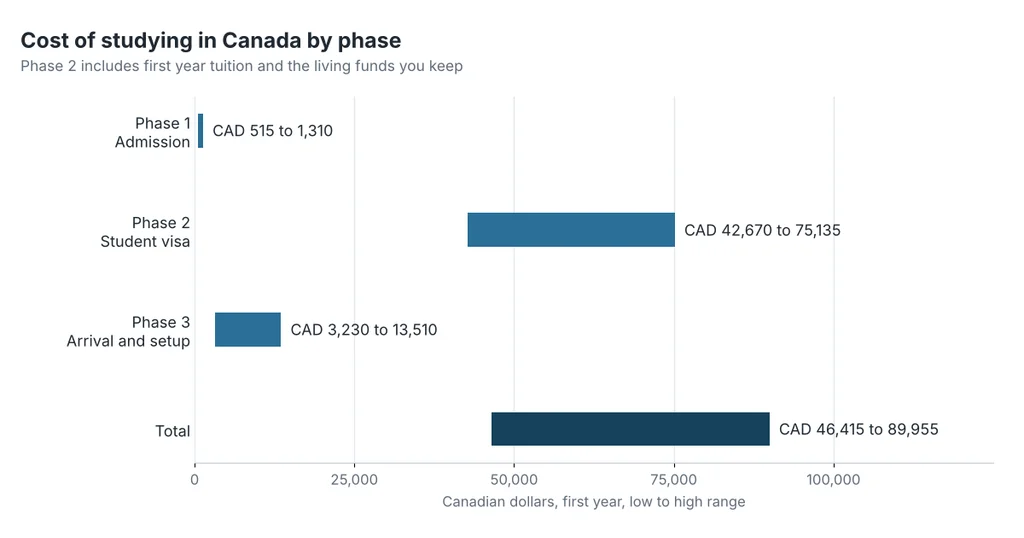
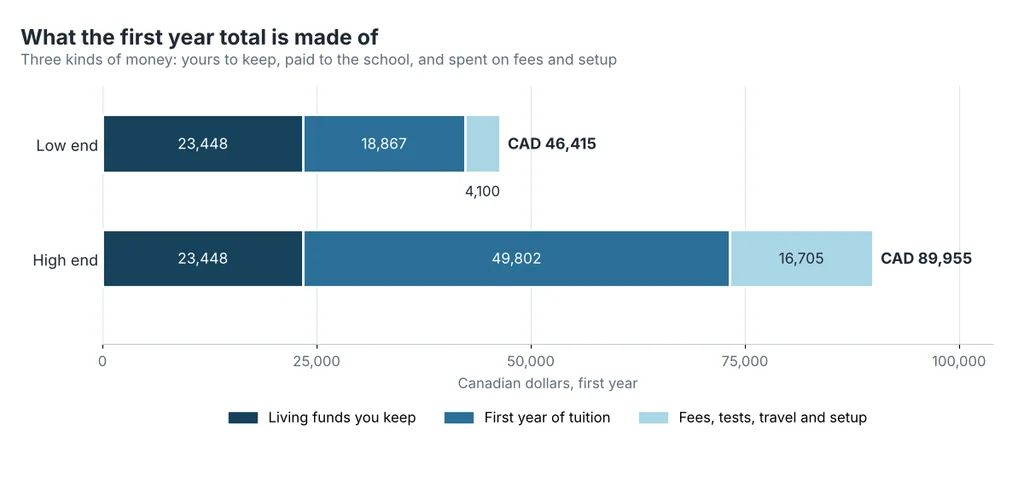
That total is large because it includes three different kinds of money, and you can only judge the cost of studying in Canada once you separate them.
Money you keep. The CAD 23,448 in living funds is yours. It is meant to pay for your rent, food and daily costs. If you leave it out, the total is about CAD 22,967 to 66,507.
Tuition. Your first year of tuition goes to the school. It is a real cost, but it buys your education and not a fee. If you leave out both the living funds and the tuition, you spend about CAD 4,100 to 16,705 on fees, tests, medical checks, travel and setup.
What the total leaves out. It covers one year of tuition and one year of funds, so a longer course costs more. It also leaves out the CAD 100 open work permit holder fee and the CAD 155 work permit fee you pay for the PGWP, which IRCC lists, the fee for a language test for the PGWP, which for IELTS is about CAD 335 to 410 in Canada, and your living costs beyond the first year. Rent in a big city will take much of your living money. If you choose a college diploma at the low end of EduCanada’s range, CAD 16,000, your tuition is about CAD 2,867 lower than the low end used in this total.
Typical yearly tuition by level of study
| Level of study | Typical yearly tuition for international students | Note |
|---|---|---|
| Undergraduate | CAD 41,746 on average | Statistics Canada, 2025/2026, up an expected 2.5 percent |
| Graduate | CAD 24,028 on average | Statistics Canada, 2025/2026, up an expected 1.5 percent |
| Undergraduate in Newfoundland and Labrador | CAD 18,867 on average | Statistics Canada, 2025/2026 |
| Undergraduate in Ontario | CAD 49,802 on average | Statistics Canada, 2025/2026 |
| Graduate in Newfoundland and Labrador | CAD 6,964 on average | Statistics Canada, 2025/2026 |
| Graduate in Ontario | CAD 28,624 on average | Statistics Canada, 2025/2026 |
| College diploma | About CAD 16,000 to 25,000 | EduCanada, a Government of Canada site |
| Language program | CAD 340 to 425 a week | EduCanada |
| Public primary or secondary school | CAD 10,000 to 17,000 | EduCanada |
| Private day school | CAD 15,000 to 30,000 | EduCanada |
| Private boarding school | CAD 63,000 to 83,000 | EduCanada |
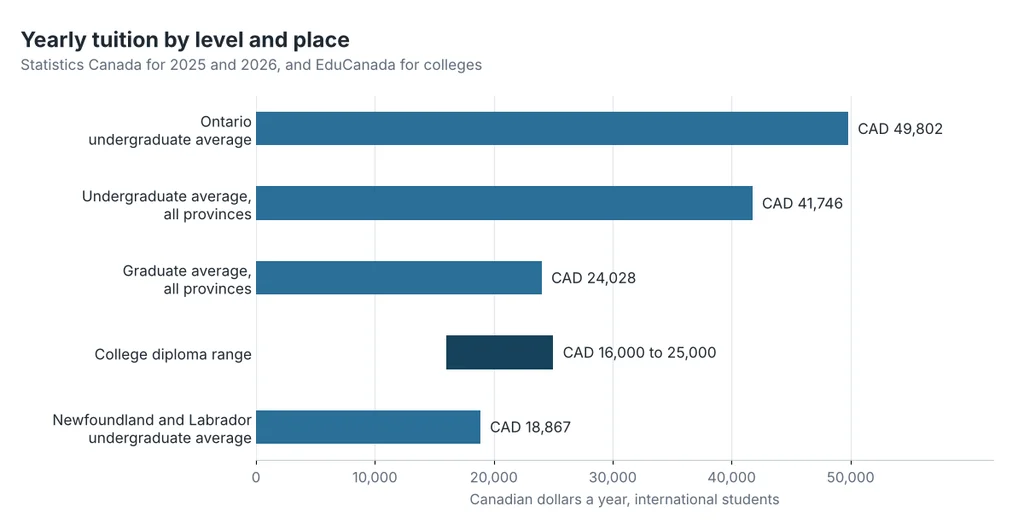
An average does not show how much tuition differs, since it can be more than double between provinces, so the cost of studying in Canada depends a lot on which province you choose.
Statistics Canada names only these two provinces in the text of its release, and we did not find a reliable national figure for doctoral programs, so read your own school’s fee page for the school you want. A college diploma costs less than a university degree on these figures, but the work permit rules are stricter for college graduates, as Step 1 explains: they need a language score of CLB 5 and a program that is on IRCC’s list of eligible fields.
If tuition is what worries you most, our guide to the cost of studying in Germany is worth a look, because most public universities there charge none, although the visa and setup costs still add up.
Living costs in Canada by city
IRCC asks you to show CAD 23,448 for living costs, and EduCanada tells students to budget a minimum of CAD 23,000 a year for living costs, with more if family members come with you. However, neither of the figures are a budget for your city, but each is a minimum that officers use to judge your file, so what you spend depends mostly on where you live and whether you share a home.
Rent is the largest cost for most students. The Canada Mortgage and Housing Corporation (CMHC) published average rents for purpose built apartments, which are apartments in buildings with three or more rental units, in its 2025 Rental Market Report. The table shows the average for a two bedroom apartment in nine cities, and what that comes to for each of two students who share it.
| City | Average rent for a two bedroom apartment, a month | Rent for the whole apartment, a year | Your half, a year, if two students share |
|---|---|---|---|
| Montreal | CAD 1,346 | CAD 16,152 | CAD 8,076 |
| Regina | CAD 1,473 | CAD 17,676 | CAD 8,838 |
| Saskatoon | CAD 1,548 | CAD 18,576 | CAD 9,288 |
| Winnipeg | CAD 1,571 | CAD 18,852 | CAD 9,426 |
| Edmonton | CAD 1,603 | CAD 19,236 | CAD 9,618 |
| Calgary | CAD 1,914 | CAD 22,968 | CAD 11,484 |
| Ottawa | CAD 1,926 | CAD 23,112 | CAD 11,556 |
| Toronto | CAD 2,034 | CAD 24,408 | CAD 12,204 |
| Vancouver | CAD 2,363 | CAD 28,356 | CAD 14,178 |
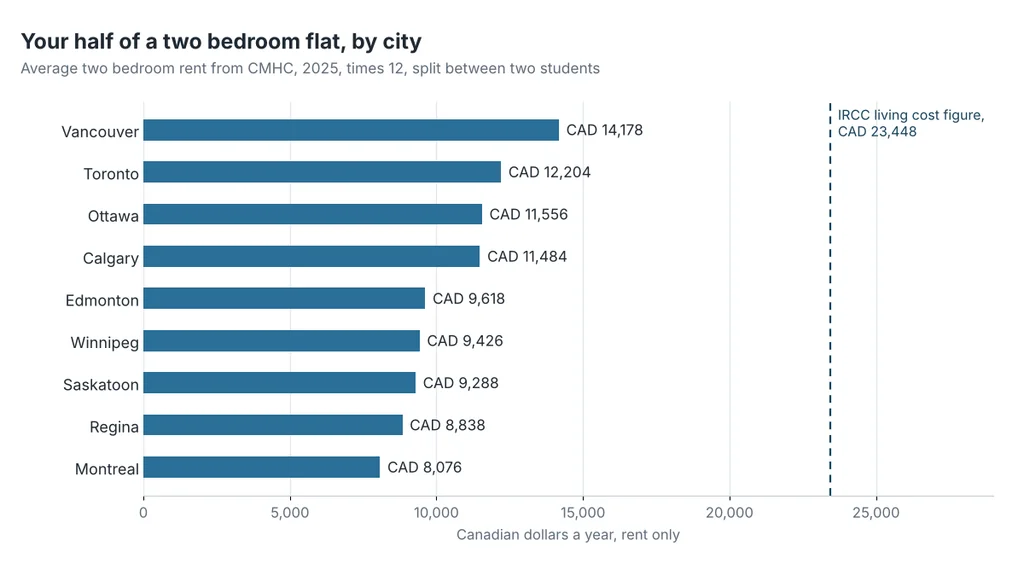
In Vancouver, your half of the rent comes to about 60 percent of the IRCC living cost figure. In Toronto it is about 52 percent, and in Montreal about 34 percent. Because rent takes half or more of that figure in Toronto and Vancouver, a student in either city may need to spend more than the IRCC minimum on food, transport and everything else.
Please read these numbers with care. They are averages for all tenants in each city, so a new lease can cost more or less. They are also for whole apartments, and we did not find an official figure for a single room in a shared home.
Rent is not the only cost. EduCanada lists the other things to budget for: housing or residence fees, food, transport, health insurance, books and supplies, phone and internet, clothing and emergency savings. It gives no dollar amount for most of them, and neither did we find an official figure for each one, so ask your school whether it publishes its own estimate.
Ways to lower the cost of studying in Canada
- Compare provinces before you compare schools. The average undergraduate tuition is CAD 18,867 in Newfoundland and Labrador and CAD 49,802 in Ontario, a gap of more than CAD 30,000 a year, and rent also differs by city, as the table above shows.
- Look at colleges, but check the work permit rules first. EduCanada gives CAD 16,000 to 25,000 a year for college diplomas, against an undergraduate average of CAD 41,746. College graduates need a language score of CLB 5 for the post graduation work permit, and the program must be on IRCC’s list of eligible fields, so ask the college to confirm in writing that yours is on it.
- Ask each school about scholarships. EduCanada says funding for international students is available through the Government of Canada, the provinces and territories, and many schools, and its website has a search tool. We found no single list that covers every school, so ask each school’s international office what it offers.
- Use the work rules. IRCC says that eligible students can work on campus with no limit on hours during the school term, and off campus for up to 24 hours a week during term. Pay from work helps with daily costs, but IRCC wants to see your funds before you travel, so do not count on future pay for your permit application.
- Share your home. The table above shows that sharing a two bedroom apartment cuts your rent to half of the whole apartment.
- Add up the health cost for your province. British Columbia charges CAD 75 a month, and Ontario universities charge CAD 948 a year for UHIP, so include it when you compare provinces.
Frequently asked questions about the cost of studying in Canada
How much does it cost to study in Canada for one year?
In this guide, the first year costs between CAD 46,415 and CAD 89,955. That total includes CAD 23,448 in living funds that you keep, tuition of CAD 18,867 to 49,802 that you pay to the school, and CAD 4,100 to 16,705 in fees, tests, travel and setup. The range is wide because tuition and rent depend on the province, the school and the program.
How much money do I need to show for a Canada study permit?
If you apply on or after 1 September 2026 and you are a single student outside Quebec, you must show CAD 23,448 for living costs. You must also show money for your first year of tuition and for travel to and from Canada. Quebec sets its own financial rules, so check the Quebec government website if you plan to study there.
How much does a Canada study permit cost?
The study permit fee is CAD 150 per person and the biometrics fee is CAD 85 per person, so the two together are CAD 235 for one student. Other costs, such as a medical exam or a police certificate, depend on your situation.
Is the CAD 23,448 spent or paid to IRCC?
No. IRCC does not collect it. It is money that you must show you have for living costs, and you spend it yourself on rent, food and other costs during your first year.
Is it cheaper to study at a college than at a university in Canada?
On the figures we found, yes. EduCanada gives CAD 16,000 to 25,000 a year for college diplomas, while the average undergraduate fee for international students is CAD 41,746. Before you choose a college, check that your program is on IRCC’s list of eligible fields and plan for a language score of CLB 5, because you need both to qualify for a post graduation work permit.
Which province has the lowest tuition?
Statistics Canada gives an average undergraduate fee of CAD 18,867 for international students in Newfoundland and Labrador and CAD 49,802 in Ontario. Rent also differs by city, so compare the whole cost and not tuition alone.
Can I work in Canada to pay for my studies?
Eligible students can work on campus with no limit on hours during the school term, and off campus for up to 24 hours a week during term and full time during scheduled breaks. You need a valid study permit with the work condition and a Social Insurance Number. Do not use expected pay as part of your proof of funds.
Do international students need health insurance in Canada?
You need cover, either from a provincial plan or from a private plan, and the rules depend on the province. Ontario universities require UHIP at CAD 948 a year from 1 September 2026, and British Columbia charges international students a health fee of CAD 75 a month. Alberta lets students with a 12 month study permit join its health plan if they will live there for 12 months or more. Other provinces have their own rules and waiting periods, so check the health website of your province.
Read this before you spend any money
- Ask your school about the attestation letter first. Without it, most applicants cannot go forward, and the letter applies only to your school and your level of study.
- Check the school and the program on the official lists. The school must be on the DLI list. If you plan to work after graduation, check that your exact program is PGWP eligible.
- Check your language scores against the PGWP rule now. A score that is enough for admission may be lower than the CLB level you need to work afterward.
- Use the right proof of funds figure on the day you apply. The living cost number changes each year, and tuition and travel come on top of it.
- Keep a clear paper trail for every dollar. Officers care less about how much you have than about whether they can see where it came from.
- Ask for every fee in writing. That includes school deposits, bank and GIC fees, and money transfer costs.
- Plan your whole study path before you start. You can only get one PGWP, and a change of school or course can affect your rights.
- Compare totals, not tuition. If Canada is one of several countries on your list, read our cost guides for France and Japan as well, because each one covers admission, visa and arrival in the same order and lets you compare like with like.
How we checked these figures
We took each fee, amount and rule from the official pages of IRCC, EduCanada, Statistics Canada, CMHC, and the governments of British Columbia and Alberta wherever we could, and we read them in October 2026. Rows marked “our estimate” are our own judgement and not an official figure.
This article is general information and is not immigration advice. Canadian study rules, fees and funds requirements change often, and some change every year. Confirm every detail on the official IRCC website at canada.ca, and on the Quebec government website if you plan to study in Quebec. Before you pay for help, speak to a licensed adviser. Immigration consultants in Canada are regulated by the College of Immigration and Citizenship Consultants, which has a public register where you can check a licence. Lawyers who belong to a provincial or territorial law society, and notaries in Quebec, may also give immigration advice for a fee.