
On 7 October 2026 DHS announced a plan to charge $70,000 for each international student who wants Optional Practical Training, known as OPT. OPT is the work year most students count on after graduation. The school would pay the fee, not the student, but the plan does not stop a school from passing the charge to the students. It is only a proposal for now, but it still shows how fast the rules around the F-1 student visa are changing.
This guide covers the cost of studying in the USA in four stages: picking a level of study, winning a place at a school, getting the F-1 student visa, and arriving. For admission, the student visa and arrival you get a cost table in US dollars. Then we add the three tables together and split the result into real charges, money you keep and money that pays for your education.
If you typed “cost of studying in the USA” into a search box hoping for one number, you will find a range instead, since tuition alone costs between about $11,700 and $68,600 a year. You will also find a table of tuition by type of school, some closing notes and a few quick answers.
Rules and fees do change often, so before you pay anything, check each figure on the official sites we link to. If an official page did not give us a number, we say so and label the figure as our estimate. Lastly, every link in this guide is to a US government page or an official university page. All of them are in English.
The Cost Of Studying in the US calculator
This calculator adds up the cost of your first year in three phases: admission, the student visa, and arrival and setup. Pick your type of school, add your own figures if you have them, and leave any box blank to use the range from this guide. Use the Summary tab for the total, and open each phase tab to see every item, which costs people often miss, and which money you get back. The Low, Middle and High buttons change the costs you cannot choose, such as tests, translations and furnishing. All these cost have been discussed more on this guide
Your situation
Show costs in your own currency
Estimated cost for your first year
$0
This is a budgeting tool, not immigration or legal advice. Check your own fees with your school and the official pages linked in the calculator and in the guide.
What changed in 2025 and 2026
Most guides were written before the biggest changes were made, so start here.
- 17 July 2026: The government published a final rule that would end “duration of status” for F-1 students. Students would get a fixed end date, up to four years, instead of staying as long as their studies last. On 14 September 2026 a federal court paused it, and USCIS says it will use the old rules for now. However, the government has since appealed, so the rule may change again.
- 7 October 2026: The OPT fee plan above. It is a proposed rule with a $70,000 fee for first time OPT and $30,000 for any later OPT, and the public can comment before it is final.
- 1 January 2026: A wider travel ban took effect, and under it the US suspends student visas for nationals of many countries. The list is in Step 3.
- 1 October 2025: Most student visa applicants must attend an in person interview, because the old waiver for many cases ended.
- June 2025: The State Department said F, M and J applicants would be told to make their social media profiles public.
- 2026: A new $250 visa integrity fee is being collected at some US posts, but not everywhere.
- 8 June and 24 July 2026: Courts blocked the agency from collecting the $100,000 H-1B fee, which matters if you hope to move from OPT to an H1B work visa. USCIS says it will collect the fee again if the order is lifted.
Step 1: Choosing a level of study with the work years after it in mind
How long you may work in the US after you graduate depends on your level of study, so consider this before you pick a school. The main tool is OPT, which lets you work in a job linked to your field of study but it is not automatic. First, you will need your school’s recommendation, then a work permit card from USCIS. Please note; you cannot start working until you hold the card.
How each level of study turns into work time
The rule is simple on paper. USCIS may give you 12 months of OPT at each higher level of study, so 12 months after a bachelor’s degree and another 12 months after a master’s degree. Students with a degree on the official STEM list can add a 24 month STEM extension.
| What you study | Work time after you finish |
|---|---|
| English language program | None. Language students cannot use OPT |
| Vocational program on an M-1 visa | One month of training for every four months of study, starting only after the program ends |
| Associate or bachelor’s degree | 12 months of OPT, plus 24 more months if the degree is on the STEM list |
| Master’s degree | A fresh 12 months of OPT, plus 24 more months if the degree is on the STEM list |
| Doctoral degree | A fresh 12 months of OPT, plus 24 more months if the degree is on the STEM list |
Ask your school official to confirm in writing whether your exact degree is on the STEM list. A degree name that sounds scientific may not be on the list.
Mistakes to avoid before you even apply
Most OPT problems start with choices made in the first year, not with the work permit form itself. Read these before you pay a deposit.
OPT before graduation reduces the time you have after it. OPT done before you graduate is taken out of the time you can use after. USCIS gives an example: if you use one year of full time OPT before graduation, you have no OPT left after graduation at that level. Part time work counts at half.
Full time CPT can end your chance of post completion OPT. Curricular Practical Training, or CPT, is paid training built into your course. DHS says students who finish one year or more of full time CPT cannot use post completion OPT.
The filing period is short. For OPT after graduation, you may file up to 90 days before your program ends and no later than 60 days after it. You must also file within 30 days of your school’s recommendation. All your OPT must be finished within 14 months of your program end date.
Time without a job is limited. A student on standard OPT may be without a job for 90 days in total. On the STEM extension the total rises to 150 days, and that figure includes any of the 90 days you already used.
For STEM OPT, your employer must qualify. Your employer must be enrolled in E-Verify, and you and the employer must complete a training plan called Form I 983.
If you move up a level, you lose your card. If you transfer to a new school or start a higher level, your OPT permission ends automatically. Time your move so you do not lose a work card you still need.
Age and language scores. The DHS pages we read set no age limit for F-1 students or for OPT, and no national language score. Each school sets its own English rules, so a school’s score and a visa officer’s view of your English are two separate checks.
The step after OPT is not guaranteed. Many students hope to move to an H-1B work visa. The $100,000 fee for some new H-1B petitions is not being collected after a court order, yet the White House extended the policy on 18 September 2026 and a separate fee of $103,265 has been proposed. Do not make a plan that depends on one particular outcome.
Can you stack programs to stay longer?
Not by adding their lengths together, no. The US counts OPT by level, so the way to get more work time is to move up a level; for example you can only move from a bachelor’s to a master’s degree, which would then give you a new 12 months. The problem is that you lose any OPT you already hold. Something else to keep in mind; if the paused fixed date rule ever takes effect, a student who finishes a program would also be barred from starting a new program at the same or a lower level, and graduate students can not change their field or school.
Step 2: Get accepted by a school that US immigration recognizes
Only a school approved by the Student and Exchange Visitor Program, called SEVP, can give you the form you need for a U.S student visa. So check that first, before you spend money on any application.
Check the school against the federal list
DHS runs a School Search tool and a downloadable list of SEVP certified schools that you can filter by state, school type and whether the school takes F-1 or M-1 students. A school missing from the list cannot give you the form you need, whatever its offer says. Use the list to avoid fake schools. It will not tell you whether an agent is genuine, and the disclaimer at the end says where to check an adviser.
Free advice is also available and DHS points students to EducationUSA, a State Department network with advising centers in more than 170 countries.
Papers a school will ask for
Every school has its own list, but most want the same documents:
- Transcripts and certificates from earlier study
- A copy of your passport
- An English test score, if your school asks for one
- An essay or a statement of purpose
- Letters from teachers, for some programs
- Proof that you can pay for the first year
If your records are not in English, plan for certified translations. Ask your old school early for extra copies, since some take weeks. Application fees are set by each school and are usually charged per application.
The offer, the deposit and the Form I-20
After you are accepted, your school enters you in the federal student database known as SEVIS, and issues a Form I-20. This form I-20 is the paper the visa officer and the border officer will read first. It lists your program dates, your school’s estimate of your yearly costs and the funds you must show.
Before the school can issue it, a school official must collect proof of your financial ability. Also, most of the schools will also ask for a deposit to hold your place, make sure you have read the refund terms first, because some schools keep part of a deposit if you are refused a visa.
The US has no national cap on student visas and no federal limit on tuition discounts. Limits are often put in place by each school and you do not need a letter from any government office before you apply to a school. So the school’s offer and the Form I-20 come first.
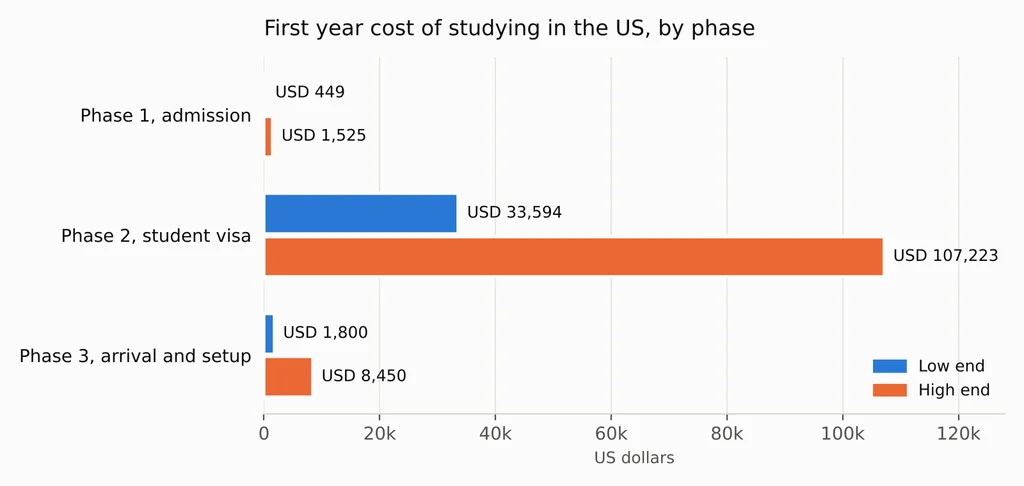
Phase 1 costs: admission
| Item | Typical cost in USD | In your local currency | Why it is on this list |
|---|---|---|---|
| English test, one sitting | USD 180 to 280 | Estimated by us. Prices differ by country, so check the test owner’s site | |
| Extra score reports | USD 29 to 145 | ETS charges US$29 for each additional TOEFL score report, and we assume one to five | |
| Applications to three to six schools | USD 150 to 600 | Estimated by us, since every school sets its own fee | |
| Translations and certified copies | USD 50 to 300 | Estimated by us, needed when your records are not in English | |
| Courier for records and the Form I-20 | USD 40 to 200 | Estimated by us, because some schools post the form instead of emailing it | |
| Place deposit | USD 0 here | The deposit is normally part of tuition, so we count it only in Phase 2 | |
| Phase 1 subtotal | USD 449 to 1,525 | Sum of the lines above |
Step 3: Apply for your F-1 student visa
The F-1 student visa is a sticker that lets you ask to enter the US. It does not mean you will be let in. You will need to apply for it online and then attend an interview. But all this can only be done after you hold your Form I-20. The State Department allows visas for new students up to 365 days before the program starts, but you cannot enter more than 30 days before the start date.
What to gather before the interview
The State Department asks for these items during your student visa interview.
- A passport valid for at least six months beyond your planned stay, unless your country is exempt
- The confirmation page of the online form DS-160
- The receipt for the visa application fee
- A photo
- Your Form I-20
You may also need to carry your transcripts, diplomas, test scores, proof that you intend to leave the US after your studies, and proof of how you will pay, so to be safe take all of them. The State department does not list a police certificate or a medical exam for students, but your school may ask for vaccine records, so enquire from them.
Be ready for tighter checks too. In June 2025 the State Department said F, M and J applicants would be told to set their social media accounts to public, and a page updated in September 2026 still lists students among the groups that get an expanded online presence review. Assume an officer can read anything you have posted, and do not post anything you could not explain.
Check the travel ban list before you pay anything
A presidential order that took effect on 1 January 2026 fully restricts entry for nationals of Afghanistan, Burkina Faso, Burma, Chad, the Republic of the Congo, Equatorial Guinea, Eritrea, Haiti, Iran, Laos, Libya, Mali, Niger, Sierra Leone, Somalia, South Sudan, Sudan, Syria and Yemen, as well as people traveling on Palestinian Authority documents. It also suspends F, M and J visas for nationals of Angola, Antigua and Barbuda, Benin, Côte d’Ivoire, Dominica, Gabon, The Gambia, Malawi, Mauritania, Nigeria, Senegal, Tanzania, Tonga, Zambia and Zimbabwe.
Burundi, Cuba, Togo and Venezuela stay under the earlier order, which also suspended student visas for them. Turkmenistan’s student visa suspension was lifted. Visas issued before 1 January 2026 were not canceled, and case by case exceptions exist. The list can change, so read the order itself before you spend money on an application.
F-1 student visa proof of funds: what to show and how to show it
The US sets no single dollar figure for proof of funds, so your Form I-20 is your guide. Italy is different, since it raised its required figure this year, so watch the date on any funds number you read, and our cost of studying in Italy guide explains the rise. DHS says you must show enough money for tuition and living costs for the period of study, and your school official must see that evidence before the form is issued. You should bring the same evidence to the visa interview and keep it in your hand luggage at the border.
DHS names these types of proof, and says the list is not complete:
- Family bank statements
- Documents from a sponsor
- Financial aid letters
- Scholarship letters
- A letter from an employer showing your yearly salary
Some schools set stricter rules about what they accept, so ask the international office before you gather papers.
Schools differ on the paperwork itself, so read your own international office page twice. Northwestern, for instance, says a bank statement must be dated within the last six months, show the full name of the account holder, and name the currency in letters, since symbols are not accepted, in English or with a certified translation.
The University of Kansas takes checking, savings, stock holdings and certificates of deposit, a bank letter on letterhead, an official student loan approval letter, or a graduate assistantship offer. The University wants the full amount to show in the closing balance, and the documents should be less than six months old. Fixed deposits and retirement accounts are not mentioned there, so ask before you count them. A seven month old statement does not meet the rule at either school.
Most schools ask you to prove the first year only, though Kansas says to be ready to show funds for the rest of your studies too. So it is important to work out how years two to four will be paid before you apply, not at the interview.
Use the school’s own number. The University of Minnesota, for example, says its form I-20 uses the 12 month cost, and that expected pay from an on campus job cannot be counted. For a 2026 to 2027 international undergraduate, that page lists a total of $73,002 for 12 months, with $44,743 of it for tuition and fees. The same school lists $67,085 for a nine month plan, so watch which period your form uses.
Students make three mistakes again and again. First, considering only funds that cover only tuition, when living costs belong in the total too. Second, a large deposit that appeared last week with no history behind it. Third, papers that do not match each other, such as a sponsor’s letter that names a different amount from the one on your Form I-20. So use pay slips, sale deeds or loan contracts that explain where each sum came from.
Who can pay for your
A parent, relative or other sponsor can pay. Their documents must show the money exists and that they intend to give it to you, which is why DHS lists sponsor papers by name. A letter alone is weak evidence. Bank history is stronger evidence. If the money is held in a family business, move the amount you need into a personal or family account well ahead of your interview, and keep every transfer slip.
Each school sets its own forms for this. Northwestern wants a new Sponsor Statement of Support from every family or friend sponsor, while an employer or government sponsor sends a support letter instead of bank statements. If a company is the sponsor, Kansas says financial papers alone are not enough, and also wants an affidavit and a signed letter on the letterhead. This is to confirm that the representative controls the funds and that the money may be used for your studies. Documents that are not in your own name need an affidavit there as well.
Health cover when there is no national student plan
The school sets the health plan for their students, and several schools make cover compulsory and bill it with tuition. Minnesota lists $3,590 for mandatory health insurance, Santa Monica College lists a mandatory plan at $2,310 for the year, and Arizona State lists $2,765, using last year’s rates.
New York University is a useful warning. Its cost page states that health insurance is not included in the standard figure, and students without cover are put on a university plan that is added to the bill. So a low estimate may not include one of your biggest yearly costs. Also ask when the plan starts, if the cover begins after you arrive, or whether you may need a short travel policy to cover the gap.
English tests
There is no national minimum English score stated in the DHS and the State Department websites that publish for F-1 students. So often your school will set its own score. Book a test early, because results take days and some schools want the test owner to send the score directly.
Working while you study
An F-1 student may work only with permission. On campus work is allowed for up to 20 hours a week while classes are running, and you can apply up to 30 days before classes start. Off campus work is allowed only after one full academic year, and only if you have an economic hardship that meets DHS rules, with approval from your school and from USCIS. Note that CPT and OPT are separate routes that were covered in Step 1.
Do not take any job before you are cleared. DHS warns that if your school official learns you work without permission, they must report it, your SEVIS record will be ended, and you may have to leave at once. Plan your first year as if you will earn nothing.
Booking the interview and waiting for a decision
The steps are in this order: complete the DS-160 form, pay the application fee, book an interview, attend it, and pay any issuance fee if you are approved. The State Department says to book at the embassy or consulate in your country of residence, and a page updated in July 2026 adds that applicants who apply based on where they live must be able to prove they live there.
There is no single processing time. The State Department’s wait time page, updated on 17 September 2026, shows the next free appointment for student visas at each post. Many posts, including Accra and Lagos, showed under one month, while Dubai showed about five months and Beijing about five and a half months. Some files go to extra checks after the interview, and the officer will tell you if yours does.
You pay three fees at this stage. The visa application fee is $185 and is not refunded, even if you are refused. The SEVIS fee for F-1 and M-1 students is $350, paid online by card. Some nationalities also pay a visa issuance fee after approval, set by country in the reciprocity tables. Then there is the new $250 visa integrity fee. Boston University’s office says some posts have begun charging it, that it is separate from the other fees, and that it may be refundable if you follow the visa rules. We list it as a range from zero to $250 for that reason.
Phase 2 costs: student visa
| Item | Typical cost in USD | In your local currency | Category | Why it is on this list |
|---|---|---|---|---|
| Visa application fee | USD 185 | Standard | The State Department lists it for F and M visas, and it is paid before the interview | |
| SEVIS fee | USD 350 | Standard | ICE sets it for F-1 and M-1 students | |
| Visa integrity fee | USD 0 to 250 | Often missed | Only some posts collect it so far, and it is not on the main fee page | |
| Visa issuance fee for your nationality | USD 0 to 200 | Often missed | The State Department sets it by country. The upper figure is our estimate, so look up your own country in the reciprocity table | |
| Year one tuition, paid or proven | USD 11,664 to 68,576 | Standard | The low end is tuition at a community college and the high end is tuition and fees at a private university | |
| Living costs on the Form I-20 | USD 18,955 to 32,422 | Standard | The low end is one Texas public university’s yearly living figure. The high end adds up housing, food, books, personal and travel lines at New York University. You spend this money, you do not pay it to anyone | |
| Health insurance, first year | USD 2,310 to 3,590 | Often missed | The range between Santa Monica College and Minnesota | |
| New passport or renewal | USD 30 to 150 | Often missed | Estimated by us. The passport must stay valid for six months beyond your stay | |
| Vaccine records and school health forms | USD 0 to 300 | Often missed | Estimated by us, because schools set their own health paperwork | |
| Money transfer fees and exchange margin | USD 100 to 600 | Often missed | Estimated by us, since banks charge wire fees and a margin on large sums | |
| Translations of bank and sponsor papers | USD 0 to 200 | Often missed | Estimated by us, needed when statements are not in English | |
| Travel to the embassy for the interview | USD 0 to 400 | Often missed | Estimated by us. You must usually apply where you live, and not every city has a post | |
| Phase 2 subtotal | USD 33,594 to 107,223 | Includes tuition and the living costs you keep |
Step 4: Fly in and settle
A visa lets you travel to the US, but it is not the final permission to enter. A Customs and Border Protection officer makes the final call, so what you have in your cabin bag matters as much as the visa.
Papers to keep in your hand bag
DHS says that at the first checkpoint you must show your valid passport, your valid visa and your signed Form I-20. You should also have on hand:
- Your DSO’s (Designated School Official) name and phone numbers, including one for after hours
- Your acceptance letter
- Proof that you paid the SEVIS fee
- Proof of funds, which may be what you showed at the interview
An officer who cannot confirm something may send you to a second inspection. The officer may then give you a Form I 515A, which lists missing papers, and you and your school official then have 30 days to fix them. Fill in the customs declaration honestly, and read the rules on carrying cash before you pack.
The first weeks: deadlines and mistakes to avoid
So your deadlines start almost immediately., so you must contact your school official as soon as you enter, and again no later than the program start date on your Form I-20. From then on, you must take a full course load every term, and for an undergraduate at a college or university that means at least 12 credit hours. Talk to your school official before you drop a class, change your program, move house or travel.
You will only need a Social Security number if you are paid by an employer. Students who earn any form of salary must apply, and DHS explains what papers you need for an on campus job or for a work permit card. Use the official process, and be careful with anyone who charges you to do it for you. After you finish, you have 60 days to leave or take another step under the current rules. If the paused rule returns, that would drop to 30 days.
Be careful when renting your first apartment. The law on deposits depends on the state, for example in California, a landlord generally can ask for a deposit of one month’s rent at most. However, there is a small exception for some owners with very few properties, and must return the balance within 21 days of moving out. In New York State the cap is one month’s rent, with a 14 day return deadline. Check your own state’s attorney general page before you pay, and do not wire money for a room you have not seen, or to someone you cannot verify.
Some other costs that may come up when you just rent include the: renters insurance, bedding and kitchen items for an empty room, a phone plan with a first transit pass, and a proper winter coat if you grew up somewhere warm.
Housing: dorm or off campus, and what a landlord asks of a new arrival
Your Form I-20 already includes a housing figure, so start there. Iowa State lists housing and food for 2026 to 2027 at $11,162 on campus, $9,960 off campus for a dependent student and $12,294 off campus for an independent one, the same for international students as for residents. NYU gives one figure of $26,438 for housing and food, whether you live in a hall or off campus. That gap of about $15,000 on one line is why the school’s own estimate matters more than any national average.
If you rent off campus, expect the paperwork to be harder than the rent. Most landlords want to see a US credit history, and new international students do not have one. The University of Florida says that in this case you will often pay a double deposit, and that deposits for students with no credit history and no guarantor range from $500 to $1,500. A guarantor is someone with US credit who agrees to pay if you cannot. Our Phase 3 table allows $500 to $2,500 for a deposit, so this range fits inside it.
Two more points from the same university. A lease shorter than 12 months usually costs an extra $100 a month. If you share a flat, ask for an individual lease, so you pay only your own rent and are not responsible if a roommate misses a payment.
George Mason says that without a Social Security number or credit history the deposit may be larger, and that wired money cannot be recovered. Do not pay for a place before you hold a signed lease, and use a payment method that leaves a trail. If you live in a dorm for the first term, you avoid most of this paperwork and costs
Phase 3 costs: arrival and setup
| Item | Typical cost in USD | In your local currency | Category | Why it is on this list |
|---|---|---|---|---|
| Single flight to the US | USD 500 to 2,200 | Standard | Estimated by us, and prices change by region and by season | |
| Short stay for the first two weeks | USD 300 to 1,200 | Standard | Estimated by us, for a hostel, hotel or early dorm move in | |
| Airport to campus transport | USD 20 to 150 | Often missed | Estimated by us, because campuses can be far from the airport | |
| Rental security deposit | USD 500 to 2,500 | Often missed | Estimated by us. California and New York cap it at one month’s rent in most cases, and you should get it back later | |
| First month of rent | USD 0 extra | Standard | You pay it from the living money already counted in Phase 2 | |
| Renters insurance | USD 100 to 300 | Often missed | Estimated by us, and some landlords ask for it, so ask before you sign | |
| Bedding, kitchen items and basic furniture | USD 300 to 1,000 | Often missed | Estimated by us, since many rooms and flats are unfurnished | |
| Phone plan and first transit pass | USD 60 to 200 | Often missed | Estimated by us for the first month | |
| Winter clothing | USD 0 to 600 | Often missed | Estimated by us. It depends on the state you choose | |
| Bank fees, utility deposits and first week cash | USD 20 to 300 | Often missed | Estimated by us for set up charges that you pay in week one | |
| Phase 3 subtotal | USD 1,800 to 8,450 | Sum of the lines above |
Cost of studying in the USA: all three phases added together
| Phase | Estimated cost in USD | Estimated total in your local currency |
|---|---|---|
| Phase 1, admission | USD 449 to 1,525 | |
| Phase 2, student visa | USD 33,594 to 107,223 | |
| Phase 3, arrival and setup | USD 1,800 to 8,450 | |
| Total | USD 35,843 to 117,198 |
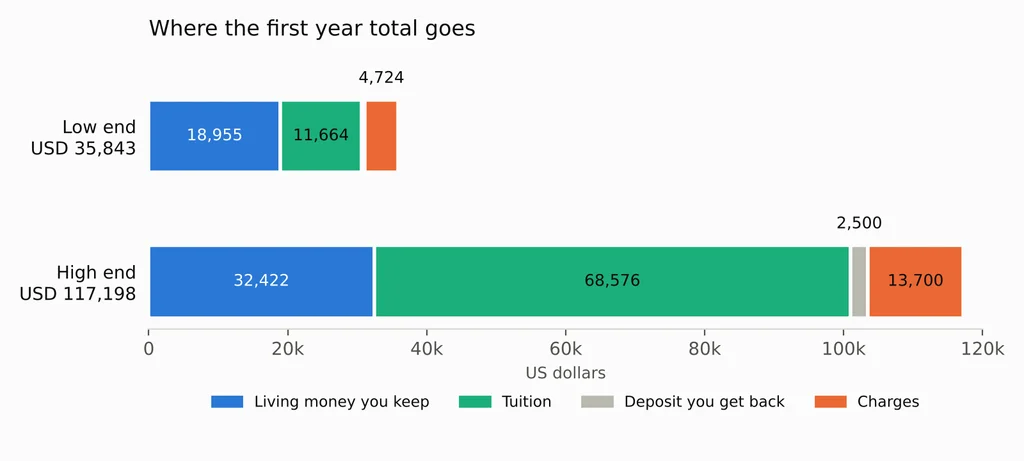
The total is huge because it includes three kinds of money, and the real cost is clear only after you look at each kind of money separately.
Money you keep. The living costs on your Form I-20, USD 18,955 to 32,422, are for your rent, food and daily life. Without them the total is about USD 16,888 to 84,776.
Money that pays for your education. The first year of tuition goes to your school. You do owe it, but it is payment for your education and not a service charge. Without it, you are left with about USD 5,224 to 16,200.
Money you get back. The rental security deposit, USD 500 to 2,500, should be returned when you move out if you leave the home in good order. Take it off too, and the amount that is truly lost to charges is about USD 4,724 to 13,700. That covers visa and SEVIS fees, health cover, tests, travel, translations, bank costs and setup.
Costs outside this table. The table covers one year, so a four year degree adds up to much more. It does not include the work permit fee for OPT, which is $520 on paper or $470 online in the general category of the USCIS fee schedule, and USCIS adds that some fees rise on 16 October 2026, so check the schedule before you file. It does not include the $70,000 OPT fee either, since it is only a proposal and the school would pay it. If it becomes final, DHS says it would apply 60 days after the final rule, and a school could not enter an OPT recommendation until it had paid. We cannot tell whether schools will pass the cost on.
What a year of tuition costs by type of school
Prices differ widely between schools, so here are real examples from school pages. They are not a national average. We did not find a reliable official national figure for international students, and we list each school’s own page.
| Type of school | Example yearly tuition and fees | Note |
|---|---|---|
| Community college | USD 11,664 for 24 units, plus about USD 125 in fees | Santa Monica College, 2026 to 2027, non resident rate |
| Lower cost public university | USD 19,700 to 22,521 | Texas State University at the low end, nine months, and University of North Texas at the high end, by college |
| Large public university | USD 43,009 to 44,743 | Arizona State (our sum of its tuition and fee lines) and Minnesota |
| Private university | USD 68,576 | New York University, 2026 to 2027 |
| Master’s degree at a public university | USD 11,100 | Texas State University, non resident, six credit hours a term. The page refers to 2025 to 2026 detail, so confirm it |
| Doctoral degree at a public university | USD 16,300 | The same Texas State page, non resident, nine credit hours a term |
Prices for graduate programs vary far more than these two lines suggest, and many research degrees come with pay or a fee waiver. Read the page for your own program.
Where you can save without risking your visa
The biggest saving is the type of school, since the examples above range from about $11,700 to $68,600 a year in tuition. A community college can cost a fraction of a private university, but check that your plan for work after study still fits. Your OPT depends on your level of study and your degree, as Step 1 shows. Some countries charge far less, and in Germany most public universities charge no tuition at all, though first year costs are still thousands of euros, as our cost of studying in Germany guide shows.
Ask each school about aid. DHS says international students cannot get US federal financial aid, but some SEVP certified schools offer their own aid and scholarships. Ask the school’s financial aid office and your school official what you could qualify for once you are accepted. A scholarship letter also counts as proof of funds.
Do not save money in the wrong place. Cutting health cover, skipping the SEVIS fee receipt or taking a cheap school that is not on the federal list can cost you the whole year.
Before you pay anything, check these
- Search the school on the federal list first. If it is not an SEVP certified school, stop.
- Use the cost on your Form I-20. It is the amount you must show, so do not rely on a rule of thumb from a friend or a website.
- Check the travel ban list for your passport. Do it before you pay for tests, applications or the visa fee, because the application fee is not refunded.
- Ask what the school’s health plan costs and when it starts. Then plan for the gap.
- Be ready to explain every sum. Officers want to know where money came from.
- Do not count on work. On campus pay cannot be used as proof, and off campus work is rare in year one.
- Plan your whole study path. OPT is counted level by level, and if you transfer or start a new level you lose the card you hold.
- Watch three live issues. They are the paused fixed date rule, the OPT fee proposal and the H-1B fee, and each could change in weeks.
- Compare total costs, not tuition alone. If you are weighing several countries, use our guides to the cost of studying in France and the cost of studying in Japan, which follow the same order of admission, visa and arrival.
Quick answers on US student visa costs
What is the yearly bill for a US degree?
On our figures, the first year costs about USD 35,843 to 117,198 all in. That includes USD 18,955 to 32,422 of living money you spend on yourself, and tuition of USD 11,664 to 68,576 that goes to the school. The part that is truly lost to charges is about USD 4,724 to 13,700.
What do the F-1 visa fees add up to?
The visa application fee is $185 and the SEVIS fee is $350, so you pay $535 at minimum. Some applicants also pay an issuance fee based on nationality, and a $250 visa integrity fee has started at some posts.
What amount must I prove to get an F-1 visa?
There is no fixed amount in federal rules. You must show enough for tuition and living costs for your studies, and your Form I-20 lists the amount your school expects. Bring bank statements, sponsor papers or award letters that match it.
Can I work in the US to pay for my studies?
Only in limited ways. You may work up to 20 hours a week on campus during classes, and off campus work in year one is not allowed. After you finish, you may use 12 months of OPT, and some STEM degrees add 24 more.
Is the $70,000 OPT fee in force?
No. It is a proposed rule that DHS announced on 7 October 2026, and the public can still comment. If it becomes final, the school would pay it, not the student, although a school could choose to pass the cost on.
Treat this guide as background reading, not as advice about your own case. US student rules, fees and court rulings change often, and some change within weeks, so confirm every detail on the official sites linked above, starting with the State Department and Study in the States. The US has no single regulator for immigration advisers. Lawyers are licensed by their state bar, and the Justice Department keeps lists of recognized organizations and accredited representatives who may give immigration advice. Check that anyone you pay for help is on one of those lists, and be careful with agents who promise a visa.