
Last checked: September 2026
On 1 July 2026 Japan raised the fee for a single entry visa from 3,000 yen to 15,000 yen, raising the cost of studying in Japan. That was the first change to the fee in 48 years. Japan then raised a second fee on 1 October 2026, which you pay every year that you stay in Japan. So to renew a one year period of stay, you now pay 33,000 yen at the immigration counter, where you used to pay a flat 6,000 yen. If immigration accepts your application on or before 30 September 2026, you pay the old amount even though your application acceptance comes way later.
This guide covers what you pay at every stage of the Japan student visa in 2026, from the first application form to the day you settle in Japan. It also explains the rules behind those numbers: how the Certificate of Eligibility works, what financial evidence officers read, the new Japanese requirement for language schools, how many hours you may work, and what each qualification lets you do once you graduate.
The figures here were checked at the end of September 2026, and Japan changed a great deal during the year, including the proof of Japanese that language schools have had to collect since April. Check any figure below against the Ministry of Foreign Affairs and the Immigration Services Agency before you pay it.
A note on the links. Most go to the Immigration Services Agency and other Japanese ministries, and several of those pages exist only in Japanese. Where a page has an English edition, that is the one linked here.
The Cost of Studying in Japan Calculator
Every cost covered in this guide is built into this calculator, so you can see what your first year in Japan may really cost. It includes visa fees, school fees, rent, deposits and your flight. Choose your level of study, enter your own monthly rent, and pick a low, middle or high estimate. You get one total, split into tuition, money that stays yours, money you get back and money you never see again. Open the Phase 1, 2 and 3 tabs to see every item, and tick the boxes that match your situation.
All figures come from official Japanese government sources and were last checked in September 2026. Fees and rules change, so treat the result as a budgeting guide, not immigration or legal advice. Before you pay anything, confirm your own fees with your school and on the official pages linked at the bottom of the calculator.
Your situation
Show costs in your own currency
Estimated cost for your first year
¥0
Step 1: Pick a qualification that lets you live and work in Japan afterwards
Your right to work after you graduate depends on which certificate you finish with, so pick the level of study before you pick a school. Here, two routes matter:
The first is a job hunting permission. If you graduate from a Japanese university, a graduate school, or a specialised training college with the 専門士 (Senmonshi, Diploma) title, and your school recommends you, you may change to a Designated Activities status that lasts six months and that you can renew once. That gives you a year to find work. You can get a second year only if you join a job support programme run by a local government.
The second is the Designated Activities No. 46. It lets you take jobs that an ordinary work visa does not allow, such as hotel reception, retail and food service, as long as the job uses advanced Japanese language. You will need Japanese Language Proficiency Test N1, or 480 points or more on the BJT Business Japanese Proficiency Test, and you must have earned the qualification in Japan. Immigration excludes graduates of foreign universities.
What each level of study lets you do afterwards
| What you complete in Japan | What you can apply for next |
|---|---|
| Doctorate or master’s degree | Job hunting status for 1 year, a second year through a local government programme, No. 46 with N1, ordinary work statuses |
| Bachelor’s degree from a Japanese university | Job hunting status for 1 year, the second year route, No. 46 with N1, ordinary work statuses |
| Junior college or college of technology, where you gained a bachelor’s degree on review | Job hunting status for 1 year, No. 46 with N1 |
| Accredited specialised training college course, with the 高度専門士 (Advanced Senmonshi, Advanced Diploma) title | Job hunting status for 1 year, No. 46 with N1 |
| Other specialised training college course, with the 専門士 (Senmonshi, Diploma) title | Job hunting status for 1 year, but you cannot use No. 46 |
| Japanese language institution only | Job hunting status only if you already hold a foreign bachelor’s degree and your school meets the conditions, and you cannot use No. 46 |
Where applicants go wrong
Japan sets no upper age limit for the Student status, but as expected older applicants simply face more questions about the gap in their record.
The government changed the language rules this year, in that if you are entering a Japanese language institution, you must now prove Japanese at A1 level or above, where the proof has to be a test certificate or a recorded interview. A study history of 150 hours used to be enough on its own, but it is not any more.
The rule applies to Certificate of Eligibility applications for the October 2026 intake onward, and to applications you make inside Japan from 1 July 2026. There is one exemption. If you hold a nationality on the Immigration Services Agency list of countries and regions and you submit a graduation certificate from a foreign university, you do not have to prove any Japanese at all.
Universities in Japan work differently since Japan sets no national test for them, so each programme sets its own requirement. Many undergraduate courses use the Examination for Japanese University Admission for International Students, known as EJU. If your course is taught in English, you will need an English certificate instead.
Apply earlier than you expect to. Japanese schools run two main intakes, April and October, and language schools usually close applications six to eight months ahead.
Changing from Language school to University
To move from one course to the next you change your status of residence rather than apply for a fresh visa. The usual route is one to two years at a language institution, then a university or a specialised training college. That change of status is the application whose fee went up on 1 October 2026, so from your second year onward you pay it every year. You can pay a reduced 10,000 yen if you are in serious financial hardship, but you have to prove the hardship with documents, and you cannot apply online.
Step 2: Admission, and why your school matters more here
Japan sets no national cap on the number of international student. On 1 May 2025 the country had 408,069 international students, a record, and 21.2 percent more than a year earlier, with Japanese language institutions up 30.7 percent and specialised training colleges up 39.8 percent in a single year. The government did not respond by capping places, but instead it tightened the paperwork.
Checking the school is on the official register
Your school applies to immigration on your behalf, so its legal status matters more than its marketing. For Japanese language education the official register is the Ministry of Education portal of accredited Japanese language education institutions. Until 31 March 2029 schools on the older Ministry of Justice notification list may also enrol students, and the portal links that list. If a school appears on neither list, it cannot sponsor a Student status, even though they are marketing they can.
Accredited language institutions took on a new duty in April 2026. They must ask every enrolled student about once every three months whether they hold work permission, where they work, what they do and how many hours they work, and they must report students who go over the limit.
What schools ask you to send for Application
Most schools want your final school leaving certificate and transcripts, a passport copy, photographs, an application form and a curriculum vitae. You will normally have to translate anything that is not in Japanese, and most schools want a professional translation rather than your own.
Your school checks your financial evidence before it files. When the school doubts your file, they will simply refuse to submit it. Schools charge between 20,000 yen and 30,000 yen to screen you, and they do not refund it.
Phase 1 costs: admission
| Item | Typical cost in yen | In your local currency | Why it is on this list |
|---|---|---|---|
| Japanese or EJU test sitting | 7,500 to 23,000 | You pay 7,500 yen for the JLPT in Japan, and 12,000 yen for one EJU subject or 23,000 yen for two or three | |
| Entrance examination or screening fee, per school | 17,000 to 30,000 | You pay this to each school, so three applications means paying three times | |
| Japanese translations of your documents | 10,000 to 60,000 | Most schools will not accept a translation you did yourself | |
| Certified copies of diplomas and transcripts | 2,000 to 15,000 | Your former school charges you to issue and seal each set | |
| Bank balance and income certificates | 1,000 to 10,000 | Banks charge for a formal certificate, which is not the same as a printed statement | |
| Courier of original documents to Japan | 5,000 to 20,000 | Immigration wants originals, and schools set deadlines you cannot meet by ordinary post | |
| Phase 1 subtotal | 42,500 to 158,000 | You pay all of this before your school files anything |
Step 3: The Certificate of Eligibility and the Japan student Visa
Japan splits approval into two applications at two different offices, and you cannot do them in the other order.
The Certificate of Eligibility comes first. Your school acts as your proxy and applies to a regional immigration bureau inside Japan while you are still at home. For this, the Immigration charges no fee for it and the certificate stays valid for three months after immigration issues it.
Only once you hold the certificate do you apply for the visa, at a Japanese embassy or consulate. In the Embassy you will submit your passport, the visa form, photographs and the certificate, and a copy of it is enough. You cannot use eVISA for a student visa, so you do this on paper. You now pay roughly 15,000 yen for single entry, in local currency, although some nationalities pay less or nothing under bilateral agreements.
Proof of Funds for Japan Student Visa, and the document most applicants get wrong
Prepare this part most carefully, because weak financial evidence is a common reason for refusal.
Japan publishes no single national minimum sum. Immigration asks instead for evidence that you can pay your tuition and your living costs for the whole course, and the documents it names are a savings balance certificate, an income certificate covering the past year, and material showing where the funds came from. Schools turn that into their own thresholds, so two schools can ask you for different amounts for the same course.
Applicants fail mostly on the document showing where the funds come from more often than the other documents needed to prove the funds. A balance certificate proves that a number existed on one day. It does not prove the money is yours, or that it will still be there next year. Officers look for a story they can follow: a salary paid in regularly, a property sale with a contract behind it, a business with tax filings. If you opened the account last month and it holds one large deposit that nothing explains, officers will treat it as borrowed money.
Use the government’s own figure to plan with. The 2023 JASSO survey puts average monthly living costs at 105,000 yen nationally, not counting study costs, with housing at 41,000 yen nationally and 57,000 yen in Tokyo. Over twelve months that comes to 1,260,000 yen on top of tuition. Do not treat it as an official threshold, though, because Japan publishes none.
Sources for this section: Study in Japan, immigration and student visas; Study in Japan, living costs and expenses; Immigration Services Agency, Certificate of Eligibility application, in Japanese.
If a sponsor is funding you
A parent or relative can fund you, and most students are funded this way. Officers care less about how closely you are related than about how good the evidence is: identity documents, income certificates for the past year, a savings balance certificate, and a signed undertaking to cover your costs. A sponsor with a large balance and no income you can verify makes a weaker file than a sponsor with a modest balance and a clear salary record.
Health cover and the pension bill nobody mentions
Japan does not make you buy private insurance before it issues a visa, this is very similar to France. Once you register your address you join their National Health Insurance. You must join this National Health Insurance for any stay over three months, and the scheme pays 70 percent of standard medical costs, leaving you to pay the other 30 percent.
Your premium depends on your previous year’s income, so a new arrival pays very little. However, there is a catch; you only get the reduction if you declare your income to the municipal office, and you have to declare it even when it is zero. Students who never declare get assessed at a far higher rate.
Another cost to be aware of is the National pension. Everyone aged 20 to 59 who registers as a resident has to join the National Pension, and in 2026 you pay 17,920 yen a month, or 215,040 yen a year. If you are on a degree course you can apply for the student payment exception, which lets you defer the contributions entirely, but you have to reapply every year. If you forget, you owe the full amount.
Working while you study under a Student Visa in Japan
A Student status on its own does not let you work. You need permission to engage in activities other than those permitted, which costs nothing, and you can ask for it at the airport when you arrive, if your period of stay is longer than three months. Doing it there saves you a separate trip to an immigration office.
You may work 28 hours a week, and up to 8 hours a day during your school’s official long holidays. Immigration counts those 28 hours across every job you hold, and from whichever day you start counting, so two jobs of 20 hours each puts you in breach. You may not work in adult entertainment venues at all, including in back of house roles.
The government’s own figure for average monthly part time income is about 59,000 yen, and it warns openly against claims of 200,000 to 300,000 yen a month. This work tops up a budget. It does not pay for a degree, and no officer will accept it as proof of funds.
How long does Student Visa approval takes in Japan
Allow one to three months for the Certificate of Eligibility. For the Student status, the most recent published average covers permissions granted in July 2026, and the figure is Forty One days to get the Certificate of eligibility. Immigration notes in the same series that it takes longer to decide Student applications before the April and October intakes, which is exactly when most people apply. Add one to two weeks for the visa itself. Counting the school application ahead of all that, start at least nine months before the date you want to enrol.
Phase 2 costs of student visa in Japan
| Item | Typical cost in yen | In your local currency | Category | Why it is on this list |
|---|---|---|---|---|
| Certificate of Eligibility application | 0 | Standard | Immigration charges nothing, and your school files it inside Japan, not you | |
| Visa issuance fee | 15,000 | Standard | Japan raised this from 3,000 yen on 1 July 2026, and you pay it in local currency | |
| Agency handling fee | 0 to 6,000 | Often missed | Some consulates route applications through an accredited agency, which charges you | |
| First year tuition and admission fee | 320,000 to 1,900,000 | Standard | You usually pay this in full before immigration issues the certificate | |
| Living funds evidenced for the year | 1,260,000 | Standard | The JASSO average of 105,000 yen a month, because Japan sets no official minimum | |
| New or renewed passport | 0 to 20,000 | Often missed | It has to stay valid past the end of your course, and if you renew it you must report the change | |
| Travel to the consulate to file on paper | 0 to 30,000 | Often missed | You cannot use eVISA for a student visa, so someone has to go in person | |
| Wire charges and currency spread | 15,000 to 80,000 | Often missed | You wire tuition in yen, and the bank takes a margin twice | |
| Photographs, photocopies and postage | 1,000 to 6,000 | Often missed | The photo rules are strict, so many applicants pay for a second set | |
| Phase 2 subtotal | 1,611,000 to 3,317,000 | Tuition plus the 1,260,000 yen that stays yours |
Step 4: Arrival, registration and finding somewhere to live in Japan
Your visa lets you enter Japan, but it does not make you a resident. You have to register after you arrive, and you have 14 days to do it.
What immigration will ask to see
- Your passport, showing the student visa
- Your Certificate of Eligibility, original or copy
- Your acceptance letter from the school
- The address you are going to in Japan
- Evidence of the funds you will live on
What to do in your first 14 days
Register your address within 14 days. If you land at New Chitose, Narita, Haneda, Chubu, Kansai, Kobe, Hiroshima or Fukuoka, immigration gives you your residence card at the airport. At any other airport, immigration stamps your passport to say that it will send the card later. Either way, once you have settled on an address you have 14 days to take the card to the municipal office for that address. You cannot open a bank account, sign a phone contract or join health insurance until you have registered.
Join National Health Insurance on the same visit, and declare your income even if it was zero. Apply for the student pension exception if you are 20 or over and on a degree course. Also apply for work permission if you did not do it at the airport. Your My Number (personal ID number) notification arrives by post a few weeks later, and employers and banks will ask for it.
Sources for this section: Study in Japan, immigration and student visas; Immigration Services Agency, permission to engage in activities other than those permitted, in Japanese; Japan Pension Service, student payment exception, in Japanese.
Why renting in Japan costs so much up front
Renting in Japan works unlike renting almost anywhere else, and most new arrivals underestimate that part of the cost of studying in Japan. A landlord and an agency can ask you for five separate payments on the same day.
You pay shikikin (a deposit), usually one to two months of rent, and you get it back less any cleaning and repair costs. You pay reikin (key money), often one to two months, and you never get that back. You pay the agency a commission, which the law caps at one month plus consumption tax. You pay your first month of rent. And because most landlords will not accept a foreign student without a Japanese guarantor, you pay a rent guarantee company roughly half to a full month.
The Ministry of Land, Infrastructure, Transport and Tourism publishes a room search guidebook for foreign residents in fourteen languages, which lists guarantee companies that work in foreign languages. If you take a school dormitory you avoid most of these payments. If your school offers one, compare the total first payment, not the monthly rent.
Phase 3 costs: arrival and setup
| Item | Typical cost in yen | In your local currency | Category | Why it is on this list |
|---|---|---|---|---|
| Flight to Japan | 60,000 to 250,000 | Standard | Airlines charge peak fares in April and October, when most students arrive | |
| First two to three weeks of lodging | 30,000 to 150,000 | Standard | You cannot sign a lease until you hold a residence card | |
| Shikikin (deposit), refundable | 0 to 150,000 | Often missed | You get this back when you move out, less any cleaning charges | |
| Reikin (key money), not refundable | 0 to 150,000 | Often missed | You pay this to the landlord and never get it back | |
| Agency commission | 0 to 82,500 | Often missed | The law caps it at one month of rent plus consumption tax | |
| Rent guarantee company fee | 20,000 to 90,000 | Often missed | Landlords rarely accept a student without a Japanese guarantor | |
| First month of rent | 41,000 to 90,000 | Standard | You pay it on the same day as the deposit and the key money | |
| Fire insurance for the tenancy | 10,000 to 25,000 | Often missed | Most landlords require it, and the agency arranges it | |
| National Health Insurance, first year | 10,000 to 30,000 | Standard | You only pay this little if you declare your income, even when it is zero | |
| National Pension if no student exception is filed | 0 to 215,040 | Often missed | You pay 17,920 yen a month unless you apply, and you must reapply each year | |
| Personal seal and bank account setup | 1,000 to 6,000 | Often missed | You still need a carved seal for many contracts | |
| Bedding, kitchen kit and the first big shop | 30,000 to 100,000 | Often missed | Landlords let flats bare, often without light fittings | |
| Phone and home internet, three months | 10,000 to 35,000 | Often missed | Providers want your residence card, so you pay prepaid rates first | |
| Getting to class, three months | 15,000 to 45,000 | Standard | Student commuter passes cost less, but you buy them up front | |
| Phase 3 subtotal | 227,000 to 1,418,540 | Rents and renting customs differ sharply between cities |
Adding up the cost of studying in Japan
| Phase | Estimated cost in yen | Estimated total in your local currency |
|---|---|---|
| Phase 1, admission | 42,500 to 158,000 | |
| Phase 2, student visa | 1,611,000 to 3,317,000 | |
| Phase 3, arrival and setup | 227,000 to 1,418,540 | |
| Total | 1,880,500 to 4,893,540 |
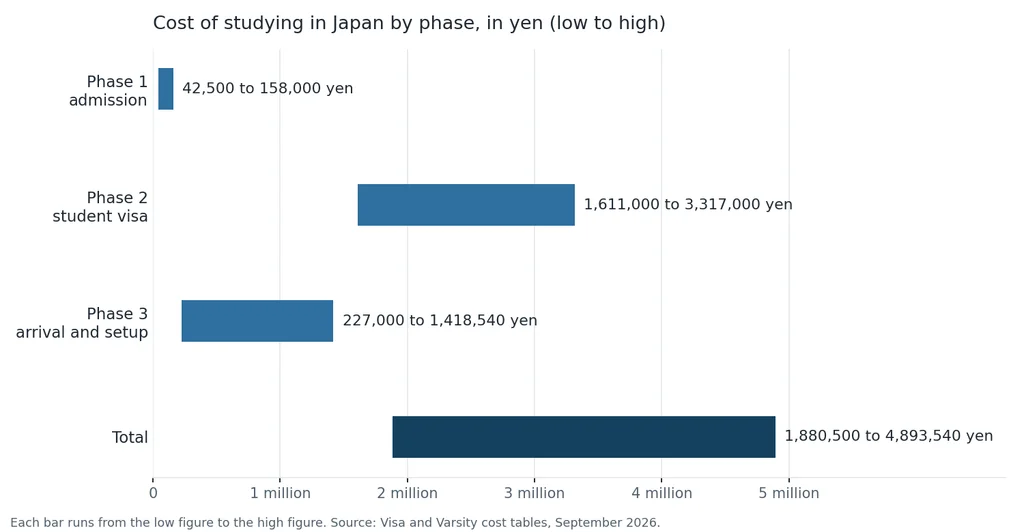
What that total really means
You do not hand most of the cost of studying in Japan to an authority. The 1,260,000 yen of living funds stays yours and pays your rent, food and transport once you arrive, so do not count the Phase 3 living items against it twice. You get the shikikin deposit back when you move out, and you pay tuition for the qualification itself.
Once you take those three out, between roughly 300,500 yen and 1,583,540 yen is money you simply pay and never see again: fees, taxes, tests, translations, bank margins, airfares, key money and furnishing an empty flat. If you file the pension exception, the top of that range falls to about 1,368,500 yen.
Two warnings: The tuition figures cover every institution type, from a national college of technology to a private language institution. The total also covers twelve months only. In your second year you pay tuition again, produce fresh financial evidence, and pay 33,000 yen at the counter or 27,000 yen online to renew.
First year fees at each kind of institution
Average admission fee and first year tuition combined, as published by the government’s Study in Japan portal.
| Level of study | National | Local public | Private |
|---|---|---|---|
| Graduate schools | about 820,000 yen | about 900,000 yen | about 1,100,000 yen |
| Universities, undergraduate | about 820,000 yen | about 910,000 yen | about 1,300,000 yen |
| Colleges of technology | about 320,000 yen | ||
| Specialised training colleges | about 1,300,000 yen | ||
| Japanese language institutions | about 610,000 to 1,900,000 yen |
Private medical, dental and pharmacy programmes cost far more than this table shows, about 3,800,000 yen in year one.
These averages do not show how much one national university can differ from another. Japan sets a standard tuition amount of 535,800 yen a year, with a 282,000 yen admission fee, but a university may charge up to 20 percent above that standard, and several now do. The University of Tokyo charges 642,960 yen a year for undergraduates who enrolled from 2025, and more universities joined it for the 2026 academic year. Check what your own university publishes rather than the average.
Sources for this section: Study in Japan, academic fees; University of Tokyo, admission fee and tuition.
Before you pay for anything, check these six
- Decide how you want to stay on before you pick a course. A Japanese degree qualifies you for both post study routes. A language course on its own qualifies you for neither, unless you already hold a foreign degree.
- Check your school against the official register today, because a school on neither list cannot sponsor you.
- Arrange your Japanese test certificate now if you are going to a language institution, because proving it by interview is messier.
- Work out how you will explain your money before you move the first transfer, because officers refuse files when nothing explains where a balance came from.
- Treat the deposit, key money, agency commission, guarantee fee and first month’s rent as one lump sum, because the agency will ask for them together.
- Put the 14 day registration deadline and the pension exception in your calendar before you fly.
Nothing here is immigration advice, and it does not replace checking your own case. Japan changed its visa fees, its residence fees and its language evidence rules repeatedly during 2026, so confirm your position against the Ministry of Foreign Affairs, the Immigration Services Agency and your school’s fee schedule before you pay anything. Japan does regulate this work. A gyoseishoshi (certified administrative procedures specialist) who holds immigration filing accreditation, or a lawyer, may do it for a fee, and the Japan Federation of Certified Administrative Procedures Legal Specialists publishes a searchable national directory. Your school’s international office is the fastest place to start.