
If you submit a Danish study permit application today, you’ll get one year to look for work after you graduate. If you’d submitted it on 30 September 2026, you’d have got three. On 1 October 2026, the Danish Agency for International Recruitment and Integration (SIRI) cut the job-seeking period for new bachelor’s and master’s applicants from 3 years to 1 year, and it stopped granting permits to the partners and children who come with them. SIRI looks at the day you apply, not the day it makes its decision.
This guide works through the cost of studying in Denmark stage by stage; picking a program, getting admitted, winning the permit and setting up a home. Each stage ends with a cost table in Danish kroner (DKK), and a final table adds everything up and shows how much of it you really lose.
Denmark changed its fees and rules several times in 2026, and it’ll change them again. Before you pay anything, open the official page we link beside each figure and confirm it. Where no official page gives a figure, we’ve labeled it Our estimate.
Every page we link belongs to the Danish government, a Danish municipality or a Danish university, and we’ve used the English version of each one.
The Cost of Studying in Denmark Calculator
Use this calculator to estimate your own first-year budget. Pick your program, type your rent if you know it, and tick the boxes that apply to you. You’ll see each phase add up, plus how much of the total you’ll never get back. Every figure comes from the official Danish government and university pages we link in this guide. Where no official page gave a number, we’ve used the same estimates as the cost tables. If you add today’s exchange rate from your bank, each amount gets a second line in your own currency.
This is a budgeting tool, not immigration advice. SIRI changes their rules for students often, and universities can change their fees each year, so check every figure on SIRI’s website and your university’s fee page before you pay.
Your situation
Show costs in your own currency
Estimated cost for your first year
DKK 0
What changed for Denmark student permits since spring 2025
Most Denmark guides you’ll find were written before these dates, so read this list first.
- 2 May 2025, programs without state approval. If you applied on or after this date for a program that isn’t state-approved, SIRI gives no work permit, no job-seeking period and no permits for family. Step 2 explains how to check a program’s status.
- 1 January 2026, new permit fee. SIRI’s fee table, last updated on this date, puts the study permit at DKK 3,060.
- 2026 living money level. SIRI’s figure for students who must show funds is DKK 7,426 a month at the 2026 level.
- 21 January 2026, new TOEFL scale. DTU now reads TOEFL results from this date on the new 1 to 6 scale, needing 4.5 overall.
- 1 July and 15 September 2026, a new approval body. The Danish Evaluation Institute (EVA) closed, and the secretariat to the Danish Accreditation Council took over its statements on programs without state approval.
- September 2026 intake, a full year paid up front. The University of Southern Denmark (SDU) now makes new students pay a full year ahead, with no installments.
- 1 October 2026, shorter job seeking and no family. New bachelor’s and master’s applicants get up to one year to look for work, down from three, and can’t bring a partner or children. PhD students keep both.
Step 1: Choose a program SIRI will reward after graduation
SIRI decides what you can do after graduation, and it looks at three things; the level of your degree, whether the program has state approval and the date you first applied. Get those right before you fall in love with a course.
Job-seeking time for each type of degree
For an application made on or after 1 October 2026, SIRI’s study page lists six months or one year for academy profession, professional bachelor’s, bachelor’s and master’s graduates, and three years for a PhD. In most cases you don’t apply for it separately, because SIRI normally adds the job-seeking period to your study permit when it first grants it, as long as your passport is valid for long enough.
| Level of study | Job-seeking time if you apply from 1 October 2026 | Notes |
|---|---|---|
| Academy profession (AP) degree | Six months, as far as SIRI’s pages show | SIRI’s one-year page names professional bachelor’s degrees and above, not AP degrees |
| Professional bachelor’s or bachelor’s degree | Up to 1 year | Three years only if you applied before 1 October 2026 |
| Master’s degree | Up to 1 year | The same date rule applies |
| Master’s for working professionals | Up to 6 months | SIRI sets the shorter period for this route |
| PhD | Up to 3 years | Partners and children can still get permits |
| Program without state approval, applied from 2 May 2025 | None | No work rights either |
While you look for work, you keep the student work limit of 90 hours a month and full time in summer. With a state-approved degree, you can also apply for a work permit with no hour limit during the job-seeking period, which costs DKK 840.
Six rules to check before you accept an offer
SIRI applies each of these strictly, and students get them wrong every year. If one of them affects you, ask your university’s international office before you pay anything.
| The rule | What it means for you |
|---|---|
| Your application date | SIRI says the date you submit determines which rules apply, not the date of the decision. If you submit on or after 1 October 2026, SIRI applies the one-year rule |
| State approval | A program needs state approval or a valid statement from the Accreditation Council secretariat. If you applied from 2 May 2025 for a program without approval, SIRI gives you no work rights and no job-seeking period |
| Passport length | Your permit can’t run past three months before your passport expires, and SIRI may cut the job-seeking period to fit it. Renew a passport that’s close to expiry before you apply |
| Six months away | If you give up your Danish address or stay abroad for more than six months in a row, your permit lapses unless SIRI gives you a dispensation |
| Full time only | SIRI doesn’t grant permits for part-time study, and a change of program needs a new permit |
| Age | We found no upper age limit on SIRI’s study or job-seeking pages. Applicants under 18 need consent from both parents |
When you apply for the job-seeking permit yourself, SIRI wants your application in when four months or less remain on your current permit, and before it runs out.
SIRI also expects you to stay enrolled and actively studying for as long as you hold the permit, so if you start failing a course, see your university’s study counselor straight away. Our guide on what happens to your student visa if you fail a module shows how the UK, Australia, the US and Canada handle the same problem.
Does a second degree extend your stay?
Not in any way SIRI describes. Each new program needs a new study permit, and SIRI’s job-seeking page doesn’t say whether you can hold the job-seeking permit twice. So don’t plan on a second bachelor’s to buy extra time.
A step up in level works better. If you take a master’s after a Danish bachelor’s, SIRI gives you a fresh job-seeking period at the end, and PhD graduates get three years. But since 1 October 2026, the one-year limit applies to the new master’s application too, because SIRI looks at the date you apply for each permit.
Step 2: Admission, tuition deadlines and refunds
Each university or academy decides who it admits. In Denmark, your first tuition payment matters twice; the university uses it to confirm your place, and SIRI accepts proof of paid first-semester tuition as your proof of funds. That makes this step more important here than in most countries.
Is the program state-approved? Check before you apply
Study in Denmark, the official guide run by the Danish ministry for higher education, lists Denmark’s higher education institutions; universities, university colleges, business academies, maritime schools and art schools. If a school isn’t on it, slow down.
The list only shows the school. SIRI also wants the program itself to be state-approved or covered by a valid advisory statement, and the school must be publicly accredited or state-approved and under state supervision. Ask the admissions office in writing whether your program is state-approved, and keep the reply. As Step 1 shows, SIRI uses that one word to decide whether you can work at all.
Denmark has no national cap on fee-paying students that we could find on SIRI’s pages, and you don’t need any approval from a government office before you apply to a university. The cap that does exist is on free places. Danish universities receive a limited number of government scholarships each year and pick the winners themselves. Aalborg University (AAU) awards about 15 a year to non-EU master’s students.
Application fees and deadlines at four universities
Each university sets its own fee, and they’re small next to tuition. These are the figures on the official pages we read.
- University of Copenhagen (KU), master’s. A DKK 1,120 application deposit fee, paid once per round, for up to three programs. If you’re admitted, KU takes it off your first tuition bill. If you’re not, you don’t get it back. For the 2026 intake, the portal opened on 15 November 2025 and closed on 15 January 2026, so expect a similar window for 2027.
- Technical University of Denmark (DTU), master’s. A EUR 100 application fee for non-EU applicants.
- Aarhus University (AU). For a bachelor’s, EUR 100 (DKK 750), due by 15 March. For a master’s, EUR 150 (DKK 1,125), covering up to three applications. AU refunds it if you accept a place, pay tuition and are still enrolled on 1 October.
- Aalborg University (AAU). EUR 150 (DKK 1,150), not refundable, for up to three programs in one intake.
Pay these fees by card where the webshop allows it. A transfer from a bank at home can lose part of the money to charges on the way.
Documents the admissions office will read
Entry rules differ by program, but most international applicants upload a passport, degree certificates and transcripts (or school results for a bachelor’s), a language test result and, for many master’s programs, a CV or a motivation letter. AAU asks you to upload the fee receipt to every application in its portal. Order certified copies and translations early, because some exam boards and universities at home take weeks.
The offer, the tuition invoice and refunds
After you accept, the university sends a tuition invoice, and deadlines are tight.
- KU wants the first semester by 15 April for a September start and doesn’t take installments within a semester.
- AAU wants the first two semesters at once, by 20 April for September, a deadline it won’t extend.
- SDU now charges a full year ahead for students starting in September 2026 or later.
- AU wants a bachelor’s first semester by 15 June.
- DTU lists 1 May for new autumn students.
Danish universities don’t ask for a separate place deposit. They treat the first tuition payment as one, and SIRI accepts the same payment as your proof of funds.
What if SIRI says no? KU gives a full refund up to 31 July for autumn starters, and after that a refund is possible if SIRI rejects your residence permit, paid to the original payer, minus any bank service fee. AAU refunds in full before study start and, after a refused permit, in full if you withdraw by 20 September. SDU lists a refused permit as one of its exceptional reasons for a refund, but you must send signed papers by 1 December for a fall start. Whichever university you choose, read its refund page before you pay, and keep every receipt.
Phase 1 costs: admission
| Item | Typical cost in DKK | In your local currency | Why it is on this list |
|---|---|---|---|
| English test, one sitting | DKK 1,400 to 2,200 | Fees vary by test center and country. Our estimate | |
| University application fees | DKK 750 to 2,300 | One school at DTU’s EUR 100 at the low end. Two schools, such as KU and AAU, at the high end | |
| Certified translations and copies | DKK 0 to 2,000 | Nothing at all if your school issues papers in English. Our estimate | |
| Courier and credential checks | DKK 0 to 700 | Some exam boards charge to post results directly to the university. Our estimate | |
| Card or bank charges on fees | DKK 0 to 250 | Your own bank decides what a foreign payment costs. Our estimate | |
| First tuition payment | DKK 0 here | You pay it at this stage. We count it once, with the full year’s tuition, in Phase 2 | |
| Phase 1 subtotal | DKK 2,150 to 7,450 | Sum of the rows above |
Step 3: The SIRI study permit, document by document
SIRI decides your permit, which it calls a residence permit for a higher educational program. The fee is DKK 3,060, and SIRI expects a decision in about two months, or up to three if it asks for more papers. SIRI grants the permit for the nominal length of your program, so most students don’t renew it every year.
The ST1 application and what goes with it
The application form is called ST1. Your university fills in Part 1 and you fill in Part 2, which SIRI says takes about 30 to 40 minutes. The order matters, because SIRI lists these steps;
- Create a case order ID on SIRI’s website.
- Pay the fee, and keep the receipt. SIRI won’t accept the payment status from its website as a receipt, so save the bank statement or card receipt.
- Gather the documents.
- Complete the ST1 online, or print it.
- Submit it, online or at a Danish mission or application center.
- Record your biometrics.
For the documents, SIRI asks for;
- the case order ID
- the fee receipt
- a copy of every page of your passport, including empty pages and the covers
- proof that you can support yourself, which for most degree students is the paid tuition
- a signed sworn declaration, if you don’t sign with MitID, the Danish digital ID that most new students don’t have yet
SIRI’s page doesn’t list a police certificate or a medical exam for higher education students, so don’t pay anyone to arrange them. Documents not in Danish or English may need translating.
Why paid tuition replaces the bank statement
Denmark differs most from its neighbors on this point. If you’re taking a complete degree and you’ve paid tuition to a Danish institution, SIRI’s self-support page says no documentation of self-support is required. SIRI accepts the receipt for your first semester instead of a bank statement.
You’ll need a bank statement after all if you don’t pay tuition, for example because you won a fee waiver, or if you’re an exchange student. Then SIRI wants DKK 7,426 for each month of study, capped at 12 months, which is DKK 89,112. Germany works the other way, and our breakdown of the cost of studying in Germany shows how a year of living money gets locked in a blocked account before the visa.
Don’t read the Danish rule as “no money needed”. SIRI simply trusts that a student who paid tuition has planned the rest. You still have to pay rent, food and a deposit from your first week, and you can’t fall back on Danish state support, because SIRI says students may not receive public benefits, including the State Educational Grant (SU) or housing benefit. Taking them can cost you the permit.
We use SIRI’s own DKK 89,112 as the minimum budget for a year in our tables. In Copenhagen, it’s tight. KU estimates EUR 1,280 to 1,800 a month for living costs in Copenhagen, and DTU’s student guide puts an off-campus month at EUR 1,650 to 2,800. Outside the capital, VIA University College suggests at least DKK 6,500 to 7,500 a month.
“I won a tuition waiver. What do I show SIRI now?”
A scholarship letter that covers living costs, or a bank statement. A university’s government scholarship usually pays both. SDU’s version gives a full fee waiver and DKK 6,090 a month before tax, and AAU’s pays DKK 11,225 a month at the 2026 rate, so the letter itself may meet SIRI’s rule.
If your waiver covers tuition only, you’re back to the bank statement. It needs to be in your name, no more than 30 days old when you submit, and it must show your full name, the balance and the currency. If you send two statements, both need the same date.
“Can my uncle’s bank statement count?”
No. SIRI doesn’t accept bank statements in another person’s name, and it doesn’t accept declarations from third parties either. If a relative is paying, they need to move the money into your own account before your bank prints the statement. Keep the transfer slips, so you can show where the money came from if anyone asks.
SIRI also turns down restricted stocks, bonds and investment portfolios, and it won’t take cryptocurrency until you’ve exchanged it into DKK or another national currency.
Students get into trouble here in two ways. The first is printing the statement too early, so it’s older than 30 days on the day you submit. The second is spending from the shown balance before you submit, on the permit fee or the flight. Show the balance first, then spend.
Health cover; the yellow card and the gaps around it
SIRI sets no health insurance condition for degree students on its study page. Once you live in Denmark and register your address, you’re covered by the public system. KU explains that non-EU students staying more than three months apply for the health insurance card, known as the yellow card, on arrival, and the card shows your CPR number and your assigned doctor.
Free care isn’t the same as full cover, though. Dental treatment and physiotherapy aren’t included, and dental care in Denmark is generally not free. KU doesn’t require you to buy insurance, but it strongly encourages accident and liability cover, because its own policies don’t cover students. The public system doesn’t cover your flight or the days before you register, so buy travel cover for that stretch.
English tests: why your English-medium degree probably won’t do
Each university sets the English level for its programs, and SIRI only asks that you understand the teaching language well enough to take an active part in your courses. For most master’s programs at KU, the level is English B, which means IELTS Academic 6.5 with at least 6 in each part, TOEFL iBT 83 on the old scale, or 180 points in a Cambridge C1 or C2 exam. Some programs ask for English A, which needs IELTS 7.
Applicants from Ghana, Kenya, Nigeria, Bangladesh, India and Pakistan often miss this part. KU won’t accept a degree or school certificate taught in English as proof, offers no waivers and asks native speakers to prove it too. DTU says the same; it doesn’t accept English as the language of instruction as proof, and none of the six countries gets an exemption on either university’s page. Unless your program’s own page says otherwise, budget for a test.
DTU’s scores are a little higher than KU’s; IELTS 6.5 with at least 6.0 in each section, or TOEFL 92 on the old scale. Read the exact figure on your own program’s page, because a university can turn you down over a single half band.
Working while you study; 90 hours a month, not 20 a week
SIRI issues your work permit with your study permit, and the limit is 90 hours a month from September to May, and full time in June, July and August. It’s been a monthly limit since 1 July 2024, so older advice about 20 hours a week is out of date. Your residence card shows whether you may work and how much.
Some limits are easy to miss;
- The work permit covers Denmark only, not other Schengen countries.
- During a compulsory internship, you may work full time. For a voluntary one, you have to get a separate permit from SIRI first.
- Unpaid volunteer work for a nonprofit doesn’t count toward the 90 hours.
- If you applied on or after 2 May 2025 for a program without state approval, you can’t work at all.
The penalties are real. SIRI can withdraw the permit, decline an extension or issue a warning that stays in effect for two years. Keep a simple log of your hours each month, and don’t let an employer talk you into extra shifts in exam season.
Biometrics, VFS and the 14-day deadline
After an online application, you have 14 days to record your fingerprints and photo, at a Danish mission or an application center. If you refuse, SIRI rejects the application. If you can’t find an appointment in time, SIRI asks you to email it the date you’ve booked so your case stays open.
In East Africa, the Danish embassy in Nairobi works only with VFS Global, and applicants give biometrics at visa application centers in Kenya, Tanzania or Uganda. The embassy also notes that you pay an additional fee to VFS on top of SIRI’s DKK 3,060. Applicants in Ghana, Nigeria, Bangladesh, India and Pakistan should read the Danish embassy page for their own country, since not every mission handles permits in the same way.
“My course starts 1 September. When should I apply?”
As soon as you’ve paid the first tuition bill. SIRI’s normal time is two months and its upper estimate is three, so a payment in mid-April gives you a decision between mid-June and mid-July if your file is complete. If SIRI asks for extra papers, you’ll wait longer. SIRI doesn’t publish a peak season figure. In our reading, though, most universities set tuition deadlines between April and June, so many files likely reach SIRI in the same weeks.
A late payment is the biggest risk you control. AAU won’t move its 20 April deadline, and KU’s 15 April date comes soon after results. Have the tuition money ready in March.
Phase 2 costs: student visa
| Item | Typical cost in DKK | In your local currency | Category | Why it is on this list |
|---|---|---|---|---|
| SIRI study permit fee | DKK 3,060 | Standard | SIRI charges this for every study permit, and it doesn’t refund it after a refusal | |
| First year of tuition | DKK 55,600 to 129,100 | Standard | The low end is AAU’s DKK 55,600 for Economics and Business Administration. The high end is SDU’s EUR 17,300 for science and engineering, at our conversion of about DKK 7.46 to the euro | |
| Living money for the first year | DKK 89,112 | Standard | SIRI’s own 12-month figure, which we use as a minimum budget. You keep it and live on it | |
| VFS service fee | DKK 200 to 600 | Often missed | The Nairobi embassy says you pay VFS separately. VFS sets the amount, so the range is our estimate | |
| Travel to a VFS center | DKK 0 to 3,000 | Often missed | Some students cross a border to give biometrics. Our estimate | |
| New passport or renewal | DKK 300 to 1,200 | Often missed | A passport near expiry shortens your permit and your job-seeking time. Our estimate | |
| Translations of bank or scholarship papers | DKK 0 to 1,500 | Often missed | Needed when a document is in neither Danish nor English. Our estimate | |
| Bank charges and exchange margin on tuition | DKK 1,000 to 5,000 | Often missed | A bank’s margin on a payment of DKK 50,000 or more adds up fast. Our estimate | |
| Travel insurance before the yellow card | DKK 0 to 1,500 | Often missed | Public cover begins when you register, not when you land. Our estimate | |
| Police certificate and medical exam | DKK 0 | Often missed | SIRI’s page doesn’t ask for either, so you shouldn’t pay an agent for them | |
| Phase 2 subtotal | DKK 149,272 to 234,072 | This figure includes tuition and a year of your own spending money |
Step 4: Settling in, from CPR registration to a signed lease
Your local municipality and SIRI handle most of what happens in your first weeks. The municipality registers your address and gives you a CPR number, and SIRI sends your residence card once that’s done. Both have short deadlines.
At the border
If you need a visa for Denmark, the mission that took your biometrics puts a visa sticker in your passport along with your permit letter. Travel with both. In your hand luggage, keep your admission letter, your tuition receipt, your housing contract or first address, and your degree papers.
Cash or similar valuables of EUR 10,000 and above need declaring to the Danish Customs Agency. You can fill in the form online, but you still need to visit a customs office with the reference number. We’d move large sums through a bank instead.
Five days, 14 days and six months; deadlines to meet after you arrive
Register your address within five days. Once you’ve moved in, go to your municipality’s citizen service with your permit, your passport and proof of your address, such as a rental contract. Study in Denmark notes that you can only get a CPR number after you arrive, and must notify the municipality within five days. The CPR number is the personal ID that banks, doctors and employers will ask for.
Put your name on the mailbox. SIRI posts your residence card about two to three weeks after your biometrics and your CPR registration. If your name isn’t on the mailbox, the post service returns the card to SIRI. Until it arrives, you need a re-entry permit to leave Denmark and return, unless you’re from a visa-free country or your visa still covers your return.
Give biometrics within 14 days if you haven’t. If your biometrics weren’t taken abroad, SIRI wants them no later than 14 days after you enter Denmark, at a SIRI branch office you book in advance.
Open a bank account after the CPR number. Study in Denmark advises you to bring your CPR card and passport to a branch, register the account as your NemKonto so public bodies can pay you, and have enough cash or a credit card for the first few weeks, since a new card can take time.
Protect your address for six months at a time. If you give up your Danish address or stay away more than six months in a row, your permit lapses.
Housing: the up-to-seven-months problem
Danish landlords can ask for a lot at signing. The City of Odense explains that a deposit may be up to three times the rent without utilities, that prepaid rent has the same cap, and that most landlords may ask for both plus the first month’s rent. On a DKK 5,000 room, that’s up to DKK 35,000 before you sleep there. Your landlord should return the deposit when you leave, minus any repairs. Your landlord uses prepaid rent for your last months after you give notice, so you don’t lose it, but you can’t spend that money in year one.
Fraudsters target new students looking for rooms. Copenhagen Business School’s housing advice warns about landlords with foreign email addresses, texts from hidden numbers and pressure to sign at once. It suggests checking who owns the property at boligejer.dk, confirming that you can register your CPR at the address, and never paying a deposit in cash or through a service that can’t reverse payments. If a landlord won’t let you register the address, walk away, because you need that registration for your CPR number and your residence card.
Even a furnished room may need bedding and kitchen items. VIA University College lists DKK 500 to 1,500 for a used bike, which is how many Danish students get around. Students from warm countries should buy a proper coat, gloves and boots before November.
Danish lessons and the DKK 2,000 deposit
Your municipality must offer you free Danish lessons once you’re registered, if you’re 18 or older. Students pay a deposit first. Frederiksberg Municipality sets it at DKK 2,000, refunded if you finish each module in the time allowed. Miss the time limit, and the municipality keeps it.
We’d start in your first semester. You won’t need Danish for most English-taught classes, but employers often ask for it in part-time jobs and, later, in your job-seeking year.
Phase 3 costs: arrival and setup
| Item | Typical cost in DKK | In your local currency | Category | Why it is on this list |
|---|---|---|---|---|
| One-way flight to Denmark | DKK 3,500 to 8,000 | Standard | Airlines raise late August fares as students travel. Our estimate | |
| Hostel or short stay before your room | DKK 0 to 5,000 | Standard | Nothing at all if your lease begins the day you land. Our estimate | |
| Airport to your city | DKK 40 to 300 | Often missed | Copenhagen’s airport is close to the city, while Aalborg and Odense students travel further. Our estimate | |
| Rental deposit | DKK 0 to 15,000 | Often missed | Our estimate, using Odense’s cap of three months’ rent on a DKK 5,000 room. Your landlord refunds it after you leave | |
| Prepaid rent | DKK 0 to 15,000 | Often missed | Our estimate, under the same cap. It pays your final months, so you get the value later | |
| First month of rent | DKK 0 extra | Standard | Already inside the DKK 89,112 of living money, so we don’t add it twice | |
| Danish lessons deposit | DKK 0 to 2,000 | Often missed | Frederiksberg’s figure, refunded if you pass modules on time | |
| Bedding, kitchen items and small furniture | DKK 500 to 3,000 | Often missed | Lower in a furnished dorm. Our estimate | |
| Winter coat, gloves and boots | DKK 1,000 to 3,500 | Often missed | Needed by anyone arriving from the tropics. Our estimate | |
| Used bike | DKK 500 to 1,500 | Often missed | VIA’s range for a secondhand bike | |
| Phone and first month of transport | DKK 500 to 1,000 | Often missed | VIA lists DKK 300 for phone and DKK 200 for transport, and Copenhagen costs more. The range is our estimate | |
| Contents, accident and liability insurance for a year | DKK 0 to 2,400 | Often missed | VIA’s budget includes DKK 200 a month for insurance, and KU urges cover its own policies don’t give | |
| Phase 3 subtotal | DKK 6,040 to 56,700 | Sum of the rows above |
How the cost of studying in Denmark adds up
| Phase | Typical cost in DKK | In your local currency |
|---|---|---|
| Phase 1, admission | DKK 2,150 to 7,450 | |
| Phase 2, student visa | DKK 149,272 to 234,072 | |
| Phase 3, arrival and setup | DKK 6,040 to 56,700 | |
| Total | DKK 157,462 to 298,222 |
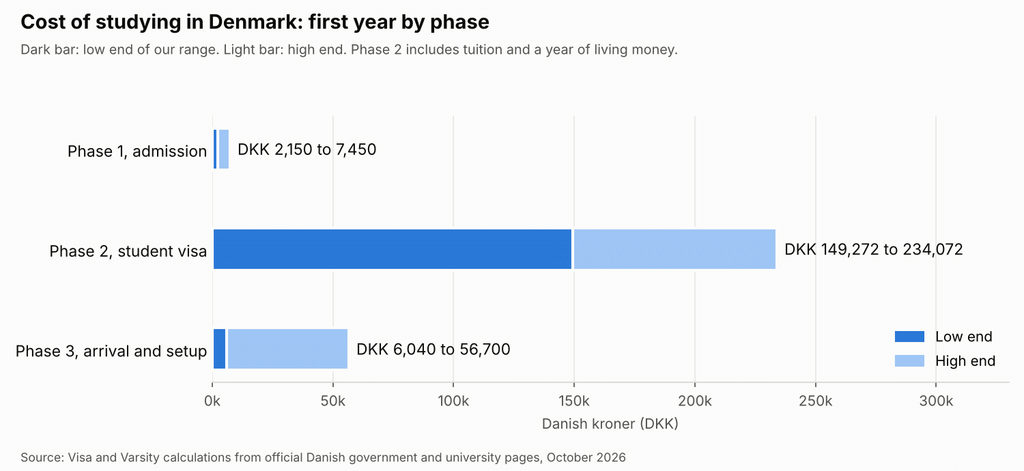
Bar chart of the cost of studying in Denmark for one year, split into admission (DKK 2,150 to 7,450), student visa (DKK 149,272 to 234,072) and arrival and setup (DKK 6,040 to 56,700)
The part you really lose
The total cost of studying in Denmark looks large, but you keep most of it or spend it on your degree.
Start with the DKK 89,112 of living money. You spend it on your own rent and food through the year, so we treat it as your money. Remove it, and DKK 68,350 to 209,110 is left. Tuition of DKK 55,600 to 129,100 goes to the university for your teaching and your degree. Take that out as well, and DKK 12,750 to 80,010 remains.
You get three items at the high end back, or use them as rent later; a rental deposit of up to DKK 15,000, prepaid rent of up to DKK 15,000 and the DKK 2,000 Danish lessons deposit. Without those, about DKK 12,750 to 48,010 is what’s truly lost to charges; permit and application fees, bank charges and currency margins, the English test, translations, the VFS trip, the flight, insurance and setup costs. Most of the gap between the low and high figures comes from our estimates for flights, transfers and short-term housing.
This covers year one only. In year two of a two-year master’s, you have to pay tuition again. SIRI usually grants the permit for the whole program, so most students don’t pay an extension fee, but if your studies run late you’ll pay DKK 3,060 to extend. If SIRI didn’t add the job-seeking period to your permit, applying for it separately costs another DKK 3,060, and an unlimited work permit during that period costs DKK 840.
If you apply for a bachelor’s or master’s from 1 October 2026, SIRI won’t grant permits to partners and children, so a family plan needs a different country or a PhD. Sweden still lets families join students, as our page on the cost of studying in Sweden explains, though they need insurance of their own.
What Danish universities charge non-EU students
Every Danish university prices its programs one by one, and Study in Denmark gives a national range of DKK 45,000 to 120,000 a year. The real figures below come from official university pages, and they show why the cost of studying in Denmark depends so much on your field.
| University and level | Tuition per year | What to know |
|---|---|---|
| AAU bachelor’s, Economics and Business Administration | DKK 55,600 | 2026 figure for two semesters |
| AAU bachelor’s, engineering programs | DKK 115,700 | Applied Industrial Electronics and Energy Engineering, among others |
| AAU master’s, business and social programs | DKK 55,600 | DKK 27,800 a semester, such as International Relations and Tourism |
| AAU master’s, engineering and science | DKK 115,700 | DKK 57,850 a semester in 2026 |
| DTU master’s | About DKK 111,900 | EUR 7,500 a semester, at our conversion, and DTU expects to revise it |
| SDU, humanities, both levels | About DKK 80,600 | EUR 10,800 a year, at our conversion |
| SDU, science and engineering, both levels | About DKK 129,100 | EUR 17,300 a year, at our conversion |
Universities charge the most for engineering and science almost everywhere, and the least for business and humanities. KU and AU publish their fees through program selectors, so check your exact program there. If tuition is your main worry, set these totals beside our breakdown of the cost of studying in Poland, where universities charge less but the permit rules differ.
Before you pay anyone anything
- Get “state-approved” in writing. Without it, SIRI gives anyone who applied from 2 May 2025 no work rights and no job-seeking time.
- Submit early. SIRI applies the rules in force on the day you submit, and it needs about two months.
- Have the tuition money ready by March. AAU’s 20 April and KU’s 15 April deadlines don’t bend.
- Book an English test, even if you studied in English. KU and DTU won’t accept your degree instead.
- Budget for a year with no job. The 90-hour limit and the Danish language gap make student work uncertain, and Danish state support isn’t open to you.
- Hold back cash for housing. Up to seven months’ rent can be due at signing.
- Compare countries on the full total. Post-study rights are shrinking in more than one place. Our breakdown of the cost of studying in the UK shows how the Graduate route is changing there too.
Denmark student permit FAQ
Is the cost of studying in Denmark as high as the total suggests?
No. Our first-year total is DKK 157,462 to 298,222, but most of it is tuition and a year of your own spending. Only about DKK 12,750 to 48,010 is gone for good in charges.
Do I need to show a bank balance for a Denmark student permit?
Usually not, if you’re taking a full degree and have paid tuition to a Danish institution, because SIRI accepts the paid tuition instead. With a tuition waiver, you show a scholarship covering living costs or DKK 7,426 a month for up to 12 months, which is DKK 89,112.
Can I work while studying in Denmark?
Yes, on a state-approved program. SIRI allows 90 hours a month from September to May and full time in June, July and August. Students who applied from 2 May 2025 for a program without state approval can’t work.
How long can I stay in Denmark after my master’s?
If you applied for your study permit on or after 1 October 2026, up to one year. If you applied before that date, you keep up to three years, and PhD graduates still get three.
Can my wife and children come with me to Denmark?
Not for bachelor’s and master’s applicants who submit on or after 1 October 2026. PhD students can still bring a partner and children under 18.
We wrote this guide as general information on Danish student permits and costs, not as advice on your own application. SIRI changed the job-seeking and family rules on 1 October 2026, so confirm each figure on nyidanmark.dk and with your university before money leaves your account. We found no official register or licensing scheme for immigration consultants in Denmark. For regulated legal advice, look for an advokat, a lawyer supervised by the Danish Bar and Law Society, and treat any agent who guarantees a permit with suspicion.