
If you’re a Kenyan graduate with a few years of work behind you, DAAD EPOS is probably the best scholarship in Germany for you. It pays your living costs, insurance and flights for a full master’s or PhD, and it’s built for people who already work in fields like public health, water, energy, agriculture or economics.
It’s also one of the most misunderstood scholarships. Many Kenyans send their documents to DAAD, which is the wrong address, or apply with an internship in place of real work experience. This guide to the DAAD EPOS scholarship for Kenyans walks you through the program the way DAAD sets it out for the 2027/2028 intake: what it pays, who qualifies, which courses are open, and how to put together an application that gets past the first round.
New to studying in Germany? Start with our main guide on studying in Germany from Kenya, then return here.
What is the DAAD EPOS scholarship for Kenyans, and how much does it pay?
EPOS stands for Development-Related Postgraduate Courses. The German Academic Exchange Service (DAAD) picks a set of master’s and PhD programs at German universities that focus on development, and funds students from developing countries to take them. Kenya is one of those countries.
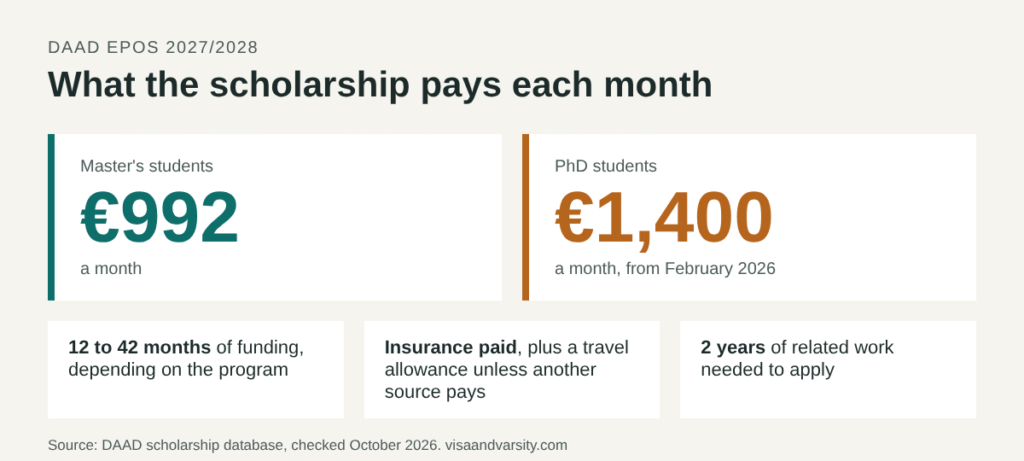
Here’s what the EPOS entry in the DAAD scholarship database lists for 2027/2028:
| What you get | Master’s students | PhD students |
|---|---|---|
| Monthly stipend | €992 | €1,400 (from February 2026) |
| Health, accident and liability insurance | Paid | Paid |
| Travel allowance | Yes, unless another source pays | Yes, unless another source pays |
| German course before your degree | Six months, for German-taught courses | Six months, for German-taught courses |
| Rent subsidy and family allowance | In some cases | In some cases |
| How long | 12 to 42 months, depending on the program | 12 to 42 months, depending on the program |
Does EPOS cover the visa money?
Yes. The German Embassy in Nairobi asks students to show €992 a month, and that’s exactly what EPOS pays master’s students. Your award letter replaces the blocked account, so you don’t need to put €11,904 of your own money aside. If your course charges tuition, check whether it’s covered, because the embassy will ask about that too. Our German student visa guide explains the funding rules.
Is EPOS the same as other DAAD scholarships?
No. Many DAAD awards are open to graduates from most countries. EPOS is only for people from developing countries, only for the listed courses, and only for applicants with at least two years of work. That narrower pool is good news for Kenyan professionals, because you’re competing against people with similar backgrounds.
DAAD EPOS requirements: who can apply from Kenya
DAAD’s rules are short, but each one causes Kenyan applicants a different problem. Here they are with what they mean for you.
| Rule | What DAAD says | What it means in Kenya |
|---|---|---|
| Degree | A bachelor’s, usually four years, in a related subject | Most Kenyan degrees are four years, so you’re fine. A three-year or diploma route needs checking with the course |
| Grades | “Far above average” results, in the top third | Your class of degree and transcript need to show it. A rank letter from your university helps |
| Work experience | At least two years of related work after your first degree, at the time you apply | Attachment and internships during your degree usually don’t count |
| Degree age | Your latest degree should normally be no more than six years old | If you graduated in 2019 and have no newer degree, you may be too late |
| Time in Germany | No more than 15 months living in Germany at the deadline | Rarely an issue for applicants in Kenya |
| Age | No age limit | Mid-career applicants are welcome |
Language requirements for EPOS
- English-taught courses: IELTS or TOEFL. DAAD’s EPOS FAQ gives IELTS band 6 or TOEFL iBT 80 as the usual minimum, but many courses ask for more, so check each course. The institutional TOEFL isn’t accepted.
- German-taught courses: at least B1 German when you apply, and DSH 2 or TestDaF 4 before your degree starts. DAAD pays for six months of German classes in Germany to get you there.
If your degree was taught in English, some courses may accept that in place of IELTS. EPOS itself asks for a test certificate in the application, so plan to take one unless your course says otherwise in writing.
What counts as related work experience?
The work has to connect to the course you’re applying for. A water engineer with two years at a county water company fits Hydro Science and Engineering. A bank teller applying to Tropical Forestry doesn’t, even with five years of work. Whatever the role, your employer has to confirm it in writing. If you’re not sure your experience counts, email the course coordinator before you apply.
DAAD EPOS courses for 2027/2028
You can only use EPOS for courses on DAAD’s list. DAAD’s 2027/2028 deadline list, dated June 2026, names these 25 master’s course entries:
| Field | University | Course |
|---|---|---|
| Economics and business | Göttingen | MSc Development Economics |
| Economics and business | Leipzig | MBA Small Enterprise Promotion and Training (SEPT) |
| Development cooperation | Ruhr University Bochum | MA Development Management (intake every two years, next in 2028) |
| Development cooperation | Bonn and United Nations University | MSc Geography of Environmental Risks and Human Security |
| Engineering | TU Dresden | MSc Hydro Science and Engineering |
| Engineering | TU Dresden | MSc Textile Machinery and High Performance Material Technology |
| Engineering | Flensburg | MEng Sustainable Energy and Development (SEDev) |
| Engineering | Oldenburg | MSc Sustainable Renewable Energy Technologies (SuRE) |
| Engineering | HfT Stuttgart | MSc Photogrammetry and Geoinformatics |
| Engineering | Bauhaus University Weimar | MSc Natural Hazards and Risks in Structural Engineering |
| Urban planning | TU Berlin | MSc Urban Management |
| Urban planning | Stuttgart and Ain Shams University | MSc Integrated Urbanism and Sustainable Design |
| Agriculture and forestry | TU Dresden | MSc Tropical Forestry |
| Agriculture and forestry | Hohenheim | MSc Agricultural Economics |
| Environment | Bremen | MSc Marine Biology (ISATEC) |
| Environment | TU Darmstadt | MSc Tropical Hydrogeology and Environmental Engineering |
| Environment | Freiburg | MSc Environmental Governance |
| Environment | Greifswald | MSc Landscape Ecology and Nature Conservation |
| Environment | TH Köln | MSc Natural Resources Management, Integrated Water Resources Management or Renewable Energy Management |
| Environment | TH Köln and German Jordanian University | MSc Integrated Water Resources Management (MENA) |
| Environment | TH Köln and San Luis Potosí | MSc Environment and Resources Management (Latin America focus) |
| Public health | Charité, FU and HU Berlin | MSc International Health |
| Public health | Heidelberg | MSc International Health |
| Public health | Bonn | MSc Global Health |
| Education | PH Ludwigsburg and Helwan University | MA International Education Management |
DAAD’s 2026/2027 list had 40 entries, including PhD programs, so check whether the 2027/2028 list has been updated. Look up each course in the DAAD international programs database for entry rules and fees.
How to pick your three courses
You can apply to up to three EPOS courses and rank them. Pick courses that match your degree and your work, not just the most famous university. A public health officer from a county health department has a real story for International Health. The same person applying to Textile Machinery doesn’t.
How to apply for DAAD EPOS, step by step
The EPOS process is different from most scholarships. You don’t apply to DAAD first. You apply to the universities, and they put you forward to DAAD.
- Choose up to three courses from the EPOS list and rank them in order of preference.
- Apply directly to each course by its own deadline, using the course’s own method. DAAD’s EPOS FAQ is blunt about this: applications sent to DAAD won’t be passed on to the courses. Don’t email your documents unless the course says you can.
- Send the same core documents to each course, including one motivation letter that covers all your chosen courses, in priority order.
- Wait for the course selection. Each course’s selection committee reviews you and suggests its top candidates to DAAD.
- Upload to the DAAD Portal if you’re suggested. DAAD then contacts you and asks you to upload your full application as PDFs on its portal.
- Get DAAD’s decision. DAAD makes the final selection and tells you the result. DAAD’s EPOS FAQ notes that most selection is done by March.
You don’t need an admission letter before you apply. The course reviews you for a place and for the scholarship at the same time.
DAAD EPOS documents checklist
DAAD accepts documents in English or German. Here’s the list, with notes for Kenyan applicants:
| Document | What DAAD asks for | Kenya tip |
|---|---|---|
| Signed checklist | DAAD’s EPOS checklist, signed | Download the current version for 2027/2028, not an old one |
| EPOS application form | DAAD’s own form | Fill in every field, and keep names the same as your passport |
| Europass CV | The Europass format, signed and dated | List every role since your degree with month and year, no gaps |
| Motivation letter | One letter covering all your chosen courses, in priority order | See the next section |
| Employer recommendation | On letterhead, signed, stamped and recently dated | Kenyan offices often have a rubber stamp. Use it, since DAAD asks for an office stamp |
| Employment certificates | Proof of your work, ideally with a promise to rehire you when you return | Ask HR to state your start date, role and whether your job will be kept for you |
| Language certificate | IELTS, TOEFL or a German certificate | Book early so your result arrives before the course deadline |
| Degree certificates | Your university certificates | Include your KCSE certificate only if the course asks for it |
| Transcripts | Full transcript, plus an explanation of the grading scale if it isn’t printed on it | Many Kenyan transcripts show letter grades only. Attach your university’s grading key |
The promise to rehire you isn’t strictly required, but DAAD asks for it “if possible.” It shows the panel you’ll go home and use what you learn, which is the whole point of EPOS.
DAAD EPOS deadlines for 2027/2028
There’s no single EPOS deadline. Each course sets its own, and DAAD’s 2027/2028 list simply says “see website of the course” for every entry.
The pattern from the year before gives you a good idea of timing. On DAAD’s 2026/2027 deadline list, most courses closed between June and December 2025 for studies starting in 2026. A few examples:
| Course | Deadline for the 2026/2027 intake |
|---|---|
| HS Rhein-Waal, Sustainable Development Management | June 1, 2025 |
| TU Berlin, Urban Management | August 31, 2025 |
| Ruhr University Bochum, Development Management | September 30, 2025 |
| Leipzig, SEPT MBA | October 1, 2025 |
| TU Dresden, Hydro Science and Engineering | October 15, 2025 |
| Bonn and UNU, Environmental Risks and Human Security | December 15, 2025 |
| Hohenheim, Agricultural Economics | December 15, 2025 |
So if you want to start in 2027, some 2027/2028 deadlines may already have passed by the time you read this, and others close in the coming weeks. Check each course page today.
A timeline that works for a 2028 start
If 2027 is too close, plan for the 2028/2029 intake instead:
- Now to early 2027: finish your two years of work, if you haven’t, and shortlist three courses.
- Early 2027: book IELTS or TOEFL, and start German classes if you’re aiming at a German-taught course.
- March to May 2027: collect your employer letter, employment certificate and transcripts with a grading key.
- May to June 2027: write and polish your motivation letter.
- June to December 2027: apply to each course by its deadline, which DAAD usually publishes in its yearly list around mid-year.
- Early 2028: expect a request to upload to the DAAD Portal if a course nominates you, and DAAD’s decision after that.
- After your award: apply for your visa in Nairobi.
How to write an EPOS motivation letter that stands out
EPOS exists to train people who’ll go back and improve things at home. Your motivation letter has to prove you’re one of those people. The panel reading it already has your grades and CV, so the letter’s job is to connect the dots.
What to put in it
- The problem you work on. Start with a real issue from your job in Kenya, like water losses in a county utility, poor yields among smallholder farmers in your area or gaps in maternal health data. Be specific.
- What you’ve already done about it. Show your role, a project you led or a result you can measure.
- What you’re missing. Name the skills or knowledge you can’t get in your current role or in Kenya.
- Why these courses. Since you write one letter for all three choices, explain what each course offers and why you ranked them in that order.
- Your plan after. Say where you’ll work when you return and what you’ll change. If your employer has promised to rehire you, mention it.
Stick to any length limit the course sets, and write it in your own words. A letter full of phrases copied from templates looks like hundreds of others on the panel’s desk.
Get the employer letter right
Your employer’s recommendation counts for a lot in EPOS, because it confirms your work and your plans. Ask your supervisor, not HR, to write it, and give them a short note listing:
- Your role, your main duties and how long you’ve done them
- One or two achievements they can describe in their own words
- Why the organization supports your study and wants you back
The letter must be on letterhead, signed, stamped and recently dated. An undated or unsigned letter gives the panel an easy reason to set your file aside.
Common mistakes that sink Kenyan EPOS applications
Many of these mistakes are about rules, not talent, which means you can avoid them:
- Sending your application to DAAD. DAAD won’t forward it. Apply to each course directly.
- Counting your attachment as work. EPOS wants two years of work after your first degree, at the time you apply. Industrial attachment and internships during your degree usually won’t count.
- Applying to a course that isn’t on the list. If you’re already admitted to a German master’s that isn’t an EPOS course, EPOS can’t fund it.
- Missing a course deadline. DAAD’s FAQ says late applications aren’t possible. Each course has its own date, so track all three.
- Using the wrong test. For English-taught courses, only IELTS or TOEFL is accepted, not the institutional TOEFL.
- A degree that’s too old. If your latest degree is more than six years old, you’ll usually be turned away.
- A weak employer letter. It has no letterhead, stamp or date, or it’s a generic letter from HR.
- A motivation letter that doesn’t name your three courses. The panel wants one letter that explains all your choices and your ranking.
- Transcripts with no grading key. If the panel can’t tell whether your grades are in the top third, it can’t select you.
Didn’t get it this year?
You can apply again in a later round, as long as your degree is still within the six-year window. Use the gap to strengthen your file: more relevant work, a better test score or a short course in your field. In the meantime, look at the other funders in our list of scholarships in Germany for Kenyan students.
Quick answers: DAAD EPOS scholarship for Kenyans
How much does DAAD EPOS pay per month?
€992 a month for master’s students and €1,400 for PhD students, plus insurance and a travel allowance.
Can I apply for EPOS without work experience?
No. You need at least two years of related work after your first degree when you apply. If you’re a fresh graduate, look at the other awards in our scholarships list.
Can I apply for EPOS with a Second Class Honours, Lower Division degree?
DAAD asks for results in the top third. A Second Class Honours, Lower Division can still put you in the top third at some universities, so get a rank letter that shows where you placed.
Do I need IELTS for DAAD EPOS?
For English-taught courses, EPOS asks for IELTS or TOEFL in the application. Some courses may accept English-medium study, but plan to take a test unless your course confirms otherwise.
How many EPOS courses can I apply to?
Up to three, ranked by preference, with one motivation letter that covers all of them.
Is there an age limit for EPOS?
No. DAAD’s FAQ says there’s no age limit, but your latest degree should be no more than six years old.
Can I bring my family on EPOS?
DAAD may pay a family allowance in some cases. Family visa rules apply separately, and our visa guide covers them.
Is the DAAD EPOS scholarship for Kenyans only for master’s students?
Not on paper. DAAD’s database lists a €1,400 monthly stipend for PhD students too. But DAAD’s 2027/2028 course list names 25 master’s course entries, and the 2026/2027 list had PhD programs as well, so check DAAD’s list before you plan a PhD.
More guides in this series
- Study in Germany from Kenya: the complete guide
- KCSE and Kenyan degree requirements for German universities
- Do you need German? English-taught degrees and language tests
- German student visa from Kenya: the Nairobi process step by step
- Scholarships in Germany for Kenyan students
Disclaimer: EPOS rules, amounts, courses and deadlines change each year. The details here come from DAAD’s official scholarship database, its EPOS FAQ and its 2026/2027 and 2027/2028 course lists, as checked in October 2026. Always confirm on DAAD’s site and each course’s page before you apply.