
One week ago, the government changed a rule that many students have not heard about. Since 2 October 2026, most people who hold an Australia student visa cannot apply for their next one from inside the country, and most new applicants cannot bring a partner or children. If you planned to start on a cheap short course and switch to a degree without leaving, there are now very few legal ways to do it. Because of that one change, you should think about your course first, long before you start adding up the cost of studying in Australia.
This guide covers the Australia student visa (subclass-500) in four steps: choosing a course, getting an offer, filing the visa application, and landing. Each step ends with a cost table in Australian dollars (AUD). The final section adds the three tables together and shows which part is real charges and which part is money you keep, money you get back or money that pays for your degree. You will also find tuition examples for public and private schools and a short list of ways to spend less.
Fees and rules in Australia change often, and several changed this year. Treat every figure here as a snapshot from October 2026, and confirm it on the Home Affairs Student visa page before you pay anyone. Where an official page did not give a number, we say so.
The Cost of Studying in Australia Calculator
This calculator builds in every part of the cost of studying in Australia that the guide covers, from tests and application fees to the visa charge, health cover, flights and setup. Choose your course level, enter your weekly rent and pick a low, middle or high estimate. You get one first year total, split into tuition, living funds, the rent bond and costs you never get back. Open the Summary, Phase 1, Phase 2 and Phase 3 tabs, and tick the boxes that match you.
The figures come from official sources, last checked in October 2026. Fees and rules change, and this is a budgeting tool, not immigration or legal advice. Confirm your fees with your school and on the official pages linked under Where the numbers come from on the Summary tab.
Your situation
Show costs in your own currency
Estimated cost for your first year
AUD 0
What changed in the last eighteen months
Six changes that matter most for a student applying now, and each has a date.
- 4 August 2025. The government announced a yearly limit on new overseas students, with 295,000 places for 2026, which is 25,000 more than 2025.
- 7 August 2025. The government raised the English scores you need for tests taken on or after this date, and the full table is in Step 3.
- 14 November 2025. Student visa applications filed outside Australia on or after this date are decided in the order set by Ministerial Direction 115.
- 21 January 2026. TOEFL iBT candidates must pick “Taking TOEFL for Australia” when they register, or the result will not count.
- 3 July 2026. The government set the limit at 295,000 again for 2027 and said TAFE students will be exempt in 2027.
- 2 October 2026. The new rules on applying inside Australia and on bringing family began.
The base visa fee is now AUD 2,500. We did not find an official page that states the date of the latest rise or any rise already announced, so check the pricing estimator before you budget.
Step 1: Choose your course, and check your work rights after study
How long you may stay and work after you finish depends on the level of your course, so choose the course before you think about the visa. The work visa you can apply for after study is called the Temporary Graduate visa (subclass-485).
Work rights after study abroad in Australia, by level of course
A degree qualifies you for a longer stay than a diploma, and a research degree for the longest. This table shows the usual result for most passports.
| What you finish in Australia | Temporary Graduate visa stay |
|---|---|
| Diploma, associate degree or trade qualification | Up to 18 months, and only if it matches an occupation on the skilled list |
| Bachelor degree, including honours | 2 years |
| Masters by coursework or extended masters | 2 years |
| Masters by research | 3 years |
| Doctoral degree | 3 years |
| Graduate diploma | 2 years by default, longer if earlier study earned more |
Home Affairs gives 2 years for a bachelor degree and 3 years for a masters by research in the degree stream, and up to 18 months in the diploma stream. Two groups get different terms. Citizens of India receive longer periods under a trade agreement: 3 years for any masters, 4 years for a doctorate, and 3 years for a bachelor degree with first class honours in a science, technology, engineering, maths or computing field. Holders of a Hong Kong or British National (Overseas) passport can stay up to 5 years.
A second stream exists for people who studied in a regional area. It allows between 1 and 2 more years and costs less than the first.
Most students forget the price of that work visa. The main applicant pays AUD 5,750, which is more than double the student visa fee.
Graduate visa rules that students find out about late
Most of these rules are easy to meet if you know them on day one, and too late to fix in your last semester.
- Age. You must be 35 or younger when you apply. The limit is under 50 if you qualify through a masters by research or a doctorate, or if you hold a Hong Kong or British National (Overseas) passport.
- Study length. Your course must be on the official register, and your study must add up to at least 16 calendar months and two academic years, all taught in English, and all done while you were in Australia on a study visa. A one year course cannot meet it.
- Timing. The qualification must be awarded in the 6 months before you apply, and you apply from inside Australia. Ask your school for the completion letter as soon as your results are final.
- A higher English score. For the graduate visa you need IELTS Academic 6.5 overall with 5.5 in every skill, from a test taken in the 12 months before you apply. A student who entered with 6.0 may have to retake it. Citizens of the UK, USA, Canada, New Zealand and Ireland are exempt.
- Only once. If you held the Temporary Graduate visa before as a main applicant, you cannot be granted it again as one.
- Health insurance and a police check. You must hold suitable cover for the whole stay and show that you applied for an Australian Federal Police check.
- No job comes with it. The visa lets you work for most employers, but finding the employer is your task.
Stacking courses on one visa
Australia lets you cover several courses with one student visa, but only if one clearly leads to the next. You must give a Confirmation of Enrolment for each course, and the gap between them must be under two calendar months. The exception is a break at the end of one academic year and the start of the next, where three to four months is acceptable.
The last course in the stack is your main course. Home Affairs uses it to set the money and English evidence you need. A package can also save you a little here. If you add at least 10 weeks of English study (called ELICOS) before your main course, the IELTS score you need falls from 6.0 to 5.5, and at least 20 weeks lowers it to 5.0. English weeks cost money, so work out whether the saving is real.
If you are already inside Australia, the stacking rule is stricter. Apart from school studies and a few other cases, you can apply for only one further course.
Step 2: Get an offer and your Confirmation of Enrolment
You cannot file a valid student visa application without a Confirmation of Enrolment, called a CoE. Your school issues it after you accept an offer and meet its payment terms.
Check the course on the official register
Your course must be full time and listed on CRICOS, the official government register of schools and courses open to overseas students. Search by course code, not only by school name. A school can be listed while one of its courses is not, and a course that is not on the register cannot be used for your visa.
How the limit on places and the visa queue affect you
The government caps new overseas students each year, and each school has its own share. The limit is 295,000 for 2026 and 2027, as the dates above show. For you, two things matter. A school that has used its places may stop offering seats for an intake, so apply early. And your choice of school can change how fast Home Affairs decides your visa. If you are weighing Australia against Canada, the cost of studying in Canada page sets out the same stages in the same order.
Under Ministerial Direction 115, Home Affairs sorts offshore applications into priority groups. School students, standalone English students, TAFE students, PhD students, scholarship holders and students from the Pacific and Timor Leste are in the top group, along with higher education and vocational students whose school has not yet reached its prioritisation threshold.
The Department of Education publishes a weekly list of each higher education provider’s prioritisation status, so you can look up your school before you pay a deposit. The department also says a direction is not a cap on visas, and officers do not approve or refuse you because of your priority group. We found no separate permission letter that a student must get before applying, and no cap on the reduced visa fee.
What schools ask for
Each school sets its own list, but these come up most:
- Your school certificates and academic records
- A passport copy
- An English test result, where one is required
- A short personal statement or study plan
- A CV for postgraduate courses
- Reference letters, if the school asks for them
- Proof that you paid the application fee
Papers not in English need a certified translation. Order extra certified copies of transcripts early, since some schools take weeks to reply. Your passport must also be valid for the whole visa, so renew a nearly expired one now.
Application fees, the first payment and the CoE
Schools charge application fees from nothing to about AUD 150. The University of Sydney charges AUD 150, which is not refunded, and UNSW lists an online application fee of AUD 150. TAFE NSW charges AUD 100 for its courses and AUD 150 for English courses.
After you accept, you make a first payment. At Sydney it acts as a deposit and covers the first semester of tuition. Your school will also ask for proof of health cover, covered in Step 3. Then it issues the CoE. Before you pay, ask in writing what the school keeps if your visa is refused, because we found no standard rule on its website pages.
A CoE must still be valid on the day Home Affairs decides your case. It stops being valid if it is cancelled or the course ends, so tell your school at once about any change.
Phase 1 costs: admission
| Item | Typical cost in AUD | In your local currency | Why it is on this list |
|---|---|---|---|
| English language test, one attempt | AUD 330 to 450 | Our estimate, since test centres in your own country set the fee | |
| School application fees, one to four schools | AUD 100 to 600 | From AUD 100 at TAFE NSW to AUD 150 at Sydney, and some schools charge nothing | |
| Passport renewal or a new passport | AUD 50 to 250 | Our estimate, because the passport must be valid for the whole visa and prices differ by country | |
| Certified translations of your papers | AUD 50 to 250 | Our estimate, because you need them when records are not in English | |
| Transcript requests, courier and postage | AUD 30 to 150 | Our estimate, since a former school may bill you for copies and for postage | |
| First tuition payment as a deposit | AUD 0 here, counted in Phase 2 | You pay this from your first year of tuition, so we add it only once, later | |
| Phase 1 subtotal | AUD 560 to 1,700 | Total of the priced rows above |
Step 3: File your Australia student visa application (subclass 500)
The student visa lets you study a registered course for up to 6 years, in line with your enrolment. You apply online, and since 2 October 2026 you must usually be outside Australia when you apply.
Rules that began on 2 October 2026
Home Affairs published a page on the changes, and many older websites still show the old rules.
- Applying inside Australia. A student visa holder can apply again from inside the country only under one of six exemptions. They need up to 12 more months for the same course at the same school, they are being sponsored by the Foreign Affairs or Defence departments, they are starting a PhD, they are starting primary or secondary school, moving up a level after finishing a main course, or having a school that defaulted. People on visitor, Temporary Graduate and several other visas cannot apply for a student visa from inside Australia at all.
- Family members. Most applicants cannot include a partner or children. Exemptions cover PhD students, students sponsored by the Australian government, students fully funded by a foreign government scholarship, and nationals of Pacific Island and ASEAN countries. A family member also cannot join the application later.
- Older applications. Those lodged before 2 October 2026 are judged under the old rules.
If you hoped to bring a spouse, check these exemptions before you pay any deposit.
Papers to gather for your Australia Student Visa
Home Affairs builds a personal list in its Document Checklist Tool. Enter your passport country and your school, and run it again the day you file, because the department refreshes it twice a year, on 31 March and 30 September. In most cases you will need:
- The photo and detail pages of your passport, and a national identity card if you have one
- Proof of any change of name
- A CoE for every course in the application
- Your answers to the Genuine Student questions, with supporting papers
- English test evidence, unless you are exempt
- Proof of funds, where the checklist asks for it
- Proof that you paid for health cover
- A polio vaccination certificate, if you travel from or lived in a country the department lists as at risk
- Health examination results and character documents where they apply
- A signed Australian Values Statement, if you are 18 or older
Applicants under 18 need more, including a guardianship form or accommodation letter, and a parent consent form.
The Genuine Student statement
Many applicants with sound cases are refused on the Genuine Student requirement, because their answers are short and vague, which are easy to spot. From 23 March 2024, every applicant must show they are a genuine applicant for entry and stay as a student and understand that study is the main reason for the visa.
On the online form you answer questions in English, with no more than 150 words for each answer. They cover your life now, including family, community, work and money, why you picked this course and school, what you know about living in Australia, and how the course will help you. A fifth question applies if you held a student visa before.
Officers weigh evidence more than claims. Good evidence includes transcripts and certificates, a record of earlier study in Australia, proof of your job from someone who can confirm it, and papers showing your income and ties at home. They also ask why you are not studying a similar course closer to home, and whether the course fits your past study and future work. One point helps honest applicants: the department says a genuine student may later choose to apply for permanent residence, and that officers do not hold this kind of future plan against you. Officers will mark down a statement that could belong to anyone. Name the school, the subjects and the reason they suit you.
Proof of funds for Australia Student Visa: the amount, the evidence and the mistakes to avoid
Many applicants are refused over proof of funds, and the rule has three parts. You must show money for your travel, for the 12 months of course fees, and for the 12 months of living costs.
Living costs. The figure for a student is AUD 29,710 for 12 months. UNSW dates it to 10 May 2024, and the law is a legal instrument on evidence of financial capacity. For the few applicants who may still bring family, a partner adds AUD 10,394 and each child adds AUD 4,449, plus at least AUD 13,502 a year in school fees for each child. Home Affairs says this is the visa minimum and real costs may be much higher. Italy asks for a funds figure as well, and the cost of studying in Italy page explains how that one works.
Course fees. Use the first 12 months of fees, or the whole fee for a course shorter than 12 months. Subtract any amount you already paid and can prove. Home Affairs gives an example: a course of AUD 20,000 over 18 months counts as about AUD 13,333 for the first 12 months.
Travel. The department’s guide is AUD 2,000 from most places, AUD 2,500 from East or Southern Africa and AUD 3,000 from West Africa.
These examples use round tuition numbers and the East and Southern Africa travel figure.
| Example course | First year tuition | Living costs | Travel | Total to show |
|---|---|---|---|---|
| Diploma | AUD 18,000 | AUD 29,710 | AUD 2,500 | AUD 50,210 |
| Bachelor degree | AUD 36,000 | AUD 29,710 | AUD 2,500 | AUD 68,210 |
| Masters by coursework | AUD 42,000 | AUD 29,710 | AUD 2,500 | AUD 74,210 |
What officers accept. The accepted evidence includes deposits at a financial institution, government or bank loans, and scholarships. A second route also exists: papers showing that your parents or partner earned at least AUD 87,856 in the 12 months before you apply. Tax assessments less than 12 months old are accepted. Bank statements and employer letters are not.
Show where the money came from. You must prove real access to the funds. If a relative pays, show your relationship, their identity papers and any past help they gave you or another student. For deposits, explain how the money built up, using statements that show salary or steady growth. The department says a balance certificate for a single day does not show how funds grew. For a loan, the best proof is evidence that it was paid out. For money from a business, show that the business operates.
Mistakes that cost applicants.
- Showing tuition and living costs but forgetting travel.
- Moving a large sum into your account days before filing, with no history behind it.
- Counting on a job in Australia to fill a gap. The department says you should not rely on work.
Rent by city: where the cost of studying in Australia changes most
Rent differs a great deal between cities, and Sydney costs the most in every column below. A shared house in the centre costs AUD 667 a week in Sydney and AUD 275 in Adelaide, a gap of AUD 392 a week, or AUD 20,384 over 52 weeks. The table uses the rent data inside the government’s cost of living calculator, dated November 2025, in AUD a week. Shared houses, units and managed apartments include utilities, and homestay also covers some or all meals.
| City | Shared house, centre | Shared house, suburbs | One bedroom unit, centre | Managed student apartment | Homestay |
|---|---|---|---|---|---|
| Sydney | AUD 667 | AUD 403 | AUD 876 | AUD 670 | AUD 445 |
| Brisbane | AUD 432 | AUD 297 | AUD 687 | AUD 489 | AUD 410 |
| Melbourne | AUD 384 | AUD 300 | AUD 622 | AUD 480 | AUD 440 |
| Perth | AUD 353 | AUD 294 | AUD 659 | AUD 375 | AUD 410 |
| Canberra | AUD 342 | AUD 274 | AUD 625 | AUD 482 | AUD 405 |
| Hobart | AUD 309 | AUD 239 | AUD 458 | AUD 358 | AUD 405 |
| Darwin | AUD 307 | AUD 269 | AUD 584 | AUD 320 | AUD 400 |
| Adelaide | AUD 275 | AUD 261 | AUD 674 | AUD 460 | AUD 400 |
Moving out of the centre saves you a great deal in Sydney, where a shared house costs AUD 264 a week less in the suburbs, and almost nothing in Adelaide, where you save AUD 14. The suburb figures come from a sample of suburbs, so your own street may differ.
A one bedroom unit in central Sydney comes to AUD 876 a week, which is AUD 45,552 over 52 weeks and more than the AUD 29,710 that Home Affairs asks you to show for all your living costs. Treat the visa figure as the least you need and not as a budget, and price your own city before you choose a school. Groceries change little from city to city, so rent is the number to check first.
Who can pay for you
Parents and close relatives often pay. Treat their papers as seriously as your own. Prepare a clear statement of who is paying and how much, their identity documents, and records that show the money exists and where it came from. If the money is held in a family company, move the amount you need to a personal account early, and keep the transfer records.
Health insurance you must buy before you fly
Australia does not give most international students public health care, so you must buy cover from a private insurer. This is Overseas Student Health Cover, or OSHC. Only students from Norway, Sweden or Belgium with listed arrangements may be exempt.
Two details are easy to get wrong. First, you must show proof that you paid for cover for the whole visa period, and the visa usually lasts 2 months longer than your course, so you need cover for that whole time. Second, cover must start on the day you arrive in Australia, not on the first day of class.
Six insurers sell the policy: ahm OSHC, Allianz Care Australia, Bupa, CBHS International Health, Medibank and nib OSHC. The basic plan covers hospital, medical treatment and ambulance, and leaves out dental, optical and physiotherapy. Prices vary. TAFE NSW says one year for a single student starts from AUD 643, and ANU lists AUD 806 for 12 months and AUD 2,505 for 36 months on a 2025 price list. Your school may offer to arrange cover, which is convenient, but ask for a second quote.
English scores
Your English score requirement depends on your passport, your course and any English study in your package. Home Affairs exempts citizens of the UK, USA, Canada, New Zealand and Ireland, school students, standalone English course students, postgraduate research students, and people who completed five years of study in English in certain countries. Everyone else shows a test score. For tests taken on or after 7 August 2025, the overall minimums are these.
| Test | Standard minimum | With 10 weeks of English study or an eligible pathway | With 20 weeks of English study |
|---|---|---|---|
| IELTS Academic or General Training | 6.0 | 5.5 | 5.0 |
| PTE Academic | 47 | 39 | 31 |
| TOEFL iBT | 67 | 51 | 37 |
| LANGUAGECERT Academic | 61 | 54 | 46 |
| Michigan English Test (MET) | 53 | 49 | 44 |
| CELPIP General | 7 | 6 | 5 |
The table comes from Home Affairs, and the rules are set out in a legal instrument on English tests. Three practical rules can save you money. The test must be taken in a test centre, because tests delivered entirely online, such as IELTS Online, are not accepted. The result must be from the 2 years before you file. And TOEFL iBT takers must choose the Australia option when they register.
Your 48 hour limit on paid work
You may work up to 48 hours a fortnight while your course is in session. Masters by research and doctoral students, and their families, have no limit. A fortnight is two weeks, so the cap is not 48 hours in one week. Breaking a work condition can put your visa at risk, so keep your own record. Do not count on this pay in your visa application, because officers look at what you hold before you travel.
Filing the application and waiting for a decision
You file online with an ImmiAccount, and the department may then ask for a health examination or fingerprints and a photo. The charge depends on the date Home Affairs receives your file, so if the price rises between your lodging and its receipt, you pay the new charge. Use the Visa Pricing Estimator before you pay. Eligible citizens of Pacific Island countries, Timor Leste and ASEAN countries pay less, as do students in standalone English and non award courses, but we did not find the lower amounts on a page we could open, so use the estimator.
Paying by card adds a cost most guides skip. Home Affairs states a surcharge of 1.40 percent on Visa and MasterCard, 1.01 percent on PayPal and 1.90 percent on Union Pay. On AUD 2,500 that is between AUD 25 and 48.
Some students pay no visa charge, including holders of an Australian government funded scholarship, students supported by the Foreign Affairs or Defence departments, and secondary exchange students. If you are unsure, do not claim the exemption, because a wrong claim can invalidate the application.
We could not confirm a typical processing time, so we give none. Home Affairs offers a processing times guide based on recent decisions and says it is not specific to your case. The department adds that peak periods can take longer, so file a few months before the start date, and send everything the first time.
Getting help without getting scammed
You can use a registered migration agent, a legal practitioner or an exempt person. Home Affairs explains who can help and warns about visa scams. Never pay anyone who guarantees approval. Agent fees are not in our tables.
Phase 2 costs: student visa
| Item | Typical cost in AUD | In your local currency | Category | Why it is on this list |
|---|---|---|---|---|
| Student visa application charge | AUD 2,500 | Standard | The base charge for a main applicant | |
| Card or PayPal surcharge | AUD 25 to 48 | Often missed | 1.01 to 1.90 percent of the charge, depending on how you pay | |
| First year of tuition, shown or paid | AUD 31,800 to 65,900 | Standard | From the lowest 2026 bachelor fee at Federation University to the top of Sydney’s 2026 undergraduate range | |
| Living costs to show | AUD 29,710 | Standard | The visa minimum for one student, and you keep and spend this money | |
| Travel money to show | AUD 0 here, counted in Phase 3 | Standard | Home Affairs sets a guide of AUD 2,000 to 3,000, but we price the flight once, in Phase 3 | |
| Health cover, first year | AUD 643 to 806 | Standard | A single student pays from AUD 643 at TAFE NSW and AUD 806 on the ANU list | |
| Health examination, if asked | AUD 0 to 350 | Often missed | Our estimate, because the price depends on the clinic and on whether your case needs one | |
| Passport photos and certified copies | AUD 20 to 200 | Often missed | Our estimate for extra papers that most files need | |
| Police certificate, if asked | AUD 0 to 150 | Often missed | Our estimate, as the price differs by country | |
| Bank transfer fees and currency margin | AUD 150 to 900 | Often missed | Our estimate, since banks charge wire fees and a margin on large sums | |
| Phase 2 subtotal | AUD 64,848 to 100,564 | Includes tuition and the AUD 29,710 you keep |
Step 4: Landing, deadlines and setting up a room
Your visa is linked to your passport digitally, and Home Affairs says you will not get a label in your passport. You can check its details with Visa Entitlement Verification Online. Do that before booking a flight, because a wrong date is easier to fix before you leave.
Papers for the airport desk
Check your cover start date first. The department warns that you must not enter Australia before your cover begins and may be refused entry if you cannot show insurance. Book the flight first, then set the cover start to match your arrival date. Keep these in your hand luggage:
- Your passport, the same one you used to apply
- Your visa grant letter
- Your Confirmation of Enrolment
- Proof of your health cover
- Your first address in Australia
- Proof of funds
- A completed incoming passenger card
Deadlines that start the day you land
Several tasks have deadlines that start from the day you arrive.
- Within 7 days: tell your school your home address in Australia. Study Australia names this as visa condition 8533, due within 7 days of arriving.
- As soon as you can: create your Unique Student Identifier, which you can only do after you arrive, using your passport and visa.
- The week before classes: attend orientation, usually held then.
- Before your first paid shift: apply for a Tax File Number through the Australian Taxation Office. Without one, you are taxed at a higher rate.
- All the time: keep your health cover active and keep your enrolment going. A student visa depends on both.
Renting without losing money
Rent rules differ by state, and the New South Wales rules are a useful example. A bond cannot be more than 4 weeks of rent. A landlord may also ask for a holding fee of up to one week and rent in advance of up to two weeks. The bond is held by NSW Fair Trading, so it is a refundable deposit and not a fee. Other states have their own rules, so read the page for your state.
Never send money for a room you have not seen or to a person you cannot check, even if the photos look perfect. Ask for a written agreement and a receipt for every payment.
Students often do not expect two further costs. Universities charge a student services fee, and the 2026 maximum is AUD 373, though some providers charge less. Some courses also need equipment. Study Australia notes work safety boots and laboratory coats as examples.
Phase 3 costs: arrival and setup
| Item | Typical cost in AUD | In your local currency | Category | Why it is on this list |
|---|---|---|---|---|
| One way flight to Australia | AUD 900 to 2,500 | Standard | Our estimate, and Home Affairs uses AUD 2,000 to 3,000 as its travel guide | |
| Temporary stay, first two weeks | AUD 600 to 1,800 | Standard | Our estimate, for a hostel bed or a short rental until you find a room | |
| Rent bond, refundable | AUD 800 to 1,800 | Often missed | Up to 4 weeks of rent, using our estimate of AUD 200 to 450 a week for a shared room | |
| Rent in advance | AUD 400 to 900 | Often missed | Up to two weeks of rent on the same estimate | |
| First month of rent | AUD 0 here, paid from living funds | Standard | You pay it from the AUD 29,710 you keep, so we do not count it twice | |
| Contents insurance for your room | AUD 100 to 300 | Often missed | Our estimate, since landlord cover does not protect your belongings | |
| Extras cover for dental and glasses | AUD 0 to 400 | Often missed | Our estimate, because basic student cover leaves out dental and optical care | |
| Bedding, kitchen items and first food shop | AUD 400 to 1,100 | Often missed | Our estimate, as rooms are often rented bare | |
| Phone plan and first transport card | AUD 60 to 200 | Often missed | Our estimate, covering a SIM and the first weeks of travel | |
| Student services fee | AUD 0 to 373 | Often missed | The 2026 maximum is AUD 373, and some providers charge less | |
| Books and supplies, first term | AUD 300 to 900 | Often missed | Our estimate, and some courses cost more | |
| Course equipment and uniform | AUD 0 to 400 | Often missed | Our estimate, as some courses need extra items | |
| Phase 3 subtotal | AUD 3,560 to 10,673 | Rent and flight prices vary a lot, so the range is wide |
Adding it up: the cost of studying in Australia in your first year
| Phase | Estimated cost in AUD | Estimated total in your local currency |
|---|---|---|
| Phase 1, admission | AUD 560 to 1,700 | |
| Phase 2, student visa | AUD 64,848 to 100,564 | |
| Phase 3, arrival and setup | AUD 3,560 to 10,673 | |
| Total | AUD 68,968 to 112,937 |
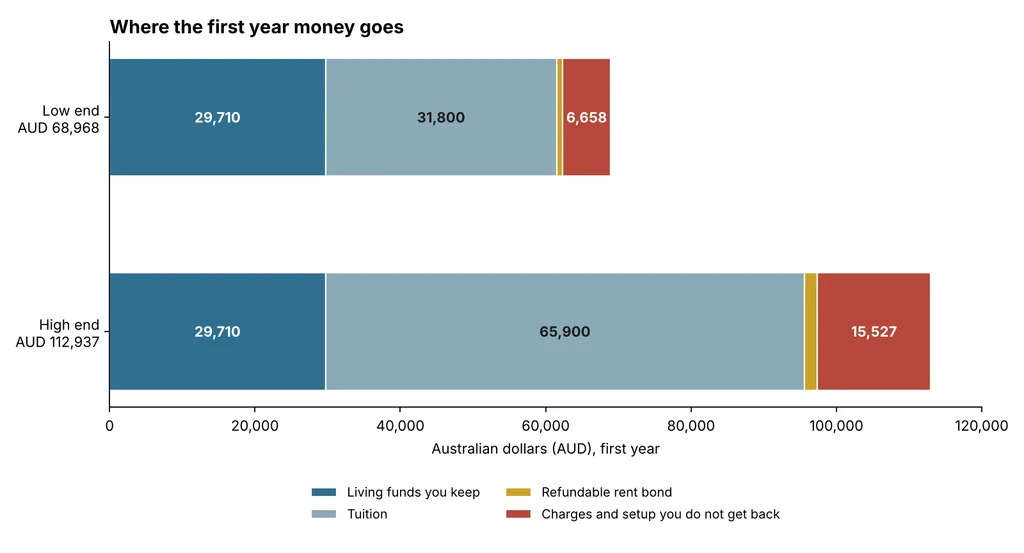
The total mixes four kinds of money, and the cost of studying in Australia is easier to judge once you stop treating them as one.
Money you keep. The AUD 29,710 is for your own rent, food and daily life. Money you get back. The rent bond, AUD 800 to 1,800, is returned when you leave a room in good order. Money that pays for your degree. Tuition, AUD 31,800 to 65,900, is what you pay for your education, and it is not a charge. Take all three out and the amount genuinely lost to charges is about AUD 6,658 to 15,527. Those charges are the visa fee, card surcharge, health cover, tests, travel, setup and the student services fee.
What is missing from the total. The total covers one year only. You must keep health cover for the whole visa, so a three year course costs more. At ANU’s 2025 prices, 36 months costs AUD 2,505 against AUD 806 for one year, an extra AUD 1,699. The total also leaves out the AUD 5,750 graduate visa fee, the stronger English score that visa needs, agent fees, and every year of tuition after the first. The government’s own cost of living calculator can help you estimate the rest, though it says its figures are approximate and were last updated in November 2023.
What schools charge each year, by level and type
We did not find one official national average for tuition, which is usually the largest line in the cost of studying in Australia, and none of the fee pages we read set a different price by passport. The government’s study site says fees depend on the school, the level and the place. The table below uses published schedules from public and private providers. They are examples, not averages.
| Level and school | Fee range | Source and year |
|---|---|---|
| Bachelor, Federation University (public) | AUD 31,800 to 43,500 a year | 2026 schedule |
| Bachelor, Flinders University (public) | AUD 35,500 to 52,300 a year, or up to 47,300 without the combined medicine degree | 2026 schedule |
| Undergraduate, University of Sydney (public) | AUD 49,200 to 65,900 a year | 2026 entry range |
| Masters by coursework, Federation University (public) | AUD 33,500 to 44,200 a year | 2026 schedule |
| Masters by coursework, Flinders University (public) | AUD 37,600 to 66,300 a year | 2026 schedule |
| Postgraduate coursework, University of Sydney (public) | AUD 46,400 to 83,500 a year, or up to 69,300 without dentistry | 2026 entry range |
| Research degrees, Flinders University (public) | AUD 37,600 to 51,000 a year | 2026 schedule |
| Research degrees, University of Newcastle (public) | AUD 36,000 to 53,000 a year | Fees page, year not stated |
| Bachelor, Kaplan Business School (private) | AUD 69,120 to 74,880 for the whole course | 2026 fees |
| Masters, Kaplan Business School (private) | AUD 40,800 to 58,920 for the whole course | 2026 fees |
| Certificate III or IV, TAFE Queensland (public) | AUD 5,400 to 12,600 for the whole course, for most courses | 2027 price list |
| Diploma, TAFE Queensland (public) | AUD 12,000 to 25,000 for the whole course, for most courses | 2027 price list |
Read this table with care. The Kaplan page does not state how long its courses last, so we cannot turn those totals into a yearly figure. The TAFE totals are for the whole course, and some trade and health courses cost far more, up to AUD 45,600 for one dental technology diploma. University fees often rise each year, and Sydney’s own table shows higher ranges for 2027 entry. Use the course page of your own school.
Cost is only one side. A diploma costs less than a degree, but its graduate visa is shorter and depends on the skilled list, as Step 1 explains.
Ways to spend less on your first year
- Compare schools by fee. The table shows a bachelor starting at AUD 31,800 at one public university and AUD 49,200 at another. Over a three year degree, that gap passes AUD 50,000. Many students worry about tuition more than anything else, so it helps to see the cost of studying in Germany, where most public universities charge no tuition.
- Look for scholarships early. The Australia Awards Scholarships for the 2027 intake closed on 30 April 2026, so look for the next round. Students funded by an Australian government scholarship also pay no visa charge.
- Check for a lower visa fee. Citizens of Pacific Island countries, Timor Leste and ASEAN countries pay less, as do students in standalone English and non award courses.
- Think about research. Masters by research and doctoral students have no limit on work hours and are in the top priority group for visa decisions.
- Consider a smaller city. Study Australia says smaller cities can have a cheaper cost of living, and rent is the cost you control most.
- Get two health cover quotes. Prices differ between insurers and between a school’s offer and the open market.
Quick answers students search for
What is the total cost of studying in Australia for one year?
The first year in this guide comes to between AUD 68,968 and AUD 112,937. That includes AUD 29,710 in living funds you keep, tuition of AUD 31,800 to 65,900, and about AUD 6,658 to 15,527 in real charges after the refundable bond is removed. A vocational course costs far less in tuition.
What balance does the visa officer expect to see?
You must show your first 12 months of course fees, AUD 29,710 for 12 months of living costs and your travel. Home Affairs uses AUD 2,000 for travel from most places, AUD 2,500 from East or Southern Africa and AUD 3,000 from West Africa. Subtract any fees you have already paid and can prove.
What does the visa itself cost?
The base charge is AUD 2,500, with lower charges for some citizens and course types. Card payments add a surcharge of 1.01 to 1.90 percent, which is AUD 25 to 48 on the base charge. Health examinations and police certificates cost extra.
Can I bring my husband, wife or children?
Most applicants cannot since 2 October 2026. Exemptions cover PhD students, students sponsored by the Australian government, students with a fully funded foreign government scholarship, and nationals of Pacific Island and ASEAN countries.
Is paid work allowed during my course?
Yes, up to 48 hours a fortnight while your course is in session. Masters by research and doctoral students have no limit. Leave this income out of your funding plan.
Can I stay and work after I graduate?
Possibly. If you meet the age limit, the study requirement and the English score, you can apply for the Temporary Graduate visa, which costs AUD 5,750. No guide can promise you a job or approval.
Last checks before any payment
- Run the Document Checklist Tool with your own passport and school, and run it again the day you file.
- Confirm the exact course code on the CRICOS register.
- Look up your school on the weekly prioritisation list before you pay a deposit.
- Add up funds in three parts, tuition, living costs and travel, using this year’s figures.
- Ask your school in writing what happens to your first payment if the visa is refused.
- Check your age and English score against the graduate visa rules now, and not in your last semester.
- Start your health cover on your arrival date, and ask for the price for the whole visa period.
- If you plan to bring family, check the exemptions before you pay.
- Keep every bank statement and receipt, and write the Genuine Student answers yourself.
- Compare whole totals and not tuition alone, and if Japan is also on your list, read the cost of studying in Japan page before you decide.
Treat this guide as background reading and not as advice on your own case. It is general information, it is not immigration advice, and it promises no visa, job or residency. Rules and fees change, so confirm every detail on the official Department of Home Affairs website before you apply or pay. For regulated advice, use a migration agent who is registered with the Office of the Migration Agents Registration Authority, or a legal practitioner.