
If you want to study in Germany from Kenya, know that a KCSE certificate on its own doesn’t qualify you for a German bachelor’s degree. Germany checks your school certificate against its own, and Kenyan students usually have to do a one-year preparatory course first. For a master’s the route is shorter, but a Kenyan upper second may fall short of the minimum grade some German universities set.
Our Germany from Kenya guides:
- KCSE and Kenyan degree requirements for German universities: which KCSE grade qualifies you for a Studienkolleg, and how your Kenyan degree converts for a master’s or PhD.
- Do you need German? English-taught degrees and language tests: which courses teach in English, which tests universities accept, and where to take them in Kenya.
- German student visa from Kenya: how the Nairobi embassy process works step by step, how the blocked account works, and what to do after a refusal.
- Scholarships in Germany for Kenyan students: which awards Kenyans can apply for from the German Academic Exchange Service (DAAD), political foundations, churches and universities, with amounts and deadlines.
- DAAD EPOS scholarship for Kenyans: who qualifies, which 2027/2028 courses to consider, and how to apply.
What’s different about studying in Germany
Germany doesn’t cap the number of international students it admits, and you don’t enter a lottery. Each university decides on your place based on your qualifications and the course you choose.
Most public universities charge no tuition, but that’s changing in a few places, and we cover where below. You still need to show €11,904 for your first year before the embassy will issue a visa.
Don’t treat the visa as the last step. The visa you collect in Nairobi only lets you enter Germany. Once you arrive, you register your address, enroll, and then apply to the local foreigners office for a student residence permit. That permit is what lets you stay.
The routes into a German degree from Kenya
Germany compares your school certificate with the Abitur, the German school-leaving certificate. From that comparison, universities decide whether you can go straight into a bachelor’s or need a preparatory year first.
Route 1: KCSE, then a Studienkolleg
A Studienkolleg is a preparatory course of about one year. It ends with an exam called the Feststellungsprüfung, and passing it lets you apply for a bachelor’s in the subject area your course covered.
An admission list from the Studienkolleg Konstanz, which HS Pforzheim publishes, says Kenyan applicants need a KCSE mean grade of at least C+ to enter a Studienkolleg. The list follows guidance from Germany’s Central Office for Foreign Education. It is several years old, so look for your own certificate in the DAAD admission database before you plan around it. DAAD says the database is only a guide, and universities don’t have to follow it.
A place isn’t automatic. You take an entrance test first, and the courses are taught in German. The University of Kassel, for example, asked for B1 German and at least 400 lessons before applicants could take its entrance exam. Kassel’s Studienkolleg is closing after the 2026/27 year, but other Studienkollegs set similar rules.
Route 2: KCSE C+ and one year of university in Kenya
The same Pforzheim list says a KCSE of at least C+ plus one successful year of university study gives you direct entry to a bachelor’s, but only in the field you studied or a related one. If you’ve finished first year at a Kenyan university, you can skip the Studienkolleg for that field.
Route 3: Goethe-Institut Kenya’s Studienbrücke
The Goethe-Institut Kenya in Nairobi runs a program called Studienbrücke (Study Bridge) for strong school leavers. Its 2026/2027 program sheet asks for excellent school results, especially in STEM subjects, and German at level B1.3. The required modules cost KSh 120,000, which you can pay in two installments, and successful students start at a partner university in Germany on October 15, 2027.
Route 4: A Kenyan bachelor’s into a German master’s
If you hold a Kenyan bachelor’s degree, you can apply for a master’s directly. Your Kenyan university has to be recognized in Germany, and your grade must meet the course’s minimum.
Confirm your grade first, because German universities convert foreign grades with a formula known as the Modified Bavarian Formula. The Würzburg-Schweinfurt University of Applied Sciences says most of its master’s programs need at least 2.5 after conversion. In the German system, 1.0 is the best grade and 4.0 is a pass.
If your Kenyan university’s pass mark is 40 percent, your average converts roughly like this:
| Your Kenyan average | Approximate German grade |
|---|---|
| 70% | 2.5 |
| 65% | 2.75 |
| 60% | 3.0 |
So an upper second with an average around 60 percent can fall short of a 2.5 minimum. Each university uses its own conversion rules, so treat this table as a guide and check the course page. The KCSE and degree requirements guide covers the KCSE rules, master’s grade minimums and PhD entry.
Changing field, or coming back after years of work
You can switch fields, but you’ll need to explain why. The embassy asks for a motivation letter you write yourself that sets out why you chose the subject and the university, and what the degree will mean for your future. The same checklist asks for a CV with no gaps, and it doesn’t mention an age limit.
Do you need German to study in Germany?
Not always. Many master’s programs teach in English, and far fewer bachelor’s programs do. You can search for English-taught courses on Hochschulkompass, the official database of the German Rectors’ Conference.
For the visa, the embassy usually wants proof of German or English at B2, depending on the language of your course. In Kenya, it accepts certificates from the Goethe-Institut, ÖSD, IELTS or TOEFL. If you studied in English in Kenya, you usually won’t need a separate English certificate, but your admission letter must say so explicitly.
If you need German, the Goethe-Institut in Nairobi runs exams from A1 to C2. A full Goethe-Zertifikat B2 costs KSh 20,000 for its own students and KSh 26,000 for external candidates. The guide to German language requirements covers English-taught programs, every German test, and where to take them in Kenya.
How much does it cost to study in Germany from Kenya?
We price every stage, from your first application fee to your first month in Germany, in our guide to the cost of studying in Germany. It includes a calculator you can fill in with your own rent and flight. Start with tuition here, because that’s the question most Kenyans ask first.
Is university education free in Germany?
At most public universities, yes. But if you want to study in Germany from Kenya, don’t assume every course is free, because the list of exceptions is growing.
- Baden-Württemberg: the state has charged non-EU students €1,500 a semester since the winter semester of 2017/18. It applies at universities such as Heidelberg, Stuttgart and Freiburg.
- Technical University of Munich (TUM): TUM charges non-EU students and will raise its fees from the winter semester of 2027/28 to €2,300 or €3,400 a semester for a bachelor’s and €4,600 or €6,800 for a master’s.
- FAU Erlangen-Nürnberg: FAU will charge non-EU students from the summer semester of 2027.
- Technische Hochschule Ingolstadt (THI): THI has charged €800 a semester for a bachelor’s and €1,200 for a master’s since the summer semester of 2026.
Everyone also pays a semester contribution each term, and private universities set their own fees. So read the fee page of every university on your shortlist rather than assuming a course is free.
If you need a Studienkolleg and don’t win a place at a public one, the private ones charge tuition, so price that in before you choose this route.
The blocked account and proof of funds
Before the embassy issues a student visa, you must show you can support yourself for your first year. The German Embassy in Nairobi accepts three kinds of proof:
- A blocked account holding €11,904 for one year, which is €992 a month. You open it before you apply, and the embassy only accepts the bank’s official confirmation showing the amount paid in and the amount you can withdraw each month.
- A formal obligation letter from a sponsor who lives in Germany, once the local authority has confirmed the sponsor can pay.
- A scholarship letter showing at least €992 a month. If your scholarship pays less, you top up the difference with a blocked account.
If your university charges tuition, you must also show that you’ve paid the first year’s fees, or add those fees to your blocked account.
You choose your own blocked account provider. The Federal Foreign Office doesn’t recommend any provider, and it reminds you that you pay bank fees on top of the amount you deposit. Once you’re in Germany, the bank releases a set amount each month.
Sending nearly €12,000 from a Kenyan bank takes planning. Ask your bank for a written quote of its fees and exchange rate before you send, and keep every receipt. The officer will want to see where the money came from.
Working while you study in Germany
Your student residence permit lets you work, within limits. As Ruhr University Bochum explains to its students, you can work 140 full days or 280 half days a year, and that limit also covers voluntary internships, paid or unpaid. Student assistant jobs at your university don’t count toward it. In this post: how student visa work hours are counted we explain the half-day rule and how to stay within the limit.
What is the minimum wage for student jobs?
The German government set the minimum wage at €13.90 an hour from January 1, 2026, and €14.60 from January 1, 2027. Student jobs must pay at least that.
Can you pay your living costs with a part-time job alone?
Not reliably, and the embassy won’t count future wages as proof of funds anyway.
Many student jobs in Germany are mini-jobs, a type of job with a monthly earnings cap. The German Pension Insurance says that cap rises to €603 a month in 2026 and €633 in 2027. Even at the full €603, a mini-job pays about 61 percent of the €992 Germany expects you to live on each month. At €633 in 2027, it pays about 64 percent.
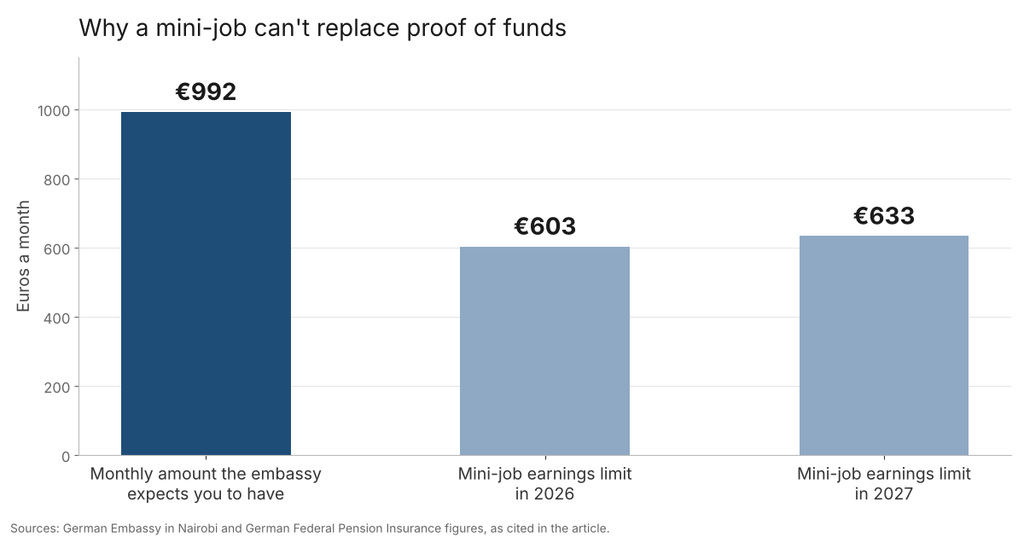
You can earn more in a regular part-time job, but you’ll pay tax and social contributions, and many jobs ask for German. Treat work as a top-up to your blocked account. It can’t replace it.
Applying for the German student visa in Nairobi
The German Embassy in Nairobi handles student visas for applicants who live in Kenya. You apply for a national visa, which is different from a short-stay Schengen visa.
- Apply online. You fill in the application and upload your documents on the Consular Services Portal. Embassy staff look into your file and contact you through the portal if anything’s missing.
- Book your appointment. Once your documents pass the check, the portal sends you a link to book an appointment.
- Attend at TLScontact. At the appointment, TLScontact staff confirms your identity, take your fingerprints and photo, collect the €75 visa fee in Kenyan shillings, and check the original documents the embassy asked for.
- Wait for the decision. The embassy says processing usually takes one to two months, and it asks you not to contact it about your status during that time.
The embassy’s checklist includes your admission letter, proof of funds, certificates and transcripts, language certificate, gapless CV, motivation letter, and travel health insurance for your first three months.
Is there a visa interview?
The embassy’s published checklist doesn’t list one. Your appointment is about identity, biometrics and original documents. That’s why your motivation letter and CV matter so much, and why they need to tell the same story.
What if your visa is refused?
Since July 1, 2025, Germany no longer lets you ask the embassy to review a refusal. You can reapply with a stronger application, or file a case at the Berlin Administrative Court at your own cost, within one month. So it pays to get the first application right. Our German student visa guide goes through the Nairobi process step by step, with the reasons Kenyan applications most often fail.
Scholarships for Kenyans
Full scholarships to study in Germany exist, but nearly all of them are for master’s and PhD students, and the competition is tough. For a bachelor’s, expect partial help at best.
DAAD EPOS
DAAD funds development-related postgraduate courses at selected German universities, a program known as EPOS. Kenyans can apply. DAAD asks for at least two years of relevant work experience after your bachelor’s and a degree that is normally no more than six years old.
DAAD lists €992 a month for master’s students and €1,400 for doctoral candidates (from February 2026), plus insurance and a travel allowance. The master’s rate matches the €992 the embassy expects, so a DAAD award letter alone can serve as your proof of funds. Our DAAD EPOS guide has the 2027/2028 course list and the application steps.
Leadership for Africa
DAAD’s Leadership for Africa program has funded master’s degrees in Germany for East Africans, and Kenya has been on the list in earlier calls. But the most recent call on DAAD’s site was open only to nationals and refugees in South Sudan and Uganda. Check with the DAAD Regional Office in Nairobi for the next call.
Smaller awards once you’re enrolled
Universities across Germany award the Deutschlandstipendium, worth €300 a month, to strong students, and many international students can apply. It helps, but it won’t cover your living costs on its own.
Our list of scholarships in Germany for Kenyan students covers 22 awards Kenyans can apply for, by level, with the requirements for each.
Intakes and a timeline from Kenya
German universities have a winter semester starting around October and a summer semester starting around April. Most programs start in winter.
Work back from your start date and allow more time than you think:
- 12 to 18 months before: check your KCSE or degree in the DAAD admission database, pick courses, and start German if you’ll need it.
- 9 to 12 months before: take your language test. If you need a Studienkolleg, apply early. The University of Bayreuth recommends applying by June 15 for the winter semester, because entrance tests come before the course starts.
- 6 to 9 months before: submit your university applications. Many go through uni-assist, an application service for international students. The University of Kassel says it needs about four to six weeks to process a file.
- 3 to 4 months before: once you have an admission letter, open your blocked account, buy travel health insurance and apply for your visa.
Can you bring your spouse or children?
Sometimes. The Federal Foreign Office says a student’s family can usually join only if the student holds a residence permit, the marriage already existed when that permit was granted, and the stay is expected to last more than a year. You must also be able to support your family without public funds.
Your spouse will usually need basic German at level A1 before entering. The Residence Act sets that rule and a list of exceptions, and the embassy decides case by case whether one applies.
Finding housing before you land
German universities don’t usually run their own housing. Rooms in student halls come through the local Studierendenwerk (student services), and many students rent on the open market.
Rental scams target international students who can’t view a room in person. The University of Mannheim tells students not to send money to a landlord before they’ve seen the room and signed a contract. If someone asks for a deposit to “hold” a room you’ve never seen, walk away.
Is university the only route? Ausbildung (vocational training)
Many Kenyans also look at Ausbildung, Germany’s vocational training system, for careers such as nursing, IT and the trades. You train in a company and attend a vocational school, and you’re paid while you train.
For an Ausbildung visa, the German Embassy in Nairobi asks for a training place in a company and German at B1 for qualified training (otherwise usually A2). Germany also offers a visa to look for a training place. You can stay up to nine months, you need B1 German, and you must be under 35.
After you graduate: staying to work
Once you finish a degree in Germany, you can apply for a residence permit to look for work. The Residence Act gives you up to 18 months, and it can’t be extended beyond that. You must be able to support yourself during that time.
What the Kenya and Germany migration agreement means for you
Germany and Kenya signed a migration and mobility agreement in September 2024. The Federal Ministry of the Interior says the agreement supports immigration by skilled workers, sets up cooperation on vocational training and aims to bring more students to Germany. However, the announcement did not quote any actual number of these jobs. So be wary of anyone who promises you a job in Germany because of the agreement. You still have to meet Germany’s normal immigration rules.
Scams to avoid
Germany’s process is official and online, so you don’t need to pay an agent to get through it.
- “Guaranteed visa” offers. Only the embassy decides on visas. Nobody can guarantee one.
- Fake admission letters. Check every university on Hochschulkompass, and confirm any offer through the university’s own website.
- Job offers tied to the migration agreement. The ministry’s announcement gives no number of jobs or places.
- Rooms you can’t see. Never pay before you’ve seen the room and signed a contract.
Before you fly
Keep your passport, visa, admission letter, blocked account confirmation and proof of health insurance in your hand luggage. In your first weeks you register your address, enroll at your university, and then apply for your residence permit. The post here: cost of studying in Germany lists what each of those steps costs.
Quick answers
Can I study in Germany from Kenya with a KCSE alone?
Not directly. With a mean grade of at least C+, you can usually enter a Studienkolleg first. With a C+ and one year of university study in Kenya, you can go straight into a related bachelor’s.
Is studying in Germany free for Kenyans?
At most public universities, there’s no tuition. Baden-Württemberg, TUM, FAU and THI are exceptions, and you still need €11,904 in a blocked account for your first year.
Do I need IELTS to study in Germany from Kenya?
Not always. If you studied in English in Kenya and your admission letter confirms the university accepted that, the embassy usually won’t ask for a separate English certificate.
Is there an interview at the German Embassy in Nairobi?
The embassy’s checklist doesn’t list one. Your appointment at TLScontact covers identity checks, biometrics, the fee and your original documents.
Can I work enough to live without a blocked account?
No. Future wages don’t count as proof of funds, so you need a blocked account, a sponsor’s obligation letter or a scholarship letter. A mini-job also pays at most €603 a month in 2026.
How long can I stay after I graduate?
Up to 18 months to look for work, under the Residence Act.
This article is general information only and is not immigration advice. German study rules, fees and financial requirements change often, and some change every year. Check the current position on the German Embassy in Nairobi’s website, on the Consular Services Portal at digital.diplo.de, and on the page of each university you apply to before you pay for anything.
Explore our other study abroad from Kenya guides to compare Germany with the UK, the USA, Canada, Australia and New Zealand.