
Before you fly, Immigration New Zealand wants you to prove you hold NZ$20,000 for your first year of living costs, and that money must be separate from your tuition. Immigration New Zealand declines more applications over that one requirement than over anything else. That NZ$20,000 is only one line in the cost of studying in New Zealand, so this guide covers what the government charges, what the universities charge, what you will actually spend in your first twelve months, and which qualifications Immigration New Zealand accepts when you apply to work here after you graduate.
Two of those answers change on 16 November 2026, so read the work rights section even if you have already chosen a course.
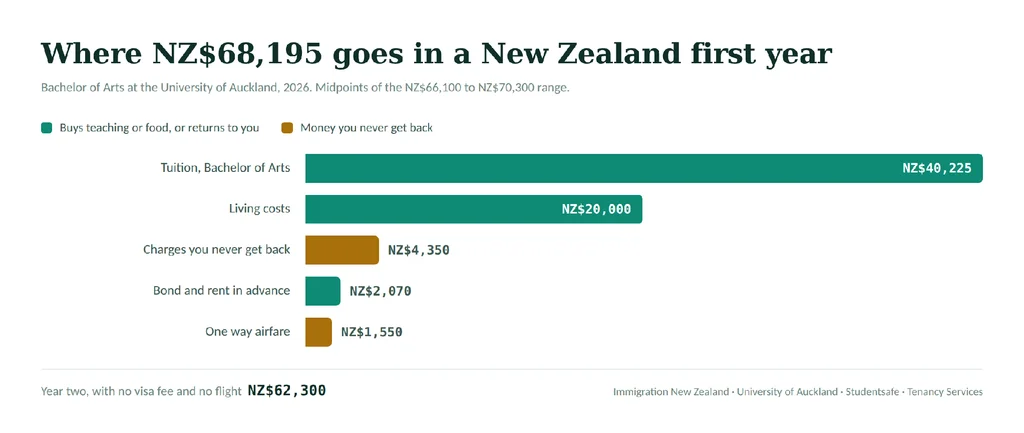
Cost of studying in New Zealand in 2026 broken into tuition, living costs and the charges you never get back
The Cost of Studying in New Zealand Calculator
Every cost in this guide is built into the calculator below, from the English test, translations and courier, through the visa charges, medical examination, police certificate, airfare and bank margin, to tuition, the Student Services Fee, insurance, the living costs you must prove, and your bond and rent in advance. Set the dropdowns and the single checkbox to match your situation, type your own weekly rent, and choose Low end, Middle or High end for the costs you cannot control. The Summary tab shows one total for your first year, split into tuition, living funds that stay yours, the refundable bond, and the costs you pay and never see again. Phase 1, Phase 2 and Phase 3 list every line behind it.
The figures come from official government and university pages and were last checked in October 2026. Fees and rules change several times a year, so treat this as a budgeting tool, not immigration advice. Confirm your tuition with your own university, and check the current charges on the official pages linked under Where the numbers come from on the Summary tab.
Your situation
Show costs in your own currency
Estimated cost for your first year
NZ$0
Why students choose New Zealand
Education New Zealand counted 83,535 international students enrolled between January and August, 14 percent more than in the same months a year earlier. Education related travel earned the country NZ$4.52 billion, which puts international education among New Zealand’s ten largest exports. The government has reason to keep the system working, and that shows in the rules: where you may work up to 25 hours a week during term and full time in scheduled breaks, and a graduate of the right qualification can stay on afterwards for up to three years.
However, from an honest side, New Zealand is expensive, the job market is small, and you are a long flight from almost everywhere. Five million people live there, so if you are counting on walking into a graduate job in your field, understand that the field may be three employers wide. Students who do well in New Zealand usually go for the lifestyle and the residence pathway rather than for salary alone. If that is not you, I have done the same arithmetic for the cost of studying in Japan and the cost of studying in Italy.
The visa you need to study in New Zealand
Almost every international student applies for the Fee Paying Student Visa. The New Zealand student visa cost is NZ$850 in total, and Immigration New Zealand builds that figure from three separate charges: an application fee of NZ$485, an immigration levy of NZ$265, and the International Visitor Conservation and Tourism Levy of NZ$100. You pay all three when you apply, and you get none of it back if the officer declines your application.
The visa can last up to four years and the Immigration New Zealand decides 80 percent of these applications within eight weeks, and you should treat eight weeks as the planning figure rather than the promise.
If you plan to take an English language course and then a degree, look at the Pathway Student Visa instead. It costs from NZ$750, and lasts up to five years. It also covers up to three qualifications one after another on a single application. Two limits matter; Only approved pathway education providers can offer courses on this visa, so check your provider against the register that NZQA maintains before you pay a deposit. Also, you must complete all English language study within 30 weeks .
Parents bringing school age children should read the Dependent Child Student Visa rules, which use a lower living costs figure of NZ$17,000 a year, this requirement can also be waived if you show you are able to support the child fully.
Choose the qualification before you choose the university
This is the part most students get wrong. Often they pick a university, then a course, and only afterwards ask what they are allowed to do with the course. Immigration New Zealand ties your right to work after graduation to the level of your qualification, not to the reputation of the institution that taught you.
| WHAT YOU COMPLETE IN NEW ZEALAND | HOW LONG YOU MAY STAY AND WORK AFTERWARDS |
|---|---|
| Doctoral degree, level 10 | Up to 3 years |
| Master’s degree, level 9 | Up to 3 years |
| Postgraduate diploma, level 8 | Up to 3 years |
| Bachelor’s degree, level 7 | Up to 3 years |
| Graduate diploma, level 7, from 16 November 2026 | Up to 1 year, matching your study time |
| Qualification at level 5 to 7 that does not qualify above | 6 months on the new short term visa |
| English language course on its own | No work visa afterwards |
Every qualification in that table must be a full time study in New Zealand for at least 30 weeks, or for the full length of the programme if that is shorter.
Two changes take effect on 16 November 2026, and both are worth planning around. First, Immigration New Zealand extends the Post Study Work Visa to people who finish a level 7 graduate diploma in New Zealand and already hold a bachelor’s degree, whether they earned that degree in New Zealand or overseas. Those applicants get up to one year, matching the time they spent on the graduate diploma.
Second, the government introduces a Short Term Graduate Work Visa for graduates of level 5 to level 7 qualifications that do not already qualify for the longer visa. That visa allows six months of unrestricted work, and you must apply within three months of your student visa expiring and show you hold at least NZ$5,000.
All that said, I want to be explicit about one rule; Immigration New Zealand grants one Post Study Work Visa per person over their lifetime. If you use it after a diploma and later finish a master’s degree, you cannot apply again. Plan the whole sequence before you enrol in the first course.
Five rules people get wrong when applying for the New Zealand Student Visa
Here are the five mistakes that cost students money, in the order that I see them most often.
- Treating an English language course as the destination. If you study only a language course, Immigration New Zealand will not grant you any work visa afterwards. Use it as a bridge to a qualification at level 7 or above, which is the level Immigration New Zealand requires, and remember the 30 week limit if you study on a pathway visa.
- Enrolling with a provider that cannot host the visa you want. Not every education provider can offer courses on a Pathway Student Visa. Check first, because it may take long to get back your deposit, to re-apply to another institution.
- Assuming you can take another program for a second Post-Study Work Visa : Please note you can only get one Post-Study Work Visa in your lifetime.
- Missing the unlimited hours rule. Doctoral students and master’s by research students face no cap on working hours at all, while everyone else stops at 25 a week during term. If you are choosing between a taught master’s and a research master’s, that difference will strongly matter in this case.
- Forgetting that the cheap doctoral fee comes with a condition. International PhD candidates at the University of Auckland pay the New Zealand domestic fee of NZ$8,847.60 a year, which is a genuine bargain. However, you keep that rate only if you live in New Zealand for the whole programme, with up to twelve months of research abroad allowed in total.
Proof of Funds for New Zealand Student Visa, and the part that causes most refusals
Most refusals happen here, and almost none of them happen because the applicant was poor. They happen because the applicant documented the money badly.
The student fund requirements are very specific. For tertiary or English language study you must show NZ$20,000 for each year if you study for a year or more, or NZ$1,667 for each month if your course is shorter than a year. School students in years 1 to 13 show NZ$17,000 a year. Prepaid accommodation reduces the figure, so a hall of residence you have already paid for works in your favour. You must also show a paid onward ticket, or prove you hold enough to pay for one. Also if you are pregnant, add NZ$9,000 for maternity and medical costs.
For that part that often most go wrong is on the documents. Immigration New Zealand accepts bank statements covering the last three months, fixed term deposit certificates for deposits you have held for at least three months. A scholarship award letter, education loan papers from a nationalised or multinational bank, and provident fund evidence can also be used. A parent or other acceptable sponsor may hold the money for you, in which case your guarantor completes the Financial Undertaking for a Student form.
Immigration New Zealand explicitly rejects two things that applicants send all the time: screenshots of bank transfers, and receipts from education agents. If your agent has given you a receipt and told you it proves your funds, you do not yet have evidence of funds.
If you apply from China, India, Nepal, the Philippines, Sri Lanka or Vietnam, look at the Funds Transfer Scheme, which Immigration New Zealand runs with ANZ (the largest bank in New Zealand ). It lets you move your support money through a channel the visa officer already trusts, which removes a whole category of obstacles from your application.
The cost of studying in New Zealand, phase by phase
The three tables below separate what you spend before you apply, what you spend to get the visa and get there, and what you spend once you arrive. The figures use the University of Auckland as a worked example because it publishes its fees clearly. Your own university will differ, and a few of these lines depend on which country you apply from.
Phase 1: before you apply
Nobody refunds this phase. You pay for the test, the certified copies and the courier before a single university has looked at your file, and if they all turn you down, that money is gone. Budget for two sittings of the English test rather than one. Most applicants who miss their band on the first attempt did not plan to resit, and you pay the second fee at the worst possible moment.
| ITEM | TYPICAL COST IN NZ DOLLARS | IN YOUR LOCAL CURRENCY | WHY IT IS ON THIS LIST |
|---|---|---|---|
| One sitting of an English test | NZ$ 390 to NZ 480 | · | IELTS and its alternatives are priced locally, and you pay again if you resit |
| Certified translations and copies | NZ$ 50 to NZ 250 | · | Immigration New Zealand needs certified documents, not photographs of them |
| Courier and postage | NZ$ 40 to NZ 120 | · | Some universities still ask for paper originals |
| Phase 1 subtotal | NZ$ 480 to 850 | · | You spend all of this before anyone has offered you a place |
Phase 2: the visa and the journey
On this phase: Immigration New Zealand keeps the NZ$850 whether they approve you or decline your application, and the panel doctor and the police office keep their fees either way. The airfare and the bank margin are the two figures that move most, and you can plan for both. Book outside December and January, and compare what actually arrives in the New Zealand account rather than the fee your bank advertises.
| ITEM | TYPICAL COST IN NZ DOLLARS | IN YOUR LOCAL CURRENCY | WHY IT IS ON THIS LIST |
|---|---|---|---|
| Fee Paying Student Visa, all three charges | NZ$ 850 | · | NZ$485 fee, NZ$265 immigration levy, NZ$100 visitor levy, and Immigration New Zealand keeps all of it if they decline you |
| Medical examination and chest x ray | NZ$ 150 to 450 | · | A panel doctor in your country sets this price, not Immigration New Zealand |
| Police or character certificates | NZ$ 20 to 80 | · | Your own government charges this, and some offices take weeks |
| One way airfare | NZ$ 900 to 2,200 | · | Prices in December and January are the worst of the year |
| Bank charges on moving your funds | NZ$ 200 to 700 | · | Your bank takes a margin on the exchange rate as well as a fee |
| Phase 2 subtotal | NZ$ 2,120 to 4,280 | · | You receive no teaching for any of this |
Phase 3: your first twelve months in New Zealand
Three lines account for almost all of the cost of studying in New Zealand: tuition, the NZ$20,000 you must prove, and the money your landlord wants in your first week. The rest looks small next to those. That is why so many students meet the Student Services Fee and the insurance premium for the first time at enrolment, long after they thought the budgeting was done. Change the weekly rent to match the city you are moving to, because that one number moves your bond and your rent in advance together, and the official cost of living figures vary by hundreds of dollars a week.
| ITEM | TYPICAL COST IN NZ DOLLARS | IN YOUR LOCAL CURRENCY | WHY IT IS ON THIS LIST |
|---|---|---|---|
| Tuition, Bachelor of Arts | NZ$ 40,225 | · | The 2026 undergraduate rate for a full year of 120 points. Engineering costs NZ$58,009 |
| Student Services Fee | NZ$ 1,133 | · | Your university charges NZ$9.44 per point on top of tuition, and nobody mentions it in the brochure |
| Studentsafe insurance, full year | NZ$ 899 | · | Your visa requires acceptable insurance, and your university bills this with your fees |
| Living costs | NZ$ 20,000 | · | The figure Immigration New Zealand requires you to prove, and a realistic minimum for one year |
| Bond and rent in advance | NZ$ 1,260 to 2,880 | · | You pay both in your first week, before your first student loan or wage arrives |
| Phase 3 subtotal | NZ$ 63,517 to 65,137 | · | A postgraduate Arts year costs NZ$44,970 instead, and a doctoral year NZ$8,848 |
Add the three phases and the cost of studying in New Zealand for a first year on a bachelor’s degree comes to roughly NZ$66,100 to NZ$70,300.
The costs nobody puts in the brochure
Four of those lines need more explanation than a table row allows.
The Student Services Fee of NZ$1,132.80 is not optional and not included in any tuition figure you will see advertised. Every student pays it, every year.
Insurance is a condition of your visa rather than a suggestion. Studentsafe charges NZ$899 for a full year, NZ$449.50 for one semester, and NZ$1,798 for a couple or a student with one child. Separately, the Accident Compensation Corporation covers everyone in New Zealand for injury, including visitors, which many students do not realise that it only covers injuries and not illness.
Housing costs more in your first week than in any later week. Tenancy Services allows a landlord to charge a bond of up to four weeks of rent, and the landlord must lodge that bond with Tenancy Services rather than keep it. Most landlords also want rent in advance. On a room at NZ$300 a week you therefore need NZ$1,200 for the bond plus NZ$600 in advance before you have bought a plate.
The official cost of living figures put accommodation at NZ$140 to NZ$484 a week, food at NZ$80 to NZ$120, transport at up to NZ$37, and power at NZ$200 to NZ$300 a month. New Zealand houses are colder indoors than most students expect, and you will see that in a Dunedin power bill.
Moving money across borders is never free. Between the transfer fee and the exchange rate margin, sending NZ$60,000 in tuition and living funds commonly costs NZ$200 to NZ$700. Compare what actually arrives in the New Zealand account, rather than the advertised fee.
What you actually lose
Most of the cost of studying in New Zealand is not a fee. The NZ$40,225 in tuition is what you pay for teaching. You spend the NZ$20,000 in living costs on food and rent you would need anywhere. You get your bond of NZ$1,200 or so back when you leave the flat in good order.
Once you set those three aside, the charges you never get back add up to roughly NZ$3,700 to NZ$5,000: the visa, the insurance, the Student Services Fee, the medical examination, the police certificate, the English test, the translations, the courier and the bank margin. That is the number worth arguing about, and it is the number no agent will quote you. I did the same subtraction for the cost of studying abroad in France, down to the euro.
Year two and beyond
Most students budget for year one and stop there. The cost of studying in New Zealand repeats, and in your second year you pay tuition again, plus living costs, plus insurance of NZ$899 and the Student Services Fee of NZ$1,133. You do not pay the visa fee again unless your visa expires, you do not pay the airfare, and Tenancy Services still holds your bond. A second year on the same bachelor’s degree therefore costs about NZ$62,300.
At the end, the Post Study Work Visa costs NZ$1,670, made up of a NZ$320 application fee and a NZ$1,350 immigration levy. Immigration New Zealand decides 80 percent of those within six weeks. Budget for it now, because you will pay it at the moment your bank balance is lowest.
Six things to settle before you spend any money
- Confirm the level of your qualification in writing. Ask your provider for the NZQCF level, not the marketing name of the course. Level 7 and above changes what you may do afterwards.
- Check your provider against the official register. Look up the institution on the NZQA register and confirm it signs the Code of Practice, which sets out what providers owe you if something goes wrong.
- Check anyone who charges you for advice. Giving New Zealand immigration advice without a licence is an offence unless the person is exempt. Search the Immigration Advisers Authority register before you pay a single fee, and read what the Authority says about exempt people.
- Season your funds for three months. Move the money into the account you will show, and leave it there. A deposit made last week will not satisfy the officer who reads your file.
- Price your own country’s lines, not mine. The medical examination, the police certificate, the English test and the airfare all depend on where you apply from. Get real quotes and replace my ranges.
- Complete your New Zealand Traveller Declaration before you board. Fill in the declaration in the 24 hours before you fly, and keep your offer of place, your visa approval and your proof of funds in your hand luggage, because border officers may ask to see them. Once you arrive, apply for an IRD number in your first week, since you cannot be paid properly without one.
If you are applying to a second country as a hedge, Canadian universities use a different timetable, and I have written up their application process separately. Apply through Immigration Online when your documents are ready, and check the current charges in the Immigration New Zealand fees guide on the day you pay, since the government revises them without much notice.
This guide covers the rules and prices that applied in October 2026. Immigration New Zealand changes fees, funds requirements and work rights several times a year, and 2026 has already brought two rounds of changes. Confirm every figure on the official pages linked above before you pay anything. Nothing here is immigration advice, and only a licensed immigration adviser or an exempt person may give you advice about your own case.