
Last checked: October 2026
If you finish a UK degree and apply for your work visa on or before 31 December 2026, you can stay and work for two years. Apply one day later, on 1 January 2027, and the Home Office gives you 18 months instead of two years. Students finishing a master’s this autumn can still get the longer visa, but only if their university reports their results in time and they apply before the new year. That one date says a lot about the UK student visa cost in 2026, because the government keeps changing the rules that set the cost of studying in UK universities.
In this guide, we follow the four stages every student goes through: choosing a course, getting an offer and a CAS from a university, applying for the Student visa, and settling in after you land. For each of the last three stages, you’ll get a table of costs in British pounds. At the end, we add the tables together and take out the money that isn’t really a charge, so you can see what you lose for good.
The UK changes its fees and rules several times a year. The Home Office raised the visa fee in April 2026, it raised the money you must show on 30 November 2026, and it shortens the Graduate visa in January 2027. Before you pay anything, open the official GOV.UK page we link to for each figure and check it again. Where we couldn’t find an official figure, we say the number is our own estimate.
Every link in this guide goes to a UK government page, an NHS page or an official university page, and all of those pages are in English.
Cost of Studying in UK Calculator
Use the calculator below to work out your own first-year cost of studying in UK universities. Pick your level of study and whether you’ll live in London, then add your tuition, rent and flight if you know them, or leave the boxes empty to use the ranges from this guide. The calculator splits your total into four parts: tuition, the living money you spend on yourself, the rent deposit you should get back, and the charges you’ll never see again. If you add today’s exchange rate from your bank, you’ll see every figure in your own currency too. It’s a budgeting tool, so check each fee on GOV.UK before you pay.
Your situation
Show costs in your own currency
Estimated cost for your first year
£0
New UK rules and fees since spring 2025
Many older guides came out before these changes, so read this list first.
- 8 April 2026: The Home Office raised the Student visa fee from £524 to £558, and the Graduate visa fee from £880 to £937.
- 1 May 2026: In England, private landlords can no longer ask for more than one month’s rent before a tenancy starts. Before this, many landlords asked international students for six or twelve months of rent up front.
- 1 June 2026: The Home Office made its pass marks for universities much harder. A university now needs a visa refusal rate under 5 per cent and an enrolment rate of at least 95 per cent among its international students. Step 2 explains why that matters to you.
- 30 November 2026: The money you must show for living costs goes up from £1,529 to £1,570 a month in London, and from £1,171 to £1,203 a month outside London. The Home Office has said it’ll keep this figure in line with the loans home students get, so expect another rise in future years.
- 1 January 2027: The Home Office cuts the Graduate visa from two years to 18 months for bachelor’s and master’s graduates. Doctoral graduates keep three years.
- 1 August 2028: Universities in England start paying a levy of £925 for each international student every year. The university pays it, not you. The plan is still in a draft Finance Bill, and nobody can say yet whether universities will raise tuition to cover it.
Step 1: Pick a course with life after graduation in mind
The Home Office ties your right to work after graduation to your level of study, so think about the Graduate visa before you choose a course. With a Graduate visa, you can stay and work, or look for work, at any skill level and without an employer sponsoring you. You apply for it from inside the UK, and only after your university tells the Home Office you’ve passed.
How long the Graduate visa lasts at each level
Under the Graduate route rules, the Home Office sets the length of the visa by two things: the qualification you finished and the date you apply.
| Level of study | If you apply on or before 31 December 2026 | If you apply on or after 1 January 2027 |
|---|---|---|
| English language course | You can’t apply | You can’t apply |
| Foundation year or other course below degree level | Usually you can’t apply, so check the list of qualifying courses | Usually you can’t apply, so check the list of qualifying courses |
| Bachelor’s degree | 2 years | 18 months |
| Master’s degree, taught or by research | 2 years | 18 months |
| PhD or other doctorate | 3 years | 3 years |
The Graduate visa has its own fee and its own health surcharge. On its Graduate visa page, the Home Office lists a fee of £937 and a health surcharge of usually £1,035 for each year you’ll be in the UK. So a student who applies in 2027 for 18 months pays about £2,490 before starting work. We return to this figure at the end, because it isn’t part of the first-year bill.
Graduate visa rules students often get wrong
Most Graduate visa problems start with a small detail that the student didn’t check early enough. Read these points before you accept an offer.
You can only hold the Graduate visa once. Under rule GR 1.4, the Home Office won’t give you a Graduate visa if you’ve already held one, or held the old Doctorate Extension Scheme. If you’re planning a master’s and then a PhD, decide which one you want to use it after. For most people, the PhD is the better choice, because it gives three years.
You must apply before your Student visa ends. The Home Office says you must apply before your Student visa expires, and you must be in the UK when you apply. For a course of 12 months or longer, the Home Office normally ends your Student visa four months after your course end date. If you fly home for a long holiday after your exams, you could lose the chance to apply.
You must have studied in the UK for long enough. For a course of 12 months or less, you must have held your Student visa in the UK for the whole course. For a longer course, you need at least 12 months of it in the UK on a Student visa. If you plan to study part of the course online from home, check this with your university first.
Your university must report your result before you apply. Under rule GR 4.3, your university must have told the Home Office you completed the course by the date you apply. You don’t have to wait for graduation day, but you do have to wait for that report. If you’re aiming for the two-year visa before 31 December 2026, ask your university office when it’ll send the report, and push for an exact date.
The Student visa has its own time limit. From age 18, the Home Office usually lets you hold Student visas for no more than five years at degree level and no more than two years below degree level. Longer courses such as medicine, dentistry, architecture and veterinary science get extra time.
Age. You must be at least 16 to apply for a Student visa, and the rules we read set no upper age limit for either the Student or the Graduate visa. Applicants under 18 need written consent from their parents.
English level. For degree-level study you need English at CEFR level B2, and for courses below degree level you need B1. At degree level, your university can check your English itself, which is why some universities accept the English results from your school exams at home. Check your own university’s list before you pay for a test. A pathway college below degree level will usually ask for a Secure English Language Test, known as a SELT, from an approved test centre.
Some subjects need security clearance. If your course covers an area such as advanced engineering, physics or some life sciences, you may need an ATAS certificate before you apply for the visa. Step 2 explains how.
You can’t bring family on a taught master’s. Since January 2024, the Home Office only lets students on a PhD, another doctorate or a research-based higher degree bring a partner or children, unless a government sponsors the student. A one-year taught master’s doesn’t allow dependants, even when it costs more than a research degree.
Can you join one course to another?
Yes, you can move from one course to the next, but each new course has to be at a higher level, and you can’t add the work time from each course together. Under rule ST 14, a student asking for a new Student visa must have passed the last course and must show academic progress. So a pathway year, then a bachelor’s, then a master’s, is a normal path. The Home Office usually won’t allow a second bachelor’s, unless your case fits one of the exceptions in the rules.
Moving up a level doesn’t give you a second Graduate visa, because you can only hold it once. Your time on Student visas also counts towards the five-year limit. Take a three-year bachelor’s followed by a one-year master’s, for example. That plan uses most of the five years, and it leaves very little room for a re-sit or a change of course.
Step 2: Get an offer and a CAS from a licensed university
Only a university or college on the Home Office list of licensed student sponsors can give you the document you need for a UK student visa. That document is the Confirmation of Acceptance for Studies, or CAS. Check the list before you pay for any application.
Is your university licensed? Search the register
The Home Office publishes a register of licensed student sponsors, and its staff update the list on most working days. If a college isn’t on the register, it can’t issue a CAS, and its offer letter won’t get you a visa. Search for the exact name on the offer letter, because some private colleges use names that sound very close to a well-known university. The register shows whether a college can sponsor students. It says nothing about whether an agent is honest, and the note at the end of this guide explains how you can check an adviser.
Your application papers
Each university sets its own document list, but most of them ask for the same papers:
- Your school or university certificates and transcripts
- A copy of the photo page of your passport
- Proof of your English, if your school results don’t cover it
- A personal statement
- One or two references from teachers or employers
- A research proposal, if you’re applying for a research degree
For a bachelor’s degree, you apply through UCAS. For 2027 entry, UCAS charges a single fee of £34.50 for up to five choices. For a master’s or PhD, you usually apply straight to the university, and many universities don’t charge an application fee. If your papers aren’t in English, you’ll need certified translations, and some schools and universities at home charge for official transcripts.
From unconditional offer to CAS number
Once you meet all the conditions in your offer, the university makes the offer unconditional. Then it asks you for a tuition deposit, and only after that does it issue your CAS. The CAS is an electronic record with a reference number. On it, the university lists your course, your start and end dates, your tuition fee, any money you’ve already paid, and the way it checked your English. The visa officer reads it first, so check every detail and ask the university to fix any mistake before you apply.
You must apply for your visa within six months of getting your CAS. Universities ask for very different deposits. The University of Liverpool usually asks for a minimum deposit of £2,000, while the University of Westminster asks for £5,500, which it takes off your tuition when you enrol. Both universities say they may refund the deposit if the Home Office refuses your visa, but not if the Home Office refused it for false or misleading information. Westminster also wants your refund request within 30 days of your course start date. Read your own university’s refund terms before you pay.
Why some universities have become stricter with offers
The UK has no national cap on international students and no national limit on fee discounts or scholarships. Still, since 1 June 2026 the Home Office has judged each university on three numbers. Its visa refusal rate must be under 5 per cent, at least 95 per cent of the students it gives a CAS to must enrol, and at least 85 per cent must finish their course. The Home Office raises the completion figure to 90 per cent from 1 June 2027.
If a university misses these numbers, the Home Office cuts how many CAS it can issue, and after repeated failures it can take away the university’s licence. Which means each university now guards its own CAS numbers closely. You may have to attend a credibility interview, show your bank statements before the university issues your CAS, or pay a bigger deposit. None of this is a visa rule, so the questions differ from one university to the next. Answer honestly and tell the same story in every interview, because the visa officer must also be satisfied that you’re a genuine student.
Extra clearance for some science and engineering subjects
Some postgraduate courses and research in sensitive subjects need an Academic Technology Approval Scheme certificate, called ATAS. Your offer letter or CAS will tell you if you need one. ATAS is free, but it takes at least 30 working days, and there’s no fast track. You must hold the certificate before you apply for your Student visa, and the ATAS team can take longer from April to August. If your course needs ATAS, apply the week your offer arrives.
You apply online and give the CAH3 subject code that your university supplies, your course modules or research outline, your supervisor’s name, your study and work history, two referees and how you’ll pay for your studies. The team behind ATAS warns that it’ll refuse an application with false or unverifiable details, and asks applicants not to use a Gmail address because of a technical problem. The certificate stays valid for a visa application for six months from the date of issue. If your course end date moves by three months or more, or your supervisor or course content changes, you’ll need a new one. Most students never need ATAS, so don’t worry about it unless your offer letter mentions it.
Phase 1 costs: admission
| Item | Typical cost in GBP | In your local currency | Why it is on this list |
|---|---|---|---|
| English test, one sitting | £180 to 250 | Our estimate. Test centres in Kenya, Nigeria, Ghana, India, Pakistan and Bangladesh set their own local prices, so check the test owner’s page for your city | |
| Application fees | £0 to 100 | UCAS charges £34.50 for up to five choices. Many master’s portals are free, and the top figure is our estimate for the few universities that charge | |
| Official transcripts from your old school | £10 to 100 | Our estimate, because many schools and universities at home charge for sealed or emailed transcripts | |
| Certified translations and copies | £30 to 200 | Our estimate, for any certificate or letter that isn’t in English | |
| Courier for papers | £0 to 60 | Our estimate. Most universities accept scans, but a few still want originals by post | |
| Tuition deposit to receive your CAS | £2,000 to 5,500 | From Liverpool’s usual minimum to Westminster’s deposit. The university counts the deposit as part of your first-year tuition, so we take it off the tuition line in Phase 2 | |
| Phase 1 subtotal | £2,220 to 6,210 | We added the rows above together in code |
Step 3: Send your Student visa application to the Home Office
Apply for your Student visa online once you have your CAS, and apply no earlier than six months before your course starts. For applications from outside the UK, the Home Office usually decides within three weeks. If it approves you, you’ll get an eVisa, which is a digital record of your status, instead of a sticker in your passport.
Your document checklist
On its documents page, the Home Office asks every applicant for a current passport and the CAS reference number. Depending on your case, you may also need:
- Proof that you have the money for your tuition and living costs
- An ATAS certificate, if your course needs one
- Your tuberculosis test certificate
- Written consent from a government or official sponsor who paid your fees or living costs in the last 12 months
- Consent from both parents and a birth certificate, if you’re under 18
- Certified translations of any document that isn’t in English
Keep the original papers you used to get your CAS, such as your certificates and English results, because the Home Office can ask to see them.
The tuberculosis test
You need a TB test if you’re coming for more than six months and you’ve lived in a listed country. Kenya, Nigeria, Ghana, India, Pakistan and Bangladesh are all on the Home Office list. You must use a clinic that the Home Office approves, and the clinic’s certificate is valid for six months from the date of your chest X-ray. Take the test too early and the certificate may expire before you apply, so book it once your CAS is nearly ready.
At the clinic, staff take a chest X-ray. If the X-ray isn’t clear, they may ask for a sputum sample, which is phlegm you cough up from your lungs. If you’re pregnant, you can ask for a sputum test instead of an X-ray, but it may cost extra and the results can take up to eight weeks. Children under 11 don’t normally have an X-ray, and a clinician decides instead. The clinic sets its price in local money, and the Home Office doesn’t publish it.
UK student visa bank statement rules: the amount, the 28 days and the accounts that count
The Home Office refuses more students over money than over anything else, so read this part slowly. You must show enough money to pay any tuition that’s still unpaid on your CAS, plus a fixed amount for living costs. The living cost figure depends on where your university is, and on whether you apply before or after 30 November 2026.
| Where you will study | Monthly figure until 29 November 2026 | Monthly figure from 30 November 2026 | Total for a course of nine months or longer, from 30 November 2026 |
|---|---|---|---|
| London (the City of London and the 32 boroughs) | £1,529 | £1,570 | £14,130 |
| Anywhere else in the UK | £1,171 | £1,203 | £10,827 |
You show the monthly amount for up to nine months, even when your course lasts three years. The new figures come from the statement of changes the Home Office published on 3 September 2026. If you’re starting in January 2027, you’ll almost certainly apply after 30 November, so plan on the higher figure.
The 28-day rule. You must hold the money for at least 28 days in a row, and the last day of that 28-day period must fall within 31 days of the date you apply. Your balance can’t drop below the full amount, not even for a day. If it dips by a small amount on day 20, the Home Office can refuse you, and it won’t refund the visa fee.
Accounts you can use. Under Appendix Finance, the money can be in your own name, a joint account with your name on it, or the name of a parent or legal guardian. If you use a parent’s account, you also send a consent letter from that parent and a birth certificate or another official paper that proves the relationship. Money in an uncle’s, a sibling’s or a family company’s account doesn’t count under these rules, however close the family is.
Types of savings that count. The Home Office accepts a current, savings or deposit account at a bank or building society if you can take the money out straight away. It doesn’t accept shares, bonds, credit cards, pensions you can’t withdraw at once, or an overdraft. If your family keeps the money in a fixed deposit, ask the bank for a letter saying you can withdraw it at any time, or move the money into a savings account before your 28 days start.
Which bank you use. The Home Office won’t accept money held by a bank that it can’t check, that its own country doesn’t regulate, or that doesn’t keep electronic records. Big national banks rarely cause trouble. Savings groups, chamas, mobile wallets and cooperative societies often do, so move the money to a regulated bank well before the 28 days start.
Exchange rates. Caseworkers convert other currencies at the OANDA rate on the date you apply. If your currency is weak or falling, a balance that was enough in September may fall short in October. Keep about 5 to 10 per cent more than the target.
Student loans and scholarships. A loan only counts if it comes from a government, a government-backed loan company or a regulated education loan scheme. The lender’s letter must be dated no more than six months before you apply, and the lender can’t set any condition for paying out other than your visa being approved. An official sponsor, such as your own government, the British Council, an international company or the university itself, can cover you with a letter instead of bank statements.
Money you can take off the total. If you’ve already paid part of your tuition, the university should show it on your CAS or give you a receipt. You can also take off a deposit you paid the university for accommodation it arranges, up to £1,529 now and £1,570 from 30 November 2026.
No shortcut for these six countries. The Home Office lets students from some countries, such as Malaysia or the United States, skip sending financial papers with the application. Kenya, Nigeria, Ghana, India, Pakistan and Bangladesh are not on that list, so you must send full evidence.
We see the same three mistakes again and again. The first is a big deposit that arrives in the account a few days before the 28 days start, with no record of where the money came from. The second is a sponsor letter or a CAS figure that doesn’t match the statements. The third is an old statement, because your newest statement must be dated within 31 days of the date you apply. Ask your bank for a stamped statement, and if the bank doesn’t issue it in English, pay for a certified translation.
When a parent or sponsor pays
A parent or legal guardian can pay, but the money has to be in their own account, and you must show the consent letter and proof that they’re your parent. A relative who isn’t your parent can’t keep the money in their own name and lend it to you on paper. If that relative wants to help, they can give the money to you or to your parent, and you or your parent then keep it in the account for the full 28 days. Keep the transfer slips, because the visa officer may ask where the money came from.
A company, a government department or a foundation counts as an official financial sponsor only if it’s one of the types listed in the rules. In that case, the sponsor writes a letter with its contact details, the amount and the dates it covers. If the sponsor has paid your fees or living costs in the last 12 months, you also need its written consent to the application.
The immigration health surcharge and what the NHS still charges
Instead of buying private health insurance, you pay the immigration health surcharge, or IHS, when you apply for your visa. For students, the Home Office charges £776 for each year. It charges half the yearly amount for any extra part of a year up to six months, and the full yearly amount for anything longer. The Home Office usually starts your visa one month before your course and ends it four months after, so:
- A one-year master’s gives you a visa of about 17 months, and you pay £1,164
- A three-year bachelor’s gives you a visa of about three years and five months, and you pay £2,716
You pay the whole surcharge on the day you apply, not year by year. If the Home Office refuses your visa, it usually refunds the surcharge within six weeks, but it keeps the visa fee.
Once your visa starts and you’ve paid the surcharge, you can use the National Health Service free of charge, just like a UK resident. Some services still cost money. In England, you pay £9.90 for each prescription item, and a check-up at an NHS dentist costs £27.90. Opticians also charge for eye tests, so if you wear glasses, buy a spare pair before you travel. The NHS won’t pay for a flight home in a medical emergency, so some students buy a small travel policy just for the journey.
English language proof for the visa
The visa officer checks your English through your CAS. For degree-level study, your university decides how you prove level B2 and writes the method on the CAS. For a course below degree level, you usually need a SELT from an approved test provider.
Outside the UK, the Home Office only accepts SELTs from four providers: Skills for English UKVI from PSI, IELTS for UKVI or IELTS Life Skills, the LanguageCert SELT tests, and PTE Academic UKVI or PTE Home from Pearson. You must take the test at an approved centre, and the Home Office treats results as valid for two years from the date the provider awards them. A common and costly mistake is booking an ordinary IELTS when the college wanted IELTS for UKVI. Check the exact test name with your university before you book.
Book early, because popular test centres in Lagos, Nairobi, Accra, Delhi, Lahore and Dhaka fill up before the September intake. Even with a good score, expect a university or Home Office officer to test your spoken English at a credibility interview.
How many hours you can work
A full-time student at degree level at a university can take paid work for up to 20 hours each week during term, and full-time during official vacations. Below degree level, the limit is 10 hours a week during term. Part-time students can’t work at all. You also can’t be self-employed, work as a professional sportsperson or sports coach, or fill a permanent full-time job.
The 20 hours is a weekly limit, not an average. If you work 25 hours one week and 15 the next, you’ve broken the condition, and your employer may report it. Ask your university for its official term dates, because employers use them to check when you can work full-time. Your right to work is part of your eVisa, so you don’t need a separate work permit. The safest plan is to treat any wages as extra and to pay your tuition and rent from money you already hold.
Applying online, giving fingerprints and getting a decision
You fill in the online form on GOV.UK, pay the visa fee and the surcharge, and then prove your identity. Depending on your nationality, you either visit a visa application centre to give your fingerprints and a photo, or you use the official UK Immigration: ID Check app on your phone. After the decision, you set up a free UKVI account, link your passport to it, and you can view your eVisa online.
For applications from outside the UK, the Home Office usually decides within three weeks, counted in UK working days. In July, August and early September, far more students apply, and decisions can take longer. The Home Office warns that it won’t pay you back for flights you booked before a decision, so wait for yours before you buy a ticket.
In some countries, you can pay for a faster decision. The Home Office charges £500 extra for priority and £1,000 extra for super priority. You’ll see whether either service is open to you when you book. Visa centre staff may also offer extras such as a lounge, document scanning or courier return, and you don’t need any of them.
Phase 2 costs: student visa
| Item | Typical cost in GBP | In your local currency | Category | Why it is on this list |
|---|---|---|---|---|
| Student visa fee | £558 | Standard | The Home Office raised the fee from £524 to £558 on 8 April 2026, and it keeps the fee if it refuses you | |
| Immigration health surcharge for the whole visa | £1,164 to 2,716 | Standard | The Home Office charges £776 a year. The low end is a one-year master’s, the high end a three-year bachelor’s, and you pay it all on the day you apply | |
| First-year tuition after the deposit | £15,100 to 40,000 | Standard | Annual fees from £17,100 at Keele to £45,500 for engineering at Imperial, less the deposit you paid in Phase 1 | |
| Living money held for 28 days | £10,827 to 14,130 | Standard | Nine months at the rates from 30 November 2026, outside London and in London. You spend this money on your own rent and food | |
| TB test at an approved clinic | £60 to 150 | Often missed | Our estimate, because each clinic sets its own local price. Students from all six countries named above need the test | |
| ATAS certificate | £0 | Often missed | The certificate is free, but the wait of six weeks or more can delay your visa application | |
| Priority decision | £0 to 500 | Often missed | Optional. The Home Office charges £500 for priority where it offers the service | |
| Visa centre extras | £0 to 100 | Often missed | Our estimate for optional extras that visa centres sell. You don’t need any of them | |
| New passport or renewal | £40 to 120 | Often missed | Our estimate. If your passport expires during your course, you’ll have to link a new one to your eVisa later, so renew it now if it’s close to expiry | |
| Translations of bank papers and birth certificate | £20 to 150 | Often missed | Our estimate, for statements or letters your bank doesn’t issue in English | |
| Bank transfer fees and exchange margin | £100 to 700 | Often missed | Our estimate. Banks charge you to send tuition abroad and add a margin to the exchange rate on large sums | |
| Travel to the visa centre | £0 to 150 | Often missed | Our estimate, because many countries have only one or two visa centres | |
| Phase 2 subtotal | £27,869 to 59,274 | Most of this is tuition and your own living money |
Step 4: Arriving in the UK and finding a place to live
With your eVisa you can travel, but a Border Force officer at the airport decides whether you can enter. Pack your papers in your cabin bag, not your suitcase, so you can show them if the officer asks.
What to have with you at UK passport control
- The passport you linked to your UKVI account
- Your CAS reference number and your university offer letter
- Your bank statements or sponsor letter from the visa application
- Your TB certificate, in case the officer asks for it
- Your university’s address and the phone number of its international student office
- The address where you’ll stay for your first nights
You can arrive up to one month before your course starts if it lasts more than six months, and up to one week before for a shorter course. You mustn’t travel before the start date on your visa. If you’re travelling on a different passport from the one linked to your eVisa, update your UKVI account before you fly, or the airline may refuse to let you board.
Deadlines that start when you land
Your first weeks bring several deadlines, and missing one can cost you money or put your visa at risk.
- Enrolment. University staff must see your passport and confirm you’ve started. If you don’t enrol, the university reports you to the Home Office, and the Home Office can cancel your visa.
- Doctor. Register with a local GP surgery in your first week. In England, registration is free, and you don’t need ID or proof of address.
- Council tax. A household where everyone’s a full-time student doesn’t pay council tax, but you must ask your university for a student certificate and send it to the local council. If you don’t, the council may send you a bill.
- Deposit protection. In England and Wales, your landlord must put your deposit in a government-approved scheme within 30 days and give you the details. If you don’t get them, ask in writing.
- Right to rent and right to work. Landlords in England and employers will ask for proof of your status. You can give them a share code from your UKVI account, and the share code is free.
- Graduate visa. Write down the date your Student visa expires now. Your Graduate visa application must reach the Home Office before that date.
Renting in the UK: what’s new and what still goes wrong
The government changed renting law in England a lot in 2026, and the changes help international students. From 1 May 2026, a private landlord in England can ask for no more than one month’s rent before the tenancy starts, and once the tenancy starts, the landlord can’t ask for rent before it’s due. Most private tenancies also became rolling tenancies with no fixed end date. These protections cover shared student houses and flats. They don’t cover a contract for purpose-built student halls signed after 1 May 2026, so a hall can still ask you to sign a fixed contract for the whole academic year.
Under the Tenant Fees Act, a landlord in England can ask for a holding deposit of no more than one week’s rent, and a tenancy deposit of no more than five weeks’ rent when the yearly rent is under £50,000. The landlord can’t make you pay for insurance, a credit check or a separate council tax payment. Scotland, Wales and Northern Ireland have their own renting laws, so check the government page for the nation you’ll live in.
Many landlords still ask for a UK guarantor, a person in the UK who promises to pay if you can’t. Most international students don’t have one. Ask your university whether it runs a guarantor scheme, or pick university halls for your first year, because many halls don’t ask for a guarantor. Hall contracts often include bills such as power, water and internet, which makes your first months easier to budget.
Scammers target students before the September intake. Never pay for a room before you, or someone you trust, has viewed it in person or on a live video call with the owner. Don’t pay anyone who won’t give you a written tenancy agreement, and pay in a way that leaves a record, such as a bank transfer to a named UK account.
The small costs of the first month
Your first month brings a run of small costs. You’ll need bedding, pots and plates if your room is empty, a UK SIM card and a bus or train pass. If you watch live TV or use BBC iPlayer, you need a TV Licence, which costs £180 a year. Many halls include it, so ask before you buy one. Contents insurance for your laptop and phone is optional, but a stolen laptop in your first term costs far more than a year of cover. If you come from a warm country, budget for a proper coat, gloves and shoes for wet weather.
Bring enough money in pounds, or a card that works abroad, for your first one to two weeks. Opening a UK bank account often takes that long, because banks want proof of your UK address. The University of York, for example, tells students to bring their passport, offer letter and a letter of introduction from the university with their UK address, and it names Monzo and Starling as online banks that ask for a video selfie and proof of address instead. Ask your own university for its bank letter on your first day, since you can’t do much without a local account.
If you’ll live in London, apply for an 18+ Student Oyster photocard, which costs £20 and gives 30 per cent off Travelcards and bus passes. If you buy a Travelcard most weeks, the discount soon covers the £20.
Phase 3 costs: arrival and setup
| Item | Typical cost in GBP | In your local currency | Category | Why it is on this list |
|---|---|---|---|---|
| One-way flight to the UK | £350 to 1,000 | Standard | Our estimate for flights from West Africa, East Africa and South Asia. Airlines charge more in August and September | |
| Room for the first nights | £0 to 600 | Standard | Our estimate. You pay nothing if your hall lets you move in on arrival | |
| Airport to your city | £10 to 120 | Often missed | Our estimate, from a coach ticket to a taxi with two suitcases | |
| Tenancy deposit | £250 to 1,385 | Often missed | Our estimate. Halls often ask for a few hundred pounds, and at a rent of £1,200 a month the legal limit of five weeks’ rent comes to about £1,385. You should get this back | |
| First month of rent | £0 extra | Standard | You pay this out of the Phase 2 living money, and from 1 May 2026 a private landlord in England can’t ask for more than one month before the start | |
| Council tax | £0 | Often missed | You pay nothing when everyone in the home is a full-time student, but only after you send the council your student certificate | |
| TV Licence | £0 to 180 | Often missed | £180 a year if you watch live TV or use BBC iPlayer and your hall doesn’t include it | |
| Contents insurance | £40 to 150 | Often missed | Our estimate for a year of cover for a laptop, a phone and your clothes | |
| Bedding, kitchen items and a desk lamp | £150 to 500 | Often missed | Our estimate. Many landlords furnish shared houses but leave out the small items | |
| Winter clothing | £50 to 300 | Often missed | Our estimate, depending on what you already own | |
| SIM card and first month of data | £10 to 30 | Often missed | Our estimate for a monthly plan with no contract | |
| Local transport for the first month | £50 to 200 | Often missed | Our estimate. You’ll pay much more for travel in London than in smaller cities | |
| NHS prescriptions and a dental check | £0 to 100 | Often missed | The surcharge doesn’t cover £9.90 prescription items or dental charges in England | |
| Bank card delivery, adapters and other setup | £0 to 100 | Often missed | Our estimate for plugs, a replacement charger and other small things you buy in week one | |
| Phase 3 subtotal | £910 to 4,665 | We added the rows above together in code |
Cost of studying in UK universities: first-year total and what you really lose
| Phase | Estimated cost in GBP | Estimated total in your local currency |
|---|---|---|
| Phase 1, admission | £2,220 to 6,210 | |
| Phase 2, student visa | £27,869 to 59,274 | |
| Phase 3, arrival and setup | £910 to 4,665 | |
| Total | £30,999 to 70,149 |
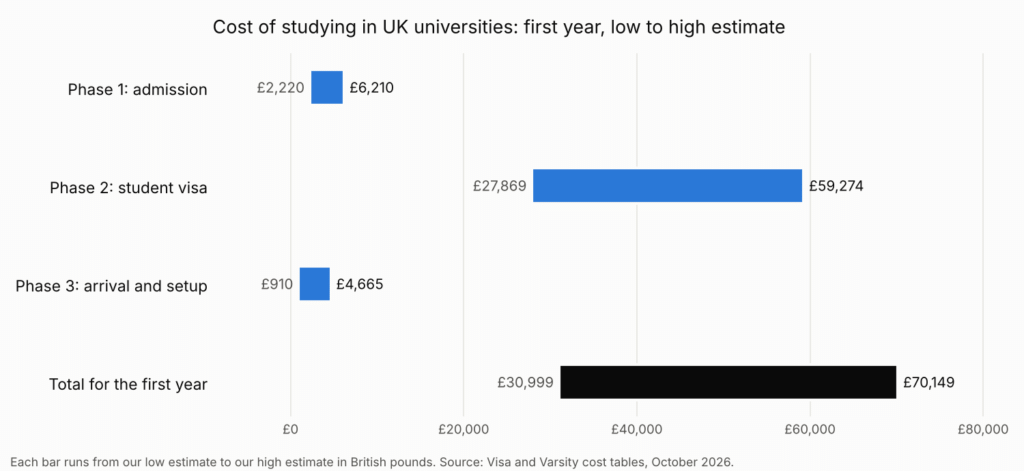
That total is large because we’ve put four very different kinds of money into it. Once you separate them, you can see what the UK really charges you for the right to study there.
Living money that stays yours. You spend the £10,827 to £14,130 you hold for 28 days on your own rent, food and bus fares over the year. Take it out, and the total falls to about £20,172 to £56,019.
Tuition that pays for your degree. Your deposit and the rest of your first-year fee, £17,100 to £45,500 in our tables, go to your university in return for teaching. You have to pay it, but it’s the price of the qualification, not a fee for paperwork. Take that out too, and about £3,072 to £10,519 is left.
A deposit you should get back. Your landlord puts your tenancy deposit of £250 to £1,385 in a protection scheme, and should return it at the end of the tenancy as long as the room is in good condition. Take that out as well, and the money you lose for good to charges and setup comes to about £2,822 to £9,134. That covers the visa fee, the health surcharge, tests, translations, bank costs, flights and the first things you buy.
For anyone on a degree longer than one year, the health surcharge is the largest single part of that lost money. Still, it’s far cheaper than private health insurance in many countries, and it gives you the same NHS care as a UK resident.
What these tables leave out. Our figures cover the first year only. A three-year degree needs tuition for years two and three, and some universities raise fees each year for continuing students. The Graduate visa costs extra too. If you apply on or after 1 January 2027, you pay the £937 fee plus £1,035 a year in surcharge for 18 months, which comes to about £2,490. If you apply by 31 December 2026, you get two years, and you pay about £3,007. Finally, we haven’t included the international student levy that English universities start paying in August 2028, because universities haven’t yet said how they’ll handle it.
UK tuition fees for international students in 2026 to 2027
Tuition is the biggest part of the cost of studying in UK universities, and the amount depends more on the university and the subject than on the level of study. We found no reliable official national average for international fees, so here are real 2026 to 2027 figures from university fee pages.
| Type of course | Yearly tuition for international students | Where the figure comes from |
|---|---|---|
| Foundation year at a public university | £11,750 to 21,250 | Northumbria University, for two to four semesters |
| Bachelor’s degree at a lower-fee public university | £17,100 to 29,800 | Keele University fee bands, and Northumbria at £19,850 to £21,500 |
| Bachelor’s degree at a research-intensive university | £25,500 to 45,500 | University of Bristol from £25,500, and Imperial College London at £45,500 for engineering |
| Medicine or dentistry | £45,800 to 49,700 | Bristol, for medicine and dental surgery |
| Bachelor’s degree at a private university | £22,200 | University of Buckingham, which teaches most degrees in two longer years |
| Taught master’s degree | £17,100 to 59,400 | Keele at the low end and a clinical MSc at Bristol at the high end. Campus master’s degrees at Bristol start at £25,500 |
| PhD | £17,854 to 29,400 | Keele for 2026 to 2027, and the top of Surrey’s published range for 2027 entry. Lab-based projects can add bench fees |
A one-year master’s is one of the cheapest ways into the UK system, because you pay one year of tuition and one year of living costs, and you can still apply for the Graduate visa. The trade-off is that you can’t bring your family on a taught master’s, and a Graduate visa you get in 2027 will last 18 months, not two years. If your goal is a UK job, that shorter window is the bigger risk of the two, so start job hunting in your second term.
Smart ways to spend less on a UK degree
Your biggest saving comes from the city and the university you choose. Outside London, you show about £3,300 less in living money over nine months, and you’ll usually pay much less rent too. Lower-fee universities such as Keele and Northumbria charge thousands of pounds less than research-intensive universities for many of the same subjects. If you’re weighing the cost of studying in UK universities against other countries, our guide to the cost of studying in Germany is worth reading, because most public universities there charge little or no tuition, though you’ll still pay living costs.
Ask each university about scholarships before you pay the deposit. Some UK universities give automatic discounts for paying early or for students from certain countries, and some pay part of the fee for strong grades. If a scholarship letter shows the amount, and the university puts it on your CAS, it also counts towards your proof of funds.
Don’t save money in ways that can sink your application. Don’t move your money into a cheaper but unregulated account, don’t take the TB test too early to avoid a second trip, and don’t book a non-refundable flight before the Home Office approves your visa.
Nine things to confirm first
- Check the register. Search for the university on the Home Office register of licensed student sponsors before you pay any application fee.
- Work out your exact funds figure. Add the unpaid tuition on your CAS to the living money for London or outside London, using the figure for the date you’ll actually apply.
- Start the 28 days on time. Count back from your planned application date, and don’t let the balance drop for even a day.
- Use the right account. That means your own account, a joint account in your name, or a parent’s account with a consent letter and birth certificate.
- Book the TB test at the right time. The certificate lasts six months from the X-ray.
- Apply for ATAS on the day you learn you need it. It takes at least six weeks.
- Write down your Graduate visa deadline. Your application must reach the Home Office before your Student visa ends.
- Watch the date changes. The Home Office raises the funds figure on 30 November 2026 and shortens the Graduate visa on 1 January 2027.
- Compare full costs between countries. Our Italy study cost guide and our France study cost guide use the same stages and the same tables, so you can set them side by side.
Questions students ask about the cost of studying in UK universities
How much does a UK student visa cost in total?
The visa fee is £558, and the health surcharge adds £776 for each year of your visa, so a one-year master’s costs about £1,722 in Home Office charges. In our tables, the full first year, with tuition and living money, comes to about £30,999 to £70,149. Of that, about £2,822 to £9,134 is gone for good in charges and setup costs.
How much money do I need in my bank account for a UK student visa?
From 30 November 2026, you need your unpaid first-year tuition plus £1,203 a month outside London or £1,570 a month in London, for up to nine months. You must keep the money in the account for 28 days in a row, and your newest statement can’t be more than 31 days old when you apply.
Can I work in the UK on a Student visa?
Yes, within limits. A full-time degree student at a university can take paid work for up to 20 hours each week during term and full-time in official vacations, while a student below degree level can work 10 hours a week in term. You can’t be self-employed.
Is the Graduate visa still two years?
You get two years if you apply on or before 31 December 2026, and 18 months if you apply on or after 1 January 2027. PhD graduates still get three years. You can only hold the Graduate visa once.
Do I get my money back if the Home Office refuses my UK visa?
The Home Office usually refunds the health surcharge within six weeks, but it keeps the £558 visa fee. Many universities refund the tuition deposit after a refusal, but not if the Home Office refused you for false or misleading information, so read the refund terms before you pay.
Everything on this page is general information for students planning to study in the UK, and it isn’t immigration advice for your own case. The UK government changes visa rules and fees several times a year, so check every figure on the official GOV.UK pages linked above before you pay or apply. In the UK, only certain people can legally give immigration advice: advisers registered with the Immigration Advice Authority, members of approved professional bodies, and regulated solicitors and barristers. You can search for a registered adviser on GOV.UK. Check that an agent is registered before you pay them, because you can’t get your money back from an adviser nobody regulates.