
Most students check the number of student visa work hours on their visa and stop there. That’s where the trouble starts, because the number only means something once you know how your country counts it. This guide covers Canada, the UK, Australia, New Zealand, the US, Malaysia, Germany, France and Japan. We’ve organized it around four questions you need to answer to know your limit. These are the unit, what counts as work, what you need before your first shift, and term time versus breaks. You’ll find short country cards near the end, then puzzles, a rumor check and quick answers.
A few names come up often. IRCC is Canada’s immigration department, and IRPR is its immigration regulations. INZ is Immigration New Zealand. F-1 is the US student status, 8 CFR is the US federal immigration regulations, and USCIS is the US agency that issues work permits. ICE runs the US student database. ISA is Japan’s Immigration Services Agency, and the Department of Home Affairs runs Australian visas. In the UK, your eVisa is your digital record of immigration status.
A. How student visa work hours are measured
1. Same 20, different rule
Each government decides its own unit, so you learn less from the headline number than you’d think. Put the UK and Germany side by side. Both seem to offer “about 20 hours.”
In the UK, a full-time degree student at a university with a track record of compliance can work 20 hours in each week of term. Germany sets no weekly cap at all. Instead, you get a yearly account of 140 working days, and a lecture-period week of up to 20 hours can count as 2.5 of those days.
So Germany’s 20 hours is a way of counting days, not a weekly maximum. A German student can work 38 hours in a semester-break week and stay legal, as long as days are left in the account. A UK student who works 38 hours in a term week breaks the rules that week.
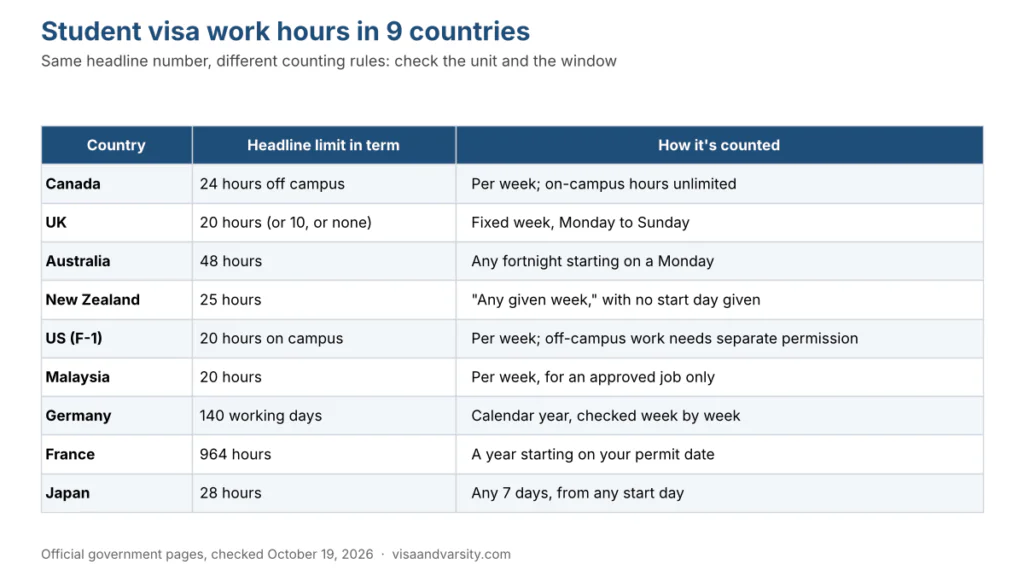
Here’s how the headline numbers compare once you add the unit and window.
| Country | Headline limit in term | How it’s counted |
|---|---|---|
| Canada | 24 hours off campus | Per week; on-campus hours unlimited |
| UK | 20 hours (or 10, or none) | Fixed week, Monday to Sunday |
| Australia | 48 hours | Any fortnight starting on a Monday |
| New Zealand | 25 hours | “Any given week,” with no start day given |
| US (F-1) | 20 hours on campus | Per week; off-campus work needs separate permission |
| Malaysia | 20 hours | Per week, for an approved job only |
| Germany | 140 working days | Calendar year, checked week by week |
| France | 964 hours | A year starting on your permit date |
| Japan | 28 hours | Any 7 days, from any start day |
You’ll find the official link for each row in the country cards in section E. If you’re comparing countries, compare the unit and the window, not the headline number.
2. When does my counting week actually start?
Your government decides which hours get added together, and only a few of them say so clearly.
UK: fixed weeks. The Home Office defines a week as seven days beginning with a Monday. So only the calendar week matters.
Australia: overlapping fortnights. Under visa condition 8105, a fortnight is 14 days commencing on a Monday. The law doesn’t say “every second Monday.” An older Home Affairs page said a fortnight starts on any Monday. That page used the old 40-hour figure, so we only rely on it for the counting method.
Japan: any 7 days. The Immigration Services Agency says your 28 hours must hold whichever day of the week you start counting from.
Germany: the calendar year. The Residence Act gives 140 days “in the year” but doesn’t say which year. Your foreigners authority (the Ausländerbehörde, the local office that issues your residence permit) applies it. The offices in Dresden and Leipzig both use the calendar year.
France: your permit year. Your 964 hours start when your residence card is issued or your VLS-TS is validated. A VLS-TS is a long-stay visa that also works as a residence permit. So a permit issued on September 1, 2025 gives you a year ending on August 31, 2026.
New Zealand: not defined. INZ allows 25 hours “in any given week” but never says when a week starts.
Canada, the US and Malaysia: not defined either. Canada’s regulations allow 24 hours per week. The US regulations allow 20 hours a week on campus. Malaysia’s Immigration Department allows 20 hours a week. None of them names a start day. Example from the University of Colorado Boulder: the university runs its payroll week from Sunday to Saturday. That’s the school’s choice, not federal law.
If your country isn’t clear, ask your international office which week your employer uses. Then test your schedule the strict way below.
3. The strict way to test a schedule
Where no government defines the window, you decide how carefully to check, and we’d always check every window.
- Write down your hours day by day.
- Add up every run of 7 days in a row: Monday to Sunday, Tuesday to Monday, and so on.
- If any run goes over your limit, change the schedule.
Take New Zealand’s 25 hours. You work 1 hour on Thursday, 8 hours each on Friday, Saturday and Sunday, then 8 hours each on Monday and Tuesday. The calendar weeks hold 25 and 16 hours, so both pass. But Friday to Thursday holds 40 hours. Under the strict reading, you’re over.
The UK works differently because the Home Office defines its week. So 20 hours from Friday to Sunday, then 20 hours from Monday to Wednesday, is legal. That’s 40 hours in six days, but only 20 in each fixed week.
Australia shows why payslips aren’t enough. Say you work 15, 30, 24 and 10 hours over four weeks. Your employer pays you every two weeks, so your payslips show 45 and 34 hours. But the fortnight that starts on the Monday of week 2 holds 54 hours. That breaks condition 8105.
4. Germany’s half-day line
The Residence Act sets the line, and your foreigners authority checks it. A day on which you work up to 4 hours counts as half a working day. Any longer day counts as a full day. So exactly 4 hours is a half day, and 4 hours and 1 minute is a full day.
But the law also counts each calendar week in whichever way is better for you:
- Day method: half days and full days, as above.
- Week method: 2.5 days for the whole week, if you worked no more than 20 hours during the lecture period. Outside the lecture period, any week counts as 2.5 days.
The lecture period (Vorlesungszeit) is the teaching part of the semester, and your university sets its dates.
| Lecture-period week | Day method | Week method | What you use |
|---|---|---|---|
| Three shifts of 4 hours (12 hours) | 1.5 days | 2.5 days | 1.5 days |
| Three shifts of 4 hours 15 minutes | 3 days | 2.5 days | 2.5 days |
| Four shifts of 5.5 hours (22 hours) | 4 days | Not allowed (over 20 hours) | 4 days |
Fifteen extra minutes per shift turned 1.5 days into 2.5. And once a lecture week goes over 20 hours, you lose the week method completely. So in lecture weeks, we’d keep each shift at 4 hours or less, or keep the whole week at 20 hours or less.
B. What counts as work
5. Does an unpaid internship count?
Often, yes. Your government decides what “work” means, and in most of these countries it doesn’t just mean paid work.
| Country | What the official pages say |
|---|---|
| Canada | IRCC counts unpaid work that would usually be paid, or that gives valuable experience, such as an unpaid internship |
| UK | The Home Office counts unpaid jobs and unpaid placements as employment |
| Australia | The Migration Regulations treat work as any activity that normally attracts pay. Home Affairs counted unpaid work unless it was genuine volunteering for a non-profit |
| New Zealand | INZ lets you volunteer only if you get no gain or reward, and free board, food or transport counts as reward |
| Germany | Your foreigners authority counts voluntary internships, which you need approved first, but not required ones |
| US, France, Japan, Malaysia | We found no official answer |
Universities fill some gaps. Example from the University of British Columbia: UBC tells students that volunteer work may count toward the 24 hours. Example from Liverpool John Moores University: LJMU counts regular charity shop shifts but not occasional volunteering. Example from the University of Wisconsin-Madison: UW-Madison treats unpaid work for a company as employment.
Our rule of thumb: if a local person would normally get paid for the role, count the hours. If you’re not sure, email your international office before you start.
6. Delivery apps and gig work
Most governments haven’t said whether time spent logged in and waiting counts. So it’s your record, not the app’s, that protects you.
Japan has the clearest rule. The Immigration Services Agency allows delivery work as a sole trader under the standard permission only if your hours can be checked objectively. If they can’t, you need an individual permission.
The UK and New Zealand ban self-employment, so contractor-style app work is out. The Home Office bans self-employment and business activity for students, and INZ says you must work for an employer under an employment agreement. Example from University College London (UCL): UCL lists delivery and ride-hailing apps as not allowed.
In Canada, IRCC counts self-employed time spent earning, selling or collecting commission. We found no official answer on whether waiting time counts.
In the US, app work is off-campus work. You’d need CPT or OPT (two kinds of practical training, explained in section 8) or a hardship authorization first.
We found no official statement on app work for Australia, Malaysia, Germany or France. Where app work is allowed, log the time from when you switch to “available” until you switch off.
7. Can I freelance or run my own business?
Your immigration office decides, and the answer is usually no or “only with permission.”
| Country | What you can do |
|---|---|
| Canada | You can work for yourself off campus within the 24 hours, or on campus if your business is located there |
| UK | You can’t, unless you have a pending, endorsed Innovator Founder application (Appendix Student). The Home Office also treats owning 10% or more of your employer, or being its director, as business activity |
| New Zealand | You can’t. INZ bans self-employment |
| Germany | You need your foreigners authority to approve it first, and it then counts within your 140 days |
| France | You can’t register as an auto-entrepreneur on a student card. That’s the simplified sole-trader status |
| Japan | You need an individual permission to run a business alone |
| Australia, US, Malaysia | We found no official answer |
If you already earn money online, ask your international office about it before your first term starts.
8. Work that doesn’t use up your limit
Your government decides which jobs don’t count toward the limit, and most countries leave out work that your course requires.
- Canada: IRCC sets no limit on on-campus hours. Since April 1, 2026, you don’t need a co-op work permit for a required placement. There’s no weekly limit on it, as long as it’s no more than 50% of your program.
- UK: you can do a work placement that’s an integral, assessed part of your course on top of your weekly hours.
- Australia: work listed as a course requirement on CRICOS doesn’t count. CRICOS is the national register of courses for overseas students. Research master’s and doctoral students have no limit once they start.
- New Zealand: PhD and research master’s students have no hours limit.
- US: your school can authorize CPT (curricular practical training) for required internships and co-ops, and it can be full-time. But if you do a year or more of full-time CPT, you lose OPT (optional practical training) after you graduate.
- Germany: student assistant jobs at a university or research institute don’t count.
- France: an apprenticeship approved by an OPCO can go beyond 964 hours. An OPCO is the body that funds and approves apprenticeships.
- Japan: you don’t need permission for teaching or research assistance under a contract with your own university.
- Malaysia: we found no official answer.
Before you sign a placement contract, ask your school for a letter saying the placement is required for your course.
9. I work remotely for a company back home. Does that count?
Only Canada gives a clear answer. Four different groups could decide this, so keep the questions apart.
Immigration. IRCC says remote work for an employer outside Canada doesn’t count toward your 24 hours. For the other eight countries, we found no official answer.
Tax. The US tax agency (IRS) treats pay for work as coming from where you do the work, wherever the payer is. Canada’s tax agency (CRA) says tax residents report income from anywhere in the world. Australia’s tax office (ATO) says students in courses of 6 months or more may be Australian tax residents. We found no tax position for the other countries.
Labor law. We found no official position for any of the nine countries.
Your university. Example from UCL: UCL says remote work for an overseas employer counts toward your weekly UK hours while you’re in the UK. Example from UW-Madison: UW-Madison says F-1 employment is only authorized for US-based companies.
Outside Canada, we’d treat remote work as counting unless your school confirms otherwise in writing.
C. What you need before the first shift
10. How your school or course can change your limit
Your school often decides your limit, based on the course you take, and in some countries the answer can be zero.
UK. Your sponsor decides, based on your course. Full-time degree study at a higher education provider with a track record of compliance gives you 20 hours. A track record of compliance just means a four-year record of meeting immigration duties. Below degree level at such a provider, you get 10 hours. All other study, including all part-time study, gives you none. Your CAS (Confirmation of Acceptance for Studies, the reference your sponsor issues) and your eVisa show which applies.
Canada. You need to be full-time at a DLI. That’s a designated learning institution, a school approved for international students. Your program must also last 6 months or more. Students taking only English or French language courses can’t work off campus.
New Zealand. You need a full-time course of at least 2 academic years, a Level 4 or higher qualification, or certain English courses. INZ gives no work rights for micro-credentials.
US. On-campus work comes with F-1 status. But off-campus hardship work and CPT usually need one full academic year first.
Malaysia. The Immigration Department only accepts students at public universities and private higher education institutions. Language and training centers don’t qualify.
France. On a 6-month visa, your employer needs a work authorization first, and your hours are cut in proportion, for example to 482 hours. Algerian students follow a separate agreement. Their employer needs authorization first, and they can then work up to 50% of the annual working time in that profession.
Germany. The 140-day rule also covers you if you were admitted to a language course before your degree, or to part-time study.
Japan. You can only work while you’re enrolled.
Australia. Your limit comes from your visa condition, not your school type.
If you’re not sure which group you’re in, ask your international office before you accept a job.
11. Permission and paperwork
In some countries you just need the right visa. In others, an office has to approve you, or your employer has to file something first.
| Country | What you need before you work | Who does it |
|---|---|---|
| Canada | A work condition printed on your study permit, then a SIN (Social Insurance Number). IRCC adds a missing condition for free | You |
| UK | Work conditions on your eVisa | You |
| Australia | Condition 8105 on your visa, which you check on VEVO, the online visa check | You |
| New Zealand | Work conditions on your eVisa | You |
| US | Nothing extra on campus. For CPT, your DSO (designated school official) updates your I-20, your school’s eligibility form. For OPT, you need a USCIS work card first | DSO or USCIS |
| Malaysia | Immigration approval for a named job, with a job offer, an institution letter showing semester and holiday dates, and a passport copy. You apply through your institution and go to Immigration with its representative | Your institution and you |
| Germany | Nothing extra within 140 days. To go further, you need the foreigners authority and the Federal Employment Agency | You |
| France | Your employer declares you to the prefecture at least 2 working days before you start | Your employer |
| Japan | Permission to engage in activity outside your status of residence. It’s free and usually takes 2 weeks to 2 months, and new students can get it at the airport | You |
Examples from Monash University Malaysia and the University of Nottingham Malaysia: Monash sends students to Immigration in person, and Nottingham adds an interview at Immigration.
12. Jobs you can’t take
Your immigration office decides which jobs are off limits, and the lists are short but strict.
- UK: the Home Office bans professional sport or coaching, entertainment work and permanent full-time jobs. The permanent-job ban only lifts if you have a pending Graduate or Skilled Worker application that meets paragraph ST 26.6.
- Japan: the ISA bans any job at an adult entertainment business.
- New Zealand: INZ bans commercial sexual services.
- Malaysia: the Immigration Department bans front desk and recruitment agent work, and Education Malaysia adds cashier and some hotel roles.
- US: on-campus work must be for the school or a firm serving students directly, so a construction company on campus doesn’t count.
- Canada, Australia, Germany and France: we found no student-specific bans beyond the self-employment rules in section 7.
13. My visa shows the old limit. Which one applies?
It depends on the country, and the answers go in opposite directions.
Canada: the new rule applies automatically. If 20 hours is printed on your permit, IRCC says you can still work 24.
New Zealand: you have to apply to change it. INZ raised the limit to 25 hours on November 3, 2025. If your visa was granted earlier with 20 hours, you stay at 20 until INZ approves a variation of conditions and issues an updated eVisa.
Australia: the text says 40, but you get 48. Condition 8105(1) still says 40 hours. But subclause (2A) changes it to 48 for Student visa holders.
Germany: an official portal is out of date. One Make it in Germany page still says “120 full days”, but the Residence Act sets 140. Follow the Act.
Malaysia: two government pages disagree. See the Malaysia card in section E.
When the printed condition and the current rule disagree, follow the stricter one until an official page tells you otherwise in plain words.
D. Term time versus breaks
14. What counts as a break?
Your school calendar decides, not your workload. A quiet week isn’t a break.
- Canada: IRCC needs a scheduled break to be in your school’s calendar and last at least 7 days in a row. You can work unlimited hours for up to 150 days in a row, and 180 days per calendar year. You need to be full-time before and after the break. A break you create yourself counts as leave, so you can’t work, and programs with no breaks stay at 24 hours all year. Mind you, these caps are in IRCC guidance, not the regulation itself, but we’d still plan to them.
- UK: your sponsor sets and publishes your term and vacation dates. Examples from the University of Manchester and UCL: both treat the master’s summer dissertation period as term time. Manchester also gives PhD students no vacations.
- Australia: your course is “in session” during advertised semesters, including exams. Outside that, you can work unlimited hours.
- New Zealand: you can only work full time in breaks if your visa conditions allow it, and that needs a course of at least one academic year.
- US: you can work on campus full time when school isn’t in session. Example from UW-Madison: UW-Madison may cap student jobs at 29 hours a week in breaks under its own payroll policy, which is stricter than federal law.
- Germany: you still use days in breaks. Outside the lecture period, every week you work counts as 2.5 days.
- France: there’s no separate break rule, so summer work comes out of the same 964 hours.
- Japan: you can work up to 8 hours a day during long vacations set by your school’s regulations.
- Malaysia: two government pages disagree. See the card.
Ask your school for its official break dates in writing, and keep the letter with your work records.
15. When can I start, and when must I stop?
Your government sets the start and finish lines, and your school’s dates decide when they fall.
Before your course starts. Canada doesn’t allow any work until your program begins, and neither does Australia under condition 8105(1A). The UK lets you work full time before your course if you’re in the UK with permission. In New Zealand, your 25 hours apply for the whole visa. In the US, you can start on-campus work no more than 30 days before classes.
After your course ends.
- Canada: you can work up to 24 hours a week until you get written confirmation that you’ve finished. Then you have to stop, unless you applied for a work permit, such as the PGWP (post-graduation work permit), before your study permit expired.
- UK: the Home Office treats the time after your course as a vacation, so you can work full time until your permission ends.
- Australia: Study Australia says you can work unlimited hours while your visa is valid. Example from the University of New England: UNE says you stay “in session” while your CoE (Confirmation of Enrolment) is valid, which is stricter.
- US: you can’t work on campus after you complete your course, except through practical training.
- Japan: the ISA doesn’t allow part-time work after graduation.
Between programs. In Canada, you can work full time off campus for up to 150 days between programs, if you have written completion and a new acceptance letter.
On leave. Canada doesn’t allow any work during an authorized leave. Australia lets you work unlimited hours during an approved deferral. So the two countries treat leave in opposite ways.
Dropping to part time. In Canada, you must stop off-campus work as soon as you drop to part time, unless it’s your final semester. In the UK, part-time study gives you no work rights. In New Zealand, you need a different visa to study part time. A failed module is a common reason students drop a course and lose work rights by accident. Our guide to what happens to your student visa if you fail a module explains the study-load rules. Talk to your international office before you drop anything.
E. Country cards
Each card shows the unit, the window, what counts, what you need first (the gate), term and breaks (the season), and the most common mistake. We’d still plan your first year without counting on work income. Our cost guides show the full bill for Canada, the UK, Australia, New Zealand, the US, Malaysia, Germany, France and Japan.
Canada
| Unit | Hours off campus; on campus unlimited |
| Window | Per week; no start day given |
| What counts | Paid work, unpaid internships, self-employed earning time. Not remote work for a foreign employer |
| Gate | Full-time at a DLI, program of 6 months or more, work condition, SIN |
| Season | 24 hours in session; unlimited in breaks of 7 days or more, up to 180 days a year |
| Common mistake | Taking your own break and working through it |
| Last verified | October 19, 2026 |
United Kingdom
| Unit | Hours |
| Window | Fixed week starting Monday |
| What counts | Paid and unpaid work and placements |
| Gate | Your sponsor and course: 20, 10 or no hours. No self-employment |
| Season | Your sponsor’s term dates; full time in vacations |
| Common mistake | Working full time in a master’s dissertation summer |
| Last verified | October 19, 2026 |
Australia
| Unit | Hours |
| Window | Any 14 days starting on a Monday |
| What counts | Any activity that normally attracts pay; unpaid work unless it’s genuine volunteering |
| Gate | Your course has to start first |
| Season | 48 hours a fortnight in session; unlimited out of session |
| Common mistake | Checking payslips instead of every Monday fortnight |
| Last verified | October 19, 2026 |
New Zealand
| Unit | Hours |
| Window | “Any given week”; no start day given |
| What counts | Work for an employer; volunteering only with no reward |
| Gate | Course length or level tests. No self-employment |
| Season | 25 hours a week; full time in breaks only with the right conditions |
| Common mistake | Working 25 hours on a visa that still shows 20 |
| Last verified | October 19, 2026 |
United States (F-1)
| Unit | Hours |
| Window | “A week”; no federal start day |
| What counts | All on-campus jobs combined; off campus only with CPT, OPT or hardship approval |
| Gate | Hardship work and CPT usually after one academic year |
| Season | 20 hours in session; full time when school isn’t in session |
| Common mistake | Using a year of full-time CPT and losing OPT |
| Last verified | October 19, 2026 |
Malaysia
| Unit | Hours |
| Window | Per week; no start day given |
| What counts | An approved job in a restaurant, petrol station, mini market, hotel or campus |
| Gate | Immigration approval through your institution |
| Season | The Immigration Department links work to the study period. Education Malaysia allows only breaks of more than 7 days |
| Common mistake | Working in term without written approval. Universities follow the break-only reading, and we’d plan for it too |
| Last verified | October 19, 2026 |
Germany
| Unit | Working days; half days for up to 4 hours |
| Window | 140 days per calendar year, checked week by week |
| What counts | Employment and voluntary internships. Not student assistant jobs or required internships |
| Gate | Approval for self-employment or work beyond the account |
| Season | Lecture weeks of up to 20 hours: 2.5 days. Any break week: 2.5 days |
| Common mistake | Working 4 hours 15 minutes, which uses a full day. Working without permission can bring a fine of up to €5,000 |
| Last verified | October 19, 2026 |
France
| Unit | Hours |
| Window | 964 hours from your card or VLS-TS date |
| What counts | Salaried work; OPCO-approved apprenticeships can go beyond |
| Gate | Student VLS-TS or card; your employer declares you 2 working days before |
| Season | No separate break rule |
| Common mistake | Going over, which can lead the prefecture to withdraw or refuse to renew your card |
| Last verified | October 19, 2026 |
Japan
| Unit | Hours |
| Window | Any 7 days, from any start day |
| What counts | Paid work; delivery work only if your hours can be checked |
| Gate | Permission before work; no adult entertainment venues; tell your school where you work |
| Season | 8 hours a day in long vacations |
| Common mistake | Checking only Monday to Sunday |
| Last verified | October 19, 2026 |
F. Using it
16. Shift-sheet puzzles
Try each one, decide safe or over, then read the answer. If a real schedule looks close, show it to your international office before you agree to it.
Puzzle 1: weekly counting in Japan (28 hours). Thursday 5 hours, Friday 5, Saturday 8, Sunday 8, Monday 4, Tuesday 4.
Answer: over. The calendar weeks hold 26 and 8 hours. But Thursday to Wednesday holds 34, and the ISA counts from any day. In the UK’s fixed weeks, this schedule would pass.
Puzzle 2: fortnight counting in Australia (48 hours). Four term weeks of 20, 26, 22 and 26 hours.
Answer: safe. The Monday fortnights hold 46, 48 and 48 hours. Condition 8105 bans “more than 48”, so exactly 48 is allowed.
Puzzle 3: yearly days in Germany (140 days). One 4.5-hour Saturday shift in each of 44 lecture weeks, plus 35 hours a week for 8 break weeks.
Answer: safe, using 64 days. Each Saturday is a full day by the day method and 2.5 by the week method, so it counts as 1. That’s 44 days. Each break week counts as 2.5, which adds 20. If you cut the shift to 4 hours, the Saturdays would use only 22 days.
Puzzle 4: yearly hours in France (964 hours). VLS-TS validated on September 1, 2025. You work 20 hours a week for 43 weeks, then plan 35 hours a week for 8 summer weeks.
Answer: over. Your term work uses 860 hours, leaving 104. The summer plan adds 280, so the total is 1,140. You reach 964 early in the third week of July. Your new year starts on September 1, 2026.
17. Rumor check
These claims come up a lot. Here’s what the official pages actually say.
| Claim | Verdict | What the official pages say |
|---|---|---|
| “Australia’s limit rises to 60 hours a fortnight.” | No official source | The law sets 48 under condition 8105(2A), and Home Affairs still says 48 |
| “Canada caps unlimited break work at a set number of days.” | True | IRCC caps it at 180 days per calendar year and 150 days in a row |
| “Remote work never counts.” | False | Only IRCC says so officially. UCL treats it as counting in the UK |
| “A quiet week counts as a break.” | False | Your school calendar decides. IRCC needs 7 or more scheduled days |
| “Germany’s break work uses up your day allowance.” | True | Each break week you work counts as 2.5 days |
| “France’s 964 hours reset on January 1.” | False | Your year starts on your permit date |
| “Japan’s 28 hours reset every Monday.” | False | The ISA uses any start day |
| “You can average UK hours over a month.” | False | Each fixed Monday week stands alone |
| “All New Zealand students got 25 hours automatically.” | False | You need a variation if your visa shows 20 |
| “Malaysian students can work 20 hours a week in term.” | Disputed | The two government pages disagree |
18. Rule-change log
Governments change the rules on student visa work hours more often than students expect, so check the date on any guide you read.
| Date | Country | What changed |
|---|---|---|
| March 1, 2024 | Germany | The 140-day account started, according to the Federal Employment Agency’s instructions |
| April 30, 2024 | Canada | IRCC ended a temporary policy that allowed more than 20 hours |
| November 8, 2024 | Canada | IRCC raised the off-campus limit from 20 to 24 hours |
| November 3, 2025 | New Zealand | INZ raised the limit from 20 to 25 hours |
| April 1, 2026 | Canada | IRCC dropped the co-op work permit for required post-secondary placements |
| June 11, 2026 | Sweden (not covered above) | The Swedish Migration Agency limited new student permits to 15 hours a week in semesters, with no limit from June to August |
We found no change to student work hours since 2024 for the UK, Australia, the US, Malaysia, France or Japan. We also found nothing announced but not yet in force for the nine countries. If you’re weighing up Sweden too, our Sweden cost guide covers the new limit.
19. Keeping your own record
You’re the one who has to prove you stayed within your student visa work hours. IRCC says it’s your job, not your employer’s, to track your hours, and German offices also tell students to keep records.
Your own log matters more than payroll for three reasons. Employers pay in periods that rarely match the legal window. Each employer only sees its own hours. And payroll may leave out unpaid work or time spent waiting on an app.
So log every working day: the date, start and end times, unpaid breaks, the employer or app, whether it was on or off campus, and whether it was paid. Keep a running total for your country’s window.
Keep your payslips, rosters and employment contracts. Keep exports from any app you use, your school’s term dates, and every approval or permit that shows your work conditions. We’d keep the lot until well after your visa ends.
20. Quick answers
Do unpaid internships count toward student visa work hours?
Often, yes. IRCC counts unpaid internships in Canada, and the Home Office counts unpaid work and placements in the UK. Your school usually treats required course placements differently, so ask your international office.
Can I work more hours during my summer break?
Usually, yes. Canada, the UK, Australia and the US allow full-time work in official breaks. New Zealand only allows it if your visa conditions include it. France has no break rule, Germany counts break weeks at 2.5 days, and Japan allows 8 hours a day.
When does the week start for my work limit?
The UK starts on Monday. Japan uses any start day, and Australia counts fortnights from any Monday. Canada, New Zealand, the US and Malaysia don’t say, so test every 7-day run.
Does working remotely for a company in my home country count?
In Canada, no. For the other eight countries we found no official answer, so we’d treat it as counting unless your school confirms otherwise.
Can I do food delivery work on a student visa?
Not in the UK or New Zealand, because both ban self-employment. In Japan, only if your hours can be checked. In Canada, the hours count toward your 24.
Can I start working before my course begins?
Not in Canada or Australia. In the UK, yes, if you’re there with permission. In the US, no earlier than 30 days before classes.
My visa shows 20 hours, but the limit went up. Which applies?
In Canada, the new limit applies automatically. In New Zealand, you need to apply for a variation first.
Do Germany’s 140 working days reset every year?
Yes, each January, according to local foreigners authorities.
When does France’s 964-hour year start?
On the day your card is issued or your VLS-TS is validated.
Do I need permission before my first shift in Japan?
Yes. The ISA doesn’t charge for it, and it usually takes 2 weeks to 2 months.
This is general information. Governments change these rules, and your school or a government office may apply them more strictly. Check the official pages linked here before you accept a job. For advice on your own case, speak to your school’s international office or a licensed immigration adviser in the country where you study. Budgeting guides, not immigration advice.