
Study Abroad Cost Calculator
This study abroad cost calculator adds up a scattered set of fees and gives you one number you can compare across countries. That matters because the real price of studying abroad is rarely on the tuition page. It is made up of tuition, visa fees, proof of funds, insurance, flights, language tests, a refundable deposit and the first months of living costs, and every country presents those pieces differently.
This guide explains how to use our study abroad cost calculator from the first click to the final comparison. It covers what each setting does, what the four cost types mean, how to read the bars, how to use the optional budget feature, and which mistakes to avoid when you plan. The calculator compares 10 study destinations: Australia, Canada, France, Germany, Italy, Japan, Malaysia, New Zealand, Poland and the United States.
By the end you will know how to build a realistic first year estimate, how to shortlist countries by cost, and where to go next for the details of each one.
Please note: This calculator gives cost estimates only. It is not immigration or legal advice, and it does not replace advice from a qualified immigration adviser or lawyer, your school or the official government pages. Visa rules, fees and proof of funds requirements change, and the immigration authority of each country, not this calculator, decides whether you qualify for a visa.
What a study abroad cost calculator does
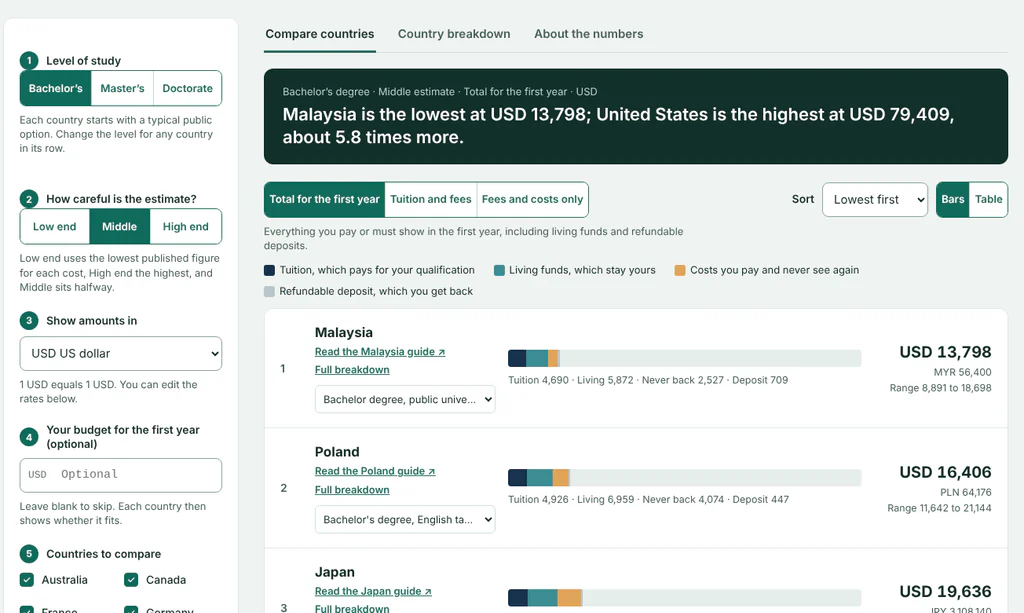
The calculator estimates what your first year of study costs in each country and shows the results side by side, in one currency. You choose your level of study, how careful the estimate should be, and the currency you think in. The calculator then runs a separate, country specific calculation for each destination and puts the answers on one scale.
Two details make the comparison fair. First, every country is measured over the same period: the first year, which is when you pay most of the one off costs. Second, every figure is converted to the currency you picked, so you are not comparing euros with yen in your head.
The study abroad cost calculator is a planning tool, not a quote. Fees and rules change often, so use it to narrow your choices, then confirm the final numbers with the school and the official immigration pages before you pay anything.
How to use the study abroad cost calculator, step by step
The settings are in a panel beside the results. Work through them from top to bottom, and the comparison updates as you go.
Step 1: Choose your level of study
Pick Bachelor’s, Master’s or Doctorate. The calculator sets a typical public option for that level in each country, so you get a sensible baseline straight away. If you plan to attend a private institution or a different programme type, change the programme in that country’s row later.
Step 2: Choose how careful the estimate should be
Choose Low end, Middle or High end. Low end uses the lowest published figure for each cost, High end uses the highest, and Middle is halfway between them. If you are unsure, start with Middle.
Step 3: Choose your currency
Select the currency you want to see. The calculator converts every country into it, so a total in one place can be compared directly with a total in another.
Step 4: Add a budget, if you have one
The budget is optional. Type the amount you can afford for the first year, and each country shows whether it fits. Leave it blank if you only want to compare costs.
Step 5: Choose your countries
All 10 countries are selected by default. Untick the ones you are not considering, or use the select all and clear links to reset the list. A shorter list makes the bars easier to read.
Step 6: Read the results and go deeper
The summary at the top names the lowest and highest country. Each row below shows a bar, a total and a link to the country guide. Open “Full breakdown” on any row for the line by line calculator behind that number.
The four types of cost in a study abroad estimate
Every bar in the calculator is split into four colours. Understanding them helps you read any study abroad cost calculator correctly, because a high total does not always mean a high real expense.
| Cost type | What it covers | Do you get it back? |
| Tuition | The fees you pay for your qualification | No |
| Living funds | Money you must show or spend to live in the country | It stays yours |
| Costs you pay and never see again | Visa fees, tests, insurance, travel, translations and setup | No |
| Refundable deposit | A deposit you must pay up front and get back later | Yes |
Tuition is usually the biggest single item, and it varies most between countries and between public and private institutions. In some countries it is low or close to zero for certain programmes.
Living funds are the money you need to live on. Many countries require you to show proof of funds for your visa, as Canada does on its official proof of financial support page and Germany does through a blocked account, so you often have to prove this amount as well as spend it. The money stays yours, but you still need to have it.
Costs you pay and never see again are the sunk costs. They include visa and permit fees, language tests, health insurance, a flight and setting up your life abroad. They are small next to tuition, but people often forget them.
Refundable deposits are included in the total because you must have the cash on the day, even though you get it back later.
Low, middle and high estimates: which should you choose?
Many costs are published as ranges, not single prices. A university may list a fee range by programme, and living costs depend on the city and your lifestyle. You choose which end of those ranges the calculator uses with the estimate setting.
- Low end uses the lowest published figure for every cost. It shows the cheapest realistic case, such as a lower fee programme and modest living.
- Middle uses the halfway point. It is the best default for general comparison.
- High end uses the highest published figure for every cost. It shows what a more expensive but still realistic year could cost.
A good habit is to compare countries at Middle, then check your shortlist at High end. If a country only fits your budget at the Low end, treat it as risky. If it fits even at the High end, you have room for surprises.
Each row also shows the range from the low end to the high end. A narrow range means the costs are fairly predictable, while a wide range means your choice of school and city matters a lot.
Using the budget feature to shortlist countries
The budget field turns the calculator from a comparison tool into a shortlisting tool. Enter the amount you can realistically spend in the first year, in the currency you selected, and three things change.
1. The summary at the top shows how many countries fit your budget.
2. A dashed line appears across the bars, showing where your budget is.
3. Each row gets a label: either how much money you would have left, or how far over budget you would be.
For example, if you enter a budget of 30,000 in your chosen currency, a country showing “Fits, 8,000 left” is inside your limit with room to spare, while one showing “Over by 1,000” is close and may become affordable with a cheaper programme or the Low end estimate.
Two tips help here. First, test your budget at both the Middle and High end estimates, so you know how much margin you have. Second, remember that the calculator compares your budget with the total for the first year, which includes living funds you must show and deposits you get back. If you only want to compare spending, switch the metric to “Tuition and fees” (explained below).
How to read the bars, ranges and comparison views
Each country row shows a horizontal bar made of the four cost colours. All bars share one scale, so a longer bar always means a higher cost. This is what makes the study abroad cost calculator useful for comparison: you can see at a glance which country is cheapest and which cost type causes the difference.
Under each bar, a short line lists the four amounts, and on the right you see the total and the range from the low end to the high end. Look at the range to see how reliable a number is.
Above the results you can switch between three views of the same data:
- Total for the first year counts everything you pay or must show, including living funds and refundable deposits.
- Tuition and fees counts tuition plus the costs you never see again. Living funds and refundable deposits are left out, so this is the best view for comparing what you actually spend.
- Fees and costs only counts visa fees, tests, insurance, travel, translations and setup. Tuition, living funds and deposits are left out.
You can also sort the list from lowest to highest, highest to lowest, or by country name, and switch from bars to a table if you prefer numbers in columns.
Going deeper: country breakdowns and guides
The comparison view is the overview. When a country looks promising, open its full breakdown. Every row has a “Full breakdown” link that opens the complete line by line calculator for that country, with each cost listed and explained. Any change you make there also changes the comparison.
The programme dropdown in each row lets you set a different level or programme for just that country, for example a private institution in one place and a public one in another.
Under every country name there is also a “Read the guide” link. Use it to read the full article for that destination, such as the cost of studying in Canada, the cost of studying in Germany or the cost of studying in Poland, which explains the fees, rules and sources behind the numbers. The calculator gives you the figure, and the guide explains why.
Some rows have a short note. For example, the figure for a country may include tuition for the first semester only, so check these notes before you compare totals. The “About the numbers” tab explains how the estimates are built and lists what is left out, such as costs after the first year.
Currency and exchange rates
A study abroad cost calculator is only as useful as its currency conversion. The calculator lets you choose from a long list of currencies, and you can enter your own code and rate if yours is not listed. Rates are set against the US dollar and were last updated on 11 October 2026.
Exchange rates change, and the rate you actually get at your bank is usually a little worse than the headline rate. If you are saving in a currency that has been volatile, open the exchange rates section and enter a rate you consider realistic. The comparison and every country breakdown follow the rates you set, so you can test a pessimistic rate in seconds.
It also helps to remember that your costs are paid in several currencies. Tuition is paid in the study country’s currency, while your savings may be in another. A weaker home currency raises every figure, and the calculator shows you by how much.
Common mistakes when estimating the cost of studying abroad
Even with a good study abroad cost calculator, a few habits can make your estimate less accurate.
- Comparing only tuition. A country with low tuition can still be expensive once living funds, insurance and setup costs are added. Always look at the total for the first year before you decide.
- Ignoring the programme. A private institution or a medical course can cost several times more than the typical public option. Set the right programme in each row.
- Treating the Middle estimate as a promise. It is a halfway point, not a guarantee. Check the range, and test your shortlist at High end.
- Forgetting what comes after year one. The calculator covers the first year. Later years usually cost less in one off fees but may include more tuition, so read each country’s notes and guide for the details.
- Skipping a safety margin. Add a buffer for exchange rate changes, price rises and unplanned travel. A budget that only just fits at Middle leaves no room for a price rise.
- Relying on one source. Use the calculator to compare, then confirm the final figures with the school and official government pages before you pay or apply.
A simple planning routine using the study abroad cost calculator
Here is a routine that works for most students. It takes about fifteen minutes.
1. Set your level of study and your home currency, and leave the estimate on Middle.
2. Enter your budget and note how many countries fit.
3. Switch the view to Tuition and fees, and see whether the ranking changes.
4. Move to High end and check which countries still fit. These are your safest options.
5. Pick two or three countries, change the programme in each row to the one you really want, and open their full breakdowns.
6. Read the guide for each shortlisted country, then confirm the key fees with the institution and the official immigration page.
By the end you have a short list, a realistic budget and a clear list of things to verify, instead of a dozen browser tabs.
Study abroad cost calculator: frequently asked questions
How accurate is a study abroad cost calculator?
It gives a well grounded estimate, not an exact quote. The numbers come from published fees and official requirements, and the range from low end to high end shows how much they can vary. Always confirm final fees with the school and the official government pages.
Does the calculator cover more than the first year?
No. It covers the first year, when most one off costs fall. The “About the numbers” tab explains what is left out, and each country guide discusses later years.
Why do some countries show very low tuition?
Tuition depends on the country, the type of institution and the programme. Some public programmes charge little or nothing, but living funds and other costs still count toward the total.
Should I choose the cheapest country?
Cost is one factor. Also consider the quality of the programme, language, work rules during and after study, and the career you want. Use the calculator to rule out options you cannot afford, then compare the rest on everything else that matters to you.
What if my currency is not listed?
Choose the option for another currency, then enter its three letter code and its rate against the US dollar. The whole comparison will follow your rate.
Can I compare only some countries?
Yes. Untick the countries you are not interested in, and the comparison redraws with the ones you keep.
Final thoughts on using a study abroad cost calculator
Studying abroad is one of the biggest financial decisions many families make, and it is easier to make well when you can see the numbers side by side. A good study abroad cost calculator replaces guesswork with a comparison: the same year, the same currency, the same four cost types for every country.
Start with your level of study, compare at Middle, then stress test your shortlist at High end. Open the breakdown and read the guide for the countries that remain. Then confirm the final figures with the institution before you commit. Used this way, the calculator saves time, prevents unpleasant surprises and helps you choose a destination you can actually afford.
A reminder: The calculator and this guide are for planning your costs. They are not immigration or legal advice. Before you apply, check the current rules on the official government page for each country, and speak to a qualified immigration adviser or lawyer if your case is not straightforward.