
Foreign students in Malaysia now pay a 6 percent service tax on tuition, and Malaysian citizens pay none. The Ministry of Finance placed higher education for non citizens under the 6 percent rate, and the rule started on 1 July 2025. Public universities began billing it at different times. USM started on 1 September 2025, and UKM told its students on 28 July 2026 that billing begins with the 2026 and 2027 session. Any article on the cost of studying in Malaysia written before mid 2025 is missing this charge.
This guide covers the Malaysia student pass from your first application to your first week in a rented room. There are four steps: pick a course, apply to an institution, get your pass through Education Malaysia Global Services (EMGS), and land. At the end of every step you will find a table of costs in Malaysian ringgit (RM). The tables include what agents tend to skip, such as the refundable bond, compulsory insurance and the new tax.
After that, one section adds up the three phases and splits the total into charges, money you keep and money you spend on your degree. Two facts make Malaysia unusual. The official checklist for the student pass does not ask you to show a minimum bank balance. And the right to stay after you graduate is open only to passport holders from 32 listed countries.
Rules and fees change often in this field. EMGS updated its fee schedule on 13 November 2025, the insurance prices for 2026 are higher than the 2025 ones, and Graduate Pass eligibility for Chinese and Indian citizens ends on 31 December 2026. Everything below reflects October 2026. Before you pay anyone, check each number against the live EMGS and Immigration Department pages. When an official page did not give a number, we say so in the text, and any row marked “our estimate” is our own judgement.
A note on the links: every link goes to an official page, meaning a Malaysian government body, the central bank or a university, with one test provider page used for the IELTS fee. All of them are in English.
The Cost of Studying in Malaysia Calculator
Every cost of studying in Malaysia in our article is built into this calculator, including fees, the 6 percent service tax, insurance, the bond, rent and flights. Choose your level of study, enter your rent and tuition if you know them, and pick a low, middle or high estimate. You get one total, split into tuition, living budget, money you get back and costs you never see again. Tick the boxes that match you, then use the Summary and Phase tabs.
The figures come from official sources and were last checked in October 2026. This is a budgeting tool, not immigration or legal advice. Confirm your fees with your institution and on the official pages under “Where the numbers come from” on the Summary tab.
Your situation
Show costs in your own currency
Estimated cost for your first year
RM 0
Step 1: Choose a course with your life after graduation in mind
Whether you can stay in Malaysia after your course depends on your level of study and your passport, and the choice is hard to undo once you enrol. The pass for this is called the Graduate Pass. It is a social visit pass, not a work permit. It gives 12 more months to students who finished a bachelor degree or higher, and it is open only to citizens of 32 named countries.
What you can get after each level of study
| Level of study | What you can get after graduating |
|---|---|
| Foundation or pre university course | No Graduate Pass |
| Certificate or diploma | No Graduate Pass, because the level is below a bachelor degree |
| Bachelor degree | Graduate Pass for 12 months, if your passport is on the list |
| Master degree | Graduate Pass for 12 months, if your passport is on the list |
| Doctorate | Graduate Pass for 12 months, if your passport is on the list |
| Language centre or training centre course | No Graduate Pass, and no part time work during the course |
The list of countries is short. It covers Australia, Bahrain, Brunei, Cambodia, Canada, China, Denmark, Finland, France, Germany, India, Indonesia, Japan, Kuwait, Laos, Myanmar, the Netherlands, New Zealand, Norway, Oman, the Philippines, Qatar, Saudi Arabia, Singapore, South Korea, Sweden, Switzerland, Thailand, the United Arab Emirates, the United Kingdom, the United States and Vietnam. If your passport is not there, such as one from Pakistan, Bangladesh, Nepal, Sri Lanka, Nigeria or Ghana, plan your study as if there will be no stay afterwards. Ask the Immigration Department about other passes before you commit.
Rules students often miss
Most Graduate Pass problems come from small conditions that students read too late. Read each point below while you can still change your plan.
- Nationality and dates. For China and India, the pass is valid until 31 December 2026, decided case by case, and needs a letter of good conduct from your institution or embassy. We found no notice that extends it past that date.
- Timing. You must apply while your Student Pass is still valid. You are not eligible if you were given a check out memo, or if you hold a social visit pass while your file is being processed.
- Passport. It must be valid for at least 18 months from the day you apply.
- A Malaysian sponsor. You need a citizen who earns at least RM 1,500 a month to sign a declaration. A judge, magistrate, commissioner for oaths or notary public must certify it. The sponsor also hands in three months of payslips, or business papers and bank statements if self employed. Start looking for a sponsor early in your course.
- Insurance. You need one year of local medical cover, and a monthly plan must be paid for the full year in advance. Personal accident cover does not count.
- A clean record. You must have no convictions in Malaysia.
- No extension. The Immigration Department says the pass cannot be extended and you cannot apply for a resident pass from it. It also allows part time work only, in permitted sectors.
- Age. The same page says there is no age limit.
- Holding it twice. No official page we read says whether you can get a second Graduate Pass after a later course. Ask EMGS in writing before you plan on it.
The cost is also easy to misread. EMGS lists a Graduate Pass processing fee of RM 900 and a pass sticker fee of RM 600, while the Immigration Department page quotes only the RM 600. Count both, plus the visa fee and the insurance.
Can you stack one course on top of another?
Yes, one step at a time, and each step has its own pass fee. If you move up a level, EMGS charges RM 800 for progression at a public university. Its schedule shows no amount for private institutions, so ask the institution what it charges. A change of course inside the same level is called a variation. EMGS allows one variation, made within 18 months after your first semester, for bachelor degrees and above.
A diploma followed by a degree followed by a master is therefore possible. But the Graduate Pass is a flat 12 months however many courses you stacked, and you only qualify once you finish a bachelor degree or higher. A longer course does not mean a longer stay.
Step 2: Get an offer from a Malaysian institution
You need an offer from an institution before EMGS will take your file, because the online application can start only after your university or college issues an offer letter. Students make the most mistakes when choosing where to apply, so check each choice carefully.
Check the institution before you send money
We did not find one official list that says which institutions may enrol foreign students. There are two checks you can use instead. First, the Malaysian Qualifications Register holds the programmes and providers accredited under the national act, and you can search it by public or private type. Second, the Immigration Department says a higher education file needs a valid approval letter from the Ministry of Home Affairs for international student intake. Ask the institution to show you that letter. If it cannot or will not, stop.
Malaysia also has no public register of education agents or immigration advisers that we could find. You can apply yourself, because you may apply online through EMGS or through your institution. Never pay an agent who promises a pass.
Where foreign students really study
Most foreign students are at private institutions, and the few at public universities are mainly postgraduates. The Ministry of Higher Education reported on 5 July 2026 that, at the end of 2025, there were 159,138 international students, which is 12.6 percent of 1,264,541 in all. Public universities held 56,565 of them. That leaves about 102,600 at private institutions. At public universities, the same statement shows 17,893 international undergraduates, which is 3.44 percent of undergraduates, against 38,672 international postgraduates, which is 33.74 percent.
Put simply, a bachelor place at a public university is hard to win as a foreigner, and a master or PhD place is far more common. We found no national cap on foreign student numbers and no cap on fee discounts in the official pages we read. The ministry’s statement gives shares, not limits.
The 6 percent tax in practice
The tax adds real money, and institutions handle it in different ways. Monash University Malaysia says it applies to tuition, application, registration and amenity fees, but not to the Student Pass or insurance. It is charged on full tuition even when a waiver applies, and a sponsor is billed if a sponsor pays. On RM 20,000 of tuition, the tax is RM 1,200. Some private colleges quote prices with the tax already inside. TAR UMT, for example, says its 2026 diploma and degree totals include 6 percent tax. Always ask in writing whether a quoted fee has the tax in it or on top.
Documents, application fees and the offer
Each institution sets its own list, but most want the same core papers: your passport, certified certificates and transcripts, passport photos, an English test result if you have one, and a sponsor letter if someone else pays. Universiti Malaya asks for RM 300 per application, which covers up to three programmes and is not refunded. That page was last updated in December 2021, so treat the number as a guide. The same page says faculties take 4 to 8 weeks to answer.
EMGS has its own checklist, which you will meet in Step 3. It is wise to start gathering those papers now, because your certificates may need certifying and translating, and some schools take weeks to post transcripts.
After you accept the offer, the institution may ask for a deposit. We found no standard rule, so ask two things in writing: is the deposit part of your tuition, and do you get it back if the pass is refused? Count the deposit once. In this guide it is counted inside the tuition row in Phase 2.
Phase 1 costs: admission
| Item | Typical cost in RM (Malaysian ringgit) | In your local currency | Why it is on this list |
|---|---|---|---|
| English test, a single sitting | RM 0 to 960 | The British Council lists RM 960 for IELTS in Malaysia, and a test in your own country has a local price. You may pay nothing if your school language already satisfies the institution | |
| Application fees, one to three institutions | RM 0 to 900 | Universiti Malaya charges RM 300, up to three programmes, and some institutions charge nothing | |
| Certified copies and translations | RM 80 to 400 | Our estimate, for papers that need stamps or a sworn translation | |
| Transcripts, courier and postage | RM 50 to 250 | Our estimate, since your old school may charge a fee for issuing and posting records | |
| Deposit paid to the institution | RM 0 here, counted in Phase 2 | The institution normally takes the deposit off your first bill, so we count the tuition only once | |
| Phase 1 subtotal | RM 130 to 2,510 | Sum of the rows above |
Step 3: Malaysia student pass requirements, from proof of funds to processing
The Malaysia student pass is a two stage permission. EMGS first checks your academic file and gives you an electronic Visa Approval Letter, called the eVAL. Then, after you land and pass a medical check, Immigration endorses your passport with the pass itself. The Immigration Department says you must be outside Malaysia when you submit. You can apply for this through EMGS yourself or through your institution, after you hold an offer.
What EMGS asks you to send
For a new application, the EMGS guidelines list:
- One white background passport photo, 35 mm by 45 mm.
- A copy of your passport, including the bio data page, every visa page and any special pass or exit stamp.
- A passport valid for at least 18 months. For a long course, EMGS suggests 12 months more than the length of the course.
- Your offer letter and a health declaration form.
- Academic certificates and transcripts.
- The personal bond form.
- An English language certificate.
A few nationalities have extra steps. Students from Libya, Iran, Iraq, Somalia, Sudan, Syria and Yemen must send every page of the passport. Sudan needs a no objection certificate, Iran and Libya need a letter of eligibility, and Oman needs a no objection letter. For Sudan and Iran, the institution arranges the paper with the embassy in Kuala Lumpur. Students from areas that the World Health Organization lists as yellow fever risks must be vaccinated before they arrive and must show the card at immigration. Sarawak has its own extra rules: you also need an authorisation letter, a cover letter from the institution, and a medical report before the eVAL.
Proof of funds: what Malaysia asks for and what it leaves out
Neither EMGS nor the Immigration Department publishes a minimum bank balance for the student pass that we could find, so an exact figure in an advert is someone’s guess. The EMGS list of documents has no bank statement for the student, and the Immigration Department’s student pass page asks for bank statements or a sponsor letter only for dependants. We found no official page that sets a minimum in dollars or ringgit.
That is not the same as being free from money checks. Your institution may ask for a sponsor letter or evidence of how you will cover year one, and an embassy may ask questions when you apply for an entry visa. So the safest plan is to keep clean statements for several months, and to keep papers that explain any large deposit. That advice is ours, not a rule.
Malaysia does ask you to leave money with the government as a guarantee. This is the personal bond. The amount depends on your country, and EMGS publishes it by group:
- RM 2,000: Canada, the United States, Colombia, and many African countries, including Nigeria, Ghana, Ethiopia, Cameroon, Rwanda, Mali and Liberia.
- RM 1,500: Australia, Brunei, China, Europe, Iran, Iraq, Saudi Arabia, Taiwan, Tunisia, Vietnam, and every country not listed elsewhere.
- RM 1,000: Japan, South Korea, Macao and Hong Kong.
- RM 750: Bangladesh, India, Myanmar, Nepal, Pakistan, the Philippines and Sri Lanka.
- RM 500: Indonesia. RM 300: Thailand. RM 200: Singapore.
EMGS says the bond is returned when you finish or withdraw, as long as you broke no immigration law. UTM adds that you get it back only after you finish, cancel your pass and clear all debts. So it is not a fee, but you do not have the money for years.
Who can pay for you
For the student pass itself, no sponsor is needed. A sponsor matters in three cases. If a parent pays your fees, the institution may want a guarantee letter. If a sponsor pays tuition, the 6 percent tax is billed to that sponsor. And for the Graduate Pass, you need a Malaysian citizen as sponsor, as Step 1 explained. When the money is held in a family firm, move it into your own account early and hold on to every transfer record, so nobody has to guess where it came from. Sending large sums across borders also costs bank fees and a currency margin, which Phase 2 includes.
Medical insurance is compulsory
Insurance is compulsory for every international student, and you buy it through your institution. The EMGS insurance page names three providers: Etiqa Family Takaful, Great Eastern Takaful and The Pacific Insurance. We found no mention of free state cover for students on that page.
The 2026 prices for one year are:
- Plans 1, 2 and 3 cover RM 20,000, 30,000 and 50,000 a year and cost RM 468, 509 and 578, with no deductible listed. Their age band is 16 to 64.
- Options A to C cover the same three limits per disability and cost RM 475, 574 and 672, with RM 25 to pay on each GP visit. Their age band is 16 to 70.
- Options D to F cost RM 475, 837 and 978, with RM 25 to RM 50 to pay on each outpatient visit. Their age band is 16 to 60.
The EMGS fee schedule from November 2025 lists the older prices, from RM 456 to RM 958, so the 2026 range is a little higher. Cover starts on the day you enter Malaysia, but only if you tell your institution your entry date as soon as you arrive. If your policy ends before your pass does, you must extend it. A dependant cannot share your policy and must buy a separate one.
Language
EMGS wants an English certificate with every new application. It accepts MUET, IELTS, TOEFL iBT, TOEFL Essentials, PTE Academic, several Cambridge exams and the ELS CIEP level. If you leave it out, processing may slow down, and your pass may be limited to less than the full length of your course. The same certificate is needed again when you move up a level. Renewals do not ask for one.
The minimum score is set by each institution, and it differs by programme. Universiti Malaya, for one, accepts IELTS 5.0, MUET band 3, TOEFL iBT 60 or PTE 41 for undergraduates, though its booklet does not show a year. Universiti Utara Malaysia asks for MUET band 2, 3 or 4 depending on the programme and offers an Intensive English course to those who fall short. Some universities also require a Malay language course before you graduate. We found no separate language rule for the Graduate Pass.
Part time work: what is allowed
You may work part time if you study at a public university or a private higher education institution. Language centres, training centres and accredited centres are excluded. The Immigration Department allows up to 20 hours a week at restaurants, petrol stations, minimarkets, hotels and the campus. Front desk jobs and acting as a student recruitment agent are banned. You need a job offer letter, a support letter from your institution that shows term and holiday dates, and approval from Immigration, which can say no.
The EMGS page is stricter. It says you may work only during semester breaks or holidays longer than 7 days, with approval in advance, that you must attend Immigration with a representative of your institution, and that cashier work is not allowed. Because the two pages differ, ask your institution which of the two it follows. Break a rule and your pass can be cancelled. Do not build your budget on this income. Only students at master and PhD level may bring a spouse, children under 18 and parents, and those dependants cannot work.
Sending the file and waiting for the answer
Apply on the EMGS website or its app, or let your institution submit through its own system. EMGS gives a client charter of 14 working days for a complete application. Missing papers and security checks can add time. We found no official peak season figure, so apply early for your intake. You can follow your file on the app.
When your eVAL arrives, it is valid for six months, and you may not enter Malaysia before it is issued. Then check whether your passport needs an entry visa. EMGS says citizens of some countries get a visa on arrival, citizens of China, India, Sri Lanka, Nepal, Myanmar, Bangladesh, Pakistan, Bhutan, Serbia and Montenegro can apply for an electronic visa that takes about 48 hours, and citizens of other countries that need a visa apply at a Malaysian embassy or consulate using the eVAL.
A student pass is normally issued for up to one year. EMGS suggests you send the renewal three months before it ends. For renewal, a student needs a CGPA of at least 2.0 and 80 percent attendance, or the institution must explain.
Phase 2 costs: student visa
All amounts below use EMGS fees for a new pass of up to 12 months at a public or private university. US dollar amounts were changed to ringgit at the Bank Negara Malaysia rate of RM 4.0905 per US dollar on 9 October 2026.
| Item | Typical cost in RM (Malaysian ringgit) | In your local currency | Category | Why it is on this list |
|---|---|---|---|---|
| First year of tuition, before tax | RM 12,783 to 27,673 | Standard | Low end is two semesters of the cheapest USM bachelor band, USD 1,562.50 a semester. High end is the top TAR UMT degree total of RM 88,000 spread over three years, with the tax taken out. Medicine costs far more | |
| Service tax on tuition, 6 percent | RM 767 to 1,660 | Often missed | This is a new charge on foreign students since July 2025, and it is the one older fee lists leave out | |
| EMGS processing fee, new pass up to 12 months | RM 1,728 | Standard | The fee is RM 1,600 plus 8 percent service tax. It is RM 800 plus tax for a course of 6 months or less | |
| eVAL fee | RM 162 | Standard | The schedule shows RM 150 for a new eVAL, with 8 percent tax on top | |
| iKad processing | RM 50 | Often missed | The schedule lists the iKad as its own charge, apart from the pass sticker | |
| Student Pass sticker | RM 60 | Standard | The Immigration Department and the EMGS schedule both give this price | |
| Multiple entry visa fee | RM 0 to 50 | Standard | The fee table shows RM 20 for most countries, RM 50 for India, RM 30 for China and RM 0 for Japan and Singapore | |
| Single entry visa, where your passport needs one | RM 20 to 150 | Often missed | No official fee list for the embassy visa turned up, so this range is a guess based on the RM 0 to 50 visa table | |
| Health check after arrival | RM 0 to 250 | Often missed | The EMGS schedule shows RM 250 at a panel clinic, and the check can be done at some university clinics. Sarawak charges RM 350 | |
| Medical insurance, first year | RM 468 to 978 | Standard | The 2026 EMGS guideline gives this range, and cover is compulsory | |
| Personal bond, refundable | RM 200 to 2,000 | Standard | EMGS sets the bond by country, and it is returned when your studies finish | |
| Passport renewal, if validity is short | RM 0 to 600 | Often missed | The pass needs 18 months of passport validity, and fees depend on your home country (our estimate) | |
| Bank transfer fees and currency margin | RM 100 to 900 | Often missed | Our estimate for sending tuition abroad, since banks charge a wire fee and a margin | |
| Passport courier | RM 10 | Often missed | The schedule adds a RM 10 courier charge to a pass application | |
| Registration and other charges, public universities | RM 0 to 920 | Often missed | USM lists a registration fee of USD 225 for postgraduate students, and private totals already include theirs | |
| Phase 2 subtotal | RM 16,348 to 37,191 | Includes tuition and the refundable bond |
Step 4: Landing, your first week and your first room
Your eVAL lets you travel to the border, but an officer there decides whether you can enter. What you have in your hand luggage matters more than what is in the hold, and several deadlines start in your first week.
Keep these in your hand luggage
Pack the following where you can reach it:
- The passport you applied with.
- Your eVAL, and the entry visa if your passport needed one.
- Your Malaysia Digital Arrival Card, submitted online up to three days before you arrive and shown at immigration. The EMGS notice states no fee for it, so if a website asks you to pay, stop and check the Immigration Department site.
- Your yellow fever card, if you come from a risk area.
- Our own suggestion, not an official rule: a printed copy of your offer letter and your insurance note.
At Kuala Lumpur airport, EMGS runs the International Student Arrival Centre at Terminals 1 and 2 to help with immigration clearance.
Deadlines that start when you land
- The medical check. The Immigration Department says within 7 days of arrival, and EMGS says seven working days. Treat the shorter one as your deadline. If you fail, you can appeal at the same clinic within three days.
- Your insurance start date. Tell your institution the day you entered, so cover begins on time.
- The pass itself. After the medical, your institution sends your passport to the nearest Immigration office for endorsement. The bond form may be handed in after arrival.
- Renewal. Send it about three months before the pass ends. The renewal processing fee at a public university is RM 250.
- Work. Do not start any job before Immigration approves it.
Renting a room, and what to watch for
The monthly rent is modest, but the cash needed on day one is larger than it looks. Universiti Malaya says off campus rent for a two or three bedroom home runs RM 700 to 1,500 a month, paid in advance, with a deposit of three months’ rent and water and electricity billed on top. Nottingham Malaysia lists off campus rooms at RM 300 to 900 and campus rooms at RM 550 to 1,200 with utilities included. Neither page gives a date.
For a monthly budget, the same Universiti Malaya page puts a single student at RM 1,500 to 2,500 a month, including RM 400 to 800 for accommodation and RM 600 to 900 for food. It also says a bus from the airport to KL Sentral costs about RM 12, the KLIA Ekspres starts at RM 49, and a taxi costs RM 90 to 110. EMGS has a budget page with lower figures in US dollars, but it cites a third party website, so we used university figures.
Three points need care. First, a three month deposit can be several times your first month of rent. Second, a deposit does not count as a cost only if you get it back, so ask for the return terms in writing. Third, do not pay for a room before you have viewed it, and do not pay anyone you cannot verify.
Phase 3 costs: arrival and setup
| Item | Typical cost in RM (Malaysian ringgit) | In your local currency | Category | Why it is on this list |
|---|---|---|---|---|
| Single ticket to Malaysia | RM 600 to 3,500 | Standard | Our estimate, as prices depend on your city and the month | |
| Airport to city transfer | RM 12 to 110 | Standard | Universiti Malaya gives prices from the KL Sentral bus to a taxi | |
| Short stay before your room is ready | RM 0 to 600 | Often missed | Our estimate for a hostel or a few nights in a budget hotel | |
| Rent deposit, refundable | RM 900 to 2,700 | Often missed | Three months of a room at RM 300 to 900, using the two university pages above | |
| Living budget for 12 months | RM 18,000 to 30,000 | Standard | Twelve months at Universiti Malaya’s RM 1,500 to 2,500 a month. It includes your first month of rent, and you spend it on daily life, not on fees | |
| Bedding, kitchen basics and a first shop | RM 150 to 600 | Often missed | Our estimate, since many rooms are rented with no linen or cookware | |
| Books and supplies, first term | RM 200 to 800 | Often missed | Our estimate, as some programmes need software or lab kits | |
| Insurance gaps | RM 0 to 500 | Often missed | Our estimate for the RM 25 or RM 50 you pay per visit and for costs above your plan limit | |
| Home contents insurance | RM 0 to 150 | Often missed | Our estimate for cover on a laptop and phone | |
| Phase 3 subtotal | RM 19,862 to 38,960 | Includes the living budget and the refundable deposit |
Adding it all up: what the cost of studying in Malaysia comes to in one year
| Phase | Estimated cost in RM | Estimated total in your local currency |
|---|---|---|
| Phase 1, admission | RM 130 to 2,510 | |
| Phase 2, student visa | RM 16,348 to 37,191 | |
| Phase 3, arrival and setup | RM 19,862 to 38,960 | |
| Total | RM 36,340 to 78,661 |
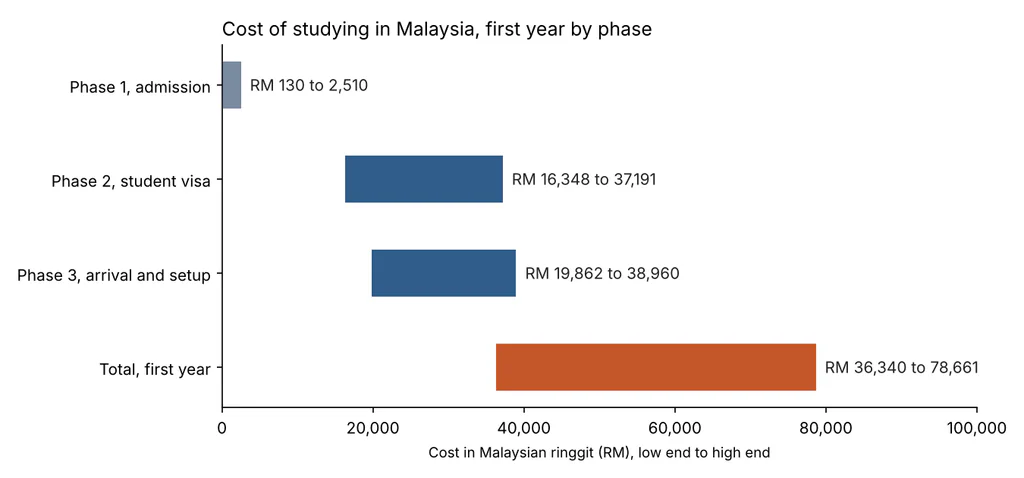
Bar chart of the cost of studying in Malaysia in the first year by phase, from RM 130 to 2,510 for admission up to RM 19,862 to 38,960 for arrival and setup
The chart shows each phase as a range, so you can see that you spend most of the first year’s money in Phase 2 and Phase 3.
That figure is big because it mixes money of three types. The cost of studying in Malaysia becomes clear only when you split them.
Money you keep or get back. The living budget of RM 18,000 to 30,000 is your own spending on rent, food and daily life. The personal bond of RM 200 to 2,000 and the rent deposit of RM 900 to 2,700 are money you should get back. Remove all three and the total falls to RM 17,240 to 43,961.
Money you spend on the degree. Tuition of RM 12,783 to 27,673 goes to the institution, and it pays for your qualification. Subtract tuition as well and RM 4,457 to 16,288 is left. That is the money you pay in charges and do not get back: the 6 percent tax, EMGS and Immigration fees, insurance, tests, medical checks, transfers, travel and setup.
What is not in the number. The table prices a single year of study, so the cost of studying in Malaysia for a three year degree is higher. Each later year needs a renewal at RM 250 at a public university, plus a new year of insurance. It leaves out dependants, the Graduate Pass at RM 1,500 in EMGS fees before insurance and the visa fee, and any tuition rise. It also leaves out medicine, which costs far more than the range above, and the Sarawak health check at RM 350. Rents differ widely between Kuala Lumpur and smaller cities.
Tuition at each level of study
The figures below for the cost of studying in Malaysia come from institution pages, not from a national list, and none is a promise for your course. We found no separate price list by nationality group, so these are the fees quoted to international students in general. US dollar fees were converted at RM 4.0905 per dollar.
| Level of study | Typical tuition for international students | Note |
|---|---|---|
| Foundation, private | RM 26,000 to 26,600 for the year | TAR UMT, 2026 intake |
| Diploma, private | RM 43,700 to 49,200 in total, over about 2 to 2.5 years | TAR UMT, includes 6 percent tax |
| Bachelor, private | RM 73,000 to 88,000 in total, over 3 to 4 years | TAR UMT, includes 6 percent tax |
| Bachelor, public, most non medical subjects | RM 6,391 to 12,783 a semester | USM, from USD 1,562.50 to 3,125, before tax |
| Bachelor, public, A Level route | RM 45,788 to 76,000 in total, over 6 to 8 semesters | UTM, session year not stated |
| Medicine, public | RM 56,244 a semester | USM, USD 13,750 a semester |
| Master, public, full time | RM 5,727 to 11,658 a semester | USM, 2025 and 2026 fees |
We did not find a reliable figure for private master degrees or for doctorates, so read the fee page of the institution you want. A USM semester price is not the same as a year: most degrees have two main semesters a year, but confirm that with the institution. Public fees on this table are before the 6 percent tax.
Last checks before you commit
- Ask who the sponsor will be. If you hope to use the Graduate Pass, find a Malaysian sponsor early and confirm your passport is on the list.
- Check the tax. Ask whether each fee quote has the 6 percent tax inside it or on top, and ask for the full amount in writing.
- Confirm the approval letter. Ask to see the institution’s intake approval from the Ministry of Home Affairs, and look up the programme in the Malaysian Qualifications Register.
- Do not trust a funds figure from an agent. We found none that is official, but the bond and insurance are real.
- Know your bond. Look up the amount for your country and ask how and when you get it back.
- Fix your insurance date. Tell the institution the day you land.
- Plan without work income. Do not count on part time pay to cover your first year.
- Compare totals, not sticker prices. If Malaysia is one of several options, put the same three phases for each country side by side. Our guides to the cost of studying in Canada, Australia and Germany are a fair place to start.
- Recheck before you pay. Fees, insurance prices and the China and India Graduate Pass date can change at short notice.
Several numbers changed recently, so older guides may show the wrong ones:
- 1 July 2025: the 6 percent service tax on higher education for non citizens began, and institutions started billing it between September 2025 and the 2026 and 2027 session.
- 13 November 2025: EMGS issued its current fee schedule, with 8 percent tax on its processing and eVAL fees.
- 2026: EMGS posted new insurance prices, now RM 468 to 978 a year.
- 5 July 2026: the Ministry of Higher Education published enrolment figures to the end of 2025.
- 31 December 2026: the date when Graduate Pass eligibility for China and India is listed to end.
Quick answers to common questions
What is the cost of studying in Malaysia for one year?
On our figures, the cost of studying in Malaysia for the first year comes to between RM 36,340 and RM 78,661. Of that, RM 18,000 to 30,000 is living money you spend yourself, and RM 12,783 to 27,673 is tuition. Around RM 4,457 to 16,288 is what you pay in charges. The range is wide because public and private fees differ so much.
How much money must I show for a Malaysia student visa?
We found no official minimum bank balance for the student pass. The EMGS list asks for an offer letter, transcripts, a health declaration, an English certificate and a personal bond, and your institution or an embassy may ask for more. The bond is RM 200 to 2,000 by country.
How much does a Malaysia student pass cost?
For most students, EMGS and Immigration fees come to about RM 2,020. That is the RM 1,728 processing fee, RM 162 for the eVAL, RM 50 for the iKad, RM 60 for the sticker and RM 20 for the multiple entry visa. A medical check, insurance and the bond come on top.
Can international students work in Malaysia after graduation?
Only some can. The Graduate Pass lasts 12 months, is for bachelor degree holders and above, and is limited to citizens of 32 countries. It allows part time work in permitted sectors, and you need a Malaysian sponsor who earns at least RM 1,500 a month.
Is there a limit on how many foreign students Malaysia takes?
We found no national cap in the official pages we read. The Ministry of Higher Education reported that foreigners made up 12.6 percent of enrolment at the end of 2025, and only 3.44 percent of undergraduates at public universities.
This is background reading for general guidance, and it is not legal or immigration advice. Malaysian fees, insurance prices and pass rules change, so check every detail on the EMGS and Immigration Department websites before you act. We could not find a government register of immigration advisers or education agents in Malaysia. For regulated legal advice, use a lawyer who is a member of the Malaysian Bar, which keeps a legal directory.