
At the National University of Singapore (NUS), an international student starting an arts and social sciences degree in 2026 pays SGD 21,400 a year with a Tuition Grant, or SGD 36,650 without one. The lower price isn’t a scholarship. The Ministry of Education (MOE) attaches a three-year bond after graduation, and Singapore Management University (SMU) spells out that you must work for a Singapore entity for three years. So the cost of studying abroad in Singapore depends on a choice most students make in one click on an application form.
We’ve set out this guide in the order you’ll pay things in: choosing a course, getting an offer, getting the Student’s Pass and settling in. You’ll find a table in Singapore dollars (SGD), which Singaporeans write as S$, at the close of every stage. A final table adds up the three stages, and we then show how much of that money you truly lose to charges.
Singapore’s fees move every academic year. NUS raised its international fees for the 2026 intake, the Ministry of Manpower (MOM) has announced higher salary rules for work passes from January 2027, and a new agency took over private schools in July 2026. Confirm each figure on the official page linked to it before money leaves your hands. Where we found no official source, we’ve marked the figure Our estimate.
All the pages we link belong to the Singapore government or to a Singapore university, and all of them are in English.
Cost of Studying Abroad in Singapore Calculator
Pick your course, passport and housing, and the calculator works out your first year in Singapore. It splits the total into the tuition that buys your degree, the living money that stays yours, and the charges you’ll never get back. Switch the Tuition Grant on and off to see what the cheaper fee saves you, and what the bond asks of you in return.
This is a budgeting tool, not immigration advice. It uses the figures in this guide, which we last checked in October 2026, and ICA, MOE and universities can change their fees every academic year. Confirm each figure on the official page before you pay anything.
Your situation
Show costs in your own currency
Estimated cost for your first year
SGD 0
Changes since spring 2025 that older guides miss
Check these dates before you trust a figure from an older article.
- AY2026/27, higher NUS fees. The subsidised arts and social sciences fee for most international students rose from SGD 20,000 to SGD 21,400 a year, and the non-subsidised fee rose from SGD 34,900 to SGD 36,650. Each cohort keeps the fee it started on.
- AY2026/27, NUS insurance for part-time students too. NUS now covers part-time students in its compulsory insurance, and it still gives full-time international students no way to opt out.
- 1 July 2026, a new regulator for private schools. The Skills and Workforce Development Agency (SWDA) now uses the powers of the Private Education Act, which the Committee for Private Education used before. James Cook University Singapore records the handover on its own page.
- 1 January 2027, higher salary rules for work passes. MOM will raise the minimum salary for a new Employment Pass from SGD 5,600 to SGD 6,000 a month for applicants aged 23 or below. The S Pass minimum for the same age group goes from SGD 3,300 to SGD 3,600.
Step 1: Public or private, grant or no grant, and life after graduation
Two choices decide your options after graduation: whether you study at a public Institute of Higher Learning (IHL) or a private school, and whether you take the Tuition Grant. An IHL is just the official name for Singapore’s public universities, polytechnics and similar publicly funded institutions. The Immigration and Checkpoints Authority (ICA) and MOM set the rules, and MOE runs the grant.
Your options after each type of course
| Type of course | What you can do after graduating |
|---|---|
| Degree or diploma at an IHL, without the Tuition Grant | Apply for a one-year Long-Term Visit Pass (LTVP) to look for work, then find an employer who will apply for a work pass |
| Degree or diploma at an IHL, with the Tuition Grant | The same one-year LTVP, but you’ve also agreed to work for a Singapore entity for three years |
| Course at a private education institution (PEI) | ICA’s job-seeking LTVP page is for IHL graduates, and we found no equivalent for PEI graduates. You’d leave unless an employer hires you before your pass ends |
| Any course, after the pass ends | No work without a work pass, which your employer has to apply for |
The job-seeking LTVP lasts one year and can’t be renewed. ICA’s application page lists fees of SGD 45 to apply, SGD 60 on issue and SGD 30 for a multiple journey visa if you need one, and all of them are non-refundable. ICA aims to decide within six weeks. ICA doesn’t give the pass automatically, and you must cancel your Student’s Pass first.
Six rules that change your plan
ICA and MOM apply each of these as written. Where one applies to you, raise it with the school’s international office before you accept.
| Condition | How it affects you |
|---|---|
| Full time only | ICA says part-time courses and evening or weekend courses aren’t eligible for a Student’s Pass |
| EduTrust for private schools | A private school without EduTrust certification can’t offer places to foreign students. EduTrust is a government quality mark for private schools |
| The salary you’d need | An Employment Pass needs at least SGD 5,600 a month for an applicant aged 23 or below, and SGD 6,000 for new applications from 1 January 2027. MOM’s points test, called COMPASS, also needs 40 points |
| The grant’s bond | You and two sureties sign the Tuition Grant Agreement. MOE says you and your sureties may have to pay liquidated damages if you stay unemployed for a long time |
| One job-seeking pass | The LTVP for graduates can’t be renewed, so plan your job search for that single year |
| Age | ICA’s pages set no upper age for the Student’s Pass or the graduate LTVP |
Sureties are people who promise MOE they’ll pay if you don’t. That’s a real risk for the family members who sign, so explain it to them before they do.
Is the Tuition Grant worth it?
For many students, yes. It can save about SGD 15,000 to 21,500 a year. At SMU, business and most other degrees cost SGD 26,200 a year with the grant and SGD 47,700 without it. Over four years, that’s SGD 86,000 less.
But the bond only works if you can get a job in Singapore. MOE tells bonded graduates to apply for the one-year LTVP and to keep looking for work. If you were job hunting but couldn’t find a job before it ends, MOE may issue a support letter so you can stay longer. The bond doesn’t give you a work pass, and an employer still has to meet MOM’s salary rules to hire you.
MOM’s points test gives up to 20 points for qualifications from top-tier institutions and 10 for other degrees, so where you study matters at this stage too. You need 40 points in total, and your employer earns the rest from salary, workforce diversity and local hiring.
We’d take the grant if you’re studying something employers in Singapore hire for, such as computing or engineering. If you’re sure you want to go home or move on after graduating, pay the full fee and stay free of the bond. SMU says students who don’t take the grant have no work obligation.
Diplomas at a polytechnic
Polytechnics offer the grant for full-time diplomas too, and each polytechnic runs its own timetable for it. Temasek Polytechnic caps the grant at 10 semesters, or 8 if you enter directly into Year 2, and counts semesters funded at other institutions toward the cap. For its 2026 cohort, students had to update their foreign identification number and local address by 16 October, apply between 28 October and 16 November with Singpass and their sureties’ details ready, and sign the agreement between 17 and 24 November.
So you need a Singpass account and two sureties lined up within weeks of starting. Ask your polytechnic for its dates as soon as you accept the place.
Can you add a second course to stay longer?
Only through a new Student’s Pass for each course. ICA wants a new application if you transfer school before collecting your pass, and private school students who change course or school must apply at least four weeks before the new course starts. A second course doesn’t give you a second job-seeking LTVP, as far as the pages we checked show. And Temasek Polytechnic explains that you can’t get a Tuition Grant for a qualification at the same or a lower level than one you’ve already had a grant for, so a second bachelor’s would cost the full fee.
Step 2: Admission, the grant choice and the fee you pay to apply
Each university or polytechnic decides whom it admits and whether you get a Tuition Grant. MOE funds a limited number, and SMU says selection is competitive and based on merit. Your school also starts your Student’s Pass, so admission and the pass are linked from the start.
Check that a private school can take you
Public universities are all IHLs, so you can skip this check for NUS, Nanyang Technological University (NTU), SMU and the other public universities. For a private school, check two things. First, the school must be registered under the Private Education Act. SkillsFuture Singapore keeps an A to Z list of private schools and the courses they’re permitted to offer. Second, the school needs EduTrust certification, or ICA won’t issue you a pass at all.
Ask how the school protects your fees, too. James Cook University Singapore charges every student a Fee Protection Scheme premium of 0.52% of the year’s fees. That’s insurance that pays you back if the school closes. Ask any private school for its own figure.
We found no national cap on international student numbers on the official pages we checked, and you don’t need any government approval before you apply. The limit that matters is on Tuition Grants.
What it costs to apply
- NUS. Undergraduates with international qualifications pay SGD 20 per application, and NUS doesn’t refund it. NUS adds 3.15% for foreign-issued cards and doesn’t accept overseas debit cards, so use a credit card.
- James Cook University Singapore. An application fee of SGD 260 for international students, and an international student registration fee of SGD 872 once you enroll. JCU says fees paid aren’t refundable.
- Management Development Institute of Singapore (MDIS). A registration fee of SGD 490.50, including the 9% goods and services tax (GST).
Public university fees for international students already include GST. Both NUS and SMU say their quoted fees include it, so don’t add 9% on top.
Documents your school asks for
Entry rules vary, but most schools want your passport, school or degree certificates and transcripts, English results and a photo. ICA later needs official translations of any document not in English, done by your country’s embassy or a notary public. It doesn’t endorse private translation companies. So get your translations done the official way once and use them for both the school and ICA.
Will your English-medium degree count?
It depends on your school and level. At NUS’s College of Design and Engineering, graduate applicants need IELTS 6.0 for most coursework master’s programs, and some need 6.5. Applicants are exempt if they took a degree taught fully in English in an English-speaking country. NUS lists India and Pakistan among its examples, and says the list isn’t complete.
Kenya, Nigeria, Ghana and Bangladesh aren’t named in that list, so don’t assume an exemption. Email the admissions office, quote your degree, and ask for a yes or no in writing. Private schools often run their own test. MDIS accepts proof of English-medium study, its own placement test, IELTS or TOEFL.
Phase 1 costs: admission
| Item | Typical cost in SGD | In your local currency | Why it is on this list |
|---|---|---|---|
| English test, one attempt | SGD 300 to 450 | The test company sets the fee in your country. Our estimate | |
| Application fees | SGD 20 to 300 | NUS charges SGD 20 for one application. Applying to several schools, JCU among them at SGD 260, costs more. Our estimate | |
| Certified copies and official translations | SGD 0 to 150 | Your embassy or a notary public sets the fee. Our estimate | |
| Courier and exam board postage | SGD 0 to 100 | Your exam board may charge to post results to the school. Our estimate | |
| Card charges on fees | SGD 0 to 30 | NUS adds 3.15% for a foreign card, and your bank adds its own margin. Our estimate | |
| Registration fee at a private school | SGD 0 to 872 | JCU’s fee for international students. Public universities don’t charge one at this stage | |
| First tuition payment | SGD 0 here | We count tuition once, in Phase 2 | |
| Phase 1 subtotal | SGD 320 to 1,902 | Total of the items above |
Step 3: The Student’s Pass, from SOLAR to your digital pass
ICA decides your Student’s Pass, and your school starts the application by registering you on ICA’s system, called SOLAR. You then fill in eForm 16, ICA’s online application form. ICA aims to decide within one week, or two weeks if you need a visa for students at IHLs. For private schools, it takes up to a month, or two weeks at an EduTrust school.
Three fees, paid at two different times
ICA charges very little next to most study countries. You pay:
- a non-refundable SGD 45 processing fee when you apply
- an SGD 60 issuance fee when ICA issues the pass
- SGD 30 for a multiple journey visa, if your nationality needs one
That’s SGD 105 to 135 in all. NTU warns that you must pay the processing fee within seven days of submitting eForm 16, or ICA withdraws the application.
What ICA asks for
ICA’s checklist for IHL students asks for:
- the Registration Acknowledgement Letter from your school
- your passport’s biodata page and, if applicable, your birth certificate
- details of where you’ve lived, your education, your work history and your financial support
- details of your parents, spouse or siblings, where applicable
- your Singapore address and contact details
- a recent color photo taken in the last three months
ICA says it may ask for more documents and may reject a file with too few. Keep the originals ready to show.
“Will ICA want to see my bank statement?”
Not as a fixed amount, at a public university. ICA’s checklist asks you to describe your financial support. But ICA’s pages give no minimum figure, and none of them says every IHL student must send a bank statement. NTU’s Student’s Pass page doesn’t mention financial documents at all.
Private schools are different. MDIS asks every applicant for proof of financial ability, such as a bank, savings or fixed deposit statement, and it gives a minimum only for one nationality. So if you’re heading to a private school, ask the admissions office which statement you need to send, how recent it has to be and whose name should be on it.
Even without a fixed figure, you’ll need real money. NUS estimates SGD 1,200 to 2,100 a month on campus and SGD 1,550 to 3,400 off campus, covering rent, food, transport and personal costs. We use SGD 1,200 to 3,400 a month in our tables, which gives SGD 14,400 to 40,800 for a year.
“My aunt in Lagos is paying. Does that work?”
ICA asks who supports you, and a relative or sponsor can do it. ICA doesn’t say you need to hold the money in your own name. The Tuition Grant involves a different kind of sponsor. MOE wants two sureties to sign the agreement with you, and they take on the bond risk. Pick sureties who understand that, and who can be reached for years.
The medical exam, and when you can skip it
ICA wants a Medical Examination Report from students on longer courses. NTU says you need one if your study period is six months or more. The exam includes an HIV test and a chest X-ray for tuberculosis.
You can do it at home or in Singapore. NTU charges SGD 54.50 at its campus clinic for most programs, and NTU says the report is valid for three months from the date of issue. SMU’s clinic charges SGD 48.45 before GST for the combined university and ICA check. NTU strongly encourages international students to do the exam at home before they fly. If you do, check that the clinic uses ICA’s form, because NTU’s own clinic may charge to fix a report that doesn’t meet its requirements.
ICA doesn’t list a police certificate for university students, so you can skip it.
Your university’s insurance
Your university’s scheme is your main health cover in Singapore. NUS enrolls every full-time student in a hospitalization and surgical policy and an outpatient specialist policy, with no opt-out. Its hospitalization policy has an annual limit of SGD 30,000, and cover for international students starts when you arrive.
NUS bills a Health Service Fee of SGD 83.25 a semester. SMU’s miscellaneous fees include SGD 268 a year for insurance. A long hospital stay can cost more than SGD 30,000, so if you have a health condition, ask your insurer about a top-up plan.
Part-time work in term and in vacations
You can work without a work pass if you meet MOM’s conditions. Full-time students at institutions on MOM’s list can work up to 16 hours a week during term, and MOM sets no weekly limit in the vacation. An internship that counts toward your degree doesn’t count toward the 16 hours.
Everything depends on MOM’s list. MOM keeps one list of institutions for term time and a wider one for vacations, and the term-time list is the shorter of the two. Find your school on it by name. If it isn’t there, you can’t work in term at all. Exchange students can’t work in Singapore, and MOM calls working without a valid pass an offense. Our guide on how student visa work hours are counted compares Singapore’s weekly limit with eight other countries.
What if ICA refuses the pass?
ICA keeps the SGD 45 processing fee, because it’s non-refundable. You can appeal, and NTU says an appeal takes about four weeks. Ask your school’s international office to help with the appeal, and ask the school what it’ll refund if the appeal also fails.
Visas for India, Nigeria, Pakistan and Bangladesh
Citizens of India, Nigeria, Pakistan and Bangladesh need a visa to enter Singapore, because ICA’s list of visa-required countries names all four. Kenya and Ghana aren’t on it. Students don’t file a separate visa application. NTU explains that ICA puts a Single Journey Visa inside your In-Principle Approval (IPA) letter if you need one. The IPA letter is just ICA’s approval in principle. It isn’t a pass, and you must enter Singapore and complete the formalities before it expires.
“Classes begin in August. How early can I file?”
ICA wants your application at least two months and not more than three months before the course begins. But you can’t apply before your school registers you on SOLAR, so the school’s timing decides when you start. NUS SCALE tells students the IPA letter is valid for three to four months from issue.
ICA recommends applying from home, because you can’t extend a visit while your application is being processed. Don’t fly in on a tourist visit and apply from a hostel.
Phase 2 costs: student visa
| Item | Typical cost in SGD | In your local currency | Category | Why it is on this list |
|---|---|---|---|---|
| ICA processing, issuance and multiple journey visa fees | SGD 105 to 135 | Standard | ICA charges SGD 45 and SGD 60 to everyone, and SGD 30 more if your nationality needs a visa | |
| Entry visa | SGD 0 extra | Standard | ICA puts a Single Journey Visa in your IPA letter if you need one | |
| Medical exam with HIV test and chest X-ray | SGD 48 to 84 | Standard | SMU’s clinic at the low end, before GST. NTU charges medicine students SGD 83.93 | |
| Compulsory university insurance for a year | SGD 167 to 268 | Often missed | Two semesters of NUS’s Health Service Fee at the low end, SMU’s insurance charge at the high end | |
| First year of tuition | SGD 21,400 to 47,700 | Standard | NUS’s subsidised arts fee at the low end. SMU’s non-subsidised business fee at the high end | |
| Living money for the first year | SGD 14,400 to 40,800 | Standard | NUS’s estimate of SGD 1,200 to 3,400 a month. You keep this money and live on it | |
| New passport or renewal | SGD 0 to 200 | Often missed | Your home passport office sets the fee. Our estimate | |
| Official translations for ICA | SGD 0 to 150 | Often missed | ICA accepts translations by an embassy or a notary public only. Our estimate | |
| Bank charges and exchange margin on tuition | SGD 200 to 1,500 | Often missed | Your bank adds a margin to every large payment abroad. Our estimate | |
| Travel insurance for the flight | SGD 0 to 80 | Often missed | Your university cover starts when you arrive, not when you fly. Our estimate | |
| Police certificate | SGD 0 | Often missed | ICA doesn’t list one for university students, so don’t pay an agent for it | |
| Phase 2 subtotal | SGD 36,320 to 90,917 | Most of this is tuition plus living money that stays yours |
Step 4: Landing at Changi and finding a room
ICA, your school and your landlord all set deadlines in your first weeks. Your school’s international office tells you the order, so report to it as soon as you arrive.
Before you board and at the airport
Submit the SG Arrival Card within three days before you arrive, counting the day of arrival. It’s free on ICA’s website and the MyICA app, and ICA warns against websites that charge for it. Keep these in your hand luggage:
- your passport
- the printed IPA letter, which also holds your visa if you need one
- your offer letter and Registration Acknowledgement Letter
- your Medical Examination Report, if you did it at home
- original certificates and their official translations
If you bring cash or similar instruments worth SGD 20,000 or more, you must declare it online within 72 hours before you arrive. We’d move large sums by bank transfer instead.
Deadlines once you’re in Singapore
Finish the formalities while your visit pass is valid. NTU says you must complete them within your Short-Term Visit Pass validity or before the IPA letter expires, whichever comes first. ICA works strictly by appointment, and you’ll give your fingerprints and photo there. NUS runs these sessions on campus, so NUS students don’t book an ICA slot.
Check your visit pass. NUS SCALE reminds students that the IPA letter isn’t a valid pass to stay in Singapore. Check the date on the electronic visit pass you get at the airport, and extend it if your formalities fall later. ICA treats overstaying as an offence.
Get the digital pass. ICA now issues the pass digitally. You’ll get your Student’s Pass by email through FileSG, and you can see it in the Singpass app three working days after formalities.
Cancel it when you finish. ICA expects you to cancel your Student’s Pass at the end of your course. After that, you may get a short-term visit pass of up to 89 days, or you can apply for the one-year LTVP if you’re an IHL graduate. If your grades slip before then, see your faculty early. Our four-country comparison of failed modules and student visas shows what other governments do in that case.
Renting a room outside campus
NUS’s housing office describes how off-campus renting works. You pay a good faith deposit of one month’s rent when you sign the Letter of Intent, and you lose it if you then back out. Agents generally charge half a month’s rent for a one-year lease. Stamp duty on the lease is 0.4% of the total rent.
HDB flats, the public housing most Singaporeans live in, need a minimum lease of six months. Private condos can rent for three months if the landlord agrees. NUS tells students never to pay a deposit before viewing the room, to check the agent’s name on the Council for Estate Agencies (CEA) public register, and to avoid landlords who won’t put the agreement in writing.
We’d book a university hall for the first semester if you can get one. NUS puts on-campus housing at SGD 500 to 900 a month, against SGD 650 to 1,800 off campus, and a hall saves you the deposit, the agent and the stamp duty.
Phase 3 costs: arrival and setup
| Item | Typical cost in SGD | In your local currency | Category | Why it is on this list |
|---|---|---|---|---|
| One-way flight to Singapore | SGD 400 to 1,500 | Standard | Flights from South Asia cost less than flights from Lagos, Accra or Nairobi. Our estimate | |
| Airport to your room | SGD 10 to 40 | Standard | The train is cheapest. A taxi with bags costs more. Our estimate | |
| Hostel before your room is ready | SGD 0 to 1,000 | Often missed | Nothing if your hall opens on the day you land. Our estimate | |
| Good faith deposit | SGD 0 to 1,800 | Often missed | One month on a room at NUS’s top off-campus figure. Your landlord should return or credit it | |
| Agent fee | SGD 0 to 900 | Often missed | Half a month’s rent, the usual figure NUS gives for a one-year lease | |
| Stamp duty on the lease | SGD 0 to 86 | Often missed | 0.4% of a year’s rent on a room at SGD 1,800 a month | |
| First month of rent | SGD 0 extra | Standard | We already count it inside the year’s living money | |
| Bedding, kitchen items and small furniture | SGD 100 to 400 | Often missed | Less in a furnished hall. Our estimate | |
| SIM card and first phone bill | SGD 10 to 50 | Standard | We count later bills in living money. Our estimate | |
| SG Arrival Card | SGD 0 | Often missed | ICA charges nothing, so ignore websites that ask you to pay | |
| Phase 3 subtotal | SGD 520 to 5,776 | Total of the items above |
Adding up the cost of studying abroad in Singapore for year one
| Phase | Typical cost in SGD | In your local currency |
|---|---|---|
| Phase 1, admission | SGD 320 to 1,902 | |
| Phase 2, student visa | SGD 36,320 to 90,917 | |
| Phase 3, arrival and setup | SGD 520 to 5,776 | |
| Total | SGD 37,160 to 98,595 |
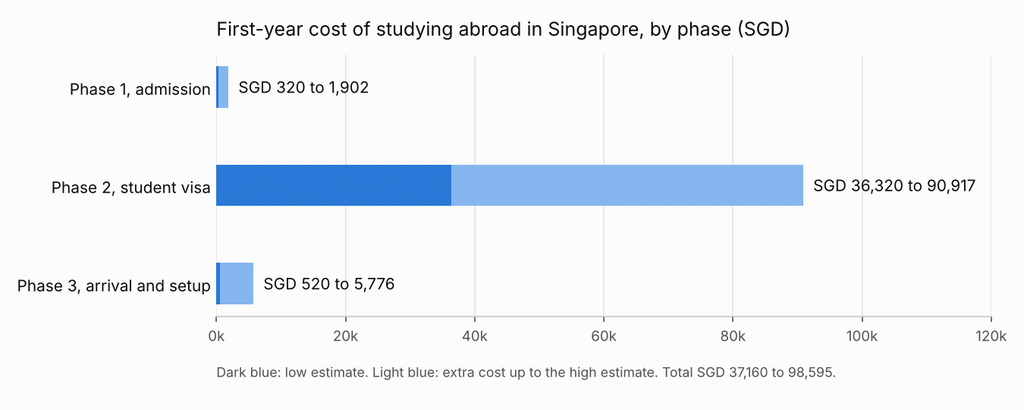
Bar chart of the first-year cost of studying abroad in Singapore by phase: admission SGD 320 to 1,902, student visa SGD 36,320 to 90,917, and arrival and setup SGD 520 to 5,776
What you won’t get back
Most of that total is your own living money or the price of your degree.
Living money comes first. The SGD 14,400 to 40,800 pays your own rent, meals and bus fares, so it stays yours. Remove it and SGD 22,760 to 57,795 remains. Next comes tuition, SGD 21,400 to 47,700, which buys the degree itself. Remove that too and SGD 1,360 to 10,095 is left.
Your landlord should return or credit one item in that remainder, the good faith deposit of up to SGD 1,800. Without it, SGD 1,360 to 8,295 is what you truly lose to charges. That covers ICA fees, the medical, insurance, the English test, application and registration fees, bank charges, the flight, the agent and setup costs. The spread between our lowest and highest figure mostly reflects three things: a private school’s registration fee, your flight and your bank’s margin on tuition.
That figure is small for a country this expensive, because ICA’s fees are low and none of the official pages we checked asks a university student for an immigration bond or deposit. The big costs are tuition and rent. And if you take the Tuition Grant, the bond is a cost that doesn’t appear in any table.
This covers year one only. In each later year, you’ll pay tuition and university insurance again. If you’re an IHL graduate looking for work, add SGD 105 to 135 for the LTVP.
Tuition at Singapore universities, course by course
Tuition is the largest part of the cost of studying abroad in Singapore. Each university sets its fees, and MOE decides the subsidised rate through the grant. Public universities quote a yearly fee that already includes GST. Private schools often quote the whole course.
| University and course | Fee for international students | What to know |
|---|---|---|
| NUS, arts and social sciences | SGD 21,400 a year with the grant, SGD 36,650 without | NUS’s AY2026/27 fees, fixed for your cohort |
| NUS, computing or engineering | SGD 21,400 a year with the grant, SGD 39,700 without | The same table |
| NUS, business | SGD 22,200 a year with the grant, SGD 33,400 without | The gap is smaller in business than in computing |
| NUS, law | SGD 30,450 a year with the grant, SGD 44,450 without | The same table |
| NUS, medicine | SGD 87,800 a year with the grant, SGD 190,150 without | The most expensive course NUS lists |
| SMU, business and most degrees | SGD 26,200 a year with the grant, SGD 47,700 without | SMU’s AY2026/27 fees, plus SGD 367 a year in other fees |
| NUS, coursework master’s in arts and social sciences | SGD 40,250 a year | NUS’s graduate table. Most coursework master’s programs have no grant |
| JCU Singapore, Bachelor of Business | SGD 70,893.60 for the course | JCU’s fee list, a private university |
| JCU Singapore, Master of Business Administration | SGD 43,164 for the course | The same list |
Students from ASEAN countries pay a little less than everyone else at NUS, so check that you’re reading the “all other international students” column. For most of our readers, the cheapest route to a Singapore degree is a public university with the grant, but only if you’re happy to work in Singapore for three years afterward. To set these fees beside another Asian option, read our guide to the cost of studying in Malaysia, or compare with the cost of studying in Australia, where the post-study visa has no bond attached.
Five checks before money leaves your account
- Decide on the grant before you apply. SMU asks on the application form, and you accept the grant together with your place.
- Talk to your sureties. They take on the risk of the bond with you.
- At a private school, check registration and EduTrust. Without EduTrust, ICA won’t issue a pass.
- Check MOM’s work list for your school. If it isn’t there, plan on no income in term.
- Use ICA’s own sites for the arrival card and the pass. Both are cheap or free there.
Quick answers on Singapore study costs
How much is the cost of studying abroad in Singapore for one year?
Our first-year total is SGD 37,160 to 98,595, including tuition and a year of living money. Only about SGD 1,360 to 8,295 of that goes on charges you won’t get back.
What is the Tuition Grant bond?
It’s MOE’s condition for subsidised fees. You agree to work for a Singapore entity for three years after graduation, and two sureties sign with you.
Can I work while studying in Singapore?
Yes, if your school is on MOM’s list. You can work up to 16 hours a week in term and without a weekly limit in vacations, with no work pass needed.
Do Indian or Nigerian students need a visa for Singapore?
Yes, both countries are on ICA’s visa-required list, along with Pakistan and Bangladesh. ICA includes the visa in your IPA letter, so there’s no separate visa form.
Can I stay in Singapore after graduating?
If you studied at an IHL, you can apply for a one-year LTVP to look for work. To stay longer, an employer has to hire you on a work pass.
This page is general information about Singapore’s Student’s Pass and what it costs, not advice on your own case. ICA, MOM, MOE and your university can change fees and rules each year, so confirm every figure on their official pages before money leaves your account. ICA states that it doesn’t regulate the immigration consultancy industry and doesn’t endorse consultants. For regulated legal advice, use a lawyer with a valid practicing certificate in Singapore, and be wary of any agent who promises you a pass or a job.