
You can still study in Australia from Kenya in 2027, but a rule that started on 2 October 2026 changes the plan for many families. Since that date, most new student visa applicants can’t include a partner or children, and Kenya isn’t one of the countries whose citizens are exempt. If you’re married, read the family section under the new rules below before you pay any deposit.
There’s a second trap that we didn’t find in any other guide. Since the 2023 exams, the Kenya National Examinations Council works out your mean grade from Mathematics, one language and your five best subjects. Some Australian universities still use the old method. RMIT, for example, counts your best seven subjects including English, Kiswahili and Mathematics. So the mean grade on your certificate and the grade a university works out can be different.
This guide is for Kenyan students and parents planning a 2027 or 2028 start. It takes you through each step to study in Australia from Kenya: getting admitted, what it costs, the money you have to show, the new visa rules, supporting yourself in Australia, and what comes after you graduate. It also covers the cheaper cities, the cheapest universities, the courses that lead to work, and the scholarships Kenyans can still win. Our cost of studying in Australia guide prices every fee stage by stage, so this guide links to it rather than repeating it.
Guides in this series
- KCSE and Kenyan degree entry requirements for Australian universities
- Proof of funds for an Australia student visa from Kenya
- Scholarships for Kenyan students in Australia
- Australia Student Visa Refusals
- From the 485 visa to permanent residency for Kenyan graduates
- Cost of Studying in Australia
These are the figures a Kenyan applicant needs before anything else. To see any of them in shillings, multiply by the selling rate your own bank quotes you that day, because that’s the rate you’ll actually pay.
| What you need or get | 2026 figure | Where it comes from |
|---|---|---|
| KCSE mean grade for a bachelor’s degree | From about a C plain to an A, depending on the university and course | University entry tables, compared below |
| Student visa fee | AUD 2,500 for the main applicant | Department of Home Affairs |
| Living money to show for one year | AUD 29,710 | Department of Home Affairs |
| Travel money to show from East Africa | AUD 2,500 | Department of Home Affairs |
| English test for the visa | IELTS Academic 6.0 overall, or an equal score on another approved test | Department of Home Affairs |
| Paid work during term | Up to 48 hours a fortnight, unlimited in scheduled breaks | Study Australia |
| Work visa after a bachelor’s or coursework master’s | 2 years, or 3 years after a research degree | Temporary Graduate visa page |
| Bringing a spouse or children | Not allowed for most new students since 2 October 2026 | Department of Home Affairs |
What are the KCSE requirements to Study in Australia?
Most Australian universities accept the KCSE for direct entry to a bachelor’s degree, so many Kenyans don’t need a foundation year. That’s a real difference from the UK, where the University of Manchester, for example, says KCSE holders must finish a recognized foundation program first. The grade you need in Australia, though, ranges from about a C plain to an A.
What KCSE mean grade do you need for a bachelor’s degree?
For direct entry to a bachelor’s, most universities that publish a KCSE rule want a mean grade between C+ and B, rising to A- or A for the most competitive courses. Charles Darwin, Western Sydney and Victoria University list a C+, Federation asks for a B, and RMIT moves from a B to an A as courses get harder. Each university converts KCSE its own way, using a points total, an average or a mean grade, and some still count both English and Kiswahili.
Our guide to KCSE requirements for Australian universities has the conversion tables for nine universities, subject prerequisites and a worked example.
What if my KCSE results fall short of the requirements?
A C, C- or even a D average can still get you in through a foundation year or a diploma first. Deakin College takes a C- for its foundation program, and Curtin College takes a D for its first-stage diplomas.
You don’t need two visas for this. Home Affairs lets you package two or more courses on one student visa if each leads to the next, with a gap of under two months between them. Home Affairs uses the last course in the package to decide how much money and English evidence you need to show. A diploma on its own, though, leads to a shorter work visa after you graduate, as the graduation section below explains.
Master’s and PhD entry
For a coursework master’s, universities assess your Kenyan degree class or average. Victoria University, for example, asks for a 50% average, while competitive courses usually want a Second Class Upper. For a PhD, you’ll need evidence of research, such as a four-year degree with a project or a research master’s, and a supervisor’s support. The KCSE guide linked above covers both.
English requirements for Australian universities and Visa
Some universities accept your KCSE English for admission, such as UWA with a C+ and Curtin with a B. The visa follows separate rules, and Kenya isn’t one of the exempt countries. Run the Home Affairs Document Checklist Tool to see whether you need to attach a test score. If you do, take the test at a center in Kenya, because at-home tests aren’t accepted.
Australian Universities Intakes
Most universities start the year in late February or early March, with a second intake in July. Monash, for example, starts semester one in early March and semester two in mid-July. Deakin runs three trimesters, so you can also start in November.
KCSE results usually come out in January, which leaves too little time for an offer, a visa and a flight before a March start. For a Kenyan school leaver, July is the realistic first intake.
| Intake | When classes start | Apply to the university by | Lodge your visa by |
|---|---|---|---|
| Semester 1 or Trimester 1 | Late February to early March | August to October of the year before | November or December |
| Semester 2 or Trimester 2 | July | February to April | April or May |
| Trimester 3 (some universities) | November | June to August | August or September |
The last two columns are our planning estimates, not official deadlines. Each university sets its own closing dates, and Home Affairs says processing times change, so leave at least three months for the visa.
Where to study in Australia: cheaper towns, the lowest fees and how to check a university
Studying outside Sydney, Melbourne and Brisbane usually costs less in rent, and it can add one or two years to your work visa after you graduate. For a Kenyan family paying in shillings, the city you pick can matter as much as the university.
How Australia sorts its cities and towns
The Department of Home Affairs puts every postcode into one of three groups, and the group decides which regional benefits you get. Home Affairs uses these categories for regional incentives, such as extra years on your post-study work visa.
| Category | Places | Regional benefits |
|---|---|---|
| 1. Major cities | Sydney, Melbourne and Brisbane | None |
| 2. Cities and major regional centres | Perth, Adelaide, the Gold Coast, the Sunshine Coast, Canberra, Newcastle and Lake Macquarie, Wollongong and Illawarra, Geelong and Hobart | 1 extra year on the work visa, if you study and live there |
| 3. Regional centres and other regional areas | Every other postcode, including all of the Northern Territory and towns such as Ballarat, Wagga Wagga, Lismore, Toowoomba and Armidale | Up to 2 extra years on the work visa |
The official postcode list decides which group a campus is in. Check the exact postcode of your campus, because a university can have a regional campus and a big-city campus.
Which places are cheaper, and which suit a Kenyan student best
Study Australia says groceries cost about the same across the country, so you save mostly on rent. Smaller cities also have less competition for rooms. The government’s cost of living calculator puts a room in a shared house in central Adelaide at AUD 275 a week, against AUD 667 in central Sydney. Over a 52-week year, that gap comes to AUD 20,384.
- Adelaide and Perth. Both are full capital cities with large universities, yet both count as regional. They suit a student who wants a big city, part-time jobs and the extra work-visa year.
- Canberra, Hobart, Geelong, Newcastle and Wollongong. These are smaller Category 2 cities with well-known universities and lower rent than Sydney or Melbourne.
- Regional towns such as Lismore, Wagga Wagga, Ballarat, Armidale and Toowoomba. Rent is usually lowest here, and you can get up to two extra years on the work visa. Part-time jobs are fewer, so check the local job market before you commit.
- Darwin. It counts as Category 3, so students there get the largest regional benefits of any capital city.
The universities with the lowest fees
The cheapest fees we found for 2027 are at regional universities. Every figure below is the university’s own fee for one full-time year for an international student, taken from its official 2027 fee page.
| University and main campuses | 2027 annual tuition | Source |
|---|---|---|
| Southern Cross University: Lismore, Gold Coast and Coffs Harbour | AUD 27,000 for most courses, bachelor’s and master’s alike. Master of Nursing and veterinary courses cost more. | Southern Cross Access27 |
| Charles Sturt University: Wagga Wagga, Bathurst, Port Macquarie, Albury-Wodonga and Orange | Communication AUD 28,960, Accounting AUD 33,632, Business Studies AUD 34,400, IT AUD 35,280, Nursing AUD 36,096 | Charles Sturt 2027 fees |
| Federation University: Ballarat, Berwick and Gippsland | Education AUD 35,000, Business AUD 39,600, IT AUD 41,400, Nursing AUD 42,000 | Federation 2027 fee schedule |
For comparison, the University of Sydney lists undergraduate fees of AUD 49,200 to 65,900 a year. Over a three-year degree, a Kenyan at Southern Cross could save well over AUD 60,000 in tuition alone. Fees rise most years, so budget for a small increase in years two and three.
How to find and check a university before you apply
- Shortlist courses. Use Study Australia’s course search and its list of Australian universities to find every provider that teaches your subject.
- Compare results, not adverts. The government-funded ComparED site shows how satisfied students are, how many graduates find full-time work and what they earn, by university and subject.
- Check the course on CRICOS. Search the exact course code on the CRICOS register. A course that isn’t registered there can’t be used for a student visa.
- Check the university’s visa priority. The Department of Education publishes a weekly list of each provider’s processing priority. A provider that has used up its allocation of new students moves to a slower queue, though the department says this changes the time, not the decision.
- Read the course page for your own entry rules. Note the KCSE or degree grade, the English score and any prerequisite subjects, such as Mathematics for engineering.
- Apply directly or through an agent. Most universities let you apply online yourself. If you use an agent, ask which universities pay them, because an agent may push the schools that pay commission.
Which course is in high demand in Australia?
Nursing, teaching, engineering, social work and construction management are the courses in highest demand, because they lead to jobs on the government’s shortage list. Any Australian bachelor’s degree leads to the same post-study work visa, whatever the subject. What changes is how quickly you find a job afterwards, and whether that job can lead to permanent residence. So the smart choice is a degree that takes no longer than it must and leads to an occupation Australia is short of.
The work visa doesn’t depend on your subject
Study Australia explains that a graduate with a qualification at degree level or higher applies in the Post-Higher Education Work stream, and that stream has no list of approved occupations. A diploma is different. A diploma graduate can only use the vocational stream, and the diploma must be closely related to an occupation on the skilled list.
The catch is the length of study. The University of South Australia sums up the rule as at least two academic years of study, completed in no less than 16 calendar months, all while you’re in Australia. That has three practical effects for a Kenyan student:
- A three-year bachelor’s degree is the shortest bachelor’s route to a two-year work visa. Four-year degrees, such as engineering or teaching, give the same visa but cost an extra year.
- A one-year master’s degree doesn’t meet the rule on its own. Kenyans with a degree should pick a master’s of at least two years, or a combination of courses that adds up to two years.
- Credit for earlier study can backfire. If credit from your Kenyan diploma cuts your Australian study below 16 months, you can lose the work visa. Ask before you accept any credit.
Courses that lead to high demand jobs Australia
Jobs and Skills Australia (JSA), the government’s workforce agency, rates every occupation each year. Its 2025 Occupation Shortage List found 29% of occupations in shortage, down from 36% in 2023 and 33% in 2024. JSA’s additional insights report names the large and growing occupations still in shortage: registered nurses, doctors such as general practitioners and surgeons, teachers, engineers, aged and child carers, and workers in construction and clean energy.
| Bachelor’s degree | Job it leads to | Why it suits a Kenyan graduate |
|---|---|---|
| Nursing | Registered nurse | One of the largest occupations in shortage, with jobs in every state and in regional towns |
| Education (early childhood, primary or secondary) | Teacher | Teachers are on JSA’s list of large occupations in shortage, and many regional schools struggle to fill posts |
| Engineering (civil, electrical or mechanical) | Engineer | Engineers are in shortage, but the degree usually takes four years |
| Social work or community services | Social worker, aged care or disability worker | Study Australia names aged care and disability support as some of the most sought-after roles in Australia’s largest employing industry |
| Construction management | Construction manager | Construction roles are part of JSA’s shortage group, linked to housing and clean energy projects |
| Accounting or IT | Accountant, IT roles | Popular and transferable to Kenya, but more crowded. Check the current shortage list before you choose. |
Most marketable jobs in Australia right now
JSA found 139 occupations in shortage every year from 2021 to 2025, and just over half were technicians and trades workers. Among graduate jobs, health and teaching stand out. The same Study Australia page says health care and social assistance employs nearly 14% of Australian workers, and that primary teachers, secondary teachers and teacher’s aides are the most in-demand jobs in education.
Shortages change every year, and JSA has released a newer list that says shortages continued to ease in 2026. Check the list for the state you plan to live in before you pay a deposit. A course that also works in Kenya, such as nursing, teaching or engineering, protects you if you don’t stay in Australia.
How much does it cost to study in Australia from Kenya?
If you pick the lowest-fee university we found, plan on about AUD 60,000 for your first year: AUD 27,000 in tuition, AUD 29,710 for living costs and about AUD 3,000 for travel. You also pay the AUD 2,500 visa fee and a few costs that only Kenyan applicants face. Our cost guide prices every other fee stage by stage, so this section covers only what’s different for a Kenyan.
Costs only a Kenyan applicant pays
Most of your health check happens in Nairobi. Kenya isn’t one of Australia’s lower tuberculosis risk countries, and a Home Affairs health table released under freedom of information shows that a higher-risk applicant staying 6 months or more needs a medical examination, a chest X-ray and a serum creatinine test. Aga Khan University Hospital, one of the approved clinics in Nairobi, lists KES 4,500 for an adult consultation, KES 2,750 for the X-ray and KES 1,800 for the creatinine test, or KES 9,050 in total.
If you plan to study nursing, medicine, dentistry or paramedicine, budget for more. Aga Khan charges KES 8,150 for the hepatitis B test and KES 6,950 for hepatitis C, which future health workers usually need. Home Affairs tells you exactly which tests apply in your health examination letter, so don’t book anything until you have it.
Two other Kenya-only costs are small but easy to forget. You may need a police clearance certificate from the DCI, which you apply for on eCitizen, and certified copies of your KCSE certificate and transcripts. To see any Australian figure in shillings, multiply it by your bank’s selling rate on the day, and keep about 10% extra in case the shilling weakens before you apply.
How much money is needed to study in Australia?
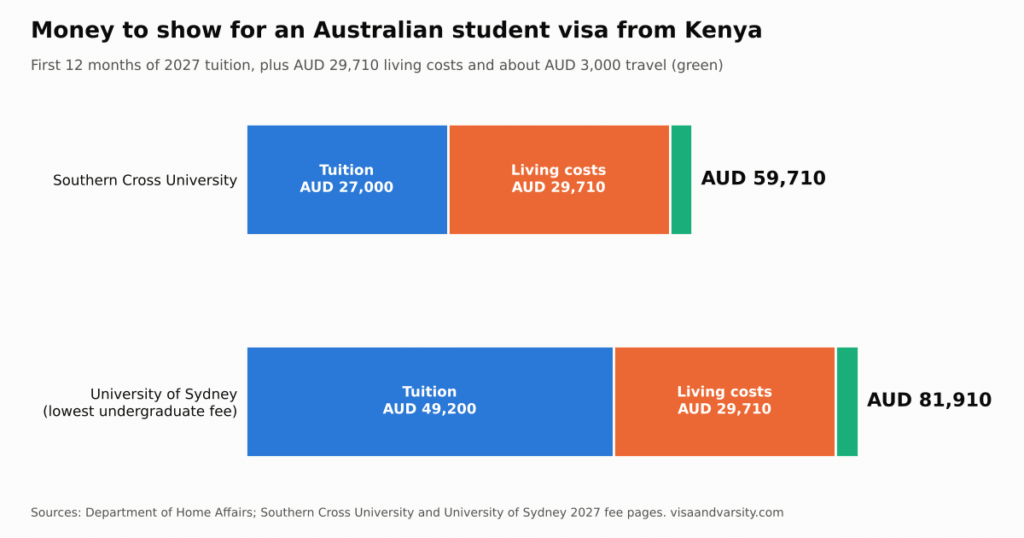
For a single student, Home Affairs adds your first 12 months of tuition, AUD 29,710 for living costs and at least AUD 2,500 for travel, though some universities ask for AUD 3,000. At Southern Cross University, with its AUD 27,000 fee and about AUD 3,000 for travel, that’s AUD 59,710. At the University of Sydney’s lowest undergraduate fee of AUD 49,200, it’s AUD 81,910. Subtract any tuition you’ve already paid. Run the Document Checklist Tool to see whether you need to attach the evidence, but have it ready either way.
Which Kenyan sources of money count
The legal instrument behind the rule accepts money deposited with a financial institution, loans, government loans, and scholarships or other financial support. Bank savings and loans that have already been paid out are the safest evidence. Move SACCO savings, M-Pesa balances and chama contributions into a bank early, and keep records of where each large deposit came from. Land and livestock don’t count.
Instead of savings, you can show that your parents or spouse earned at least AUD 87,856 in the last 12 months, using official government documents. Our proof of funds guide covers each Kenyan source, the income route, a sponsor checklist and the mistakes that lead to refusals.
What are the new rules for international students in Australia?
Since 2 October 2026, you usually have to apply from Kenya rather than from inside Australia, and most new students can’t include a partner or children. Before that, Australia had been tightening almost every part of the student visa since 2024, and Home Affairs’ own figures show that Kenyans who apply for vocational courses have had a much harder time. University applicants still do much better, as the figures below show.
What changed, in date order
| Date | What changed | What it means for a Kenyan |
|---|---|---|
| 23 March 2024 | The Genuine Student requirement replaced the old GTE test | You answer set questions in the online form, backed by documents |
| 10 May 2024 | Higher funds rules took effect, as Home Affairs notes in its June 2025 program report | You now show AUD 29,710 for living costs |
| 7 August 2025 | Home Affairs approved nine English tests and changed the scores | Check the score table for the date you take your test |
| 14 November 2025 | Ministerial Direction 115 set three processing priority levels | Your university’s place in the queue affects how fast you get a decision |
| 1 July 2026 | The visa fee rose to AUD 2,500 | More money lost if you’re refused |
| 15 July 2026 | The government kept the 2027 planning level at 295,000 new students, with TAFE exempt | Places aren’t capped, but busy providers move to a slower queue |
| 2 October 2026 | New rules on applying inside Australia and on family members | You must usually apply from Kenya, and most students can’t bring family |
| Announced, not yet law | Family limits on the graduate visa, and a new transfer stream from 1 July 2027 for students who change provider | Plan to stay with your first university, and don’t count on adding family later |
What Home Affairs’ figures show for Kenyans
Home Affairs doesn’t publish a single grant rate for Kenya, but the country tables in its December 2025 program report tell a useful story. From July to December 2025, Kenyans lodged 4,658 student visa applications, up 126.7% on the same months of 2024. That made Kenya the 11th largest source country for Australian student visas. Of those applications, 2,804 were lodged from outside Australia, up 138.2%.
Grants rose too. Kenyans applying from outside Australia got 1,078 higher education visas, up from 479, and 429 vocational visas, up from just 49 in the same months of 2024, when the crackdown hit hardest. The vocational route is still the risky one, though. Across all countries, the October to December 2025 grant rate for offshore vocational applicants was 41.8%, against 85.8% for higher education. For a Kenyan, the lesson is plain: a university degree at a provider in the top priority group is the safer route than a vocational college. For monthly figures, Home Affairs publishes a student visa dataset that you can filter by citizenship.
Writing Genuine Student answers as a Kenyan
The online form asks four questions, each limited to 150 words in English: your current circumstances, why you chose this course and provider, how it will benefit you, and anything else relevant. Home Affairs gives more weight to answers backed by evidence, and a later plan to apply for permanent residence doesn’t count against you. Write the answers yourself, make every one specific to you, and attach proof of your ties to Kenya.
Our guide to student visa refusals for Kenyans explains what officers look for, the common mistakes, how to read a refusal letter and how to reapply.
Applying from Kenya, step by step
- Accept your offer, pay the deposit and get your Confirmation of Enrolment (CoE).
- Buy Overseas Student Health Cover that starts on the day you’ll arrive.
- Run the Document Checklist Tool with Kenya and your university, and gather what it lists.
- Apply online through ImmiAccount. There’s no paper form and no interview at the High Commission.
- Do your health check at an approved panel clinic in Nairobi once you have your health examination letter.
- Give biometrics or a DCI police certificate only if Home Affairs asks.
- Wait for the decision, and don’t book a non-refundable flight before it arrives.
Can you bring your spouse or children?
For most Kenyans, no. Study Australia lists four groups who can still include family: PhD students, students sponsored by the Department of Foreign Affairs and Trade or Defence, students on a fully funded foreign government scholarship, and eligible students from Pacific or ASEAN countries. Kenya isn’t a Pacific or ASEAN country, so a Kenyan can only bring family through a PhD, an Australia Awards scholarship or a full Kenyan government scholarship.
You also can’t add family after your visa is granted, and everyone included must be in the same place when you apply. If you’re married and your course doesn’t fit an exemption, compare New Zealand, which still gives partners of master’s and PhD students an open work visa.
Agents, fees and scams
An education agent helps you choose and apply to a university, and universities often pay agents a commission. Visa advice is different. Home Affairs explains that only registered migration agents, lawyers and certain exempt people may help with your visa application. Never pay anyone who promises a guaranteed visa, and never let anyone write your Genuine Student answers or create documents for you.
Can you support yourself in Australia?
You can work up to 48 hours a fortnight while your course is in session, and unlimited hours during scheduled breaks. You can’t start any job before your course begins. Once a master’s by research or PhD starts, the limit disappears completely, as the Study Australia student visa page linked above explains.
How the 48 hours are counted
A fortnight here is a fixed 14-day period that starts on a Monday, not any two weeks you choose. Edith Cowan University gives an example: a student who works 8, 40, 10 and 38 hours over four weeks breaks the rule, because weeks two and three form a fortnight of 50 hours. Your hours from every job count together, so two part-time jobs share the same 48.
Our guide to student visa work hours compares how Australia and eight other countries count their limits.
What counts as work, including business and freelancing
Australian migration law defines work as an activity that, in Australia, normally attracts pay. The Department of Home Affairs has told Parliament that, under this test, work usually done by volunteers isn’t work, but work not usually done by volunteers counts whether or not you’re paid. Unpaid work experience can therefore count toward your 48 hours, unless it’s a compulsory part of your course.
This matters for Kenyans who want to run a side business or keep freelancing.
- Owning a business isn’t banned, but every hour you spend running it is work and counts toward the 48.
- Freelancing for a Kenyan client from your room in Australia is still an activity that normally attracts pay, so treat those hours as work too.
- Ride-share, delivery and online tutoring are paid activities, so they count.
- Genuine volunteering at a charity, doing tasks volunteers normally do, doesn’t count.
If you’re unsure about an activity, ask your university’s international student office before you start, because breaking a visa condition can lead to cancellation.
Pay, tax and your rights
From 1 July 2026, Australia’s national minimum wage is AUD 26.44 an hour, and a casual worker on the minimum must get at least AUD 33.05 an hour including the casual loading. International students have the same workplace rights as everyone else, so an employer can’t pay you less because of your visa.
Apply for a Tax File Number as soon as you arrive, because without one you’re taxed at a higher rate. Study Australia’s guide to tax and superannuation explains both.
Forty-eight hours at the casual minimum comes to about AUD 1,586 a fortnight before tax. That’s useful money, but you can’t count it in your proof of funds, and many students take weeks to find their first job.
Keeping your visa while you work
Your visa depends on study first. You must stay enrolled, attend, and make satisfactory progress, and long hours at work are a common reason students fall behind. If you fail a unit, read our guide on what happens to your student visa if you fail a module before you change your study load.
What comes after you graduate?
Most Kenyan graduates move onto the Temporary Graduate visa (subclass 485), which lets you stay and work for 2 years after a bachelor’s or coursework master’s, or 3 years after a research degree. From there, some move to an employer-sponsored or skilled visa and then to permanent residence. None of it is automatic, so plan for it from your first semester.
What the 485 lets you do
Home Affairs’ program report, linked in the new rules section, says 485 holders can work full time, and they don’t have to work in their field of study. So yes, a nursing graduate can work in a shop, and an IT graduate can drive for a delivery app. Because the visa has no limit on work, you can also be self-employed or run a small business, though you should check the conditions on your grant letter.
The visa isn’t cheap. Home Affairs lists the main applicant fee at AUD 5,750, more than double the student visa fee. Graduates of regional campuses can later apply for a second 485 that adds one or two years, as the regional section below explains.
Don’t lose the 485
The 485 is the bridge to everything else. The usual ways Kenyans lose it are being over 35 when they apply, a course shorter than two academic years or 16 months, failed units, an English score below IELTS 6.5 with 5.5 in each skill, and applying more than 6 months after finishing. Our guide from the 485 visa to permanent residency lists all ten traps and how to avoid them.
Routes from the 485 to permanent residence
Home Affairs’ program report shows where former 485 holders went in the 2024 to 2025 program year. The largest group, 26.5%, moved to the employer-sponsored Skills in Demand visa. Another 21.2% got a state-nominated skilled visa (subclass 190), 13.9% a skilled independent visa (subclass 189), and 8% a skilled regional visa (subclass 491). The skilled visas use a points test with a pass mark of 65, and most need a positive skills assessment.
None of these routes is guaranteed. The 485 to PR guide linked above explains each one, with the points test worked for two Kenyan graduates and a year-by-year plan.
Using your Australian degree back in Kenya
If you come home, the Commission for University Education (CUE) recognizes and equates foreign degrees for use in Kenya. CUE asks for certified copies of your certificates and transcripts, so collect them before you leave Australia. If your profession is regulated in Kenya, such as nursing or engineering, contact the Kenyan regulator early to learn what it needs from a foreign graduate.
Scholarships and regional benefits for Kenyans
Full scholarships to Australia mostly go to experienced professionals and PhD researchers. Most Kenyan school leavers will get a partial tuition discount at best, so build your budget without assuming one.
Australia Awards Africa: the fully funded master’s
Kenya is one of 25 African countries eligible for Australia Awards, the Australian government’s main scholarship. Its 2027 country profile lists the benefits: return airfare, full tuition, a contribution to living costs, an establishment allowance, health cover and academic support. It’s for a master’s degree only.
To apply, you have to be at least 25, have 5 years of work experience after your degree, and be employed in Kenya when you apply. The next round opens from 1 February 2027. Award holders must leave Australia for at least two years after they finish, so it suits Kenyans who plan a career at home.
University scholarships open to Kenyans
Most universities give automatic tuition discounts of 10% to 30%, and a few offer 50% or 100% by separate application. RMIT, La Trobe, Murdoch and the University of Sydney run awards that name Kenya or Africa. Our guide to scholarships for Kenyan students in Australia compares 56 awards at more than 30 universities, with the academic bar and dates for each.
PhD funding through the Research Training Program
For a Kenyan with a strong research record, a funded PhD can cost less than a bachelor’s. The government’s Research Training Program pays universities to fund research students, and international students compete for places. At the University of Sydney, for example, the international award covers 100% of tuition and a stipend of AUD 42,754 a year in 2026. Places are few, so contact a supervisor first and ask about the university’s closing dates.
Destination Australia is closed
Many websites still tell Kenyans to apply for Destination Australia, a regional scholarship worth up to AUD 15,000 a year. The Department of Education says there have been no further funding rounds since 1 July 2024. Students who already hold one keep it, but there’s no new national round for 2027. Treat any agent who offers it to you with caution.
What studying in a regional area gets you
- Up to two extra years of post-study work. Graduates who study and live in a regional area can apply for a second Temporary Graduate visa, adding one year in Category 2 places and two in Category 3.
- Five extra points for permanent residence, from the regional study points in the Home Affairs points table, explained in our 485 to PR guide.
- Lower rent and often lower fees, as the cheaper towns and lowest-fee universities sections show.
Is Australia cheaper, and why do Kenyans choose it?
Australia is rarely the cheapest place for a Kenyan to study. Its visa fee is the highest of the five countries below, and the living money you must show is higher than in Canada or New Zealand. Kenyans still choose it because of direct KCSE entry, flexible work hours and a work visa open to any field.
How Australia compares for a Kenyan student
| What a Kenyan faces | Australia | United Kingdom | Canada | New Zealand | United States |
|---|---|---|---|---|---|
| Student visa fee | AUD 2,500 | £558, plus a yearly health surcharge | CAD 150, plus CAD 85 biometrics | NZ$850 | US$185, plus a US$350 SEVIS fee |
| Paid work during term | 48 hours a fortnight | Usually 20 hours a week at degree level | Up to 24 hours a week | Up to 25 hours a week | Up to 20 hours a week on campus |
| Work visa after a bachelor’s | 2 years, any field | 18 months for applications from 1 January 2027 | Up to 3 years | Up to 3 years | 12 months of OPT, more for some STEM graduates |
| Bringing a spouse | Only PhD students and a few exempt groups | Only for postgraduate research courses | Spouse work permit for some master’s and PhD students | Partner work visa for master’s and PhD students | Check the rules for your visa |
| KCSE straight into a degree | Yes, at many universities | Usually a foundation year first | At some universities | Depends on the university | Depends on the university |
Our guides to studying in Canada from Kenya and the cost of studying in New Zealand give the sources for those columns. For the other two, see the cost of studying in the UK and the cost of studying in the USA.
So which countries is Australia cheaper than?
Not many, if you only count what the governments charge. Australia’s AUD 2,500 visa fee is the highest in the table, and Canada and New Zealand both ask you to show less money for living costs. The UK’s health surcharge, though, is charged for every year of your visa, so a three-year UK degree can cost more in government charges than Australia’s one-off fee.
Where Australia can win is the total bill. A degree at a low-fee regional university, such as Southern Cross at AUD 27,000 a year, can cost less than many US or UK degrees, especially if you use the 48-hour work allowance to cover some living costs. Compare full first-year totals, not just tuition, before you decide.
Why Kenyans choose Australia anyway
- Direct entry from KCSE. Griffith, RMIT, ANU, UWA and Federation all publish KCSE conversions, while many UK universities send KCSE holders to a foundation year first.
- More flexible work. 48 hours a fortnight lets you work more in a quiet week and less near exams, and breaks are unlimited.
- A work visa in any field. The 485 doesn’t tie you to your subject, so you can earn while you look for the right job.
- Three intakes a year at some universities. A Kenyan who misses March can start in July or November.
- An established Kenyan community. The 2021 census counted 22,348 people born in Kenya living in Australia, and a quarter of them arrived between 2016 and 2021. Almost half held a bachelor’s degree or higher.
The same census shows where many Kenyans work: 13.1% in social assistance services, 8.7% in aged care and 7.8% in hospitals. That lines up with the shortage of nurses and carers covered earlier, and it’s a useful signal when you choose a course.
Quick answers for Kenyan students
Can I study in Australia with a C+ in KCSE?
Yes, usually through a diploma or foundation first. RMIT accepts a C or C+ for its diplomas, Federation asks for a C+ for diploma entry, and Deakin College takes a C for its diplomas. Most bachelor’s degrees need a B or higher, though Griffith’s standard entry is lower.
Does Australia accept KCSE without a foundation year?
At many universities, yes. Griffith, RMIT, ANU, UWA and Federation all publish direct entry rules for KCSE holders. Ask each university how it works out your mean grade, because some still count both English and Kiswahili.
Do Kenyans need IELTS to study in Australia?
Often for the visa, even when the university waives it. UWA and Curtin accept a good KCSE English grade for admission, but Kenya isn’t one of the countries whose passport holders are exempt from visa English evidence. Run the Document Checklist Tool to see what you need to attach.
How much money do I need in the bank to study in Australia from Kenya?
Your first year of tuition, plus AUD 29,710 for living costs and about AUD 3,000 for travel from East Africa. At Southern Cross University, that comes to AUD 59,710. Subtract any tuition you’ve already paid.
Can I use M-Pesa or SACCO savings as proof of funds?
Not safely as they are. Home Affairs accepts money held with a financial institution, and it doesn’t say whether it treats a SACCO as one. Move the money into a bank account several months before you apply and keep the records that show where it came from.
Can I bring my wife, husband or children?
Most new students can’t since 2 October 2026. The exceptions that can apply to a Kenyan are PhD students, students sponsored by the Department of Foreign Affairs and Trade, such as Australia Awards scholars, and students on a fully funded foreign government scholarship.
Can I work 40 hours a week while studying?
Not every week. The limit is 48 hours a fortnight during term, so if you work 40 hours one week, you can only work 8 the next. During official breaks, you can work as many hours as you like.
Can I get permanent residence after studying?
It’s possible but not guaranteed. In the 2024 to 2025 program year, the most common next step for 485 holders was the employer-sponsored Skills in Demand visa, followed by state-nominated and independent skilled visas. Choose a course linked to a shortage occupation to improve your chances.
Which intake is best for a KCSE leaver?
July. KCSE results come out in January, which leaves too little time for an offer, a visa and a flight before a March start.
Is the Destination Australia scholarship still open?
No. The government stopped new funding rounds from 1 July 2024, so ignore anyone who offers it for 2027.
Your countdown to a July 2027 start
Work backwards from your start date. This plan suits a 2026 KCSE candidate or a graduate aiming for Semester 2, 2027. The dates are our planning guide, so check each university’s own closing dates.
| When | What to do |
|---|---|
| November to December 2026 | Shortlist three to five universities, check each course on CRICOS and note its KCSE or degree entry rule. Start moving family savings from M-Pesa, SACCOs or chamas into a bank account. |
| January 2027 | Collect your KCSE results slip and certified copies. Book an English test at a physical test center if you’ll need one. |
| February to March 2027 | Apply to your universities and to any scholarships with a separate form. |
| March to April 2027 | Accept an offer, pay the deposit and get your Confirmation of Enrolment. Buy health cover that starts on your arrival date. |
| April 2027 | Run the Document Checklist Tool, write your Genuine Student answers and gather your funds evidence. |
| April to May 2027 | Lodge your visa online, then do your health check in Nairobi when Home Affairs asks. |
| June 2027 | Once your visa is granted, book your flight and your first weeks of accommodation. |
| July 2027 | Arrive, give your university your home address within 7 days, apply for a Tax File Number and attend orientation. |
This guide is general information, not immigration advice, and it promises no visa, job or permanent residence. Fees and rules were checked on official government and university pages in October 2026, and several changed during 2026. Confirm every figure with the Department of Home Affairs and your university before you pay anything. For advice on your own case, use a registered migration agent or a lawyer.