
To get an Australian student visa from Kenya in 2027, you must be able to show your first year of tuition, AUD 29,710 for a year of living costs and about AUD 3,000 for travel. For most Kenyan undergraduates, that comes to between AUD 59,710 and AUD 81,910, depending on the university.
This guide on proof of funds for Australia student visa from Kenya explains where those numbers come from, which documents Home Affairs accepts, and how Kenyan savings such as SACCO accounts, M-Pesa balances and chama contributions fit. It’s part of our Study in Australia from Kenya 2027 guide.
How much bank balance should I show for an Australia student visa?
Show enough to cover the three costs Home Affairs adds up for your first 12 months: tuition, living costs and travel. You need to show money for all three, minus any tuition you’ve already paid and can prove.
| Cost | Amount for one student | Where it comes from |
|---|---|---|
| Tuition | Your first-year fee, as shown on your offer letter | Your university’s offer and CoE |
| Living costs | AUD 29,710 | Curtin’s financial capacity form, using the Home Affairs amount in force since May 2024 |
| Travel | AUD 2,500 from East or Southern Africa | The legal instrument on financial evidence |
Some universities ask for more than the legal minimum on their own forms. Curtin, for example, uses a flat AUD 3,000 for travel. If your university asks for a higher figure on its form, show the higher figure, because the university uses that form to decide whether you get a CoE. To be safe, the totals in this guide use AUD 3,000 for travel.
What that comes to at four universities
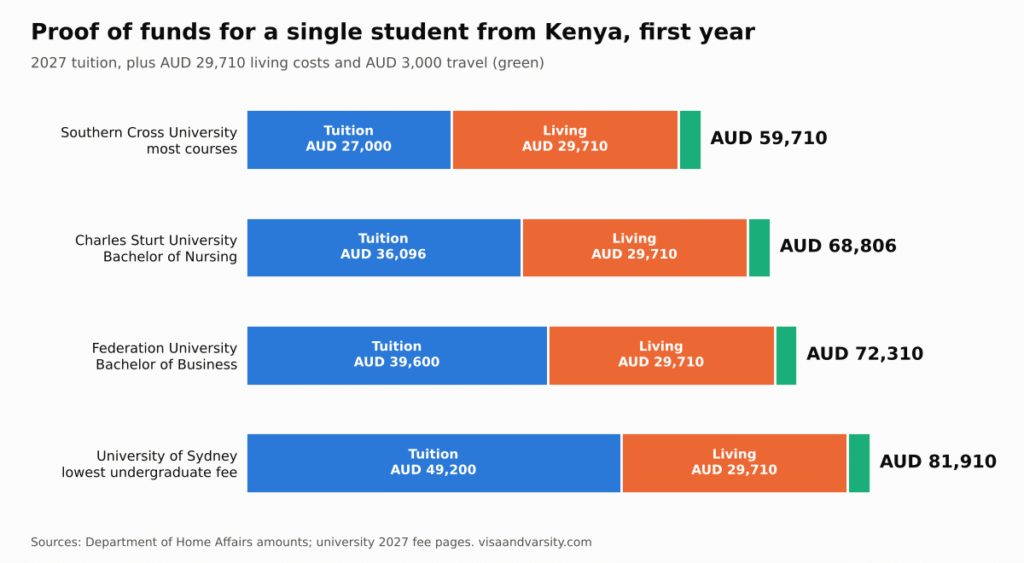
Using 2027 fees, the AUD 29,710 living cost figure and AUD 3,000 for travel, here’s what a single Kenyan student starting a bachelor’s has to show.
| Course | First-year tuition | Living costs | Travel | Total to show |
|---|---|---|---|---|
| Most courses, Southern Cross University | AUD 27,000 | AUD 29,710 | AUD 3,000 | AUD 59,710 |
| Bachelor of Nursing, Charles Sturt University | AUD 36,096 | AUD 29,710 | AUD 3,000 | AUD 68,806 |
| Bachelor of Business, Federation University | AUD 39,600 | AUD 29,710 | AUD 3,000 | AUD 72,310 |
| Undergraduate degree, University of Sydney (lowest fee) | AUD 49,200 | AUD 29,710 | AUD 3,000 | AUD 81,910 |
Converting to shillings
Multiply the AUD total by your bank’s selling rate for Australian dollars on the day you check. Then add about 10%, because the shilling can weaken between the day you save and the day you apply, and your balance still has to cover the full amount in AUD.
Paying a deposit lowers the total
Most universities ask for a tuition deposit before they issue your Confirmation of Enrolment. If you’ve paid part of your first-year tuition and the receipt or CoE shows it, subtract that amount. For example, if you pay AUD 13,500 to Southern Cross up front, the total to show falls from AUD 59,710 to AUD 46,210. Don’t count money you plan to pay later.
If family come with you
From 2 October 2026, most students can’t bring a partner or children, as our main guide explains. If you’re one of the exceptions, such as a PhD student, Curtin’s form lists these extra amounts:
| Family member | Living costs | Travel | School fees |
|---|---|---|---|
| Partner | AUD 10,394 | AUD 3,000 | Not applicable |
| Each child | AUD 4,449 | AUD 2,500 | AUD 13,502 per school-age child |
Plan your living costs separately
AUD 29,710 is what the visa needs, not what life costs. The government’s cost of living calculator puts a shared room in central Sydney at AUD 667 a week, which alone is over AUD 34,000 a year. Plan your real budget separately, and see our cost of studying in Australia guide for a fuller breakdown.
Do you have to attach the evidence?
Not always, but plan as if you do. Whether you need to attach financial evidence with your visa application depends on your passport country and your university together.
The Home Affairs Document Checklist Tool tells you. Enter Kenya as your passport country, add your university or its CRICOS code, and the tool lists the documents to attach. It also explains the two ways to meet the rule: enough money for travel, living costs and tuition, or a spouse or parents with a high enough annual income.
Three things still apply even if the tool says you don’t need to attach anything:
- The visa officer can ask. If they ask and you can’t show the money quickly, you risk a refusal.
- Your university will probably check first. Many universities assess your funds before they issue a Confirmation of Enrolment, and some ask for more than the visa minimum.
- The money must be real at the time you apply. You’re declaring that you have genuine access to it, so don’t apply on the hope that it will arrive later.
Run the tool again just before you lodge. Results can change when Home Affairs updates its risk settings, and a university’s level can move during the year.
What documents can I provide to prove my funds for a student visa in Australia?
You can provide evidence of money, such as bank statements, a paid-out loan or a scholarship letter, or evidence of your parents’ or spouse’s income, such as an income tax assessment. The legal instrument behind the rule allows those two routes, and Home Affairs decides whether your evidence meets it.
Route 1: show the money
The money can come from four kinds of source:
- A deposit with a financial institution, such as a savings, current or fixed deposit account.
- A loan from a financial institution, such as a bank education loan.
- A government loan.
- A scholarship or other financial support, including support from family. Our scholarships for Kenyan students in Australia guide lists the awards open to you.
Universities add their own detail. Curtin asks, on its form, for bank statements covering 6 to 12 months before you apply, held in your name or a sponsoring close relative’s name. It also asks for proof of that relationship, such as a birth certificate, and government photo ID for the sponsor.
For loans, Monash advises that the best evidence is a loan that’s already been paid out into an account you or your sponsor can use. A sanction letter alone is weaker, because it shows a promise rather than money.
Route 2: show the income
Instead of savings, you can show that your parents or your spouse earned at least AUD 87,856 in the 12 months before you apply, or AUD 102,500 if family come with you. Curtin’s form sets out three conditions:
- The income has to be the personal income of your spouse or parents only, not a business’s income and not an uncle’s or older sibling’s.
- A spouse who sponsors you must not come with you to Australia.
- The evidence needs to be official government documentation, such as an income tax assessment.
AUD 87,856 is a very high income by Kenyan standards, so this route suits only a few families. It also has a Kenyan catch, which the Kenyan documents section below explains.
Kenyan documents that you can use as proof of funds
From Kenya, the documents that work best are statements from a bank account, a loan disbursement letter, a scholarship or bursary award letter, and a paper record for every large deposit. Your university often checks them before Home Affairs does, so get them in order early.
How Kenyan money sources fit
Kenyan families rarely keep all their savings in one bank account. Many keep money in SACCOs, M-Pesa, chamas, land and family businesses. Here’s how each fits the four types of evidence Home Affairs accepts.
| Kenyan source | Does it count? | What to do |
|---|---|---|
| Bank savings or current account | Yes, as a deposit | Keep 6 to 12 months of statements that show the balance building up |
| Fixed deposit | Yes, if you can reach the money | Show the maturity date and that you can withdraw it for your studies |
| Deposit-taking SACCO (FOSA) savings | Does not count | Sacco are not Main stream banking so move the money to a bank months before you apply |
| SACCO share capital or BOSA deposits | Usually no | These are hard to withdraw, so they don’t show money you can use |
| M-Pesa or other mobile money | Not on its own | Move it into a bank account early, and keep the M-Pesa statements to explain where it came from |
| Chama or harambee contributions | Only once banked | Bank the money early, and keep a short letter, ID copy and transfer record from each main contributor |
| Land, title deeds or livestock | No | Property only counts once it has been sold and the proceeds are in a bank account. |
| Bank education loan | Yes, as a loan | Get it paid out into an account before you apply |
| Parents, relatives or an employer | Yes, as financial support | Prove the relationship, their ID and income, and any support they’ve given you before |
| Scholarship or county bursary | Yes | Attach the award letter and show exactly what it covers |
The timing problem
Many Kenyan families gather the money from several places in the last few weeks. A balance that jumps from KES 200,000 to KES 6 million in a month raises the obvious question: where did it come from, and is it really yours to spend?
You can still use money gathered late, but you have to explain it. For every large deposit, keep the document that shows its source: a SACCO withdrawal slip, a land sale agreement, a chama letter, a bank loan disbursement or a gift letter from a relative with their ID and statements.
The KRA catch for the income route
The income route needs official government documents. In Kenya, that points to the Kenya Revenue Authority. Home Affairs doesn’t name which Kenyan documents it accepts, so ask your university or a registered migration agent before you rely on a parent’s KRA returns. Bank statements and employer letters on their own aren’t official government documents, and income a parent earns but doesn’t declare to KRA won’t help.
Documents checklist for a Kenyan sponsor
If a parent or relative is paying, gather these before your university asks. Tick them off as you go.
From you
- Offer letter and tuition deposit receipt
- Your own bank statements, if any money is in your name
- Birth certificate, to prove your relationship to a parent sponsor
From each sponsor
- National ID or passport copy
- 6 to 12 months of bank statements, stamped by the bank
- A signed letter saying how much they’ll give you, for how long, and that the money is available for your studies
- Proof of income: payslips and an employer letter, or business registration and accounts if self-employed
- KRA tax returns or other official income records, if you’re using the income route
- Records that explain any large deposit: sale agreements, SACCO withdrawal slips, loan disbursement letters
For a loan
- Loan agreement and disbursement letter showing the money has been paid out
For a scholarship or bursary
- Award letter showing the amount, what it covers and for how long
If a sponsor isn’t a parent or spouse, check with your university before you rely on them. Curtin’s form, for example, wants accounts held by the applicant or a sponsoring close relative.
Mistakes that put your visa at risk
Most proof-of-funds problems start with how the money is held or explained. , not from how much there is. Avoid these:
- Big deposits with no paper trail. A sudden jump in the balance with nothing to explain it invites doubt about whether the money is really yours. Keep a document for every large deposit.
- Leaving money in a SACCO or on M-Pesa. Home Affairs accepts deposits with a financial institution, SACCOs are not mainstream banking. A bank account removes the doubt.
- Counting land, cars or livestock. Assets aren’t money you can spend on fees and rent. Sell early if you need to, and bank the proceeds.
- Showing a loan that hasn’t been paid out. An approval letter only confirms the lender is willing to pay, so wait until the money is in an account. A disbursed loan shows money.
- Using an uncle’s or sibling’s income for the income route. That route counts only the personal income of your parents or spouse.
- Showing only the visa minimum when your university asks for more. Your university uses its own figure to decide whether you get a CoE, so meet it.
- Ignoring the exchange rate. If the shilling weakens between your bank statement and your application, your balance may no longer cover the AUD total. Keep a 10% buffer.
- Using a fake or borrowed statement. Home Affairs warns that bogus documents or false information may lead to refusal, cancellation and restrictions on future applications. Anyone who presents forged documents can also face a penalty of up to 10 years’ imprisonment. No visa is worth that.
If you’ve already been refused, our guide to Australia student visa refusals for Kenyans explains what to do next.
Quick answers
Is proof of funds for Australia student visa from Kenya the same at every university?
No. Home Affairs sets the minimum, but some universities ask for more on their own forms. Curtin, for example, uses AUD 3,000 for travel instead of AUD 2,500.
How many months of bank statements do I need?
Home Affairs doesn’t set one rule for everyone, but universities do. Curtin, for example, asks for 6 to 12 months before you apply.
Can my uncle sponsor me?
For the savings route, possibly, if your university accepts him as a close relative and you can prove the relationship and his money. For the income route, no: only parents or a spouse count.
Does SACCO money count?
It isn’t clear. Home Affairs accepts deposits with a financial institution, however SACCOs do not form part of the mainstream banking system. So move the money into a bank well before you apply.
Can I show M-Pesa statements?
Keep your M-Pesa statements as supporting records, and move the balance into a bank account.
Can I use a bank loan?
Yes. A loan from a financial institution is one of the accepted types, and a loan that’s already been paid out is the strongest evidence.
Do I need to show money for all three years?
No. The rule covers your first 12 months of tuition and living costs, plus travel. You’ll still need to fund the later years, so plan for them.
What if my parents earn enough instead?
You can use the income route if your parents or spouse earned at least AUD 87,856 in the last 12 months, shown in official government documents such as tax assessments.
This guide is general information, not immigration or financial advice, and it promises no visa. Amounts were checked on official government and university pages in October 2026 and can change at any time. Confirm the figures with your university and the Department of Home Affairs before you apply, and use a registered migration agent or lawyer for advice on your own case.