
Most Australia student visa refusals for applicants from Africa and Asia come down to three things: the visa officer doesn’t believe you’re a genuine student, your money doesn’t look real or available, or your documents don’t hold together. A vocational course at a lower-priority college makes all three harder.
A refusal isn’t the end. Most people who apply from their home country can’t appeal, but you can reapply straight away with a stronger application. This guide explains why refusals happen, how to read your refusal letter, and how to fix each problem before you apply again. The refusal grounds and review rules are the same for every nationality, so it applies whether you’re applying from Nairobi, Lagos, Dhaka or Kathmandu. How much evidence you have to attach depends on your passport and your provider, and where we use Kenya as the example, we say so. It’s part of our Study in Australia from Kenya 2027 guide.
What is the expected student visa rejection rate for Australia in 2026?
Home Affairs doesn’t publish a forecast, and its latest program report on the pages we checked runs only to December 2025. Use that as your guide: from October to December 2025, Home Affairs refused about 1 in 6 student visa applicants outside Australia, and more than half of offshore vocational applicants.
Its December 2025 program report doesn’t give a refusal rate for each country, but it shows where refusals are most common. A grant rate is the share of decisions that ended in a grant, so the rest were refusals.
| Applicants outside Australia, October to December 2025 | Grant rate | Refused | Same quarter a year earlier |
|---|---|---|---|
| All sectors | 83.8% | 16.2% | 90.0% |
| Higher education (bachelor’s and coursework master’s) | 85.8% | 14.2% | 92.0% |
| English language courses (ELICOS) | 78.7% | 21.3% | 77.0% |
| Vocational education and training (VET) | 41.8% | 58.2% | 60.2% |
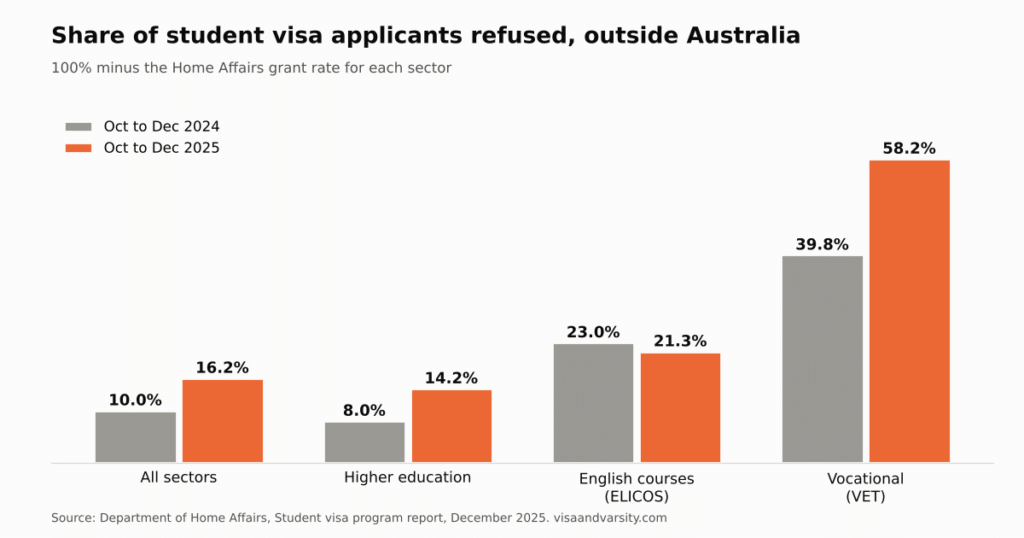
Two facts stand out. Refusals rose in every sector except English courses in 2025, and a vocational applicant was refused more often than granted. For any applicant, a university degree is a far safer route than a vocational diploma.
Example: applications from Kenya are rising fast
From July to December 2025, Kenyans lodged 4,658 student visa applications, up 126.7% on the same months of 2024. That made Kenya the 11th largest source country. Of those, 2,804 were lodged from outside Australia.
Grants rose too. Kenyans applying from outside Australia got 1,078 higher education visas in those six months, up from 479, and 429 vocational visas, up from 49. More Kenyans are getting visas, but more are also applying against tighter rules, which makes a careful application matter more.
Processing speed isn’t the same as your chances
Since 14 November 2025, Ministerial Direction 115 sorts offshore applications into processing priorities based on how close each university or college is to its enrolment allocation. Home Affairs says priority affects how fast your application is decided, not whether it’s granted. A slow decision isn’t a sign of refusal.
Why Australia student visa refusals happen
A student visa officer has to be satisfied of every criterion. Fail one and the visa is refused, however strong the rest is. These are the grounds applicants from Africa and Asia most need to prepare for.
1. The officer doesn’t accept you’re a genuine student
This is the Genuine Student requirement, and it’s the criterion that depends most on how you tell your story. Since 23 March 2024, Home Affairs asks four short questions, each limited to 150 words and answered in English in the visa form: your current circumstances, why this course and provider, how the course will help you, and anything else relevant.
The factors officers weigh are set out in Ministerial Direction 106. In plain terms, they look at:
- Your ties to your home country: family, community, job and money. Strong ties make it more believable that study is your real purpose.
- Your economic circumstances: whether your finances give you a strong reason to use a student visa for something other than study.
- Why not study at home: whether you have a reasonable reason to study abroad when a similar course exists at home.
- What you know about the course, the provider and life in Australia.
- The value of the course: whether it fits your past study and work, and whether it will help your career.
- Your immigration history: past visas, refusals and travel, in Australia and elsewhere.
- If you’ve studied in Australia before: whether you attended, progressed and avoided a pattern of course and provider changes.
What applicants get wrong:
- Answers that could be about anyone. “Australia has world-class education” says nothing about you. Name the units, the career, the employers at home who value the qualification.
- A course that goes backwards. A graduate applying for a certificate or diploma in an unrelated field needs a convincing reason, or it looks like the course is a route to work.
- No evidence. Home Affairs says it gives more weight to statements supported by evidence. Attach your employment letter, payslips, family documents, land or business records and anything else that shows your life at home.
- Hiding a plan to stay. You don’t need to. Home Affairs says a plan to apply for permanent residence later doesn’t count against you. What counts is that study is your main purpose now.
- Answers written by an agent. Officers read thousands of applications. Copied or generic wording is easy to spot.
2. The money doesn’t look real or available
You have to be able to show your first year of tuition, AUD 29,710 for living costs and travel money. Refusals usually come from how the money is held or explained, not the amount. Common problems are large last-minute deposits with no paper trail, savings held outside a bank (for Kenyans, often in SACCOs or M-Pesa), land or livestock counted as funds, and loans that haven’t been paid out. Our proof of funds guide covers each one, using Kenya as the example.
3. English evidence is missing or invalid
Only five countries’ passport holders are exempt from visa English evidence: the UK, the US, Canada, New Zealand and Ireland. No African or Asian passport is on the list. If the Document Checklist Tool says you need a score, a missing one or a test Home Affairs doesn’t accept, such as an at-home test, can lead to a refusal. Since 23 March 2024, the usual minimum is IELTS 6.0 or equivalent, 5.5 with a university pathway, or 5.0 with an English course first.
4. Missing or inconsistent documents
Officers compare everything. A birth certificate that spells your name differently from your passport, an employment letter with no contact details, a bank statement that doesn’t match the sponsor’s ID or a gap in your study history you haven’t explained all raise doubts. Explain any study gap of more than a few months, with evidence of what you did.
5. Bogus documents or false information
This is the most serious ground. Home Affairs warns that bogus documents or false information may lead to refusal, cancellation of your visa and restrictions on future applications, and anyone who presents forged documents can face up to 10 years’ imprisonment. You’re responsible even if an agent made the document without telling you, so check every paper before it’s lodged.
6. Health, character or health cover
You need a health examination at an approved panel clinic if Home Affairs asks for one (for Kenyans, in Nairobi), Overseas Student Health Cover for your whole visa, and, if asked, a police certificate. Missing the health exam deadline or leaving a gap in health cover can lead to refusal.
7. The course or provider choice
Some refusals aren’t about you alone. Officers look at whether the course makes sense for you, and the grant rate for vocational applicants is less than half the rate for university applicants. A course at a provider with a poor record, or a cheap vocational course chosen mainly for its low fee, invites closer scrutiny.
Reading your refusal letter
Your refusal letter is the most useful document you have, because it tells you exactly what to fix. Home Affairs must record its reasons, and the letter names the legal criteria you didn’t meet.
Read it for four things:
- The criterion you failed. Each refusal ground points to a clause of the Migration Regulations. The Genuine Student requirement, for example, is clause 500.212.
- The officer’s reasons. Look for the specific facts the officer relied on, such as “the applicant has not explained the gap in study” or “the source of funds deposited in May is unclear”.
- The evidence they mention. Note which documents they accepted and which they doubted.
- Review rights. The letter says whether you can apply for review, by whom and by when.
| Ground in the letter | What it means in plain English | What to fix |
|---|---|---|
| Genuine Student (clause 500.212) | The officer isn’t satisfied that study is your main purpose | Your four Genuine Student answers and the evidence behind them |
| English language | You didn’t meet the English evidence rule | Attach a valid score from an accepted test taken at a test center |
| Financial capacity | The officer isn’t satisfied you have genuine access to enough money | Your funds, their source and the documents that prove it |
| Health insurance | Overseas Student Health Cover isn’t arranged for the whole stay | Buy cover for the full visa period |
| Health or character | Health exam not done, or a character concern | Complete the exam on time and give a police certificate if Home Affairs asks |
| Public interest criterion 4020 | The officer found false or misleading information or a bogus document | Get advice before you reapply, because this ground can bar future visas |
Your letter cites the exact clause for each ground. If it cites public interest criterion 4020, read the section on future visas below before you do anything else.
If the letter is short on detail, you can ask Home Affairs for the decision record and the documents on your file through a freedom of information request. Seeing exactly what the officer saw helps you answer every concern next time.
Your options after a refusal
You have four real options. Which ones are open to you depends mainly on where you were when you applied.
| Option | Who it suits | Cost | Time |
|---|---|---|---|
| Reapply with a stronger application | Most people who applied from outside Australia | A new visa fee of AUD 2,500 | As soon as you’re ready |
| Ask the tribunal to review the decision | Mainly people who applied from inside Australia, if the letter gives review rights | AUD 3,580, or AUD 1,790 with a hardship reduction | Apply within 28 days of being notified |
| Judicial review in court | Only where the decision contains a legal error | Court fees and legal costs | Strict time limits; get a lawyer |
| Study somewhere else | Anyone who’d rather not risk a second refusal | Depends on the country | Depends on intakes |
Option 1: reapply
If you applied from outside Australia, this is usually the only route. In general, you don’t get tribunal review rights when Home Affairs refuses an application made outside Australia, and your letter will say so if that’s your case. The good news is that you can lodge a new application whenever you’re ready. There’s no waiting period after an ordinary refusal.
You’ll pay the full fee again. Home Affairs doesn’t refund the visa application charge because an application was refused, and the student visa fee has been AUD 2,500 since 1 July 2026. So don’t rush. Reapply only once you’ve fixed every ground in your letter, using the next section.
Option 2: tribunal review
The Administrative Review Tribunal reviews certain visa decisions. If your letter gives you review rights, usually because you applied from inside Australia, the main points are:
- Deadline: apply within 28 days of being notified, or 14 days if you’re in immigration detention. The tribunal can’t extend this.
- Fee: AUD 3,580, or half that if paying in full would cause financial hardship. You get 50% back if the decision is set aside or sent back to Home Affairs.
- No hearing: since 1 June 2026, the tribunal must decide most student visa reviews without an oral hearing. Put everything you want considered in writing.
The tribunal looks at the case afresh, so you can send new evidence. For a student refused for weak funds evidence, a review can work if the money was genuine and you can now prove it. But tribunal reviews can take months, so you may miss your intake.
Option 3: judicial review
A court doesn’t re-decide your visa. It only checks whether the decision was made lawfully. This suits rare cases, such as an officer ignoring evidence you sent or failing to give you a fair chance to respond. You’ll need a lawyer, and the costs are high, so it’s rarely the best route for a student refused outside Australia.
Option 4: study elsewhere
If your case is borderline, compare a second Australian application with an offer elsewhere. For Kenyans, our guides to studying in Canada from Kenya and studying in New Zealand from Kenya cover the alternatives. You must declare the Australian refusal on most other visa forms, so be honest about it there too.
Can Australia give a visa after refusal?
Yes. An ordinary refusal doesn’t stop Home Affairs granting a later application, and there’s no waiting period before you apply again. The tribunal can also send an onshore decision back to Home Affairs to decide again. The one big exception is a refusal for false documents or information, covered below, which can block many visas for 3 years.
What are the chances of getting an Australian student visa after refusal?
Home Affairs doesn’t publish a grant rate for second applications, so nobody can give you a real figure. Be wary of any agent who quotes one. What we can say is that the new officer sees your refusal, so a second application that repeats the first will usually get the same result.
Your chances go up when the new application answers every reason in the letter with evidence. Some fixes are quick, such as a missing English score or health cover. A Genuine Student or funds refusal takes longer, because you have to change what the officer doubted, not just reword it. And if your first course was vocational, a university course in your field puts you in a sector where Home Affairs granted 85.8% of offshore applicants in late 2025, against 41.8% for vocational.
What happens if my Australian student visa is refused onshore?
You may be able to ask for a review, but you have very little time, and fewer visa options while you stay in Australia. Onshore applicants also had a lower grant rate in late 2025: Home Affairs granted 75.4% of student visa applications made in Australia from October to December 2025, against 83.8% for applications made outside.
Here’s what usually happens next:
- Check your letter for review rights. People who applied in Australia are the ones who usually get them. You have 28 days to apply to the Administrative Review Tribunal, and the tribunal decides most student reviews without a hearing, as Option 2 above explains.
- You can apply for fewer visas. The Migration Act says a non-citizen refused a visa may only apply for particular visas while they stay in Australia. Since 2 October 2026, most temporary visa holders also can’t apply for a student visa from inside Australia.
- Find out when your current visa ends. If you stay after your last visa ends, Home Affairs says you become an unlawful non-citizen, subject to detention and removal.
For most students in this situation, the choice is a tribunal review, if your letter gives you the right, or leaving and reapplying from home. Talk to a registered migration agent or lawyer before your 28 days are up.
Reapplying from home: fix each ground first
Reapplying with the same application will definitely give you the same results. The new officer can see your refusal, so your job is to answer every concern in the letter, with evidence.
If you were refused as not a genuine student
- Rewrite all four answers yourself. Keep each under 150 words, in your own voice, and make every sentence specific to you.
- Answer the officer’s exact doubt. If the letter says your course doesn’t fit your background, explain the link plainly and show it with documents, such as a job description that names the skill.
- Prove your ties to home. Attach an employment letter that confirms your job will be held or your career path, payslips, family documents, land or business records, and anything that shows a life you’ll return to or build on.
- Show the career value. Name employers at home, roles or salary levels you can reach with the qualification. Evidence counts for more than claims.
- Explain every gap. Account for any time out of study or work, with evidence of what you did.
- Rethink the course if needed. If you chose a vocational course after a degree, consider a postgraduate course in your field at a university instead. The grant rate gap between the two sectors is large.
If you were refused on funds
- Move all money into a bank and keep it there. Money in savings groups or mobile wallets, such as Kenyan SACCOs and M-Pesa, raises questions Home Affairs doesn’t answer in writing.
- Document the source of every large deposit: sale agreements, savings group withdrawal slips, loan disbursement letters, gift letters with the giver’s ID and statements.
- Show the sponsor’s income, not just their balance, with payslips, business records and tax returns, such as KRA returns in Kenya.
- Use a disbursed loan, not a sanction letter.
- Show a buffer of about 10% above the required total, in case your currency weakens.
Our proof of funds guide has the full checklist.
If you were refused on English, health, insurance or documents
These are the easiest to fix. Book an accepted test at a test center in your country, complete the health exam at an approved panel clinic, such as Aga Khan University Hospital or the IOM clinic in Nairobi, as soon as you get your letter, buy health cover for the whole visa period, and make sure names and dates match across every document.
Your reapplication checklist
- Read the refusal letter line by line and list every concern
- Ask for your file through freedom of information if the reasons are unclear
- Get a new or confirmed offer and CoE, checking your intake date is still possible
- Rewrite the four Genuine Student answers yourself
- Gather evidence for every claim in those answers
- Rebuild the funds evidence with a clear source for each deposit
- Check your English evidence is valid and from an accepted test
- Declare the earlier refusal truthfully on the new form
- Ask a registered migration agent or lawyer to review the application before you lodge, if the first refusal was on Genuine Student or false-document grounds
Only registered migration agents, lawyers and certain exempt people may give visa advice. An education agent can help with your university application, but not with your visa case.
Does a refusal hurt future visas?
An ordinary refusal doesn’t ban you from anything. You can reapply for an Australian student visa straight away, and you can apply to other countries. What matters is that you declare it and fix what went wrong.
You must declare it
Home Affairs asks on its visa forms whether you’ve ever been refused a visa, in Australia or elsewhere. So do the forms for Canada, the UK, the US and New Zealand. Always answer yes and explain briefly. Ministerial Direction 106 tells officers to look at your past applications, refusals and travel history, so a hidden refusal that comes to light later looks far worse than the refusal itself.
When it does block you: false documents
The exception is a refusal for bogus documents or false or misleading information. Under public interest criterion 4020 in the Migration Regulations, a refusal on that ground in the 3 years before you apply can stop you getting many Australian visas, the student visa included. A refusal because you didn’t prove your identity looks back 10 years. The Minister can waive the rule only in compelling circumstances that affect Australia’s interests, or compassionate or compelling circumstances affecting an Australian citizen or certain others.
This is why you should never let an agent “improve” a bank statement, employment letter or certificate for you. If the refusal letter cites 4020, get advice from a registered migration agent or lawyer before you do anything else.
Quick answers
Can I appeal an Australian student visa refusal from outside Australia?
Usually not. You generally don’t get tribunal review rights for an application made outside Australia. Your letter says whether you have any. You can reapply instead.
How soon can I reapply after a refusal?
Right away, unless the refusal was for false documents or information. But wait until you’ve fixed every ground in the letter, because you’ll pay the AUD 2,500 fee again.
Will I get my visa fee back?
No. Home Affairs doesn’t refund the visa application charge because an application was refused.
What are the most common reasons for Australia student visa refusals?
Home Affairs doesn’t publish refusal reasons by country. For applicants from Africa and Asia, the grounds that need the most preparation are the Genuine Student requirement and financial capacity.
Does mentioning permanent residence get me refused?
No. Home Affairs says a later plan to apply for permanent residence doesn’t count against you under the Genuine Student requirement.
Is a vocational course riskier than a degree?
Yes. From October to December 2025, the grant rate for offshore vocational applicants was 41.8%, against 85.8% for higher education.
Should I change university after a refusal?
Only if the course or provider was part of the problem. A course that fits your background at a well-regarded university strengthens a Genuine Student case.
Do I have to tell Canada or the UK about an Australian refusal?
Yes, if they ask, and most do. Declaring it honestly is far safer than leaving it out.
This guide is general information, not immigration or legal advice. Rules, fees and figures were checked on official government pages in October 2026 and can change. Your refusal letter sets out your own review rights and deadlines. For advice on your case, use a registered migration agent or a lawyer.