
The Temporary Graduate visa (subclass 485) doesn’t lead to permanent residency on its own. What it gives you is two to three years of full work rights, more after regional study, to build the job, the work experience and the points that a permanent visa needs. Most graduates who make it go through an employer who sponsors them, or through a points-tested skilled visa with or without a state nomination.
This guide explains how to qualify for the 485, the mistakes that cost graduates the visa, each route from the 485 visa to permanent residency, and two worked examples of the points test. The rules are the same for every nationality. Our worked examples are Kenyan graduates, and we say where a detail is specific to Kenya. It’s part of our Study in Australia from Kenya 2027 guide.
The 485 visa in brief
The Temporary Graduate visa lets you live and work in Australia after you finish an Australian qualification. Home Affairs’ December 2025 program report says holders can work full time and don’t have to work in their field. Study Australia lists three streams:
| Stream | Who it’s for | How long you can stay |
|---|---|---|
| Post-Higher Education Work | Graduates of a bachelor’s degree or higher | 2 years after a bachelor’s or coursework master’s; 3 years after a research master’s or PhD |
| Post-Vocational Education Work | Graduates of a diploma, associate degree or trade qualification linked to an occupation on the skilled list | Up to 18 months |
| Second Post-Higher Education Work | First 485 holders who studied at a regional campus and lived regionally | 1 extra year in Category 2 areas, 2 in Category 3 |
Indian nationals can get up to four years under a trade agreement. Most other nationalities, Kenyans included, get the standard periods.
The main rules
- Age: 35 or under when you apply. Research master’s and PhD graduates can apply up to 49.
- Timing: you need to have held a student visa in the 6 months before you apply, and apply within 6 months of completing your course.
- Study: at least two academic years of CRICOS study, completed in no less than 16 calendar months.
- English: IELTS 6.5 overall with at least 5.5 in each skill, or equivalent, since 23 March 2024.
- Police check: proof that you’ve applied for an Australian Federal Police check.
- Health cover: adequate health insurance for the whole stay.
- Fee: AUD 5,750 for the main applicant since 1 July 2026.
What are the new rules for the 485 visa in Australia in 2026?
Two changes are dated 2026, and only one of them is in force. Study Australia says the main applicant fee rose to AUD 5,750 on 1 July 2026, and that restrictions on including family members in 485 applications will be introduced, with no start date announced yet.
The other rules people call new are older. The age limit of 35 and the IELTS 6.5 requirement came in during 2024, and 485 holders have been unable to apply for a student visa from inside Australia since 1 July 2024. If you’re married, check the family rules again just before you apply.
Ten ways graduates miss the 485
The 485 is the bridge to everything else, so losing it usually ends the plan. These are the mistakes to plan around from your first semester.
- Turning 36 before you apply. A student who starts a three-year bachelor’s at 32 can graduate at 35 and still be fine, but a delayed start or a repeated year can push you past the limit.
- Choosing a course that’s too short. A one-year master’s on its own doesn’t meet the two-academic-year rule. A 1.5-year master’s can, if it runs at least 16 months.
- Taking too much credit. Credit from a diploma or degree from home can cut your Australian study below 16 months. Count the months before you accept it.
- Failing units. Failed subjects don’t count toward the study requirement, so repeats can leave you short. Our guide on what happens to your student visa if you fail a module explains the wider risks.
- Not retesting your English. If you entered on IELTS 6.0, you’ll need 6.5 with 5.5 in every band. Book the test months before you finish, so a retake doesn’t push you past the deadline.
- Missing the 6-month window. Ask your university for a completion letter as soon as your final results are out, then lodge.
- Leaving Australia first. If you go home for the holidays after your last exam, check that you can still apply in the way your stream requires before you book the flight.
- Forgetting the police check. You must apply for the AFP check before you lodge, and attach proof.
- Letting health cover lapse. A gap between your student cover and your 485 cover can lead to a refusal.
- Breaking student visa conditions. Working more than 48 hours a fortnight in term, or poor attendance and progress, can lead to cancellation. A canceled student visa usually means no 485. Our guide to student visa work hours explains the limit.
How can I get PR after a 485 visa?
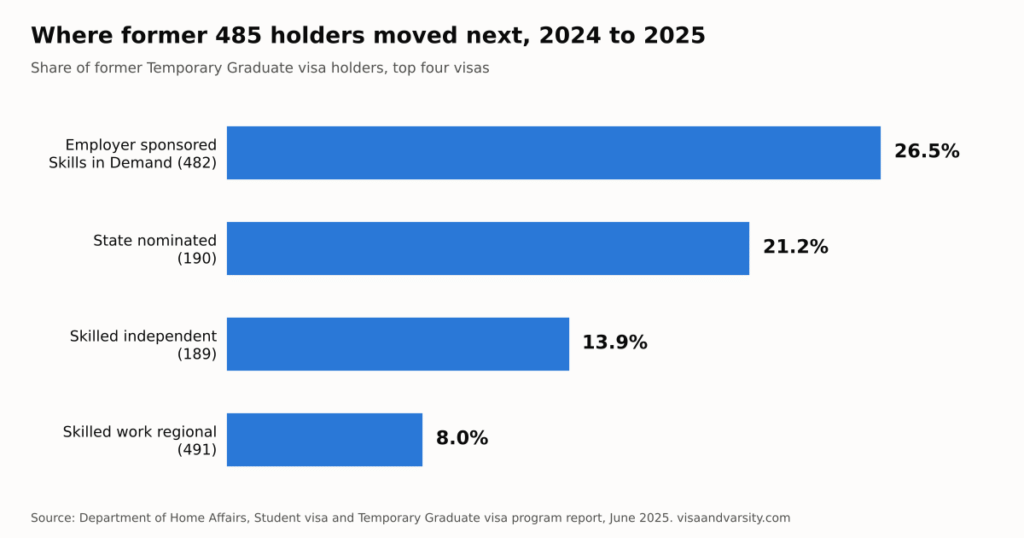
Through one of four visas: employer sponsorship, a Skilled Independent visa, a state-nominated visa or a regional visa. Home Affairs’ June 2025 program report shows where former 485 holders went in the 2024 to 2025 program year. The largest group, 26.5%, moved to the employer-sponsored Skills in Demand visa. Another 21.2% got a state-nominated skilled visa (subclass 190), 13.9% a skilled independent visa (subclass 189), and 8% a skilled regional visa (subclass 491). Those four routes are the main paths for most graduates.
| Route | How it works | Permanent? | Best for |
|---|---|---|---|
| Skills in Demand (482), then Employer Nomination Scheme (186) | An employer sponsors you for a temporary skilled visa, then nominates you for permanent residence | 482 is temporary, up to 4 years; 186 is permanent | Graduates who land a job in their field with an employer willing to sponsor |
| Skilled Independent (189) | You’re invited on points alone, with no sponsor | Yes | High scorers in occupations the government invites |
| Skilled Nominated (190) | A state or territory nominates you, adding 5 points | Yes | Graduates who studied and worked in that state |
| Skilled Work Regional (491), then Permanent Residence (191) | A state or eligible relative sponsors you to live and work regionally, adding 15 points | 491 is temporary; the 191 that follows is permanent | Regional graduates and those willing to live outside the big cities |
What is the quickest way to get permanent residency in Australia?
For most graduates there isn’t a fast lane. The quickest of the four routes is usually a Skilled Independent (189) or Skilled Nominated (190) visa, because both are permanent from the day they’re granted. The employer route and the 491 both start with a temporary visa. But you only get a 189 or 190 invitation if your points are high enough for your occupation, so the real question is how fast you can raise your points.
English is the fastest lever, as the points section below shows. Be wary of anyone who sells a guaranteed fast track to PR, because Home Affairs decides every invitation.
Employer sponsorship
The Skills in Demand visa (subclass 482) replaced the old TSS visa on 7 December 2024. Most graduates would use its Core Skills stream, which needs an occupation on the Core Skills Occupation List and a salary at or above the Core Skills Income Threshold. That threshold is AUD 79,423 from 1 July 2026. The Specialist Skills stream needs AUD 146,576.
The same Core Skills list applies to the Direct Entry stream of the permanent Employer Nomination Scheme (subclass 186). Many sponsored workers instead move to permanent residence through the 186’s Temporary Residence Transition stream after working for their sponsor for the required time.
For most graduates, the hard part is the salary and the employer. Use your 485 years to get a graduate role in your field, prove your value, and then raise sponsorship.
Points-tested visas
The 189, 190 and 491 all use the points test, and the pass mark is 65. In practice, invitations often go to people well above 65, and the score needed varies by occupation and over time. For each one you’ll usually need:
- A positive skills assessment from the assessing authority for your occupation.
- An Expression of Interest lodged in SkillSelect, showing your points.
- An invitation, then a full application.
State nomination adds 5 points for the 190 and 15 for the 491. Each state publishes its own occupation lists and rules, and graduates who studied and worked in that state usually have the strongest case.
Regional study pays off twice
Study at a regional campus earns 5 points and opens the second 485, which adds one year in Category 2 areas such as Adelaide, Perth, Canberra and Newcastle, or two in Category 3 areas such as Darwin and regional towns. The extra year or two is often what turns Australian work experience into enough points.
The points test, worked for two graduates
Points come from Schedule 6D of the Migration Regulations. Here are the items most graduates can claim.
| Item | Points |
|---|---|
| Age 18 to 24 / 25 to 32 / 33 to 39 / 40 to 44 | 25 / 30 / 25 / 15 |
| English: proficient / superior | 10 / 20 |
| Overseas skilled work, such as in your home country: 3 to 4 / 5 to 7 / 8 to 10 years | 5 / 10 / 15 |
| Australian skilled work: 1 to 2 / 3 to 4 / 5 to 7 / 8 to 10 years | 5 / 10 / 15 / 20 |
| Doctorate / bachelor’s or higher / diploma or trade | 20 / 15 / 10 |
| Australian study requirement | 5 |
| Specialist education qualification | 10 |
| Study in regional Australia | 5 |
| Professional Year in Australia | 5 |
| Credentialled community language | 5 |
| Single, or partner is an Australian citizen or permanent resident | 10 |
| Partner with skills and competent English / competent English only | 10 / 5 |
| State nomination for a 190 / nomination or sponsorship for a 491 | 5 / 15 |
The pass mark is 65. Skilled work points, Australian and overseas combined, are capped at 20.
Is it easy to get PR in Australia after a master’s?
It isn’t easy, and a coursework master’s earns no more points than a bachelor’s. Both are worth 15 points, and Home Affairs awards points for your highest qualification only, according to its points test guidance. Extra points come from research: a master’s by research or a PhD from an Australian institution, with at least 2 academic years of study in a listed STEM or ICT field, earns 10 more as a specialist educational qualification.
What a master’s does give you is time. It leads to a 2-year 485, or 3 years after a research master’s, as long as it meets the two-academic-year rule. Use that time for skilled work and a higher English score, because those add points a coursework master’s can’t.
Example 1:Mary, a Kenyan nursing graduate from a regional campus
Mary is 27, single, and finished a Bachelor of Nursing at a regional campus. She scored proficient English and has worked as a registered nurse in Australia for one year on her 485.
| Item | Points |
|---|---|
| Age 27 | 30 |
| Proficient English | 10 |
| Bachelor’s degree | 15 |
| Australian study requirement | 5 |
| Regional study | 5 |
| 1 year of Australian skilled work | 5 |
| Single | 10 |
| Total for a 189 | 80 |
| Plus state nomination for a 190 | 85 |
Mary is well above the pass mark, and nursing is one of the large occupations in shortage, which puts her in a strong position.
Example 2: Otieno, a Kenyan IT graduate from a city campus
Otieno is 24, single, and finished a Bachelor of IT in Melbourne with competent English. He has no skilled work experience yet.
| Item | Points |
|---|---|
| Age 24 | 25 |
| Competent English | 0 |
| Bachelor’s degree | 15 |
| Australian study requirement | 5 |
| Single | 10 |
| Total | 55 |
Otieno is below 65. Here’s how he could close the gap during his 485:
- Score proficient English: +10, to 65.
- Complete a Professional Year in IT: +5, to 70.
- Turn 25: +5 more, to 75, since the 25 to 32 band is worth 30.
- Work one year in his skilled occupation: +5, to 80.
Even at 80, an IT graduate faces stiff competition for invitations, so Otieno should also aim for state nomination or employer sponsorship.
The fastest points to gain
English is usually the quickest win. Moving from competent to superior English is worth 20 points, more than eight to ten years of overseas work earns. Work experience from your home country counts too, if it’s skilled work in your nominated occupation, so keep payslips, contracts and reference letters from home.
Does any job count toward my PR points?
No, but it doesn’t have to be a perfect match either. Home Affairs counts paid work of at least 20 hours a week in your nominated occupation or a closely related one, within the 10 years before your invitation. Its policy treats occupations in the same ANZSCO unit group as closely related, such as Accountant (General) and Management Accountant, according to its points test guidance released under freedom of information.
So a nursing graduate who works as a shop assistant on the 485 earns no points for that job, even though the visa allows it. Some assessing bodies also count only work done after you reached the qualification level for the occupation. VETASSESS, for example, says employment must be undertaken after you met the entry level requirements.
Occupations with the best odds
Your occupation decides almost everything: whether you can get a skills assessment, whether states will nominate you, and whether employers can sponsor you. Jobs and Skills Australia’s 2025 Occupation Shortage List found 29% of occupations in shortage, down from 36% in 2023. Its additional insights report names the large occupations still in shortage: registered nurses, doctors, teachers, engineers, aged and child carers, and construction and clean energy workers.
| Field | Why it’s strong | Assessing body |
|---|---|---|
| Nursing | One of the largest shortage occupations, in every state and in regional towns | Australian Nursing and Midwifery Accreditation Council (ANMAC) |
| Teaching | Large shortage, especially in regional schools | Australian Institute for Teaching and School Leadership (AITSL) |
| Engineering | In shortage and linked to infrastructure and clean energy | Engineers Australia |
| Aged and disability care, social work | Growing demand from an ageing population | Depends on the role; check the skilled occupation list |
| IT and accounting | Popular and transferable, but crowded, with high invitation scores | Australian Computer Society; CPA Australia, CA ANZ or IPA |
Check which body assesses your occupation on the Home Affairs skilled occupation list, then read that body’s rules before you choose a course. Some, like the nursing and teaching bodies, expect you to hold registration or meet professional standards first.
How do I get a skills assessment if my job title doesn’t match my degree?
Nominate the occupation that matches what you actually do, not your job title. Assessing bodies compare your duties with the tasks of the occupation. VETASSESS, for example, says the major tasks in your everyday work should closely match the occupation you nominate, and that a highly relevant field of study is the major field of your qualification.
- Find the matching occupation. Compare your real duties with the tasks listed for each occupation, and pick the one that fits best.
- Get a reference letter that lists your duties. Ask each employer for your duties, hours and dates, not just your title.
- Check how the body treats your degree. If your major isn’t closely related to the occupation, read that body’s rules before you apply, because it may weigh your degree differently.
- Ask before you pay, if you’re unsure. VETASSESS can’t choose an occupation for you, but it offers a paid Skills Assessment Support consultation.
Example: Kenyans already work in these fields
The 2021 Census counted 22,348 Kenya-born people in Australia. Their top industries were other social assistance services (13.1%), residential aged care (8.7%) and hospitals (7.8%). That’s a community already working in care and health, which can help with networks and job leads.
Shortages change every year, and JSA says they continued to ease in 2026. Check the list for the state you plan to live in, and choose a qualification that also works at home, such as nursing, teaching or engineering, in case you don’t stay.
A year-by-year plan from first semester to PR
Permanent residence is a five- to seven-year project for most graduates, by our estimate. Here’s how to use each stage.
| Stage | What to do |
|---|---|
| Before you apply to study | Choose a course in an occupation with real shortages that’s at least two academic years and 16 months long. Consider a regional campus for the extra points and the second 485. Check your age will be 35 or under at graduation. |
| Year 1 of study | Pass every unit. Keep your work within 48 hours a fortnight in term. Join professional bodies as a student member. |
| Year 2 of study | Look up the assessing body for your occupation and what it needs. Get part-time or placement work in your field if you can. |
| Final semester | Take the English test aiming for proficient or superior. Apply for the AFP check. Ask for your completion letter as soon as results are out. |
| Within 6 months of finishing | Lodge your 485 with health cover in place. |
| 485 year 1 | Get a graduate role in your field. Apply for your skills assessment. Start a Professional Year if your field has one. |
| 485 year 2 | Lodge an Expression of Interest in SkillSelect. Apply for state nomination where you qualify. Raise sponsorship with your employer. |
| If you studied regionally | Apply for the second 485 to buy one or two more years of work and points. |
| Permanent visa | Apply once invited or nominated, while your 485 or 482 is still valid. |
Keep every payslip, contract and reference letter from both home and Australia. Skilled work counts toward your points only if you can prove it, and employers back home can be hard to reach years later.
Quick answers
Does the 485 lead to PR automatically?
No. It gives you time and work rights. You still need a permanent visa through employer sponsorship or a points-tested skilled visa.
How long is the 485 for a bachelor’s graduate?
Usually 2 years, or 3 after a research master’s or PhD. Regional graduates can add 1 or 2 years with a second 485.
How long does the 485 visa to permanent residency path take?
Five to seven years for most graduates, counting from the start of study, by our estimate. It’s faster if you start with high points or land an employer willing to sponsor you.
What’s the pass mark for the points test?
65 points. Invitations often go to people with more, depending on the occupation.
Can I use work experience from my home country?
Yes, for points, if it’s skilled work in your nominated occupation within the last 10 years. Three to four years earns 5 points, rising to 15 for eight to ten years.
What salary does an employer have to pay to sponsor me?
For the Core Skills stream of the Skills in Demand visa, at least AUD 79,423 from 1 July 2026, and no less than the market rate.
Which degree gives the best chance of PR?
Courses linked to large shortage occupations, such as nursing, teaching and engineering, usually do best. IT and accounting are popular but crowded.
I’m 34. Is it too late?
Not for the 485 if you graduate by 35, but your points fall from 30 to 25 at 33 and to 15 at 40. Plan your timeline so you apply for PR before the next age band.
Can my family come on my 485?
Partners and children can currently be included, subject to health and character checks, but the government has announced restrictions for 485 applicants. Check the latest rules before you apply.
This guide is general information, not immigration advice, and it promises no visa or permanent residence. Rules, thresholds and lists were checked on official government pages in October 2026, and they change often. Check the current rules with the Department of Home Affairs, and use a registered migration agent or lawyer for advice on your own case.