
Your KCSE is a respected certificate, but Germany doesn’t treat it as equal to its own school-leaving exam. That makes the useful question “Which route does my KCSE lead to?” and the KCSE requirements to study in Germany depend on the answer. With a C+ you can enter a one-year preparatory course. With a C+ plus a year at a Kenyan university, you can go straight into a related bachelor’s. And for a master’s, your degree class matters less than the grade a German university gets when it converts your marks.
This guide covers bachelor’s, master’s and PhD entry. It shows how to check your own certificate, how German universities convert Kenyan marks, and what to get ready before you apply. If you want the full picture first, read our guide to studying in Germany from Kenya.
How Germany assesses Kenyan qualifications
Germany doesn’t let each university guess what a KCSE or a Kenyan degree is worth. The Central Office for Foreign Education (ZAB), which works for the education ministers of the 16 German states, rates foreign certificates and publishes the results in a database called anabin. Universities and uni-assist, the service many universities use to check international applications, apply those ratings.
For a school certificate like the KCSE, the rating gives one of three outcomes:
- Direct access to all subjects. You can apply for any bachelor’s.
- Direct access to some subjects. You can apply only in the field you’ve already studied or a related one.
- A Studienkolleg first. You take a preparatory course and pass its final exam before you can apply.
You don’t need to read anabin in German. DAAD, the German Academic Exchange Service, publishes an English version called the admission database. DAAD says the database is a guide and doesn’t bind the universities, so the university you apply to has the final word.
Kenya is not an APS country
Some countries make students verify their certificates at an academic test office (APS) before they apply. Munich University of Applied Sciences says this applies to applicants from China, India and Vietnam. Kenya isn’t on that list, so you can apply directly or through uni-assist without that extra step.
Is your Kenyan university recognized?
If you’re relying on university study in Kenya, whether a first year or a full degree, check your university in anabin before you apply. Anabin gives each foreign university a status, and Make it in Germany, the German government’s portal for skilled workers, explains what they mean:
| Status | What it means for you |
|---|---|
| H+ | The university is recognized in Germany. You still need to check that your degree is listed. |
| H+/- | Only some programs are recognized. Your program may need a further check. |
| H- | The university isn’t rated as equal to a German one. |
For a full degree, anabin also rates the qualification itself. A rating of “entspricht” (corresponds) or “gleichwertig” (equivalent) means Germany treats it as comparable to a German degree.
If your university or degree isn’t listed, that doesn’t automatically mean it isn’t recognized. Ask the international office of the German university you’re applying to how it will assess your certificate.
KCSE requirements to study in Germany: the bachelor’s grade you need
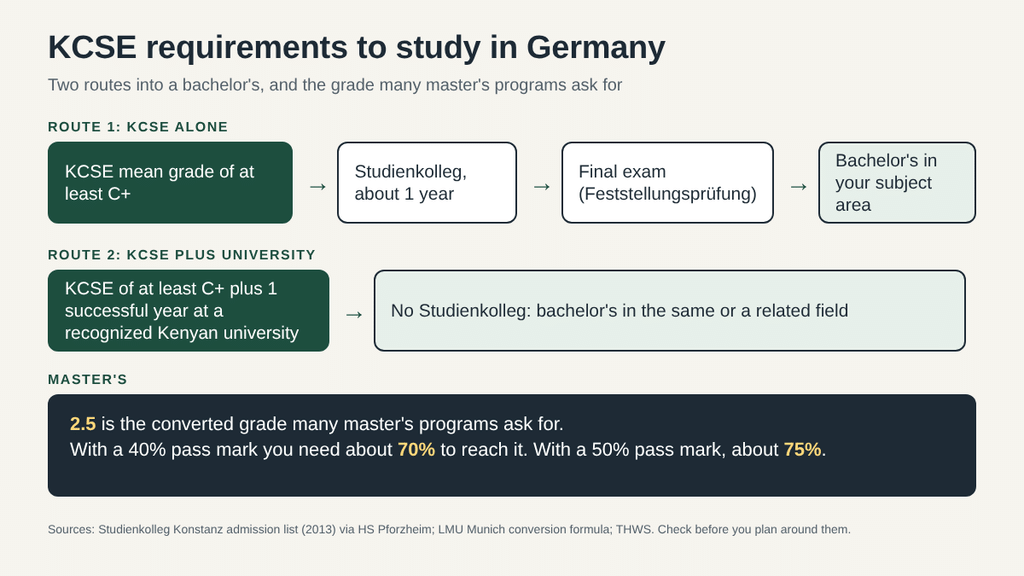
Your KCSE mean grade decides which route you can take. An admission list from the Studienkolleg Konstanz, which HS Pforzheim (Pforzheim University of Applied Sciences) publishes an admission list from the Studienkolleg Konstanz that follows ZAB guidance. It sets out two routes for Kenyans:
| What you hold | What it gets you |
|---|---|
| KCSE with a mean grade of at least C+ | A place in a Studienkolleg, the one-year preparatory course |
| KCSE of at least C+ plus one successful year of university study | Direct entry to a bachelor’s in the same or a related field |
That list dates from 2013, so check your certificate in the DAAD admission database before you plan around it.
KCSE alone: the Studienkolleg route
If you’ve just finished Form Four with a C+ or better, the Studienkolleg is your route. You prepare for about a year, pass a final exam called the Feststellungsprüfung, and then apply for a bachelor’s in the subject area your course covered. The section “The Studienkolleg in detail” below explains how it works.
KCSE C+ plus one year at a Kenyan university
If you’ve completed first year at a recognized Kenyan university, you can skip the Studienkolleg. But you can apply only in the field you studied in Kenya or one close to it. Someone with a year of engineering can apply for engineering, not for business.
Whether this route works depends on your university’s anabin status. If your university isn’t recognized, your year of study may not count.
What if your KCSE is below C+?
The Konstanz list gives no route into a Studienkolleg below a C+. If you hold a diploma from a Kenyan college or a technical and vocational education and training (TVET) institution, check how anabin rates it, or ask the international office of the university you want, before you pay any fees. You might also look at vocational training (Ausbildung), which our guide to studying in Germany from Kenya also covers.
Provisional KCSE results expire
If you apply through uni-assist, check its rule for Kenya: provisional results are valid for only one year. If you sat the KCSE more than a year ago, uni-assist wants your official KCSE certificate.
A note for CBC students
Kenya is replacing the KCSE with the new Competency Based Curriculum (CBC) as it rolls out. We couldn’t find any rating yet of the new senior school certificate by Germany’s education authorities. If you’ll finish under the new system, check anabin and the DAAD admission database again closer to your application.
The Studienkolleg in detail
A Studienkolleg prepares you for a German bachelor’s in about a year, in German. You choose a course that matches the degree you want, and the final exam, the Feststellungsprüfung, then lets you apply in that subject area.
Which course you take
The Studienkolleg at Goethe University Frankfurt runs four courses, and its final exam subjects show what each one covers:
| Course | Leads to degrees in | Final exam subjects at Frankfurt |
|---|---|---|
| M | Medicine, biology, pharmacy | German, mathematics, biology, chemistry, physics |
| T | Mathematics, science, engineering, computing | German, mathematics, informatics, chemistry, physics |
| W | Business, economics, social sciences | German, mathematics, economics, sociology or geography |
| G | Humanities | German, history, German literature, sociology or geography |
Not every Studienkolleg offers every course. The one at the University of Kassel runs only T and W courses. So pick your degree first, then find a Studienkolleg that runs the course it needs.
The entrance exam and the German you need
A place isn’t guaranteed. Frankfurt says it has more applicants than places, so it ranks them with a German-language entrance exam. Kassel’s entrance exam covers German and mathematics, and you need B1 German to take it, either a recognized certificate or a finished B1 course with proof of at least 400 lessons. Kassel held its last entrance exam on June 13, 2026, for its final 2026/27 intake.
If you’re in Form Four now and know no German, we’d plan for a year or more of German classes before you can even take an entrance exam.
Public or private?
Public Studienkollegs are linked to state universities. TUM, the Technical University of Munich, doesn’t charge its non-EU tuition to students in its Studienkolleg preparatory program, though it warns that the Studienkolleg doesn’t exempt you from tuition in the bachelor’s that follows. Private Studienkollegs charge their own tuition, so check what the final exam certificate lets you do before you pay.
Some Studienkollegs close. Kassel’s runs only through the 2026/27 academic year and takes no new students after that. Check that the one you choose will still exist when you apply.
How to apply
Each Studienkolleg sets its own route. Kassel took applications through uni-assist, which needs about four to six weeks to process a file, with a deadline of June 1 for its final intake. Others, such as the Studienkollegs serving HAW Hamburg (Hamburg University of Applied Sciences), ask you to apply to the Studienkolleg directly. Read the page of each Studienkolleg on your list, and apply early, because the entrance exams come months before the course starts.
Master’s: is an upper second enough?
A Kenyan bachelor’s from a recognized university lets you apply for a master’s. Whether you get a place depends on your converted grade, and an upper second doesn’t always convert to a high enough one.
How German universities convert Kenyan marks
German grades range from 1.0 (best) to 4.0 (lowest pass). Most universities turn a foreign grade into a German one with the Modified Bavarian Formula. LMU Munich publishes it like this:
x = 1 + 3 × (Nmax minus Nd) ÷ (Nmax minus Nmin)
Here x is your German grade, Nmax is the best possible mark in your system (100 percent), Nmin is the lowest pass mark, and Nd is your own average.
The lowest pass mark changes the answer a lot. Check your transcript or your university’s examination rules for it. Here’s how four common Kenyan averages convert at two pass marks:
| Your average | German grade if the pass mark is 40% | German grade if the pass mark is 50% |
|---|---|---|
| 75% | 2.25 | 2.5 |
| 70% | 2.5 | 2.8 |
| 65% | 2.75 | 3.1 |
| 60% | 3.0 | 3.4 |
Why 2.5 matters
Many German master’s programs set a minimum converted grade. The Würzburg-Schweinfurt University of Applied Sciences (THWS) says most of its master’s programs need at least 2.5. The University of Göttingen tells applicants to one program that their chances above 2.5 are very small.
With a 40 percent pass mark, you need about 70 percent to reach 2.5. With a 50 percent pass mark, you need about 75 percent. An upper second with an average around 60 percent converts to 3.0 or worse, which misses that minimum.
That doesn’t rule you out everywhere. Many programs set no minimum, or a lower one, and some weigh work experience or a strong motivation letter. But check each program’s minimum before you pay an application fee, and use the university’s own conversion page if it has one.
Consecutive and non-consecutive master’s
German universities split master’s programs into two kinds. A consecutive master’s continues directly from a related bachelor’s, so your Kenyan degree needs to match the subject closely. A non-consecutive master’s, often aimed at people with work experience, accepts a wider range of first degrees but is more likely to charge fees, even at public universities.
Most programs also ask for a minimum number of ECTS credits, the European unit for study load. A four-year Kenyan degree usually covers this, but the program page will say whether you need credits in particular subjects.
uni-assist and the VPD
Many universities ask international master’s applicants for a VPD, a preliminary review document from uni-assist that confirms your grade and qualification. The University of Bayreuth requires a VPD from every applicant with a foreign qualification from April 15, 2026. uni-assist charges €75 for your first application in a semester and €30 for each one after it.
PhD: individual or structured?
Germany offers two kinds of doctorate, and you apply for them in different ways. The Berlin School of Mind and Brain at Humboldt University of Berlin describes them like this:
- Individual doctorate. You work mostly on your own under a supervisor, often with a co-supervisor, and you register at a university. Your first step is to find a professor who agrees to supervise you.
- Structured doctorate. You join a graduate school’s program with a set training part, a group of fellow candidates and at least two supervisors. You apply to the program, much as you’d apply for a master’s.
The same school says doctoral programs usually expect about five years of study before you start, such as a four-year bachelor’s plus at least one year of master’s with a thesis. A Kenyan master’s after a four-year degree usually fits that pattern, but each university sets its own rules, so confirm them with the program.
If you go the individual route, write to professors whose research matches yours, with a short proposal and your CV. DAAD also asks for a written promise of supervision in most of its doctoral scholarship applications, which our guide to scholarships in Germany for Kenyan students covers.
Studying medicine in Germany from Kenya
Medicine is the hardest route for a Kenyan school leaver. Places are limited, the course is taught in German, and you need very strong German before you start. Otto von Guericke University Magdeburg sets out its rules for international applicants, and they show what to expect:
- Through a Studienkolleg. You apply through uni-assist by July 15 for an M course, with German at least at B2. The university ranks places by German test score. Passing the final exam lets you apply for medicine, but it doesn’t guarantee a place.
- Direct entry. You need a German test result (TestDaF with at least 19 points, or the top DSH level) plus the TestAS aptitude test, and Magdeburg says it admits no one without proof of very good German.
- Selection. Magdeburg ranks applicants by grade and German level, and it admits first-year medical students only in the winter semester.
Since a KCSE alone usually leads to a Studienkolleg, most Kenyans would take the M course first. We’d plan for two to three years of German study and preparation before your first medical lecture.
Getting your Kenyan documents ready
Kenyan certificates are issued in English, which saves you the cost of translation. uni-assist asks for certificates in their original language with a German or English translation, so an English original normally needs none. But you still need complete, official documents.
- Upload every page. uni-assist wants each certificate in full, with no pages or parts left out.
- Use official documents. A certificate must have the issuing institution’s signature and stamp, or a verification code.
- Get your KNEC certificate, not just the result slip. KNEC is the Kenya National Examinations Council. After a year, uni-assist no longer accepts provisional results for Kenyans.
- Ask your university for full transcripts early. For a master’s, you’ll need every year’s transcript and your degree certificate. Kenyan universities can take weeks to issue certified copies.
- Keep the originals safe. The German Embassy Nairobi asks to see your original certificates at your visa appointment.
Some universities ask for certified paper copies by post as well as the upload. Read the document list on each university’s page before you send anything.
Quick answers
What are the KCSE requirements to study in Germany?
A mean grade of at least C+ usually leads to a Studienkolleg first. With one successful year at a recognized Kenyan university as well, you can apply straight to a bachelor’s in a related field.
Is an upper second enough for a master’s in Germany?
Sometimes. Many programs ask for a converted grade of 2.5 or better, and what an upper second converts to depends on your pass mark.
Do I need APS from Kenya?
No. Munich University of Applied Sciences lists only applicants from China, India and Vietnam.
Is my Kenyan university recognized in Germany?
Check its status in anabin. H+ means recognized, H+/- means some programs are, and H- means it isn’t rated as equal to a German university.
Can I study medicine in Germany with a KCSE?
Only the long way: an M course at a Studienkolleg with German at least at B2, then a competitive application.
More guides on studying in Germany from Kenya
- Study in Germany from Kenya: the complete guide
- Do you need German? English-taught degrees and language tests
- German student visa from Kenya: the Nairobi process step by step
- 22 scholarships in Germany for Kenyan students
- DAAD EPOS scholarship for Kenyans
This article is general information only. Admission rules differ between universities and change often. Check the DAAD admission database and the page of each university you apply to before you pay any fees.