
To get a Canadian study permit from Kenya, you must show enough money for your first year of tuition, at least CAD 23,448 for living costs outside Quebec, and your travel to and from Canada. IRCC also checks where the money came from, and for a program longer than a year it wants you to explain how you’ll pay for the later years. You have to show all of this without counting on work in Canada.
This guide explains the amounts, the documents the Nairobi visa office asks for, and how to present money held in SACCOs, chamas, M-Pesa, land and family businesses. It’s part of our guide to studying in Canada from Kenya.
Proof of funds for Canada study permit from Kenya: the amounts
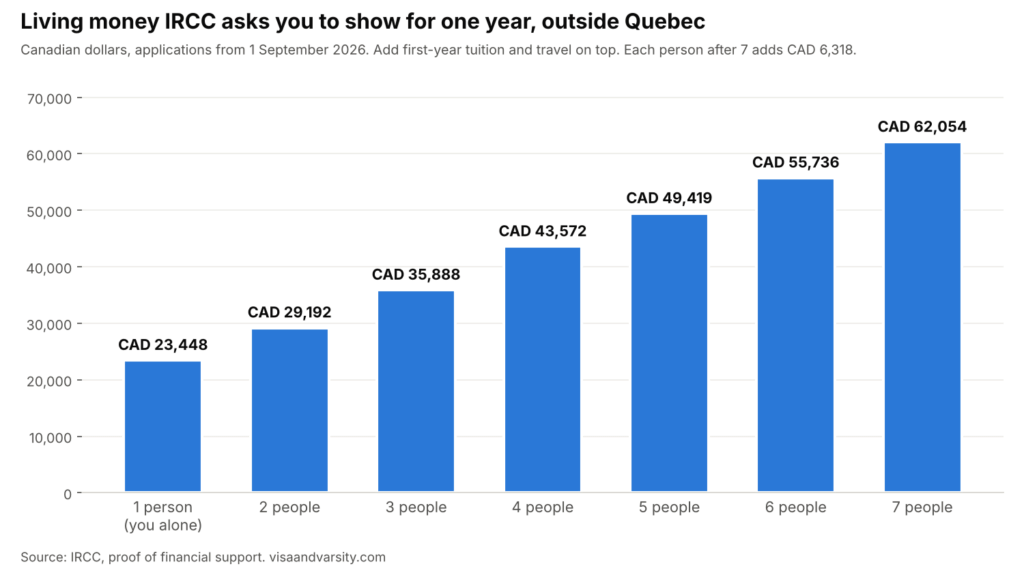
IRCC updates its living cost figure every year. For applications made on or after 1 September 2026, the amounts outside Quebec are:
| People coming to Canada, including you | Living money for one year |
|---|---|
| 1 | CAD 23,448 |
| 2 | CAD 29,192 |
| 3 | CAD 35,888 |
| 4 | CAD 43,572 |
| 5 | CAD 49,419 |
| 6 | CAD 55,736 |
| 7 | CAD 62,054 |
| Each extra person | CAD 6,318 |
If you applied between 1 January 2025 and 31 August 2026, the single-person figure was CAD 22,895, so ignore any guide that still quotes it. Quebec sets its own figure through the Quebec Acceptance Certificate: CAD 24,617 for one person for applications from 1 January 2026.
If your spouse or children will come with you, our guide to bringing your family to Canada as a Kenyan student adds up the fees and permits for each person.
Your total, with two examples
The living money is on top of tuition and travel. Two examples using Memorial University’s fees:
| Example | First-year tuition | Living money | Total before travel |
|---|---|---|---|
| Bachelor’s student at Memorial, 10 courses | CAD 22,500 (Memorial) | CAD 23,448 | CAD 45,948 |
| One-year master’s at Memorial | CAD 6,654 (Memorial) | CAD 23,448 | CAD 30,102 |
Add the price of a return flight for everyone traveling. IRCC doesn’t set a travel amount, so quote a real fare from Nairobi. Our cost of studying in Canada guide prices the visa, setup and living costs that come on top of these.
Your choice of course changes the total far more than anything else. Our guide to the cheapest level of study in Canada for Kenyans compares what each route costs, from a college diploma to a PhD.
Paying tuition first lowers what you hold
IRCC accepts a receipt showing you paid your first year of tuition and housing as proof for those costs. You still need separate proof of the living money and travel. Read the school’s refund policy before you pay, in case IRCC refuses the permit.
Keep a margin for the shilling
IRCC sets its figures in Canadian dollars. If your family holds the money in shillings, keep about 10% more than the target so you still have enough if the shilling weakens before you apply. Use the selling rate your bank quotes, not a news site’s rate. Our study abroad cost calculator turns the target into shillings at that rate.
The documents IRCC and the Nairobi office ask for
Kenyan applicants follow two lists: IRCC’s general examples and the extra checklist from the visa office in Nairobi. Use both.
IRCC’s examples of proof
IRCC says these are examples, not a complete list, and you don’t need all of them, as long as your papers cover every cost:
- a receipt from your school showing you paid the first year of tuition and housing
- a student or education loan from a bank
- a scholarship letter, or proof you’re in a Government of Canada funded program
- recent pay slips
- a letter from the person or institution paying for you
- a guaranteed investment certificate (GIC) from a Canadian financial institution
- bank statements for the past 6 months, including the month you apply or the month before, with papers that show where the income came from
- pension documents, or proof of rental income
What the Nairobi checklist adds
The Nairobi visa office checklist asks Kenyan applicants for:
- bank statements covering the past four months
- a signed bank verification consent form, which lets the officer check your statements with the bank
- papers that explain where any lump sum deposit came from
- a letter of undertaking and financial documents from your parent or sponsor
- from any third-party sponsor, their bank statements and consent form, employment records, proof of where the money came from, and a letter with current contact details explaining why they’re paying for you and whether they’ve supported you before
- proof of your relationship to a sponsor who’s a relative, such as birth certificates
The IRCC page asks for six months of statements and the Nairobi checklist for four, so it is safe to provide six months of statements, so you meet both.
What a sponsor’s letter needs to say
According to IRCC, a letter from the person paying for you should state their job or occupation, their relationship to you, how many dependants they have and how much they’ll give you. Attach a copy of their ID, or their business registration if a business is paying. The Nairobi checklist adds that a sponsor who lives in Canada must show their legal status there and the summary page of their last Canada Revenue Agency tax return.
Other papers in the same application
The Nairobi checklist also asks for a study plan, the Family Information Form (IMM 5645), your transcripts and certificates, and any papers that show family, financial, job or property ties to Kenya. If anyone helped you prepare the application, paid or unpaid, add the Use of a Representative form (IMM 5476).
How to present money from Kenyan sources
IRCC’s list of evidence is built around banks, loans, scholarships, pay slips and rental income. Many Kenyan families hold their money elsewhere, so your job is to move it into a form that’s on IRCC’s list, early enough that your statements show a clear history.
| Where your family keeps the money | What to do | Why |
|---|---|---|
| SACCO savings | Move them into a bank account in your name or your sponsor’s name several months before you apply | IRCC’s examples are bank statements, loans, GICs and similar records, and the Nairobi office checks statements with the bank |
| A chama or merry-go-round | Bank the payout early and keep the chama’s letter and records of each contribution | The Nairobi checklist asks you to explain every lump sum deposit |
| M-Pesa | Move the balance into a bank account well ahead of time | A mobile money balance isn’t one of IRCC’s listed documents |
| Harambee or relatives’ contributions | Keep a short letter from each main contributor, a copy of their ID and the transfer records | IRCC wants the source of the money, not just the balance |
| Land or a title deed | Sell early, bank the proceeds and keep the sale agreement | A plot isn’t money you can spend in Canada |
| Rent from a plot or house | Send the tenancy agreements and the bank records of rent received | Proof of income from rental property |
| A family business | Have the sponsor show the business registration, accounts and the transfer into a personal account | IRCC asks a business sponsor for proof of business registration |
| A parent’s salary | Send pay slips and an employer letter with the sponsor’s letter | Recent pay slips and a sponsor’s employment details |
IRCC sets out these documents on its proof of financial support page, and the Nairobi requirements come from the visa office checklist.
Education loans
IRCC accepts proof of a student or education loan from a bank. Send the bank’s approval letter showing the amount, the borrower and the purpose. A loan you take out only to show a balance on the statement is a different matter, and the Nairobi checklist warns that false statements or fraudulent documents lead to refusal and a possible five-year ban.
Scholarships
A scholarship letter counts as proof. IRCC mentions that if your scholarship only covers tuition, you still need other proof for living costs and travel. Our guide to scholarships for Kenyan students in Canada lists the awards Kenyans can apply for.
A guaranteed investment certificate (GIC)
A GIC from a Canadian financial institution is one accepted way to show living money. When IRCC closed the Student Direct Stream, it said the regular study permit stream accepts GICs. A GIC isn’t compulsory. If you use one, ask the bank in writing for every fee and for its refund terms if IRCC refuses your permit. The Government of Canada explains your rights when you buy a GIC.
Money mistakes that lead IRCC to refuse Kenyan applications
IRCC told Parliament that higher financial requirements were one reason refusals rose in 2025. These are the money mistakes to avoid:
- Using last year’s figure. CAD 22,895 is out of date for applications from 1 September 2026. Check IRCC’s page on the day you apply.
- Showing only the living money. The CAD 23,448 doesn’t include tuition or travel, which you also need to show.
- A big deposit with no explanation. The Nairobi checklist asks you to document the source of every lump sum.
- Short statements. Give six months, including the month you apply or the month before.
- A thin sponsor letter. Include the sponsor’s job, relationship to you, dependants and the amount, with ID and income proof.
- Counting on work in Canada. IRCC wants proof you can pay without working in Canada. Our guide to student visa work hours explains the hours you can work once you arrive.
- Using the federal figure for Quebec. Quebec’s own figure is higher.
A timeline that works
- Six months or more before you apply: move SACCO, chama and M-Pesa money into the bank account you’ll use, and stop moving money between accounts without records.
- Three months before: collect sponsor letters, IDs, pay slips, business papers, rental agreements and any land sale agreement.
- When you get your letter of acceptance: decide whether to pay first-year tuition now, after reading the refund policy.
- When you apply: download fresh statements that include the current or previous month, and sign the bank verification consent forms.
Quick answers
How much bank balance do I need for a Canada student visa from Kenya?
Your first year’s tuition, plus CAD 23,448 for living costs if you’ll study outside Quebec, plus a return flight. For a bachelor’s at Memorial that’s about CAD 45,948 before the flight.
Is a GIC required for Kenyans?
No. IRCC lists a GIC as one example of accepted proof, alongside bank statements, bank loans and scholarship letters. You can meet the rule without one.
Can my parents or relatives sponsor me?
Yes. They need a letter stating their job, relationship to you, dependants and the amount, plus ID, bank statements, a bank verification consent form and proof of where the money came from.
Can I use land as proof of funds?
Not as a plot. Sell it early and show the proceeds in a bank account with the sale agreement. Rent you receive from property can count, because IRCC lists proof of rental income.
How many months of bank statements do Kenyans need?
The Nairobi checklist asks for four, and IRCC’s general page asks for six, provide for six.
More guides in this series
- Study in Canada from Kenya: the complete guide
- Graduate certificate, diploma, degree, master’s or PhD: which is cheapest?
- Scholarships for Kenyan students in Canada
- Post-graduation work permit (PGWP) for Kenyan students
- Bringing your family to Canada as a Kenyan student
This article is general information and is not immigration advice. Canadian study rules, fees and funds requirements change often, and some change every year. Confirm every detail on the official IRCC website at canada.ca, and on the Quebec government website if you plan to study in Quebec. Before you pay for help, speak to a licensed adviser. Immigration consultants in Canada are regulated by the College of Immigration and Citizenship Consultants, which has a public register where you can check a license. Lawyers who belong to a provincial or territorial law society, and notaries in Quebec, may also give immigration advice for a fee.