
You can bring family to Canada as a student from Kenya, but IRCC looks at the course you choose to decide whether your spouse can work. Since 21 January 2025, it has given open work permits only to the spouses of students in a master’s program of 16 months or longer, a doctoral program, or a short list of professional degrees. Every other family lives on one income and has to show enough money for everyone.
This guide covers your spouse’s options, your children’s schooling, the money you need to show and the fees for each family member. It’s part of our guide to studying in Canada from Kenya.
Can your spouse work in Canada?
IRCC gives your spouse or common-law partner an open work permit, which lets them work for almost any employer, only if you hold a valid study permit and you’re:
- in a master’s degree program of 16 months or longer
- in a doctoral program
- in one of these professional degrees at a university: medicine, dentistry, optometry, veterinary medicine, pharmacy, law (LLB, JD or BCL), nursing (BScN, BSN, BN or BNSc), education (BEd) or engineering (BEng, BE or BASc)
- in one of a few named programs, such as Ontario’s Supervised Practice Experience Partnership or the Nurse Re-Entry program at Red River College Polytechnic in Manitoba
| Your course | Can your spouse get an open work permit? |
|---|---|
| College certificate or diploma | No |
| Graduate certificate or graduate diploma | No |
| Bachelor’s degree in most subjects | No |
| Bachelor’s in nursing, education, engineering, pharmacy or law | Yes |
| Master’s of under 16 months | No |
| Master’s of 16 months or more | Yes |
| PhD | Yes |
Our guide to the cheapest level of study in Canada for Kenyans compares what each of these courses costs, including the two-year master’s that lets your spouse work.
How long the spouse’s permit lasts
The spouse’s permit is usually valid for as long as your study permit. To extend it later, you’ll still need to hold a valid study permit, be in Canada, be studying full time in a PGWP-eligible program and not be in your last term. Also, please note your spouse work permit will not be valid beyond your study permit’s expiry date.
What your spouse sends
Your spouse proves your studies with your letter of acceptance, an enrolment letter or your transcripts, and proof of your relationship. Your spouse applies online, and pays CAD 155 for the work permit and CAD 100 as the open work permit holder fee, both on IRCC’s fee list.
If your spouse doesn’t qualify
Your spouse can come as a visitor. The Nairobi visa office checklist tells applicants to send a temporary resident visa application for a spouse who isn’t applying for an open work permit. A spouse who doesn’t qualify for the open permit may be able to get another type of work permit, but plan your budget as if they won’t earn. Our guide to student visa work hours explains the 24-hour weekly limit on your own off-campus work during term.
Bringing your children
Which permit each child needs
The Nairobi visa office checklist sets out what to send for each child:
| Child’s age | What to apply for |
|---|---|
| Under 6 | A temporary resident visa |
| 6 to 18 | An open study permit, on a separate application form |
| 18 to 22, studying at a college or university | Their own study permit, with their own letter of acceptance |
| 18 to 22, not studying | A temporary resident visa |
The checklist also asks for each minor child’s birth certificate, and if one parent isn’t traveling, a signed authorization letter from that parent with a copy of their ID and current contact details.
Minor children who want to study for 6 months or more must apply for a study permit before they enter Canada, including children who come with a parent who’s applying for a study or work permit. A minor child who is already in Canada with a parent allowed to study or work can attend preschool, primary or secondary school without one. When a child reaches the age of majority, 18 or 19 depending on the province, they need a study permit to keep studying.
School fees
EduCanada says international students pay CAD 10,000 to 17,000 a year at public schools from kindergarten to grade 12. Ask your local school board in writing whether your children will pay these fees as the children of a study permit holder, because the answer changes your budget.
Medical exams for the family
Kenya is on IRCC’s list of countries where a medical exam is required for anyone coming to Canada for more than 6 months. Budget a panel physician’s exam for each family member who’ll stay that long. Our cost of studying in Canada guide prices the medical exam and the other fees you pay before you travel.
Biometrics
IRCC charges CAD 85 per person, or CAD 170 for a family applying together, and applicants aged 14 to 79 usually give biometrics, at the visa application center in Nairobi.
The money you need to show for a family
You will be required to prove that you can pay your first year of tuition, living costs for everyone who comes, and return travel for all of you, without working in Canada. The living amounts outside Quebec, for applications from 1 September 2026, are:
| People coming, including you | Living money for one year |
|---|---|
| 2 | CAD 29,192 |
| 3 | CAD 35,888 |
| 4 | CAD 43,572 |
| 5 | CAD 49,419 |
| 6 | CAD 55,736 |
Quebec sets its own, higher figures, starting at CAD 34,814 for two people. To see your family’s total in shillings, use our study abroad cost calculator with your bank’s rate.
Our guide to proof of funds for a Canada study permit from Kenya explains the bank statements, sponsor letters and Nairobi checklist papers that prove this money.
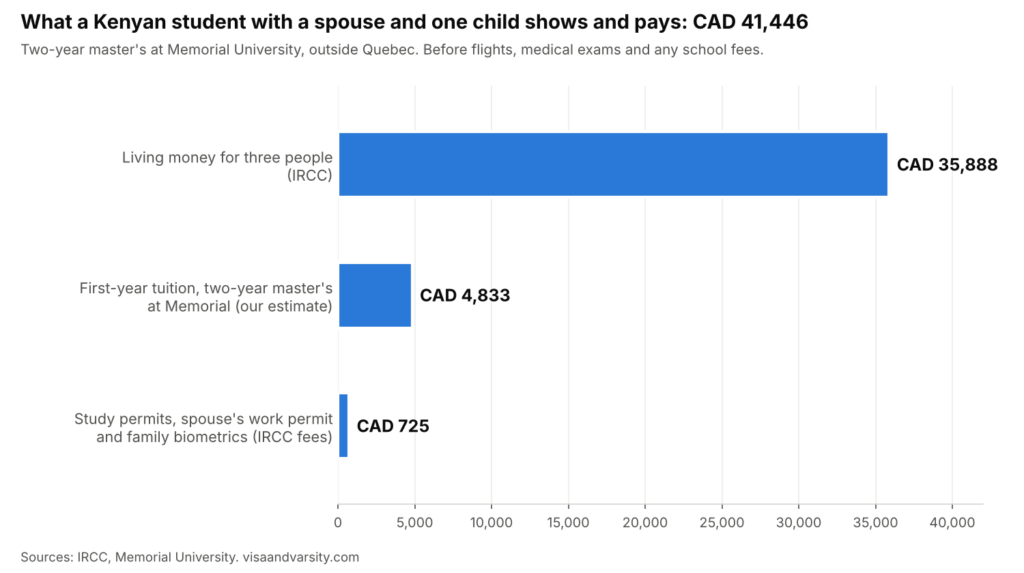
A sample family: two-year master’s at Memorial, with a spouse and one child of 8
| Item | CAD | Where it comes from |
|---|---|---|
| Living money for three people | 35,888 | IRCC |
| First-year tuition, half of the CAD 9,666 program fee (our estimate) | 4,833 | Memorial |
| Your study permit | 150 | IRCC fee list |
| Spouse’s open work permit and holder fee | 255 | IRCC fee list |
| Child’s study permit | 150 | IRCC fee list |
| Biometrics for the family | 170 | IRCC fee list |
| Total before flights, medical exams and any school fees | 41,446 |
Memorial charges graduate tuition per semester across the program, so ask the university for your exact first-year amount. Because this master’s lasts 16 months or more, your spouse can apply for an open work permit, though IRCC still wants the full living money shown before you travel.
IRCC processes PhD families fastest
IRCC aims to process a doctoral student’s application in 2 weeks, and your spouse and children get the same speed for a visitor visa, work permit or study permit if they’re included in your application, submit with you and give biometrics within 2 weeks of the instruction letter.
Should your family come with you or later?
If you can show the full amount for everyone, apply together, so your whole family is on one file. If you can’t, applying alone is safer than stretching the money, because IRCC assesses the money for every family member who comes with you.
Quick answers
Can I bring family to Canada as a student from Kenya if I study a diploma?
Yes, as a visitor, but your spouse can’t get an open work permit through a diploma. That permit is limited to spouses of students in master’s programs of 16 months or more, PhDs and certain professional degrees.
Can my spouse work if I do a one-year master’s?
Not through the spouse permit. The master’s has to last 16 months or longer.
Do my children need a study permit?
If they’ll study for 6 months or more, they must apply before entering Canada. The Nairobi office lists an open study permit for children aged 6 to 18.
How much money do I need to bring a family of four?
CAD 43,572 for living costs outside Quebec, plus your first-year tuition and return travel for everyone.
More guides in this series
- Study in Canada from Kenya: the complete guide
- Graduate certificate, diploma, degree, master’s or PhD: which is cheapest?
- Proof of funds for a Canada study permit from Kenya
- Scholarships for Kenyan students in Canada
- Post-graduation work permit (PGWP) for Kenyan students
This article is general information and is not immigration advice. Canadian study rules, fees and funds requirements change often, and some change every year. Confirm every detail on the official IRCC website at canada.ca, and on the Quebec government website if you plan to study in Quebec. Before you pay for help, speak to a licensed adviser. Immigration consultants in Canada are regulated by the College of Immigration and Citizenship Consultants, which has a public register where you can check a license. Lawyers who belong to a provincial or territorial law society, and notaries in Quebec, may also give immigration advice for a fee.