
If you already hold a Kenyan degree, a one-year master’s at a low-cost public university can be the cheapest way to study in Canada from Kenya and still leave with a 3-year work permit. At Memorial University in Newfoundland, that master’s costs an international student CAD 6,654 in tuition, and IRCC lets a master’s graduate apply for a 3-year post-graduation work permit even when the program lasted less than 2 years. If you’re leaving school with your KCSE, the cheapest route to the same permit is a two-year college diploma in a field on IRCC’s shortage list.
This guide compares every level by what it costs to reach a work permit, not by tuition alone. It’s part of our guide to studying in Canada from Kenya, which covers the permit, the money rules and family in one place.
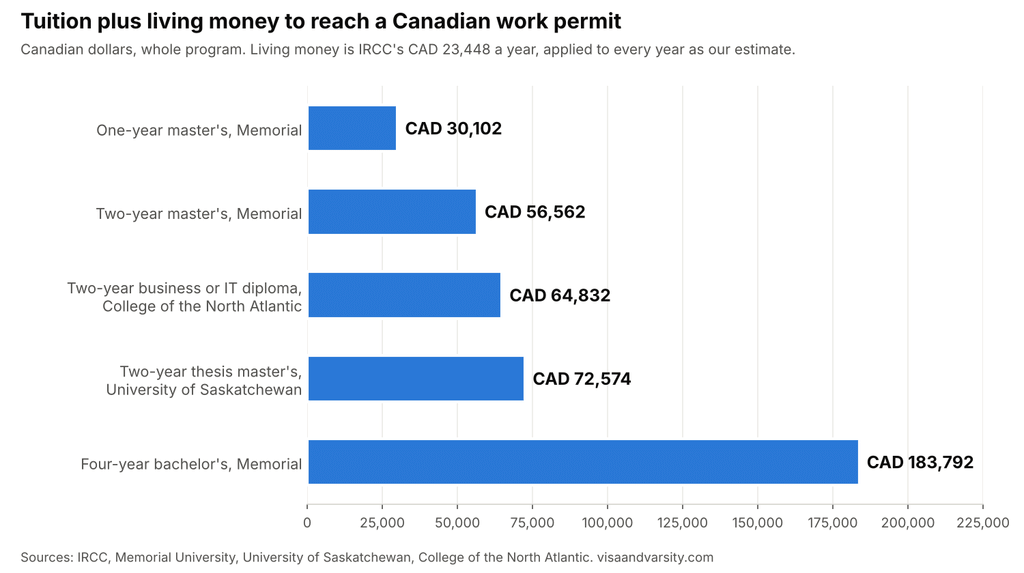
What each level costs to reach a work permit
In this table, we add tuition to the living money IRCC asks you to show, CAD 23,448 a year for one person outside Quebec. IRCC sets that figure for the first year only, so using it for every year is our estimate. Expect real costs to rise each year.
| Route | Tuition for the whole program | Tuition plus living money | Work permit after | Spouse can work? |
|---|---|---|---|---|
| One-year master’s at Memorial | CAD 6,654 (Memorial) | CAD 30,102 | Up to 3 years | No, under 16 months |
| Two-year master’s at Memorial | CAD 9,666 (Memorial) | CAD 56,562 | Up to 3 years | Yes |
| Two-year thesis master’s at the University of Saskatchewan | CAD 25,678, at CAD 12,839 a year (USask) | CAD 72,574 | Up to 3 years | Yes |
| Two-year business or IT diploma at College of the North Atlantic, four regular semesters | CAD 17,936, at CAD 4,484 a semester (CNA) | CAD 64,832 | Up to 3 years, if the field qualifies | No |
| Four-year bachelor’s at Memorial | CAD 90,000, at the frozen fall 2026 rate of CAD 22,500 a year (Memorial) | CAD 183,792 | Up to 3 years | Only for listed degrees |
The work permit lengths come from IRCC’s rules on how long a PGWP lasts, and the spouse column from IRCC’s page on helping your spouse work. A Memorial PhD costs CAD 17,988 in tuition for the whole program, but PhD length varies, so we cover it separately below.
For comparison, Statistics Canada puts average international tuition at CAD 41,746 a year for undergraduates and CAD 24,028 a year for graduate students. A two-year master’s at the national average would cost about CAD 48,000 in tuition alone, five times Memorial’s price.
How Memorial compares with other low-cost universities
Memorial isn’t the only lower-cost choice. These are the international tuition figures four universities publish for 2026 to 2027. Each one counts its fees differently, so read the notes before you compare.
Bachelor’s degrees: tuition for one year
| University | International tuition for one year | What the figure covers |
|---|---|---|
| University of New Brunswick, Fredericton | CAD 20,903, or CAD 22,754 with mandatory fees | Full-time Arts, two terms |
| Memorial University | About CAD 22,500, at CAD 2,250 per course | Ten three-credit courses at the frozen fall 2026 rate |
| University of Regina | CAD 29,348 to 34,545 | 30 credit hours over 8 months, depending on the program |
| University of Saskatchewan | CAD 39,007 | Bachelor of Arts with a full course load |
| Average across Canada | CAD 41,746 | Statistics Canada, 2025 to 2026 |
UNB’s Arts tuition comes in below Memorial’s for a full year of courses, so a Kenyan who wants a bachelor’s should price both. UNB publishes a separate fee sheet for each faculty, so check the sheet for your program.
Master’s and PhD: graduate tuition
| University | International tuition | What the figure covers |
|---|---|---|
| Memorial University | CAD 6,654 for a whole one-year master’s, CAD 9,666 for a whole two-year master’s | Totals for the whole program |
| University of Regina | CAD 9,944 to 20,486 a year | A 12-month year, not counting the Executive MBA |
| University of Saskatchewan | CAD 12,839 a year | A standard thesis master’s |
| University of New Brunswick, Fredericton | CAD 16,623 a year, plus CAD 612.75 in fees | A research master’s or PhD in computer science, three terms |
| Average across Canada | CAD 24,028 a year | Statistics Canada, 2025 to 2026 |
Memorial charges by program while the others charge by year. That makes a whole two-year master’s at Memorial cheaper than a single year at any of the other three. Request the university for the fee schedule of your exact program, because program and faculty fees change the total.
Graduate certificate or one-year master’s?
For a Kenyan graduate, a one-year master’s beats a one-year graduate certificate on every rule that matters, and at a low-cost university it can cost less too.
| Rule | One-year graduate certificate | One-year master’s at a public university |
|---|---|---|
| Work permit length | Up to the length of the program, so up to 1 year | Up to 3 years, if the program ran at least 8 months |
| Field of study rule | Applies: the program must be on IRCC’s list | Doesn’t apply |
| Language score for the PGWP | CLB 5 at a college, CLB 7 at a university | CLB 7 |
| Provincial attestation letter | Needed | Not needed |
| Spouse open work permit | No | No, because the program is under 16 months |
IRCC sets these rules on its pages about PGWP length, eligibility and language levels, the field of study rule and the attestation letter.
Why the master’s rule matters so much
Since 15 February 2024, IRCC has let master’s graduates apply for a 3-year PGWP even when the program lasted less than 2 years, as long as it ran at least 8 months. IRCC says this doesn’t apply to certificate or diploma programs. So a Kenyan who spends one year on a master’s leaves with up to three years to work, while a Kenyan who spends one year on a certificate leaves with up to one. Our guide to the post-graduation work permit for Kenyan students covers every PGWP rule in detail.
Can you stack two certificates?
IRCC may give you a PGWP that combines the length of two programs if each one is PGWP-eligible and lasts at least 8 months, and if you meet the higher language requirement of the two. You can only ever get one PGWP, so you can’t collect a permit after each program. Two one-year certificates mean two years of fees and living money to reach a two-year permit, which a one-year master’s beats on both counts.
When a two-year master’s is worth the extra year
If you’re married, choose a master’s of 16 months or longer. IRCC only gives the spouse an open work permit when the master’s program lasts 16 months or more. At Memorial, the two-year master’s costs CAD 9,666 in tuition against CAD 6,654 for one year, so for an extra CAD 3,012 your spouse gets the right to work for almost any employer.
Our guide to bringing your family to Canada as a Kenyan student explains your spouse’s permit, your children’s schooling and the money to show for everyone.
Check for special fees
Memorial charges special fees on top of tuition for some programs. The one-year Master of Data Science adds CAD 20,282, which takes the program total to CAD 26,936.Get the full fee list of your exact program before you decide.
Leaving school with your KCSE: diploma or degree?
A two-year college diploma is the cheaper way to a 3-year work permit, but only if your program is on IRCC’s list of eligible fields. A bachelor’s degree costs far more, has no field rule, and IRCC gives the spouse an open work permit for a few professional degrees.
College diplomas
EduCanada puts international tuition for college diplomas at CAD 16,000 to 25,000 a year, including mandatory fees. Some colleges charge less. College of the North Atlantic (CNA) in Newfoundland and Labrador lists these full-time international rates:
| CNA fee | Amount |
|---|---|
| Business and information technology diplomas | CAD 4,484 a semester |
| Engineering technology, health sciences and natural resources diplomas | CAD 4,685 a semester |
| Confirmation fee | CAD 105 a year |
| Technology fee | CAD 83 a semester |
| Deposit, counted toward first-semester tuition | CAD 1,500 |
| Work term fee for co-op programs | CAD 2,198 a semester |
CNA says the deposit is non-refundable, so check its refund process before you pay.
Before you choose a diploma, check four rules:
- The field of study list. IRCC only gives a PGWP to a diploma graduate whose program’s CIP code is on its list of eligible fields when you apply for the study permit or the PGWP.
- The length. IRCC gives a 3-year permit for a program of 2 years or more, but only up to the program’s length for anything shorter.
- The language score. College graduates need CLB 5 in all four skills, which on IELTS General Training means at least 4.0 in reading and 5.0 in each of the other three skills.
- The school. IRCC says a program delivered by a private college under a licensing deal with a public college doesn’t lead to a PGWP in most cases.
EduCanada notes that many college programs include a work placement such as a co-op, which may let you earn while you study. Our guide to student visa work hours explains how Canada counts the hours you work.
Bachelor’s degrees
Statistics Canada puts average international undergraduate tuition at CAD 41,746 a year, from CAD 18,867 in Newfoundland and Labrador to CAD 49,802 in Ontario. Memorial froze its fall 2026 rate at CAD 2,250 per three-credit course, about CAD 22,500 for a full year.
A degree has three advantages over a diploma:
- No field rule. IRCC exempts bachelor’s graduates from the field of study requirement, so any subject leads to a PGWP.
- A spouse work permit for some degrees. IRCC gives the spouse an open work permit for nursing, education, engineering, pharmacy and law degrees, among a few others.
- Entrance scholarships. Memorial considers every eligible international entrant for an entrance scholarship automatically, with no separate form. The awards cover the first year only and aren’t renewable.
A degree needs CLB 7 for the PGWP, which on IELTS General Training means 6.0 in every skill. Memorial asks for a KCSE average of B- in five required subject areas.
PhDs and funded research degrees
A funded PhD can be the cheapest level of all, and it’s the only route with a two-week permit decision for your whole family.
Low tuition. Memorial charges international doctoral students CAD 17,988 in tuition for the whole program, and it says it offers funding packages to graduate students in research-intensive programs.
No attestation letter. IRCC exempts degree-granting master’s and doctoral programs at public institutions from the PAL from 1 January 2026, so a PhD doesn’t count against the provincial cap.
A fast decision. IRCC aims to decide a doctoral student’s application within 2 weeks once the school has confirmed the letter of acceptance. You must apply online from outside Canada, send a complete application and give biometrics within 2 weeks of the instruction letter. Your spouse and children get the same speed if their applications go in with yours.
A working spouse. IRCC gives the spouse of any doctoral student an open work permit.
The federal doctoral scholarship
The Canada Graduate Research Scholarship, Doctoral (CGRS D) replaced the Vanier scholarship and other federal doctoral awards. Memorial says it pays CAD 40,000 a year for 36 months, and that up to 15% of each agency’s awards may go to international students. An international student can only apply once registered in a doctoral program at a Canadian institution, so a Kenyan applies for it in the first year of a PhD, not from Nairobi.
Queen’s University notes that international students can’t apply for the master’s version, the CGRS M.
How to find a funded place
Start with the professor, not the application form. Write to professors whose research matches yours, ask whether they’re taking new students, and ask what funding the department gives international PhD students. Reach out to the graduate studies office the same question in writing. Our guide to scholarships for Kenyan students in Canada lists the other awards Kenyans can apply for.
The cheapest way to study in Canada from Kenya, by situation
| Your situation | The route to look at first | Why |
|---|---|---|
| Just finished the KCSE, tight budget | A two-year diploma in a field on IRCC’s list | Lowest total cost to a 3-year permit |
| Just finished the KCSE, family can pay more | A bachelor’s at a low-cost university such as Memorial or the University of New Brunswick | No field rule, entrance scholarships, wider choice |
| Kenyan degree, single | A one-year master’s of at least 8 months | Lowest cost to a 3-year permit, no PAL |
| Kenyan degree, married | A master’s of 16 months or more | Your spouse can get an open work permit |
| Strong research record | A funded PhD | Low or no tuition, two-week decision, working spouse |
Whatever you choose, check the program on IRCC’s list of designated learning institutions and consult with the school in writing whether it leads to a PGWP. Our cost of studying in Canada guide prices the visa, setup and living costs that come on top of tuition, and our study abroad cost calculator turns your total into shillings at your bank’s rate.
Once you’ve picked a route, our guide to proof of funds for a Canada study permit from Kenya shows how much to hold and how to present money from Kenyan sources.
Quick answers
What is the cheapest way to study in Canada from Kenya?
For a Kenyan who already holds a degree, it’s usually a one-year master’s at a low-cost public university such as Memorial, where tuition for the whole program is CAD 6,654. If you’re leaving school with your KCSE and money is tight, look first at a two-year college diploma in a field on IRCC’s list.
Is a master’s cheaper than a bachelor’s degree in Canada?
At Memorial, yes. A whole two-year master’s costs an international student CAD 9,666 in tuition, while a single year of undergraduate study costs about CAD 22,500.
Does a one-year master’s give a 3-year work permit?
It can. IRCC lets a master’s graduate apply for a 3-year PGWP if the program ran at least 8 months and they meet every other rule, including CLB 7 in all four language skills.
Is a graduate certificate a good idea for Kenyans?
Usually not, if you already hold a degree. A one-year certificate leads to a work permit of up to one year, needs a PAL, must be in an eligible field, and doesn’t let your spouse work.
Can I do a PhD in Canada for free?
Not automatically. Memorial says it offers funding packages to research students, and the federal CGRS D pays CAD 40,000 a year to the students who win it, but the total depends on your offer. Inquire with each department what funding it gives international PhD students before you apply.
More guides in this series
- Study in Canada from Kenya: the complete guide
- Proof of funds for a Canada study permit from Kenya
- Scholarships for Kenyan students in Canada
- Post-graduation work permit (PGWP) for Kenyan students
- Bringing your family to Canada as a Kenyan student
This article is general information and is not immigration advice. Canadian study rules, fees and funds requirements change often, and some change every year. Confirm every detail on the official IRCC website at canada.ca, and on the Quebec government website if you plan to study in Quebec. Before you pay for help, speak to a licensed adviser. Immigration consultants in Canada are regulated by the College of Immigration and Citizenship Consultants, which has a public register where you can check a license. Lawyers who belong to a provincial or territorial law society, and notaries in Quebec, may also give immigration advice for a fee.