
You can still study in Canada from Kenya in 2027, but it’s harder than most older guides suggest. Immigration, Refugees and Citizenship Canada (IRCC) told Parliament that it refused 62% of new study permit applications as of 28 February 2026, up from 59% across 2025. Canada also limits new arrivals, and IRCC expects to issue 155,000 permits to newly arriving students in 2026.
The 2026 rules also favor some routes over others, and a careful Kenyan applicant can use that. Since 1 January 2026, master’s and doctoral students at public universities don’t need a provincial attestation letter. And Memorial University in Newfoundland charges an international student CAD 9,666 in tuition for a whole two-year master’s program.
This guide is written for Kenyan students and parents. It covers which level of study costs least, which courses keep your right to work after you graduate, the scholarships Kenyans can actually get, how to show your money from a Kenyan bank account, and when your family can come with you. Our cost of studying in Canada guide prices every fee phase by phase, so this guide links to it rather than repeating it.
Guides in this series
- Graduate certificate, diploma, degree, master’s or PhD: which is cheapest for Kenyans?
- Proof of funds for a Canada study permit from Kenya
- Scholarships for Kenyan students in Canada
- Post-graduation work permit (PGWP) for Kenyan students
- Bringing your family to Canada as a Kenyan student
- Cost of studying in Canada
The numbers a Kenyan applicant needs first
| What you pay or show | 2026 figure | Where it comes from |
|---|---|---|
| Study permit fee | CAD 150 | IRCC fee list |
| Biometrics fee | CAD 85 per person, or CAD 170 for a family applying together | IRCC fee list |
| Living money you must show, one person outside Quebec | CAD 23,448 a year | IRCC proof of financial support |
| Living money you must show in Quebec | CAD 24,617 a year | Government of Quebec |
| Average undergraduate tuition for international students | CAD 41,746 a year | Statistics Canada |
| Lowest provincial average for undergraduates | CAD 18,867 a year, Newfoundland and Labrador | Statistics Canada |
| Paid work off campus during term | Up to 24 hours a week, unlimited in scheduled breaks | IRCC |
| Work permit after you graduate | Up to 3 years | IRCC |
To see any figure in Kenyan shillings, multiply it by the selling rate your bank quotes you that day. Use your bank’s rate, not one from a news site, because your bank’s rate is the one you’ll actually pay.
What changed for students applying in 2027
Seven changes since late 2023 shape every Kenyan application, and most older guides miss at least one of them.
Canada caps new students. For 2026, IRCC expects to issue 408,000 study permits, including 155,000 to newly arriving students. In the 2026 to 2028 Immigration Levels Plan, the government targets 150,000 new student arrivals for 2027, but IRCC says it will confirm or adjust that figure by 1 November each year. Check the page again before you apply.
Most students need a provincial attestation letter. This letter (PAL) comes from the province and confirms there’s a place for you under the cap. IRCC lists who doesn’t need one: students in a degree-granting master’s or doctoral program at a public designated learning institution (DLI), school pupils up to grade 12, students on a Global Affairs Canada scholarship, and exchange students who pay no tuition to the Canadian school. Everyone else, including undergraduates, college students and graduate certificate students, gets the letter through their school and sends it with the permit application, not after.
PhD students get a two-week decision. IRCC aims to process a doctoral student’s application in 2 weeks once the school has confirmed the letter of acceptance, which can take up to 10 days. You need to apply online from outside Canada, send a complete application and give your biometrics within 2 weeks of the instruction letter. Your spouse and children get the same speed if they apply with you.
Schools check every letter of acceptance. Since 1 December 2023, colleges and universities have had to verify the letter of acceptance in every study permit application, and IRCC returns the application if the school doesn’t. Before that rule, schools confirmed 9.2% of the letters IRCC checked by hand as fraudulent or altered. A letter you buy from an agent won’t get past this check.
The Student Direct Stream is gone, and Kenya was never part of it. IRCC ended the Student Direct Stream on 8 November 2024. Its list of countries didn’t include Kenya, so an agent who offers a Kenyan a fast-track “SDS” application is offering something that never existed for you.
Refusals are high. IRCC told Parliament that it refused 52% of new study permit applications in 2024 and 59% in 2025. IRCC links the rise to higher financial requirements, the end of the Student Direct Stream and a closer focus on fraud. We didn’t find an official refusal rate for Kenyan applicants alone, so treat any Kenya-only figure you see online with care.
Changing schools now needs a new permit. If you move to another college or university after you arrive, IRCC says you must get a new study permit and, in most cases, a new PAL before you start at the new school. In the guide to what happens to your student visa if you fail a module covers the other rules that keep your permit valid.
Graduate certificate, diploma, degree, master’s or PhD: which costs least?
For a Kenyan who already holds a degree, a one-year master’s at a low-cost public university is usually the cheapest way to a 3-year work permit. Memorial University charges an international student CAD 6,654 in tuition for a whole one-year master’s, and IRCC lets a master’s graduate apply for a 3-year post-graduation work permit if the program ran at least 8 months. A one-year graduate certificate leads to a permit of up to one year. If you’re leaving school with your KCSE, a two-year college diploma in a field on IRCC’s list is the cheapest route to the same 3-year permit, and a funded PhD can cost least of all.
This post on the cheapest level of study in Canada for Kenyans compares every level by its total cost to a work permit, with 2026 to 2027 fees from Memorial, the University of New Brunswick, the University of Regina, the University of Saskatchewan and College of the North Atlantic.
The cheapest courses that still lead to a work permit
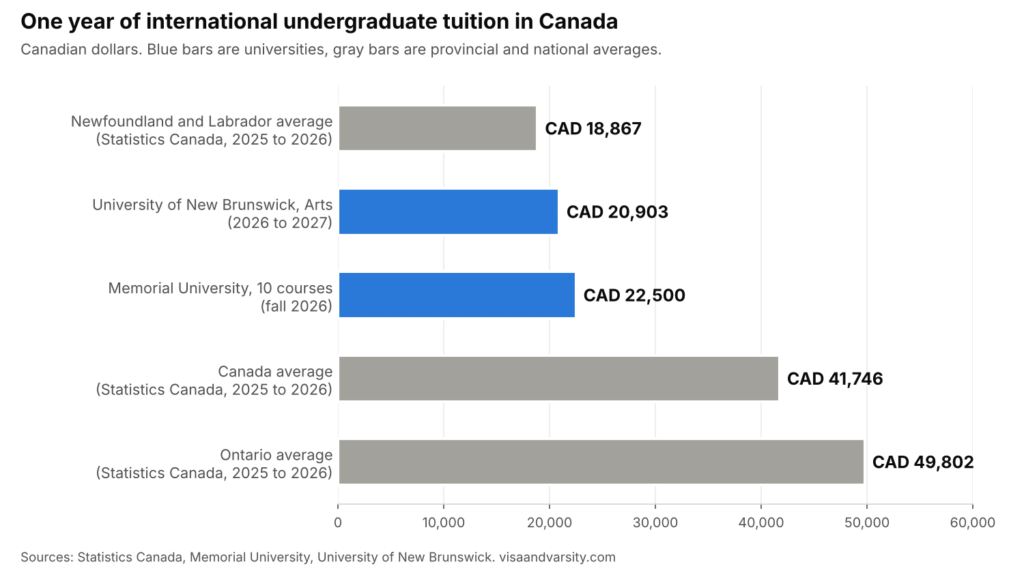
A cheap course is only worth it if it leads to a post-graduation work permit (PGWP). IRCC exempts bachelor’s, master’s and doctoral graduates from its field of study rule, so any degree subject can lead to a PGWP. A college diploma or certificate has to be in a field on IRCC’s list, and IRCC says most programs a private college teaches under a licensing deal with a public college don’t qualify. For the lowest fees, look first at Newfoundland and Labrador, where Statistics Canada puts average international undergraduate tuition at CAD 18,867 a year, against CAD 41,746 across Canada.
The guide to the PGWP for Kenyan students explains every rule IRCC applies to your permit, and the article to the cheapest level of study lists college and university fees side by side.
Getting admitted with Kenyan qualifications
Each university sets its own entry rules for the KCSE and for Kenyan degrees, so read the country page of every school on your list. Here are two examples.
Memorial University lists a minimum KCSE average of B- across five required subject areas: English, Mathematics, a laboratory science (Biology, Chemistry or Physics), Social Studies or a language, and an elective. Some programs ask for a higher average.
Wilfrid Laurier University publishes a table that converts KCSE grades to Canadian percentages. It treats a C+ as 70%, a B- as 73.2%, a B as 76.8% and a B+ as 80.4%. Use it to compare your grades with the percentage a Canadian program asks for.
Do you need IELTS to get in?
Often not. Memorial says it normally doesn’t need further proof of English from a student who completed two years of the KCSE curriculum, unless the student’s only English subject was English as a second language. The University of Calgary lists Kenya among the countries whose students meet its English requirement after three years of high school study in an exempt country. For graduate study, the University of Windsor exempts applicants who completed a degree in Kenya within the past two years.
But plan for a test before you graduate
IRCC won’t accept the waiver your university gave you at admission when you apply for the work permit. IRCC requires almost every PGWP applicant to prove their English or French with an approved test, at Canadian Language Benchmark (CLB) 7 for university graduates and CLB 5 for college graduates, in all four skills.
IRCC’s conversion table lists IELTS General Training, CELPIP General and PTE Core for English. On IELTS General Training, CLB 7 means at least 6.0 in each of the four skills. CLB 5 means at least 4.0 in reading and 5.0 in each of the other three skills. IRCC’s table doesn’t list IELTS Academic. If a university asks you for IELTS Academic at admission, expect to take IELTS General Training as well before you apply for the PGWP.
What it costs to study in Canada from Kenya
A first year at Memorial University costs about CAD 48,500 before your flight and medical exam, and almost half of that is living money you spend on yourself. Our cost of studying in Canada guide prices every fee phase by phase, including the language test, medical exam, rent deposit and setup. Here’s a sample first year for a Kenyan undergraduate at Memorial’s Grenfell Campus, using the university’s own fall 2026 figures.
| Item | CAD | Where it comes from |
|---|---|---|
| Tuition, 10 courses at CAD 2,250 each | 22,500 | Memorial, Grenfell Campus |
| Living money you must show, which you spend on rent and food | 23,448 | IRCC |
| Study permit and biometrics | 235 | IRCC fee list |
| Health plan for international students | 413.68 | Memorial, Grenfell Campus |
| Student services, student union, federation and recreation fees | 383.72 | Memorial, Grenfell Campus |
| Books and supplies, Memorial’s estimate | 1,500 | Memorial, Grenfell Campus |
| Total before the flight and medical exam | 48,480.40 |
The same year at the Ontario average would cost far more. Statistics Canada puts average international undergraduate tuition in Ontario at CAD 49,802, which is CAD 27,302 a year more than Memorial’s tuition in this example.
Memorial’s residence at Grenfell costs CAD 4,166 for two semesters in the Arts and Science residence, and you pay it out of the living money. To see the whole year in shillings, use our study abroad cost calculator with your bank’s rate.
Budget for a weaker shilling
IRCC assesses your money in Canadian dollars. If your family holds the money in shillings, keep a margin of around 10% above the target, so you still have enough if the shilling weakens between the day you check the rate and the day you apply.
Proof of funds from a Kenyan bank account
IRCC wants proof of your first year of tuition, your living costs and your travel, and it checks where the money came from. For one person outside Quebec, the living amount is CAD 23,448 a year for applications from 1 September 2026, and it rises with each family member who comes. The Nairobi visa office checklist adds bank statements for the past four months, a signed bank verification consent form and papers that explain any lump sum deposit. Money held in a SACCO, a chama or M-Pesa isn’t on IRCC’s list of examples, so move it into a bank account months before you apply.
Our proof of funds for a Canada study permit from Kenya guide has the full family table, what a sponsor’s letter needs to say, and a timeline for getting Kenyan money into shape.
Scholarships a Kenyan student can actually apply for
The full scholarships Kenyans can win in Canada come from universities and the Mastercard Foundation programs they run. The University of Toronto names about 37 Lester B. Pearson Scholars a year, and its Mastercard Foundation Scholars Program is open to graduates of partner universities, including Moi University and Amref International University. The one federal award that lists Kenya, the Study in Canada Scholarships, pays for a short exchange, not a degree. You can only apply for the federal doctoral award once you’re enrolled in a Canadian PhD.
To dig deeper on scholarships, read the scholarships for Kenyan students in Canada that covers each award, the 2027 deadlines and the conditions that make many Kenyans ineligible.
How to apply from Kenya, step by step
You apply to the school first and to IRCC second, and the whole permit application happens online with one visit to the visa application center in Nairobi.
- Choose the school and the program. Check that the school is on IRCC’s list of designated learning institutions and that your exact program leads to a PGWP.
- Get your letter of acceptance. The school sends it once you’re admitted, and the school has to confirm it to IRCC after you apply.
- Get your PAL, unless you’re exempt. IRCC says you ask your school how to apply for it. A PAL issued in 2026 is valid until 31 December 2026 unless it shows an earlier date, so you can’t use it the following year.
- Write your study plan. The Nairobi visa office checklist asks you to explain why you want this program in Canada, why you aren’t taking a similar program in Kenya, what research you did into studies at home, how the program will improve your job prospects in Kenya, and what ties you have to Kenya. If you left full-time education more than two years ago, add your CV.
- Book your medical exam. Kenya is on IRCC’s list of countries where you need an immigration medical exam for a stay of more than 6 months. A panel physician that IRCC approves does the exam.
- Get a police certificate if IRCC asks for one. In Kenya, IRCC says you apply in person for a Police Clearance Certificate at the Directorate of Criminal Investigations headquarters, Mazingira House, Kiambu Road, Nairobi.
- Apply online. IRCC says you must apply online unless a disability stops you or you hold a refugee or stateless travel document. You pay CAD 150 for the permit and CAD 85 for biometrics at the end of the form. Add the Nairobi checklist, the Family Information Form (IMM 5645) and your transcripts and certificates.
- Give your biometrics in Nairobi. IRCC sends a biometrics instruction letter, and you have 30 days from its date to give your fingerprints and photo at the Nairobi visa application center. IRCC starts processing only after that.
- Wait for the decision. IRCC’s processing time tool gives a live estimate. If IRCC approves you, it issues your visitor visa automatically at the same time, so you don’t apply for it separately.
- Travel and start studying. IRCC says you can’t start working until your program begins.
If IRCC refuses you
IRCC sends a letter explaining why. Fix that reason before you try again, and show in the new application what has changed. You’ll also need a new PAL, because IRCC doesn’t let you reuse a PAL after a refusal.
Agents, fake letters and scams
You don’t need an agent. In its Nairobi checklist, IRCC says you aren’t obliged to hire a representative and that it treats everyone equally whether they use one or not. If anyone helps you with the application, paid or unpaid, you must name them on the Use of a Representative form (IMM 5476).
A fake letter of acceptance won’t work, because the school must confirm every letter to IRCC. The University of Toronto also warns that its Pearson program doesn’t work with agents, so treat any agent who promises a scholarship as a warning sign.
Can Kenyans work while studying in Canada?
Yes. IRCC lets eligible students work off campus up to 24 hours a week during term, and unlimited hours during scheduled breaks such as the summer and winter holidays. You qualify if all of these apply:
- you study full time at a designated learning institution
- your program lasts at least 6 months and leads to a degree, diploma or certificate
- your study permit includes the condition that allows off-campus work
- you have a Social Insurance Number
- you’ve started your program
Students in English or French language courses only, or in courses they need before a main program starts, can’t work off campus. Remote work for an employer outside Canada doesn’t count toward the 24 hours, as long as you keep to your permit conditions. IRCC also allows work on campus and co-op or internship placements that are part of your program.
IRCC warns that working more than 24 hours a week in term breaks your permit conditions and can cost you your student status. You’re responsible for counting your own hours, and the article on student visa work hours explains how Canada and eight other countries count them.
Don’t plan your budget around this pay. IRCC requires you to show you can pay for your studies without working in Canada, so wages can’t be part of your proof of funds.
Going to Canada with your family, and what it costs
Your family can come with you, but IRCC looks at your course to decide whether your spouse can work. Since 21 January 2025, IRCC has given an open work permit only to the spouse of a student in a master’s program of 16 months or longer, a doctoral program or certain professional degrees. A family also needs to show more money. For three people outside Quebec, IRCC asks for CAD 35,888 a year in living costs, on top of tuition and travel for everyone. A doctoral student’s spouse and children get the same 2-week processing when they apply together.
For more insight go to bringing your family to Canada as a Kenyan student post that covers your children’s permits and school fees, medical exams and a full sample budget.
After graduation: the PGWP, permanent residence and coming home
The post-graduation work permit
The PGWP is an open work permit, and IRCC sets its length by your program. It gives up to the same length as the program for one shorter than 2 years, up to 3 years for a program of 2 years or more, and up to 3 years for any master’s degree of at least 8 months. IRCC won’t issue it beyond your passport’s expiry date, so renew an old Kenyan passport before you apply.
You’ll also need an approved language test, a full-time study record and, for most college programs, a field on IRCC’s list. Our guide to the PGWP for Kenyan students covers every rule and the mistakes that cost Kenyans the permit.
From work permit to permanent residence
IRCC names the Canadian Experience Class, the Federal Skilled Worker Program and the Provincial Nominee Program as routes that graduates may fit into. Express Entry changes on 3 November 2026. From that date, IRCC will give extra points for a qualifying job offer in a high-wage occupation, up to 100 points at twice the median wage, and extra points for at least a year of Canadian work experience in such an occupation. IRCC defines a high-wage occupation as one whose median wage is at least 1.3 times the median for all Canadian workers. Plan your studies so they’re worth the money even if you come home.
Using a Canadian degree back in Kenya
The Commission for University Education (CUE) recognizes and equates degrees and diplomas from foreign universities for use in Kenya. CUE asks for copies of your certificates and transcripts certified by an Advocate and Commissioner for Oaths or by the university, and it charges a fee for the service. Collect certified copies and your full transcript before you leave Canada.
If you have a HELB loan
If you still owe the Higher Education Loans Board, check your balance and repayment status on the HELB portal before you apply, and include the repayments in your family’s budget.
Is Canada cheaper than the US for Kenyans?
On tuition, usually yes, and on work rights Canada gives a Kenyan student much more. EduCanada, a Government of Canada site, says international students in Canada pay less than they would in the United Kingdom, the United States or Australia. The bigger gap is in what you can earn during and after your studies.
| What a Kenyan student faces | Canada | United States (F-1 visa) |
|---|---|---|
| Work during term | Up to 24 hours a week off campus, from the start of the program (IRCC) | Up to 20 hours a week on campus during term; off-campus work needs separate permission (Study in the States) |
| Work after graduation | A PGWP of up to 3 years, in any field (IRCC) | 12 months of Optional Practical Training per degree level (University of Massachusetts), plus 24 months for some STEM graduates (Study in the States) |
| Spouse’s right to work | An open work permit for spouses of master’s students in programs of 16 months or more, PhD students and some professional degrees (IRCC) | Check the rules for your visa type before you plan on a second income |
Canada isn’t always the cheaper choice in practice. IRCC refused 59% of new study permit applications in 2025, so leave time in your plan for a second application. A US university that offers you a large scholarship can also cost less than an unfunded place in Canada. Our cost of studying in the USA guide prices the American route phase by phase, so you can compare the two totals.
Quick answers for Kenyan students
How much money do I need to study in Canada from Kenya?
You need to show your first year’s tuition, CAD 23,448 for living costs outside Quebec, and the cost of travel. Our sample first year at Memorial University comes to about CAD 48,500 before the flight and medical exam.
Can I study in Canada without IELTS?
Often, for admission. Memorial and the University of Calgary accept Kenyan secondary schooling in English as proof. But you’ll need an approved test, such as IELTS General Training, CELPIP General or PTE Core, before you apply for a PGWP.
Which Canadian university is cheapest for Kenyans?
Newfoundland and Labrador has the lowest average international tuition, at CAD 18,867 a year for undergraduates. Memorial University, the school we priced in this guide, charges CAD 2,250 per undergraduate course for fall 2026 and CAD 9,666 for a whole two-year master’s. For a bachelor’s in Arts, the University of New Brunswick charges CAD 20,903 for 2026 to 2027, a little less than a full year of courses at Memorial.
Is a master’s cheaper than a bachelor’s degree?
Mostly, yes. A two-year master’s at Memorial costs an international student CAD 9,666 in tuition, while the average undergraduate pays CAD 41,746 for one year. A master’s at a public university also needs no PAL and leads to a work permit of up to 3 years.
Do I need a PAL for a master’s degree?
Not for a degree-granting master’s or doctoral program at a public university, from 1 January 2026. You still need one for a graduate certificate, a graduate diploma or a master’s at a private school.
Can my spouse come if I study a diploma?
Yes, as a visitor, but your spouse can’t get an open work permit through your diploma. That permit is limited to spouses of master’s students in programs of 16 months or more, PhD students and students in certain professional degrees.
How long does a study permit take from Kenya?
Check IRCC’s live processing time tool before you apply. Processing starts only after you give your biometrics, and doctoral students who meet IRCC’s conditions get a decision in about 2 weeks.
Can Kenyans use the Student Direct Stream?
No. IRCC ended it on 8 November 2024, and Kenya was never on its list of countries.
Before you pay anything
- Check the school and the exact program on IRCC’s DLI list, and ask the school in writing whether the program leads to a PGWP.
- Ask the school whether you need a PAL and how it issues one.
- Move family savings from SACCOs, chamas and M-Pesa into a bank account at least six months before you apply.
- Keep letters, IDs and transfer records for every large deposit.
- Book IELTS General Training, CELPIP General or PTE Core for your final year, not only an admission test.
- If you’re married, check whether your course lets your spouse work before you choose it.
- Get every fee, deposit and refund policy from the school in writing.
This article is general information and is not immigration advice. Canadian study rules, fees and funds requirements change often, and some change every year. Confirm every detail on the official IRCC website at canada.ca, and on the Quebec government website if you plan to study in Quebec. Before you pay for help, speak to a licensed adviser. Immigration consultants in Canada are regulated by the College of Immigration and Citizenship Consultants, which has a public register where you can check a license. Lawyers who belong to a provincial or territorial law society, and notaries in Quebec, may also give immigration advice for a fee.