
Last checked: September 2026
Italy has raised the amount of money you must prove by almost half, and up to this year you had to show €6,947.33 for the year. From the 2026/2027 academic year the figure would be €10,179.85, which is 46.5 percent higher, and it is a single yearly amount with no monthly budget. A second change came at the same time, where universities can now approve only a limited number of applications, and the portal stops them at that limit.
This guide prices the full cost of studying in Italy for international students, from choosing your program to the time you land in Italy . It also covers the Italy student visa 2026 rules that decide whether you get in, on issues around: proof of funds, tuition bands, health cover, the hours you may work, and what you may do after you graduate.
All the figures here were checked in late September 2026. Different offices set these fees, and they change at different times, so check any amount against the Ministry circular on Universitaly and with your own consulate before you pay.
One note about the links. Most go to Italian government pages, which are in Italian, because that is where the rules are published. Where an English version exists, that would be the one linked.
The Cost of Studying in Italy Calculator
Use this calculator to price your whole first year of study in Italy, as the guide describes it. It includes the language certificate, document translations, the study visa, the money you must prove, tuition, health cover, the flight and your first weeks in a rented room. Pick your level of study, type in your monthly rent and choose Low end, Middle or High end. The result is one total, divided into tuition, proven funds, your refundable deposit and costs that are gone for good. Move between Summary, Phase 1, Phase 2 and Phase 3, and tick the boxes that describe your situation.
All figures are taken from official sources and were last checked in September 2026. Fees and rules can change, so treat this as a budgeting tool and not as immigration or legal advice. Check the amounts with your university, using the official pages listed in Where the numbers come from on the Summary tab.
Your situation
Show costs in your own currency
Estimated cost for your first year
€0
Step 1: Picking a Qualification that would qualify you work and stay in Italy
The level you finish at decides whether Italy gives you time to look for work. Article 39 bis 1 of the Italian immigration act creates a residence permit for finding a job or starting a business. The permit lasts nine to twelve months, and you would apply from inside the country, when your study permit ends. You can then change it into a work permit once you find a job.
Italy accepts more qualifications for this permit than most countries do. A three year laurea triennale (a three-year undergraduate bachelor’s degree ) counts, and so does a higher technician diploma from an ITS Academy. This makes Italy attractive to more international students, since several popular destinations accept neither, France among them, so a qualification that would leave you stuck elsewhere still works here.
Your qualification and what it allows
| What you finish in Italy | What you can apply for next |
|---|---|
| Dottorato di ricerca(research doctorate or Ph.D. ) | Job search or business permit, nine to twelve months |
| Master universitario, first or second level | Job search or business permit, nine to twelve months |
| Laurea magistrale(master’s degree ) | Job search or business permit, nine to twelve months |
| Laurea triennale | Job search or business permit, nine to twelve months |
| Diploma accademico di primo or secondo livello | Job search or business permit, nine to twelve months |
| Diploma di tecnico superiore, ITS Academy | Job search or business permit, nine to twelve months |
| Corso singolo, foundation course or language course alone | No job search permit |
The conditions that stop many applicants
Money is the first condition. You must meet the income test in article 29, which uses the assegno sociale. For 2026 that is €546.24 a month paid thirteen times, so €7,101.12 for the year. You also need health cover, and you must register as available for work with the employment service. If your degree certificate is not ready, you can send it within sixty days of applying.
Italy sets no maximum age for a study visa or for the job search permit. However, older applicants are simply asked more about why they chose the course.
The type of institution matters more than most applicants expect. Your course must be part of the accredited school, and the Ministry publishes the lists, including the eleven recognised online universities. Pontifical universities and unaccredited private institutes are outside the pre enrolment system, so you would apply in a different way.
The language rules depend on the course. Your university runs its own Italian test at level B2 or higher, and every laurea, laurea magistrale and single cycle courses requires it unless you have a listed exemption. Foundation courses need B1 in the course language. If your course is taught in English, you still need a certificate at B2 or above in all four skills.
The deadlines are often fixed. Visa applications for 2026/2027 close on 30 November 2026, and for 2027/2028 on 31 October 2027. Universities can set earlier dates for their own courses, so follow the date on your faculty page rather than the national one.
Moving from one course to the next
Unlike Australia, Italy handles a series of courses through renewal rather than a new visa. Your permit lasts a year, and you can renew it only if the visa was issued for a course longer than one year, and never more than three years past the normal length of your course. To renew, you must pass one exam in your first year and two in later years. Remember to apply at least sixty days before it expires.
You can change to a different degree course if your university agrees, but only if you have not formally withdrawn, because withdrawing ends your right to stay in Italy under a student Visa. Also, note the 2022 law that lets students enrol on two courses at once does not apply to visas, so your permit covers one course only. And the visa is issued only for the first year of a course, so no consulate will accept entering a later year as a reason.
Sources for this section: MUR circular on entry, stay and enrolment for 2026/2027 and 2027/2028, in Italian; study residence permit rules on the immigration portal, in Italian.
Step 2: Pre enrolment, and the new limit on places
You can only apply for a visa after your pre-enrolment has been approved. You will then submit it through Universitaly, the only free official portal, and your chosen university approves it. Without that approval you cannot book an appointment leading to an automatic visa refusal.
One change that will catch many applicants, is that from 2026/2027 each university can approve applications only up to the number of places the university has set aside for international students plus twenty percent. A monitoring tool warns the university at that number and stops further approvals. Places free up again when a visa is refused, and a university can ask to approve more by formal resolution, but you cannot rely on either, so apply early, because the places now run out.
What your file has to contain while applying for a University in Italy
Universities set their own lists and most ask for your final school certificate covering at least twelve years of schooling, your transcripts, Italian translations, and proof that your qualification is real. For that proof you have two options. By either getting a CIMEA statement that costs €300 for comparability and verification together, or paying €150 for one, with €100 more to cut the wait from sixty working days to thirty. You can also get a declaration of value from your consulate which is often free but slower.
Two warnings during this stage; Having being accepted by a university does not give you a right to a visa, and a visa does not give you a right to enrol, because different authorities make those decisions. And if the portal still shows you as not enrolled by 31 January of that academic year, your visa is cancelled and the police are informed.
Phase 1 costs: admission
| Item | Typical cost in euros | In your local currency | Why it is on this list |
|---|---|---|---|
| Language certificate, one sitting | €0 to 300 | Your university usually tests you free, an outside certificate is not free | |
| CIMEA statements or a declaration of value | €0 to 400 | €150 for one statement, €300 for both, €100 extra to get it faster | |
| Institution application fee | €0 to 150 | State universities often charge nothing, private ones charge per application | |
| Sworn translations into Italian | €40 to 400 | Charged per page, and transcripts are usually long | |
| Legalisation or apostille | €0 to 150 | Set by the authority that issued your documents | |
| Certified copies of diploma and transcripts | €20 to 150 | Your former school charges you to issue and stamp them | |
| Courier and postage | €20 to 120 | Several universities still want originals on paper | |
| Phase 1 subtotal | €80 to 1,670 | You spend all of this before you even apply for the visa |
Step 3: Applying for the type D study visa
The study visa costs €50, a third of the €116 charged for other national visas, and the consulate keeps it whether or not you are approved. There is no paid fast track option, so allow up to ninety days for a decision, and expect the longest wait between June and September.
Since 11 January 2025 you must give fingerprints for national visas as well as short stay ones, so you have to attend in person. A visa that is given would last 365 days and allows multiple entries. If your pre enrolment was approved with a condition, because you are waiting for a final diploma or have to sit a test in Italy, you get a shorter visa of 100 days, enough to sit the test and enrol without going home first.
Documents the consulate expects for the study Visa to Italy
The file should contain the national visa form, a valid passport that is well past the end of your stay, official standard photographs, a summary of your approved pre-enrolment, your academic documents with translations or CIMEA statements, your language certificate, proof of accommodation, health cover and proof of your money. But please note, being on a waiting list for university accommodation does not count, which surprises many applicants.
Italy student visa proof of funds, where most refusals happen
Take your time with this section, because it decides the ultimate result. You must show €10,179.85 for the year. That amount covers living costs only, so your travel and your tuition come on top of it.
One important rule is that the money must come from legal sources that can be traced, and it should be yours, or come from a relative within the fourth degree. Fixed or rotating accounts in your own name are preferred, if your country offers them. The Italian consulates will probably check where the money came from, look at the transactions on the account, and decide whether the balance matches your family’s income and property. A new account holding one large deposit is exactly what would catch the eye of the consulate officers.
For those applying using scholarships, they would only count after they are awarded. Being eligible for a regional grant, or having applied, does not count without a document confirming the award. Universities, local governments and foreign organisations that the consulate trusts can all provide your funds.
Sponsoring relatives need identity documents, proof of income and a written undertaking, under the same tracing rules.
The consulate also has to judge the risk that you will not go home. It looks at your family’s financial position, the quality of your previous studies and whether the course you chose follows on from them. A file that is complete but does not make sense will still be refused.
Sources for this section: MUR circular on entry, stay and enrolment for 2026/2027 and 2027/2028, in Italian; consular study visa requirements, in Italian.
Health cover, and why it is not free in Italy
Italy accepts three types of cover: a consular declaration confirming your country has a health agreement with Italy. Also it could be a foreign policy valid in Italy with a consular declaration to confirm it, and lastly an Italian policy. Whichever you choose, it must have no limits or exceptions on emergency hospital treatment, and it must last as long as your permit.
After you arrive you can join the national health service instead. This is where an out of date guide on the cost of studying in Italy will cost you money: the student contribution is €700 a year, this was raised from €149.77 on 1 January 2024. You pay the student rate only if your only income is a scholarship or an Italian public grant, otherwise the minimum is €2,000. Avery important thing to note is that the health cover runs by calendar year and you cannot pay for part of one, so joining in November still costs €700 and still ends on 31 December.
Working while you study in Italy
Your study permit allows part time work, with a limit of 20 hours a week and 1,040 hours a year. The weekly limit is the one that matters. You cannot work full time over the summer and stay inside the yearly total, because the labour inspectorate has ruled that any week above 20 hours breaks the rule. To work more, you need a work permit, and no consulate will accept money you expect to earn as proof of funds.
Phase 2 costs: student visa
| Item | Typical cost in euros | In your local currency | Category | Why it is on this list |
|---|---|---|---|---|
| Study visa, national type D | €50 | Standard | Fixed, and you lose it if you are refused | |
| External visa centre service fee | €0 to 50 | Often missed | Charged when the consulate uses an outside company for appointments | |
| Living funds you must prove | €10,179.85 | Standard | Your own money, which you spend on living costs after you arrive | |
| First year tuition at a state university | €0 to 4,000 | Standard | Nothing if you qualify for the no tax area, close to €4,000 in the top band | |
| Regional tax for the right to study | €120 to 192 | Standard | Every enrolled student pays it, whatever their tuition band | |
| Stamp duty at enrolment | €16 | Often missed | A fixed charge added to your first instalment | |
| Travel health policy for the first weeks | €50 to 200 | Often missed | Covers you until your Italian health cover starts | |
| Passport renewal, if yours expires soon | €30 to 200 | Often missed | Your passport must stay valid well past the start of your course | |
| Bank transfer fees and the exchange rate margin | €100 to 500 | Often missed | You pay twice, once for the transfer fee and again on the exchange rate | |
| Official photographs, postage and photocopies | €5 to 40 | Often missed | The photo rules are strict, so many people pay for a second set | |
| Phase 2 subtotal | €10,550.85 to 15,427.85 | Tuition plus the €10,179.85 that stays your money |
Step 4: The first few days, and the bills that come with them when you go study abroad in Italy
A visa lets you enter the country, but it does not make you a resident. You have eight working days from the day you land to apply for the residence permit.
Keep these where you can reach them at passport control:
- Your passport with the study visa inside
- The summary of your approved pre enrolment, and your acceptance letter
- Proof of the money you showed the consulate
- The address you are going to, and whatever booking confirms it
- Your health cover documents
- Any tuition receipt you already have
The deadlines that start when you arrive
Apply for the residence permit within eight working days. You buy the postal kit at a Poste Italiane counter, or at a university desk if there is one, and the receipt proves you are in Italy legally while the police process your file. A patronato will fill it in with you free of charge, which is worth using, because a rejected kit costs you the whole fee again.
Get your codice fiscale (Italy’s tax id number) It is free, you get it from the tax office or your consulate, and nothing else works without it: no lease, no bank account, no phone contract.
Arrange your health cover for the year, then complete your enrolment before 31 January, or your visa is cancelled.
Renting in Italy, and the costs people forget
Renting takes most of your money in the first week, because you make two payments on the same day. Italian law limits the deposit to three months of rent, and it earns interest that the landlord owes you at the end of each year, which almost no student claims. Add the first month of rent and a mid sized city can take €900 before you get the keys.
Always check that the lease is registered with the tax office. Registration costs 2 percent of the yearly rent with a minimum of €67, plus stamp duty, and the landlord and tenant normally share it. If your landlord chooses the cedolare secca flat tax, you pay neither. An unregistered lease gives you no protection, and you need a registered one to register your address, which you need for health cover.
Landlords often ask for a guarantor with an Italian income, which most international students cannot provide. University housing offices and the regional right to study bodies are the way around this, so contact them before you look at rooms.
Phase 3 costs: arrival and setup
| Item | Typical cost in euros | In your local currency | Category | Why it is on this list |
|---|---|---|---|---|
| Flight to Italy, one way | €300 to 1,200 | Standard | Depends on where you fly from and the month you travel | |
| Residence permit, first issue | €116.46 | Standard | €30.46 for the card, €40 contribution, €16 stamp, €30 to the post office | |
| Codice fiscale | €0 | Standard | Free, and everything else depends on it | |
| Health cover for the first year | €150 to 700 | Standard | €700 to join the national service, less for a private policy | |
| Short let for the first weeks | €300 to 1,200 | Standard | Somewhere to stay while you look for a room | |
| Rental deposit, up to three months of rent | €450 to 2,100 | Often missed | The law limits it, it earns interest, and you get it back at the end | |
| First month of rent | €150 to 700 | Standard | You pay it on the same day as the deposit | |
| Your share of lease registration tax and stamp duty | €0 to 100 | Often missed | Nothing under cedolare secca, otherwise 2 percent of yearly rent, minimum €67 | |
| Bedding, kitchen kit and the first big shop | €150 to 500 | Often missed | Furnished rooms often come with less than you expect | |
| Mobile plan and home internet, three months | €30 to 150 | Often missed | Mobile plans are cheap in Italy, home internet is not | |
| City transport for three months | €50 to 120 | Standard | A yearly pass for young people costs about €120 to €200 | |
| Phase 3 subtotal | €1,696.46 to 6,886.46 | Rent and flight prices are what make this range so wide |
Adding up the cost of studying in Italy for international students
| Phase | Estimated cost in euros | Estimated total in your local currency |
|---|---|---|
| Phase 1, admission | €80 to 1,670 | |
| Phase 2, student visa | €10,550.85 to 15,427.85 | |
| Phase 3, arrival and setup | €1,696.46 to 6,886.46 | |
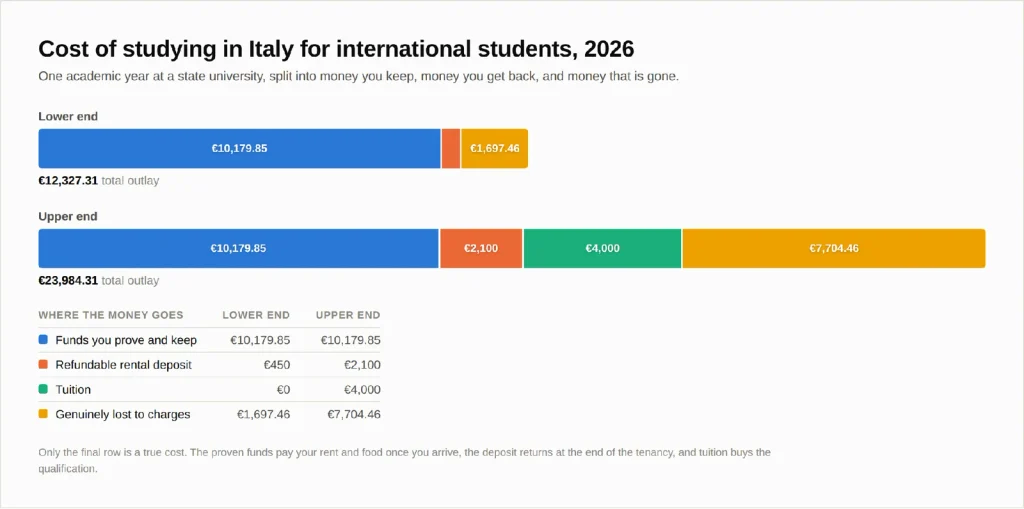
| Total | €12,327.31 to 23,984.31 |
How to read that total
Most of that range is not a fee. The €10,179.85 you prove stays your money and pays for your rent and food after you arrive. The deposit of €450 to €2,100 comes back when the tenancy ends and the inventory matches. Tuition of up to €4,000 pays for the qualification. Leave those three out, and the money you actually lose, on fees, tests, taxes, translation, transfer charges, the flight and furnishing a room, is about €1,697 to €7,704.
Even that is a little high, because the short let, your first month of rent and your transport pass come out of the same money you already proved. Take out that double count, worth €500 to €2,020, and the amount you really lose is about €1,197 to €5,684.
That total covers one academic year at a state university, which is the honest way to give the cost of studying in Italy for international students, because the second year costs almost as much again. You pay the tuition, the regional tax and the health contribution again, renew the permit, and prove the money a second time. The same calculation for France, the United Kingdom and Canada is on this site as well.
Typical yearly tuition by level
Italian state tuition depends on family income, not a fixed price, so there is no single figure. Students whose family income is abroad cannot use the ordinary ISEE and must get an ISEE parificato from an approved tax assistance centre. Miss that deadline and you pay the highest band for both tuition and regional tax, plus a late fee. It is the most expensive paperwork mistake an international student can make in Italy.
| Level of study | State institution, yearly | Private institution, yearly |
|---|---|---|
| Laurea, three years | €0 to about €4,000 by band | €6,000 to €17,000 and above |
| Laurea magistrale, two years | €0 to about €4,000 by band | €6,000 to €18,550 and above |
| Dottorato di ricerca | Normally no tuition, and most places carry a scholarship | Rare |
| Master universitario | Priced course by course | Priced course by course |
| AFAM diploma | Bands similar to a laurea | Priced institution by institution |
Add the regional tax and €16 of stamp duty to every row. That tax is €120 to €160 in Liguria and €130 to €190 in Lombardy, where students from lower income countries go automatically into the lowest band. Scholarship winners get it refunded. Among private universities, Bocconi charges €17,000 for the first year of a bachelor and €18,550 for a master in 2026/2027.
Sources for this section: University of Brescia contribution rules for 2026/2027, in Italian; tuition and exemptions for international students; Bocconi tuition and fees for 2026/2027.
Six things to check before you spend anything
- Decide how you plan to stay on before you choose the course. Italy counts a three year laurea and an ITS diploma towards the job search permit, so a cheaper qualification does not close that door.
- Start your pre enrolment early, because universities can approve only their reserved places plus twenty percent.
- Prepare the proof behind your money months in advance. Applications fail because nothing explains where the balance came from.
- Book your ISEE parificato appointment as soon as you are accepted. Miss it and you pay the highest tuition band all year.
- Budget €700 for health cover unless a private policy meets the rules, and remember it does not cover earlier months.
- Write two dates in your calendar on the day you arrive: eight working days for the permit, and 31 January to be enrolled.
Read this page as general information, not as immigration advice. Italy has changed its funds requirement, its approval rules and its health contribution in the last two years, so check your own situation against the Ministry circular on Universitaly, your consulate’s page and your university’s fee rules before you pay anything. Italy has no public register of immigration advisers. Only lawyers registered with an Italian bar can give paid immigration advice, and the national bar council has a directory you can search. Patronati, the welfare offices supervised by the Ministry of Labour under law 152 of 2001, help with residence permit applications free of charge, and your university’s international office is usually the quickest place to start.