
Most Australian universities accept a KCSE certificate for direct entry to a bachelor’s degree, usually with a mean grade between C+ and B+, depending on the university and the course. The hard part is that each university converts KCSE grades its own way, so the KCSE requirements for Australian universities differ from one university to the next. Some add up your best subjects, some average them, and some still count subjects KNEC no longer forces you to include.
This guide shows how the main universities read a KCSE certificate, using their own published tables. It also covers subject prerequisites, what to do if your grade falls short, and how a Kenyan diploma or degree counts for a master’s or PhD. It’s part of our Study in Australia from Kenya 2027 guide, which covers costs, the new visa rules and work rights. Our cost of studying in Australia guide prices every fee stage by stage.
How Australian universities read a KCSE certificate
An Australian university doesn’t use your KNEC mean grade as it stands. It recalculates your result from your subject grades, and the method changed for Kenyans in 2023.
From the 2023 KCSE, the Ministry of Education says the mean grade uses Mathematics, one language and your five best other subjects. The language can be English, Kiswahili or Kenyan Sign Language. Before 2023, English, Kiswahili and Mathematics all had to count.
Australian universities haven’t all caught up. RMIT, for example, still says its KCSE mean uses the best 7 subjects with English, Kiswahili and Mathematics compulsory. If you sat KCSE in 2023 or later and dropped Kiswahili or English from your best seven, your RMIT mean could come out lower than your KNEC mean.
Three things follow for Kenyan applicants:
- Work out your result both ways: the KNEC way and the old way with all three compulsory subjects.
- Check whether the university uses a mean grade, a points total or an average, because the same certificate can rank differently at each one.
- Look at your English grade on its own. Several universities set a minimum English grade on top of your overall result.
KCSE requirements for Australian universities, compared
Nine universities and colleges publish clear KCSE rules. The table shows the published numbers as at October 2026. Each one uses its own method, so compare the method as well as the grade.
| University | How it reads your KCSE | What you need | Source |
|---|---|---|---|
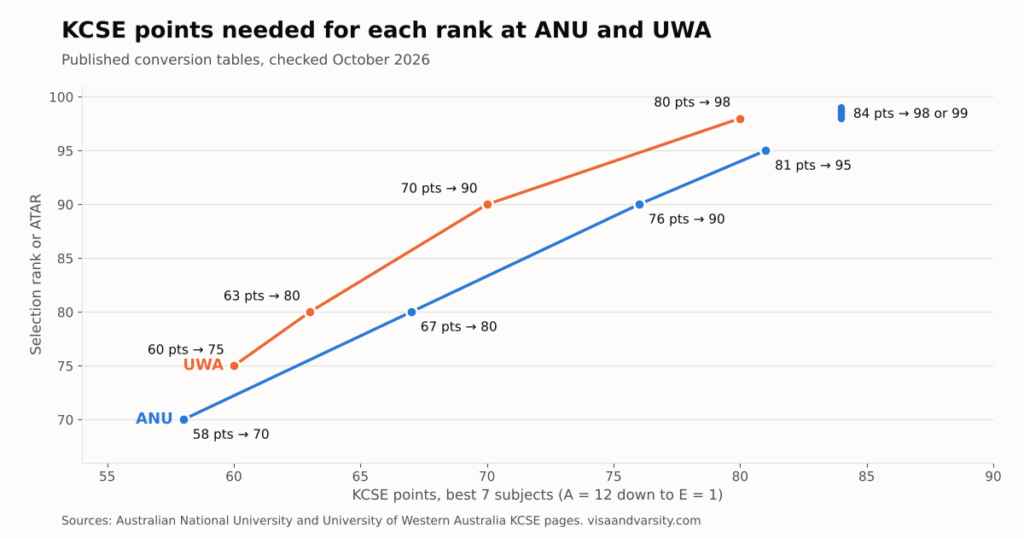
| Australian National University (Canberra) | Points from A = 12 down to E = 1 | 58 points for a rank of 70, 67 for 80, 76 for 90, 81 for 95, 84 for 98 or 99 | ANU KCSE table |
| University of Western Australia (Perth) | Points from your best 7 subjects, A = 12 down to E = 1 | 60 points for an ATAR of 75, 63 for 80, 70 for 90, 80 for 98, plus C+ in English | UWA KCSE page |
| RMIT University (Melbourne) | Mean grade of best 7, with English, Kiswahili and Maths compulsory | Bachelor’s: B for 65% courses, B+ for 70%, A- for 75%, A from 80%. Diploma: C or C+ | RMIT Kenya page |
| Griffith University (Queensland) | Grade average of your best 8 subjects | Standard entry: 5.8. Higher bands: 6.8, 8.3, 8.6, 9.3, 9.7 and 10 | Griffith entry schedule, August 2026 |
| Federation University (Victoria) | Grade average across 7 or 8 subjects | Bachelor’s: B in 8 subjects. Diploma: C+ in 7 subjects | Federation entry requirements by country |
| University of Wollongong (NSW) | Points total of your best 7 subjects | Bachelor’s: 60 for most fields, 67 for economics, finance and social work, 72 for law and pre-medicine. Diploma: 44 to 49. Foundation: 31 | UOW country equivalencies |
| Western Sydney University (Sydney) | KCSE mean grade | Bachelor’s: C+. Diploma: C | Western Sydney entry qualifications |
| Victoria University (Melbourne) | Mean grade, with at least 7 of 8 subjects passed | Bachelor’s: C+. Diploma: C- | VU academic entry requirements |
| Deakin College (pathway to Deakin University) | KCSE grade average | Diploma: C. Foundation program: C- | Deakin College entry requirements |
The University of Sydney lists the KCSE among its recognized qualifications but doesn’t publish a score, so you apply and it assesses you. Many other universities work the same way.
Work out your points
ANU and UWA give each grade a value from 12 for an A down to 1 for an E, then add up your best seven subjects. The highest possible total is 84.
Say you have A- in Mathematics (11), B+ in English (10), B in Kiswahili (9), B in Biology (9), B- in Chemistry (8), B- in History (8) and C+ in Geography (7). That’s 62 points. UWA turns 62 into a selection rank of 78, while ANU puts a rank of 70 at 58 points and a rank of 80 at 67 points.
Griffith’s 5.8 is an average, not a total. Griffith doesn’t say which grade scale it uses, so email Griffith admissions to ask how your grades convert before you count on it.
What “rank” means for your course
Each course sets the rank or ATAR it needs, and the course page shows it. Look up that number first, then read across the university’s KCSE table. A rank of 70 to 80 covers many business, IT and arts degrees. Universities set 90 or more for medicine, law and some engineering courses, and meeting the number doesn’t guarantee a place where entry is competitive.
Subject prerequisites: the grade inside the grade
A good mean grade isn’t enough if the course needs a subject you didn’t take, or took and scored low in. Australian course pages write prerequisites as Australian Year 12 subjects, such as “Mathematics Methods” or “Chemistry”. Almost no university publishes which KCSE grade matches each one.
UWA is typical. Its KCSE page says you must satisfy any prerequisite subject requirements for your course, but it doesn’t list KCSE equivalents. Charles Darwin University says the same about course requirements such as prerequisite knowledge.
Curtin College gives a clearer picture of how prerequisites work by course type. Its entry requirements for the second stage of each diploma are:
| Course area | KCSE average | Subjects needed |
|---|---|---|
| Engineering | B- | Mathematics and one science, matched to Mathematics Methods plus Physics, Chemistry or Engineering Studies |
| Computing and IT | C plain | Mathematics, matched to Mathematics Applications |
| Commerce, Built Environment, Arts | C plain | No subject listed |
| Health Sciences | B- | Higher for Physiotherapy, Pharmacy and Occupational Therapy |
Use that as a guide to what each field expects, then check your own course page. Here’s how to handle it:
- Find the prerequisite on the course page, for example “Mathematics Methods ATAR”.
- Email the admissions team with your KCSE result slip and ask whether your grade in that KCSE subject meets it.
- Ask for the answer in writing before you pay a deposit.
If you’re still in Form 3 or 4, keep Mathematics, Physics and Chemistry if you might want engineering, IT or health. If you drop a science, you may not get into those courses even with a strong mean grade.
If your KCSE grade is too low
You can still reach an Australian university with a C, C- or even a D average, through a foundation program or a university diploma first. Study Australia says foundation studies take six months to one year and prepare you for an undergraduate course. A diploma can earn you credit toward the degree.
Here are the lowest published KCSE grades for each program, from lowest to highest:
| Program | Lowest KCSE average | Source |
|---|---|---|
| Curtin College diploma, Stage 1 (all areas) | D | Curtin College entry requirements |
| Deakin College foundation program | C- | Deakin College entry requirements |
| Victoria University diploma | C- | VU academic entry requirements |
| Western Sydney University diploma | C | Western Sydney entry qualifications |
| Deakin College diploma | C | Deakin College entry requirements |
| RMIT diploma or associate degree | C to C+ | RMIT Kenya page |
| Curtin College diploma, Stage 2 (commerce, IT, arts, built environment) | C plain | Curtin College entry requirements |
| Federation University diploma | C+ in 7 subjects | Federation entry requirements by country |
| Charles Darwin University bachelor’s (direct entry) | C+ | CDU entry requirements |
| Curtin College diploma, Stage 2 (engineering, health) | B- | Curtin College entry requirements |
If you have a C+, you may not need a pathway at all. A higher grade helps with money too, because many university scholarships set an academic bar. Our scholarships for Kenyan students in Australia guide lists the bar for each award. Charles Darwin University, Western Sydney University and Victoria University all list a C+ for direct bachelor’s entry, and Charles Darwin sets it against an ATAR of 60.
Pathway problems to check before you pay
- The work visa after graduation. A diploma on its own leads to a shorter, more limited post-study work visa than a bachelor’s degree. See the “What comes after you graduate?” section of our main guide for how this works.
- Credit that cuts your study time. If diploma credit brings your total Australian study below 16 months, you may not qualify for the post-study work visa at all. Our guide from the 485 visa to permanent residency explains the rule. Ask the university how much credit it will give, then count the months.
- One visa or two. You can usually package a foundation or diploma with the degree on one student visa if each course leads to the next. Ask your university to issue a packaged offer.
- Which year you enter. Study Australia talks about credit, not guaranteed second-year entry. Get the university to confirm in writing which year of the degree your diploma leads into.
Entry with a Kenyan diploma or degree
Once you have study after KCSE, your KCSE matters less and your later results matter more. Here’s how each level works.
With a Kenyan diploma or one year of university
Federation University lets you skip the KCSE test for its bachelor’s degrees if you’ve completed at least one year of post-secondary study at a recognized institution. Other universities assess a diploma case by case.
You may also get credit for subjects you’ve already passed. Study Australia says relevant earlier study may earn academic credit, so ask for a credit assessment when you apply. Send unit outlines as well as your transcript, because the university compares content, not just names. Remember the 16-month rule for the post-study work visa before you accept a lot of credit.
For a coursework master’s
Most universities ask for a bachelor’s degree they treat as equal to an Australian degree. Western Sydney University says exactly that, and adds that some degrees are assessed individually. Deakin asks for a degree of an acceptable standard from an approved university, and Griffith sets a minimum GPA for each program.
Victoria University is the clearest we found. In its table for Kenya, VU asks for a Kenyan bachelor’s completed with an overall average of 50% across all subjects for a coursework master’s. Competitive courses at other universities usually expect more.
| Your Kenyan degree class | What it usually opens |
|---|---|
| First Class | Most coursework master’s, and research degrees if you have a project or thesis |
| Second Class Upper | Most coursework master’s. Meets VU’s research entry level |
| Second Class Lower | Many coursework master’s, especially at universities that set 50% averages like VU |
| Pass | Few direct options. Look at a graduate certificate or a masters qualifying program first |
The table is our reading of the published rules, not an official chart. Griffith runs a Masters Qualifying Program through Griffith College, and Deakin College runs one too, for applicants who fall just short.
For a research master’s or PhD
Research degrees need proof that you can do research, not only good grades. Victoria University lists an overall average of 60%, a GPA of 3.3 out of 4, or Second Class Honours (Upper Division) from a Kenyan degree. Monash asks for a four-year bachelor’s with a research project at a level equal to Second Class Honours Division A, or a master’s in which research makes up at least a quarter of a full-time year.
Many Kenyan four-year degrees include a final-year project. Keep the project report and its marks, because that is the evidence a research admissions team looks for. Contact a supervisor before you apply, since most universities won’t admit a research student without one.
English: one rule for the university, another for the visa
Your KCSE English grade can get you a place, but it may not satisfy the visa. Treat them as two separate checks.
For admission
Some universities accept your KCSE English instead of a test score:
- UWA asks for a C+ or above in English.
- Curtin accepts a B or better in the English subject.
- Charles Darwin University puts Kenya on its extended list of English-speaking countries. Study in Kenya can count if your institution confirms in writing that it taught in English and you studied within five years of starting at CDU.
Other universities want a test score whatever your KCSE says, so check the English page of each one you apply to.
For the student visa
Study Australia lists only five countries whose passport holders are exempt from visa English evidence: the UK, the US, Canada, New Zealand and Ireland. Kenya isn’t one of them. Since 23 March 2024, when you do need a test, the minimums are:
| Your study plan | Minimum IELTS or equivalent |
|---|---|
| Straight into your main course | 6.0 |
| University foundation or pathway program | 5.5 |
| English course (ELICOS) first, then your main course | 5.0 |
Those figures come from Study Australia’s notice on the changes. Whether you need to attach a score depends on your evidence level, which the Home Affairs Document Checklist Tool shows when you enter Kenya and your university.
If you take a test, book it at a test center in Kenya. Home Affairs doesn’t accept at-home versions such as IELTS Online. If you choose the TOEFL iBT, pick the “TOEFL iBT for Australia” option when you register.
Plan ahead for the post-study work visa too. It needs IELTS 6.5 overall with at least 5.5 in each part, which is higher than the student visa.
Documents to have ready
Apply with clear scans of your originals. Each university lists its own documents, but Kenyan applicants are usually asked for these:
- KCSE certificate from KNEC, or your result slip if the certificate isn’t out yet
- Subject grades for every KCSE paper, so the university can pick your best seven or eight
- Diploma or degree certificate and full transcript, if you studied after KCSE
- Unit outlines for any study you want credit for
- A letter from your college or university confirming it taught in English, if you’re using it instead of a test
- Your final-year project report and marks, for research degrees
- An English test report, if the university or the visa needs one
- Your passport
If you’ve lost your KCSE certificate, KNEC’s guideline page explains how to apply for a certification of results letter. Start early, because a university can’t assess you without proof of your results.
Think about the return trip too. If you plan to work in Kenya after you graduate, the Commission for University Education handles recognition and equation of foreign qualifications. Read its guidelines before you choose a course.
Quick answers
What are the KCSE requirements for Australian universities?
For direct bachelor’s entry, the published minimums start at C+ at Charles Darwin, Western Sydney and Victoria University, and rise to a B at Federation and B to A at RMIT, depending on the course. Diplomas and foundation programs accept a C, C- or D.
Can I study in Australia with a C plain?
Yes, through a diploma or foundation program first. Deakin College, Western Sydney and Curtin College all take a C plain for some diplomas, and RMIT starts at a C.
Do Australian universities use my KNEC mean grade?
Not always. Many recalculate from your subject grades. RMIT still counts English, Kiswahili and Mathematics, while KNEC has counted only one language since 2023.
What is 60 KCSE points in ATAR?
At UWA, 60 points from your best seven subjects equals an ATAR of 75. At Wollongong, 60 points meets the bachelor’s minimum for most fields.
Do I need a foundation year with KCSE?
Not at the universities in this guide if your grade meets their bachelor’s minimum. You’d need one only if your grade falls short.
Can I use my KCSE English instead of IELTS?
For admission at some universities, yes: UWA takes a C+ and Curtin a B. For the visa, Kenya isn’t exempt, so check the Document Checklist Tool to see whether you need to attach a test score.
What class of Kenyan degree do I need for a master’s?
It depends on the course. Victoria University asks for a 50% average for coursework master’s, and a 60% average or Second Class Upper for research degrees.
Can a Kenyan diploma get me credit?
Possibly. Ask for a credit assessment with your unit outlines, and check that credit won’t cut your Australian study below 16 months.
This guide is general information, not admissions or immigration advice. Entry rules were checked on official university and government pages in October 2026, and universities change them often. Confirm your grade and prerequisites with each university’s admissions team in writing before you pay a deposit.