
The UK Graduate visa is the post-study work visa for international students. With it, you can stay and work in the UK after finishing a UK degree, with no job offer and no salary minimum. The date matters most: if you apply on or after 1 January 2027, you get 18 months instead of 2 years. PhD graduates still get 3 years.
We wrote this guide for international students from any country. It covers who qualifies, what it costs and how to apply, then the visas you can switch to once the Graduate visa ends. If you’re still choosing where to study, start with our guide to studying in the UK from Kenya.
Two names come up often below. GOV.UK is the UK government’s official website. UK Visas and Immigration (UKVI) is the Home Office team responsible for visa applications.
At a glance
| Item | Detail |
|---|---|
| Length, applying on or before 31 Dec 2026 | 2 years |
| Length, applying on or after 1 Jan 2027 | 18 months |
| Length for PhD and other doctoral graduates | 3 years |
| Application fee | £937 |
| Health surcharge | Usually £1,035 a year, so £1,552.50 for 18 months |
| Where you apply | Inside the UK, before your Student visa ends |
| Job offer needed | No |
| Work allowed | Most jobs, including self-employment |
| Usual decision time | About 8 weeks |
| Can you extend it | No, but you can switch to another visa |
Who qualifies for the UK Graduate visa
The Home Office decides every case, and GOV.UK’s Graduate visa overview sets four basic tests. You must:
- Be in the UK when you apply
- Hold a Student visa (or the older Tier 4 student visa) right now
- Have completed an eligible course while on that visa
- Have your university confirm it. Your education provider, usually your university, must tell the Home Office you finished successfully
You don’t need to have graduated or have your certificate yet. Once your university has reported your result, you can apply, so ask its international office when it sends those reports. If you’re still at the Student visa stage, see our guide to the UK Student visa from Kenya.
Which courses count
The Home Office Graduate route guidance lists three kinds of course:
- A UK bachelor’s degree
- A UK postgraduate degree, such as a master’s or PhD
- Certain professional courses, such as a PGCE or PGDE, the Legal Practice Course or the Bar Practice Course
How long you must have studied in the UK
| Course length | UK study needed |
|---|---|
| 12 months or less | The whole course in the UK |
| More than 12 months | At least 12 months on a Student visa, studying in the UK |
Studying online from your home country doesn’t count. The only exception was for some students during the Covid-19 period between 2020 and 2022.
Who can’t apply
- Anyone who has had a Graduate visa before, since you only get one
- Anyone who has had a Doctorate Extension Scheme visa
- Anyone whose Student visa has already expired
My government paid for my degree. Can I still apply?
Only with your sponsor’s written consent, if a government or international scholarship agency paid your fees and living costs in the past 12 months. Some scholarships don’t give that consent. The Commonwealth Scholarship Commission, for example, says it doesn’t support scholars switching to the Graduate visa. So read your award terms before you plan around this route, and ask your scholarship office for its answer in writing.
How long the Graduate visa lasts in 2027
The length depends on two things: your qualification and the date you apply.
| Your situation | Visa length |
|---|---|
| Bachelor’s or master’s, applying on or before 31 December 2026 | 2 years |
| Bachelor’s or master’s, applying on or after 1 January 2027 | 18 months |
| PhD or other doctoral qualification, any date | 3 years |
The Home Office guidance ties the length to your application date, not your graduation date. Take a master’s student whose university reports their result in December 2026. Applying on or before 31 December gets them 2 years. Waiting until January 2027 gets them 18 months.
The visa starts on the day your application is approved, not the day you apply. You can’t extend it, so plan your next step well before it ends.
What the shorter visa means for you
With 18 months instead of 2 years, you have six months less to find a sponsored job. If you want to stay longer, we’d start applying during your final term, not after graduation. The Skilled Worker section later in this guide gives the salary you’d need.
How much the Graduate visa costs
The Home Office sets the fees, and you pay two of them when you apply: the application fee, and the Immigration Health Surcharge (IHS) for the whole visa. The IHS is the extra charge international students pay toward using the National Health Service (NHS). GOV.UK’s Graduate visa costs page gives these figures:
| Visa length | Application fee | Health surcharge | Total |
|---|---|---|---|
| 18 months | £937 | £1,552.50 | £2,489.50 |
| 2 years | £937 | £2,070 | £3,007 |
| 3 years (PhD) | £937 | £3,105 | £4,042 |
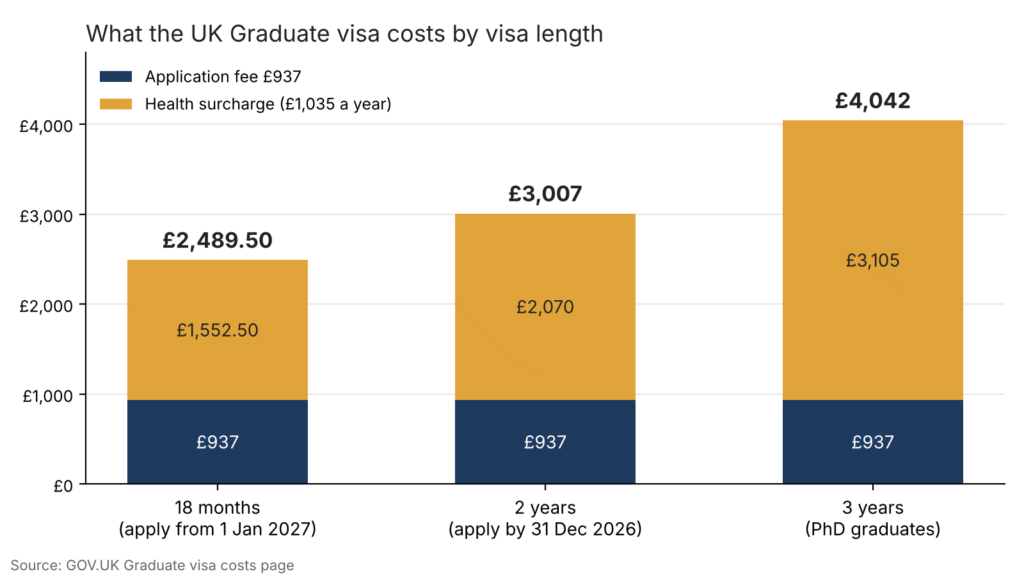
The surcharge for a Graduate visa is usually £1,035 a year, which is higher than the £776 student rate. You’re told the exact amount when you apply. For the costs before you reach this stage, see our guide to the cost of studying in the UK.
Your family members apply separately as your dependants, so check the fee and surcharge for each person. If you later work in public-sector healthcare, you may be able to get the surcharge refunded.
How to apply for the Graduate visa, step by step
You apply online from inside the UK, and UKVI decides your case. GOV.UK’s Graduate visa application page sets out the process.
- Check your Student visa end date. You must apply before it expires. For courses of 12 months or more, a Student visa usually lasts four months after your course ends, and that is your window to apply.
- Wait for your university to report your result. Your provider tells the Home Office you’ve completed the course.
- Get sponsor consent if you need it. If a government or scholarship body paid your fees and living costs in the past 12 months, get its written consent first.
- Apply online. You can save the form and finish it later. You pay the fee and the surcharge at the end.
- Prove your identity. You either scan your document with the UK Immigration: ID Check app, or give fingerprints and a photo at a UKVCAS service point.
- Wait for the decision. It usually takes about 8 weeks from when you’ve applied, proved your identity and sent your documents. UKVI may contact you if it needs longer, for example to check a document.
- Get your eVisa. If you’re approved, your Graduate visa appears as an eVisa, a digital record of your status, in your UKVI account.
Don’t travel while you wait
GOV.UK says your application is withdrawn if you leave the UK, Ireland, the Channel Islands or the Isle of Man before you get a decision. You can stay in the UK while you wait, even if your Student visa end date passes, as long as you applied in time. So plan trips home for after your decision.
What you can and can’t do on a Graduate visa
Your Graduate visa isn’t tied to an employer, so you choose your own work. According to GOV.UK, you can:
- Work in most jobs
- Look for work
- Be self-employed or freelance
- Do unpaid voluntary work for a registered charity, voluntary organization, associated fundraising body or statutory body
- Travel abroad and return to the UK
- Live in the UK with your eligible partner and children
You can’t:
- Claim most public funds, such as benefits, or the State Pension
- Work as a professional sportsperson
- Extend the visa
- Study on a course that qualifies for a Student visa. If you want another degree, you’d need a new Student visa
Using the time well
With no sponsor, you can try different jobs, work part time or start a business. But only some of that work helps you stay longer. To switch to a Skilled Worker visa, you’ll need an employer with a sponsor license, which is the Home Office permission to hire workers from abroad, and a job that meets the salary rules in this guide.
Can my partner and children stay with me on a Graduate visa?
Only if they were already with you as dependants on your Student visa. A dependant is a family member who joined you on your visa. GOV.UK’s partner and children page sets these rules:
| Family member | Can they stay on your Graduate visa? |
|---|---|
| Partner who was your dependant on your Student visa | Yes, if the relationship is ongoing |
| New partner who wasn’t your dependant before | No |
| Child under 18 who was your dependant on your Student visa | Yes |
| Child born in the UK during your Student or Graduate visa | Yes |
| Child 18 or over | Only if they were already your dependant |
To prove an ongoing relationship, you need a marriage or civil partnership recognized in the UK, two years of living together, or a relationship of at least two years where you couldn’t live together for reasons like work or study. Children have to live with you, unless they’re in full-time education away from home, and must not be married.
Taught master’s and bachelor’s students can’t bring family on a Student visa unless a government sponsors them. If that was you, you have no dependants to keep. GOV.UK notes that new family members may be able to join you if you later switch to a visa like the Skilled Worker visa.
Switching from the Graduate visa to a Skilled Worker visa
You can only switch if an employer with a sponsor license offers you a job that meets the Home Office’s skill and salary rules. The Skilled Worker visa is a work route that can lead to settlement, which means living in the UK with no time limit.
The salary you need
GOV.UK’s Skilled Worker job rules set the usual minimum at £41,700 a year or the going rate for your job, whichever is higher. The going rate is the pay level the Home Office sets for that type of job.
Recent graduates can be paid less. The lower-salary rules let you earn 70% of your job’s going rate, as long as it’s at least £33,400 a year, if any of these apply:
- You’re under 26 when you apply
- You’re on a Graduate visa, or were in the last two years and it was your most recent visa (or your most recent before a visit visa)
- You’re on a Student visa at bachelor’s level or above, or were in the last two years
- You’re working toward a recognized qualification in a regulated profession, or toward full registration or chartered status
On this lower rate, your total stay in the UK can’t be more than four years, and that includes your time on the Graduate visa. So before you accept a job on the lower rate, count your Graduate visa months, because they use up part of the four years.
| Route | Minimum salary |
|---|---|
| Standard Skilled Worker | £41,700 or the going rate, whichever is higher |
| New entrant (recent graduates and under-26s) | £33,400, and at least 70% of the going rate |
Which jobs qualify
Most jobs have to be higher skilled. Medium-skilled jobs only count if they’re on the Immigration Salary List or the Temporary Shortage List. Healthcare and education jobs follow national pay scales instead. Ask the employer which occupation code the job uses, then check it against the lists on GOV.UK.
Care work after July 2025
The Home Office changed the care work rules in July 2025. The July 2025 rule changes closed overseas recruitment for care workers and senior care workers from 22 July 2025. People already in the UK, including graduates, can still switch into these roles until 22 July 2028. They need to have worked legally for the care provider for at least three months before it issues the Certificate of Sponsorship, the document your employer gives you to apply.
Why switching matters
The Home Office counts Skilled Worker time toward settlement, which the next section covers. It doesn’t count Graduate visa time toward the five-year routes, so the sooner you switch, the sooner your five years begin.
Other ways to stay after the Graduate visa
Skilled Worker isn’t the only way to stay, and these routes suit some graduates better:
| Route | Who it’s for | Key rule for graduates |
|---|---|---|
| Global Talent | Leaders or potential leaders in academia, research, arts and culture, or digital technology | You need an endorsement or a listed prize. The visa lasts up to 5 years at a time and can lead to settlement after 3 or 5 years |
| Innovator Founder | People starting a new, innovative business | You need an endorsement from an approved body, which costs £1,000. The visa lasts 3 years and you can extend it |
| High Potential Individual (HPI) | Graduates of top universities outside the UK | You can’t apply if you’ve had a Graduate visa. UK universities aren’t on its list |
| A new Student visa | Graduates going on to further study | You can’t study a Student-visa course on a Graduate visa, so you’d apply for a new Student visa |
Check the HPI visa before you apply for the Graduate visa. It’s for people with degrees from listed universities outside the UK, and GOV.UK says you can’t apply once you’ve held a Graduate visa. So if you studied at both a listed overseas university and a UK one, compare the two routes first.
Does my Graduate visa time count toward settlement?
It depends on the route, and the Home Office decides which time counts. Settlement, also called indefinite leave to remain (ILR), lets you live in the UK with no time limit.
| Route to settlement | Does Graduate visa time count? |
|---|---|
| Five-year work routes, such as Skilled Worker | No |
| Ten-year long residence | Yes, along with your Student visa time |
The Home Office’s long residence guidance counts time on any route except a short list, such as Visitor and short-term English language study. So your Student and Graduate years both count toward the 10 years of lawful, continuous stay. For the five-year routes, the Home Office’s own settlement consultation says study and Graduate time don’t count.
Changes coming to settlement
Two changes could affect graduates planning to settle:
- Higher English for settlement. From March 2027, the Home Office says most people applying to settle will need English at an A-level equivalent standard, up from GCSE level, proved with an approved test. Those are two UK school exam levels, and A-level is the higher one.
- “Earned settlement” proposals. The Home Office has consulted on raising the usual wait for settlement from 5 to 10 years, with shorter waits for high earners and some public service workers. The proposals would also replace the separate long residence route. The consultation closed on 12 February 2026, and the government hadn’t confirmed the final rules or a start date when we checked.
Until the Home Office publishes new rules, plan on the current ones. Before any big decision, check GOV.UK or ask a regulated immigration adviser.
Mistakes that can cost you the Graduate visa
Each of these follows from the GOV.UK rules covered in this guide, and each one can be avoided.
| Mistake | What happens | How to avoid it |
|---|---|---|
| Letting your Student visa expire before you apply | You can’t apply, because you need to hold a Student visa | Note your Student visa end date and apply well before it |
| Applying from outside the UK | You can’t apply, because you must be in the UK | Stay in the UK until you’ve applied and had a decision |
| Traveling abroad while you wait | UKVI withdraws your application | Plan trips home for after your decision |
| Applying before your university reports your result | Your provider needs to tell the Home Office first | Ask your international office to confirm the report has gone in |
| Not getting scholarship consent | You need written consent if a government or scholarship body paid your fees and living costs in the past 12 months | Ask your sponsor early, and check whether it allows the Graduate visa at all |
| Not studying long enough in the UK | For courses over 12 months, you need at least 12 months of UK study on a Student visa | Don’t switch to studying from home in your final year |
| Missing the 2026 deadline if you want 2 years | Applications from 1 January 2027 get 18 months | If your result is out in 2026, apply on or before 31 December 2026 |
| Using the Graduate visa when you might qualify for HPI | You can’t get an HPI visa after a Graduate visa | Check HPI first if your earlier degree is from a listed overseas university |
FAQ: UK Graduate visa
Is the UK Graduate visa being cut to 18 months?
Yes, for applications from 1 January 2027. A bachelor’s or master’s graduate who applies on or before 31 December 2026 still gets 2 years, and PhD graduates get 3 years either way.
Do I need a job offer for the Graduate visa?
No. There’s no job offer, sponsor or salary requirement.
How much does the Graduate visa cost?
The application fee is £937, plus a health surcharge that’s usually £1,035 for each year of the visa. For an 18-month visa, that’s £2,489.50 in total.
Can I apply for the Graduate visa from my home country?
No. You need to be in the UK, and still hold your Student visa, when you apply.
Do I have to wait for my graduation ceremony?
No. Apply as soon as your university has reported your result to the Home Office. You don’t need your certificate first.
How long does a Graduate visa decision take?
Usually about 8 weeks, counted from when you’ve applied, proved your identity and sent your documents.
Can I extend the Graduate visa?
No. You can switch to another visa, such as a Skilled Worker visa, but you can’t extend this one.
Can I bring my spouse on a Graduate visa?
Only if your partner was already on your Student visa as your dependant. A new partner can’t join you on the Graduate visa.
Does Graduate visa time count toward ILR?
Not toward the five-year Skilled Worker route. It does count toward the ten-year long residence route.
What salary do I need to switch to a Skilled Worker visa?
Usually £41,700 or the going rate, whichever is higher. Recent graduates can qualify on a lower salary of at least £33,400 and 70% of the going rate, but their total stay is then limited to four years, including Graduate visa time.
More guides in this series
- Cost of Studying in UK
- Study In the UK from Kenya
- KCSE and Kenyan degree requirements for UK universities
- Scholarships for Kenyan students in the UK
- UK Student visa from Kenya: steps, proof of funds and refusals
- The best courses to study in the UK for international students
Before you apply
This guide explains the UK Graduate visa rules as published on GOV.UK in October 2026. It isn’t legal or immigration advice. Immigration rules change often, especially around settlement, so check GOV.UK before you apply. If your case is complicated, speak to an immigration adviser regulated by the Immigration Advice Authority (IAA), the UK regulator of immigration advice, or to a regulated solicitor. Visa and Varsity isn’t linked to the Home Office or UKVI.