
For most international students, the best courses to study in the USA are the ones that lead to jobs employers are hiring for, appear on the government’s STEM list, and fit your strengths and budget. The STEM list matters because it gets you up to three years of work after graduating. In practice, that points to computer science, data science, engineering, mathematics, the physical and life sciences, and STEM-designated business analytics.
Most students already choose these fields. In 2024/25, 57% of international students in the US were in STEM fields, and math and computer science was the largest single group.
This applies to international students from any country. If you’re applying from Kenya, see our complete guide to studying in the US from Kenya.
Why does a STEM degree matter so much?
The biggest practical difference between two courses is how long you can work in the US afterward, and whether the program is STEM-designated decides that. That work period is called Optional Practical Training (OPT). The H-1B is the work visa most graduates apply for after it, and because more people apply than there are places, it’s decided by lottery.
| Non-STEM degree | STEM-designated degree | |
|---|---|---|
| Work after graduating (OPT) | 12 months | Up to 36 months |
| Chances in the H-1B lottery | Usually one try | Often two or three tries, one per year |
| Unemployment allowed | 90 days | 150 days in total |
Those extra two years give you more time to build experience and more tries at a work visa. Since the H-1B lottery became weighted toward higher salaries in 2026, the extra years matter even more, because pay usually rises with experience. Our guide to OPT for international students sets out the rules in full.
How do I check whether a degree is STEM?
Ask your university for the program’s Classification of Instructional Programs (CIP) code, because the code decides, not the degree’s name. It’s a six-digit number your university assigns to the program, and it’s printed on your I-20, the form your school issues for your visa application.
The Department of Homeland Security (DHS) STEM list includes every code in engineering, biological sciences, mathematics and physical sciences, plus selected codes in related fields such as computer science, data science and some business analytics.
Before you accept any offer, you need to email the international office and ask for the program’s exact CIP code. Then check it against the current list and get the answer in writing.
Which are the best courses to study in the USA for job growth?
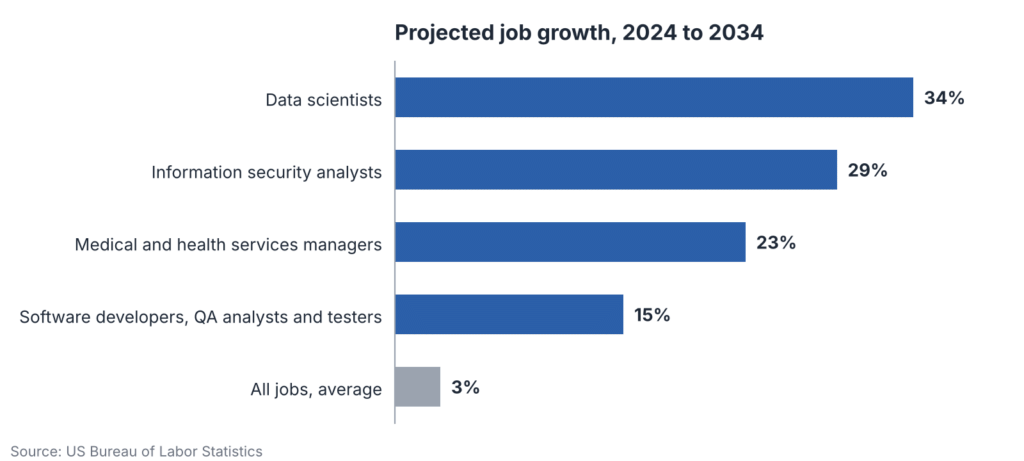
The US Bureau of Labor Statistics (BLS) projects how jobs will grow from 2024 to 2034, and average growth across all jobs is just 3%. These jobs are well above that, and all three are open to graduates with STEM degrees:
| Job | Projected growth, 2024 to 2034 | Median pay, May 2024 | Typical degrees |
|---|---|---|---|
| Data scientists | 34% | $112,590 | Data science, statistics, mathematics, computer science |
| Information security analysts | 29% | $124,910 | Cybersecurity, computer science, information systems |
| Software developers, QA analysts and testers | 15% | $133,080 for developers | Computer science, software engineering |
Software developers grow more slowly in percentage terms, but it’s such a large occupation that it still adds a lot of jobs.
What these fields have in common
- Their usual degrees are STEM, so they come with up to three years of OPT, as long as your program’s CIP code is on the list.
- Every industry hires for them, from banks and hospitals to farming and government. You can apply to many employers, including universities and hospitals that are cap-exempt, meaning they don’t go through the H-1B lottery.
- They pay well enough to move graduates into the higher wage levels of the H-1B lottery over time.
Engineering and the sciences
Engineering is the second most popular field for international students, after math and computer science. Civil, mechanical, electrical, chemical and biomedical engineering are all on the STEM list and lead to well-paid US jobs, especially in infrastructure, energy and manufacturing. Mathematics, statistics, physics, chemistry and the life sciences are STEM too, and they’re a good base for funded PhD programs.
Is AI taking the entry-level jobs?
AI is changing entry-level work in software and data, but the pay and growth projections are still strong. Employers increasingly want graduates who can show real projects, internships and specialist skills. So pick a program with strong practical work and career support over one with a fashionable title, and ask each department what projects and internships its students actually complete.
Which degrees look STEM but may not be?
Many students assume a course is STEM because it sounds technical. But the CIP code decides, and the same title can have different codes at different universities.
- MBA. A general MBA is usually coded as business administration, which isn’t on the STEM list. Some schools code their whole MBA, or a specific track, under management science, which is. The University of Minnesota’s Carlson School of Management offers a separate Management Science MBA coded 52.1301 that qualifies for STEM OPT.
- Business analytics. Often STEM, but only if the program uses a code on the list. A business analytics concentration inside a general MBA may not count.
- Information systems and IT management. Some programs are coded as STEM and others as business, so check each one.
- Economics. Standard economics usually isn’t STEM, but econometrics and quantitative economics programs often are.
- Psychology. Psychology degrees mostly aren’t STEM, though research-based programs in areas such as cognitive science or neuroscience may be.
- Public health. It depends on the program. Epidemiology and biostatistics programs are more likely to be STEM than general public health.
If two offers are otherwise similar and only one is STEM-designated, we’d take that one. The difference is worth up to two extra years of US work experience.
Which careers are harder for international students?
Some careers are open to you in theory but much harder to get into in practice. You can still choose them, but find out what you’re taking on before you apply.
Medicine
In the US, medicine is a graduate degree, taken after a four-year bachelor’s. Many medical schools don’t consider international applicants at all, and those that do admit few. Tufts University School of Medicine, for example, says it admits very few international applicants and gives strong preference to US citizens and permanent residents. Schools that accept international students often require proof of funds for all four years. Emory University School of Medicine asks international students to document funding for all four years, at a cost of more than $80,000 a year. Federal medical loans aren’t open to students on an F-1 visa, the standard international student visa.
Law
A US law degree, the Juris Doctor (JD), takes three years after a bachelor’s, and you must then pass a state bar exam before you can practice. Law isn’t on the STEM list, so you’d get only 12 months of OPT, and fewer law employers sponsor work visas than tech or engineering employers do.
Nursing and other licensed health jobs
Nursing, pharmacy and therapy careers need a US state license. Some programs limit places for international students or require clinical placements that are hard to arrange on an F-1 visa. Ask each school directly whether it admits F-1 students to the clinical stage.
Jobs that need citizenship
Many roles in defense, aerospace, government and some public schools require US citizenship or a security clearance. An aerospace engineering degree is STEM, but many employers in that field can’t hire you.
Arts, humanities and general business
These can be excellent degrees, but most aren’t STEM-designated, so you’d get 12 months of OPT rather than 36. If you love these fields, think about a double major or minor with a STEM subject, or a STEM-designated master’s afterward, to get the longer work period.
Should I do a one-year or two-year master’s?
Both lead to the same OPT, so it comes down to cost, internships and what you want next. Plenty of US master’s programs take 12 months, while traditional ones take two years.
| One-year master’s | Two-year master’s | |
|---|---|---|
| Total cost | Lower, with fewer months of living costs | Higher |
| Summer internship | Usually none | Usually one, between years |
| Time to build a network | Short | Longer |
| Research or thesis | Rare | Common, and useful for PhD applications |
| Funding through assistantships | Less common | More common |
A two-year program’s summer internship often leads straight to a job offer, which matters for OPT and the H-1B. Check that any internship you’re counting on is a required part of the degree. In August 2026, the Student and Exchange Visitor Program (SEVP), which certifies schools to enroll international students, said Curricular Practical Training (CPT), the paid work you do as part of your studies, only covers training that every student in the program must complete.
Optional internships generally don’t qualify. Education groups have sued over the change, so ask the international office where it stands. A one-year program can be the better deal if you already have work experience and a clear target job. If you’re changing fields, we’d lean toward the two-year option for the internship alone.
How can I get the best value from a course?
A strong STEM degree is no use if you can’t afford to finish it. These routes keep it within reach:
- Public universities with automatic merit awards. Many state universities give international students scholarships based on grades alone, with no separate application. You’ll find examples in full scholarships in the US.
- Community college first. Two years at a community college, then a transfer into the third year of a bachelor’s, can cut costs sharply. The 2025 Open Doors report found that community colleges saw the largest growth in international students. Confirm the transfer agreement with your target university before you start.
- A funded PhD. In STEM, most PhD offers come with a tuition waiver, a stipend and health insurance. At the University of Arizona, graduate assistants earn a minimum of $25,654 for the 2026/27 academic year. An unfunded STEM PhD offer is a warning sign.
- Assistantships for master’s students. Less common than for PhDs, but some departments offer teaching or research assistant roles that cover part of the cost. Ask each department whether it has any.
If money is the main obstacle, read our guide to student loans to study in the US before you choose a program.
What should I check before accepting an offer?
Run every offer you’re considering through these questions:
- Is the program’s CIP code on the STEM list? Ask the international office in writing.
- Does it fit your past studies? Visa officers ask, so you have to be able to explain the link in a sentence. We explain why in F-1 visa denial reasons in Nairobi.
- Where do graduates work? Ask for recent employment outcomes, ideally for international graduates.
- Is an internship required for all students? The answer tells you whether CPT is realistic under the August 2026 SEVP guidance.
- Can you afford the full program? Include living costs and a buffer for a weaker shilling.
- Does the university hold the right accreditation? Employers and licensing boards expect it, and only SEVP-certified schools can issue an I-20.
- Do employers in this field sponsor visas? Look up which companies have hired H-1B workers in your target job, and check whether universities or research institutes hire in your field.
Frequently asked questions
What are the best courses to study in the USA for international students?
For most students, a STEM-designated degree in computer science, data science, engineering, mathematics or the sciences, because it comes with up to 36 months of OPT. The right one for you still depends on your strengths and your plans after graduating.
Is an MBA a good choice for international students?
It can be, if the school codes its MBA, or a track within it, as STEM. A general MBA usually gets only 12 months of OPT, so ask for the CIP code before you apply.
Which courses give three years of work in the US?
Any degree whose CIP code is on the DHS STEM list. That gives 12 months of standard OPT plus a 24-month STEM extension, if you work for an employer enrolled in E-Verify, the government system for checking that workers can legally work in the US.
Can international students study medicine in the US?
Yes, but it’s hard. You need a bachelor’s first, and many medical schools don’t consider international applicants at all.
Is computer science still a good choice with AI?
Yes, though entry-level roles are more competitive. The BLS still projects above-average growth and high pay for software and data jobs.
Which courses make it easiest to get a US work visa?
STEM degrees in well-paid fields such as computer science, data science, cybersecurity and engineering, because they give you up to three H-1B lottery tries during OPT. Fields where universities, hospitals and research institutes hire, such as the sciences and health data, also lead to cap-exempt jobs with no lottery.
Related guides
- Study in the USA from Kenya: the complete guide
- KCSE and Kenyan degree requirements for US universities
- Full scholarships in the USA for Kenyan students
- Student loans to study in the USA from Kenya
- F-1 visa interview in Nairobi: questions and denial reasons
- OPT for international students: working in the USA after graduation
This guide is general information, not career, legal or immigration advice. Job projections are estimates, and STEM lists and visa rules change, so confirm details with each university before you decide.