
Here is the number that changed everything about the cost of studying abroad in France. For twenty four years, France asked international students to prove they had €615 a month to live on and that figure had not changed since 2002. On 1 August 2026 it became €877.50 a month, and it is no longer a fixed sum at all. It is pegged to 47 percent of the gross French minimum wage, so it climbs on its own every time the minimum wage rises. Over a twelve month course, that is €10,530 you must show instead of €7,380.
What follows in this article attaches a price tag to every stage of the cost of studying abroad in France student, beginning with the first application file and ending the day you sign a lease. Very few of these amounts appear in a prospectus. Running alongside the money are the rules that decide who is approved: proof of funds, tuition for students from outside the European Union, health cover, work limits and your status once the diploma is in hand.
Treat what follows as a snapshot taken in late September 2026 where, France rewrote a lot this year where residence taxes climbed on 1 May. The housing benefits shut to most non-European students on 1 July, and the money threshold moved on 1 August, and a May decree squeezed tuition discounts. Anything you are about to pay should be checked first against France Visas and Service Public.
A note on the links in this guide. They go to the French government and Campus France pages, and several of them open in French. Where a page exists in English, the English version is linked.
The Cost of Studying in France Calculator
This calculator builds every cost in the article into one estimate of the cost of studying in France in your first year. Choose what you will study, enter your rent and flight, tick the boxes that match you, and pick low, middle or high. You get one total, split into tuition, living funds, the refundable deposit and costs you never get back. The Summary and Phase tabs show the detail.
The figures come from official French sources, last checked in late September 2026. Fees and rules change, and this is a budgeting tool, not immigration or legal advice. Confirm your fees with your school and under Where the numbers come from on the Summary tab.
Your situation
Show costs in your own currency
Estimated cost for your first year
€0
Step 1: Your diploma level sets your exit route
It is important to note that what really determines your exit route is the level of the diploma you walk away with, not your grades or your subject. That level decides whether France lets you stay once your student visa expires, and it quietly changes the long-term cost of studying abroad in France. This would be the first thing to handle. A shorter, cheaper programme saves money today but may stand on your way to getting a lawful way to remain and work in France.
The route that matters is the residence card marked “recherche d’emploi ou création d’entreprise”, usually shortened to RECE, which gives you twelve months to find work or start a business and it is usually twelve months exactly, and it cannot be renewed, so you get one in your lifetime. To qualify you must hold a student permit or a validated student visa which you must have earned in France, within the last twelve months, a diploma at master level or above, or a licence professionnelle. Please note, a general three year university degree license does not count, so you will need a Masters or a doctorate from a French institution.
Where each qualification leaves you at the end
| What you complete in France | What you can apply for afterwards |
| Doctorate | RECE card, 12 months, once only |
| National master, or a diploma equal to master level | RECE card, 12 months, once only |
| Mastère Spécialisé, or Master of Science with the CGE label | RECE card, 12 months, once only |
| Licence professionnelle | RECE card, 12 months, once only |
| 3 year University degree/General licence, three years | No RECE card |
| BTS or BUT | No RECE card |
| A French language course alone | No RECE card |
During those twelve months you may work without limit, because the cap that binds students does not apply during this period. When the year ends you can move onto a salaried permit. But the catch is; the job must relate to your studies and should pay above one and a half times the gross minimum wage, which is roughly €2,800 a month in 2026.
The small print that sinks otherwise good applications to studying abroad in France
Your age would not be an issue, but it changes the questions. France publishes no upper age limit for a student visa or for the RECE card. What changes is the evidence, because someone returning to study at forty faces harder questions about why this course, why now.
Your Subject choice is free, but the institution type is not. There is no single national list of approved schools. Public universities and engineering schools sit under the Ministry of Higher Education, and recognised private institutions carry the EESPIG label. A second label, Bienvenue en France, marks real support for international students, so check both on campusfrance.org before sending money.
Language rules depend on your entry route. For a first year license at a public university a French test is compulsory, often the B2, provided by a TCF with the written expression paper, a DELF B2 or a DALF. Above that level there is no national test, each program sets its own rules, however programs taught in English would usually ask for an English certificate instead.
Deadlines may run earlier than you would expect. The demande d’admission préalable closes on 15 December for the following September intakes and universities answer by 30 April and you should reply by 31 May, so if you miss the December deadline you would have missed the year on that route.
Stacking one course onto the next
France has no single visa that would cover a series of courses but what it has is renewal. Your first visa runs four to twelve months, and before it expires you apply online for a student residence card, which can be granted as a multi year card covering the rest of your programs. You would be required to file it between four months and two months before expiry, because filing late can add €180. But if you are coming to sit a competitive entrance examination, there is a visa for exactly that, the VLS TS often marked as “étudiant concours”. However it important to note that a language course alone carries no work rights after completion, so treat it as a bridge, never the destination.
Step 2: Winning a place to studying abroad in France, and the letter it must produce
Unlike Canada that capped the number of international students, France does not cap international student numbers, but what has changed is the cost of studying abroad in France. Under the Choose France for Higher Education plan of April 2026 the target is 500,000, but the country accepted around 443,000 applicants in 2024 to 2025. What contributed to the lesser number is the decree of 19 May 2026, a university may exempt at most 30 percent of its non European students from the discounted tuition rate. Which would then fall to 25 percent next year and 20 percent the year after. Universities used to waive the higher fees for nearly everyone, and that is over, so it’s important to budget for the published rate.
Your country of residence decides which door you use
If you live in a country covered by the Études en France procedure, which includes most of francophone Africa, North Africa, India, China, Brazil, Turkey and Vietnam, you must apply through that platform. You will be required to create a single electronic file, where you will list your program choices, pay a file fee in your local currency, and attend an interview at your local Campus France office, after which the file travels to the consulate. If your country is not covered, you apply to institutions directly and book your own appointment. Check the list on campusfrance.org, because different Campus France sites showed different ones when this was written.
Paperwork, and the single letter that matters later
Most institutions want the same core file, which include: your school leaving certificate and transcripts, degree certificate and transcripts for a master, a language certificate, a motivation letter, a CV and a passport copy. Anything not in French usually needs a sworn translation, which is a regulated category that costs more than an ordinary one. Nationwide diploma verification may not be required, although individual institutions may request an attestation de comparabilité from ENIC NARIC France.
What is most important at the visa stage is your attestation d’inscription ( your enrollment or registration certificate), that would contain the name of the program, the level and the dates. Private schools often issue it only after a deposit, and that deposit is often non refundable even if your visa is refused, so it is wise to read the conditions before you accept. At a public university you normally owe nothing until enrolment, when tuition, the CVEC and registration are settled together.
Phase 1 costs: admission
| Item | Typical cost in euros | In your local currency | Why it is on this list |
| One sitting of a language test | 90 to 300 | TCF, DELF or an English certificate, at local prices | |
| Études en France file fee | 50 to 200 | Priced by your local office and kept whatever the outcome | |
| Sworn translations of your documents | 80 to 400 | Only a traducteur assermenté (professional authorized to translate )qualifies, and they charge accordingly | |
| Certified copies of your diplomas and marks | 20 to 150 | Issuing and stamping them is billed by your former school | |
| ENIC NARIC statement of comparability | 0 to 70 | Not required nationally, though some institutions ask | |
| Postage and courier | 20 to 120 | A few institutions insist on paper originals | |
| Phase 1 subtotal | 260 to 1,240 | Everything spent before the visa file opens |
Step 3: Applying for the VLS TS France student visa
For studies longer than three months you want the VLSTS marked “étudiant”, the long stay visa that doubles as a residence permit. It runs for four to twelve months and usually renews from inside France. For a course of four to six months there is a temporary version, the VLST, which needs no validation but cannot be renewed.
The consular fee is €99, reduced to €50 for students whose file was examined by a Centre pour les Études en France. Most consulates outsource appointments and biometrics to VFS Global, TLScontact or Capago, at a service charge capped near €40. None of it is refunded if your visa is refused.
What goes into the France Student visa file
Expect to submit your passport that is valid and has atleast three months beyond your planned departure time, the completed long stay form, official standard photographs, your acceptance letter, evidence of your living funds, evidence of accommodation for your first weeks, and proof that you have paid or can pay tuition. What the consulate is really testing is whether the study plan is coherent, so the course, the language, the previous studies and the money should all line up.
Proving your money for your studies abroad in France, the stage that breaks most files
Take your time here; often more application for French student visas are turned down over money than over anything else in the file.
Since 1 August 2026 you must show monthly resources of at least 47 percent of the gross French minimum wage, which is €877.50 a month, or €10,530 over a twelve month permit. Applications done before 31 July 2026 were judged against €615. The change came from decree number 2026 526 of 22 June 2026, and because the figure is indexed it will move again, so confirm the amount in force on the day you file.
France does not prescribe one form of proof, which works in your favour, because several routes are open:
- Bank statements in your own name showing a real history, not a sudden balance
- A scholarship letter from the French government, your own government or your institution
- An attestation de prise en charge, a sponsor’s formal undertaking to pay you a set monthly amount, backed by their income documents and identity
- A bank attestation confirming a fixed monthly sum will reach your French account
- An education loan sanction letter from a recognised bank
Two traps that catch families every year; A freshly opened account holding one large deposit with no story behind it, so if the money appeared last month, be ready to document where it originated. The second is counting money that is not truly available, such as a retirement fund that cannot be withdrawn, or a relative’s account with no signed undertaking behind it.
One further change that would affect your budget even though no visa form mentions it, is that, since 1 July 2026, non European students without a French social criteria scholarship are no longer eligible for APL housing benefit, which is worth roughly €100 to €250 a month to earlier students. So your real monthly budget would be higher than the official threshold suggests.
When somebody else is paying
A France Student Visa does not require the funds to be your own, a sponsor can carry all or part of your funding through the attestation de prise en charge. What the consulate looks into is not the relationship but the evidence, the identity document, several months of income proof, and a clear written undertaking.
Health cover
Unlike applying a student Visa for Australia, the United Kingdom, and the United States, France differs from this countries that make you buy private insurance before granting the visa. Once enrolled and staying more than three months, you register with the French public health system, the Sécurité sociale, and that registration is free.
Three things still cost money. The public system reimburses about 70 percent of standard care, so most students add a complémentaire santé, commonly called a mutuelle, at roughly €15 to €40 a month. Registration may take weeks, so many buy short private cover for the gap after landing. also, home insurance is legally required for any rental, and your landlord will ask to see it before handing over keys.
The annual hours ceiling
A validated France student visa carries the right to work with no separate permit, for up to 60 percent of the legal annual working time. That is 964 hours a year, which is a little under nineteen hours a week on average. It is an annual ceiling rather than a weekly one, so you can work full time over the summer as long as the yearly total holds, and exceeding it puts your renewal at risk. Algerian nationals fall under a separate bilateral agreement, so check your own position. At the minimum wage those hours bring in roughly €11,500 gross a year, which covers much of your rent but not your tuition, and no consulate accepts it as proof of funds.
Lodging the file, and how long the wait runs
Start on the France Visas portal, that’s where the application itself lives, and once it’s submitted you book a biometrics slot, either at the consulate or at an outsourced service center. You can file up to three months before you travel, and there is no advantage in waiting. Processing normally runs three to eight weeks, where summer is the exception: apply in June, July or August and you would be in the queue with everyone else, so budget for the slow end of that range. However, none of this counts Études en France, which comes first , so consider that and you would be looking at around six to nine months from start to visa in hand.
Phase 2 costs: student visa
| Item | Typical cost in euros | In your local currency | Category | Why it is on this list |
| Long stay visa fee | 50 to 99 | Standard | €50 via a Centre pour les Études en France, €99 otherwise | |
| External service centre fee | 30 to 45 | Standard | VFS Global, TLScontact or Capago, capped near €40 | |
| First year tuition at a public university | 398 to 3,950 | Standard | €2,902 licence, €3,950 master, €398 doctorate | |
| CVEC, the student and campus life contribution | 105 | Standard | Enrolment stays blocked until you show the certificate | |
| Living funds you must prove for one year | 10,530 | Standard | €877.50 a month of your own savings, spent after you land | |
| New or renewed passport | 30 to 200 | Often missed | Validity has to run three months beyond your departure | |
| Private cover before French health registration starts | 0 to 150 | Often missed | French cover takes several weeks to switch on | |
| Wire charges and the currency spread | 100 to 500 | Often missed | Banks take a cut on every cross border payment | |
| Photographs, photocopies and postage | 5 to 40 | Often missed | Strict official standards make repeat sittings common | |
| Phase 2 subtotal | 11,248 to 15,619 | Tuition plus the €10,530 that stays yours |
Step 4: Your first month on French soil
Note that your visa gets you through the border, however, it does not make you legal for the year. That would happen online after you land, and there is a deadline on it.
Documents to keep within reach at the border
- Your passport with the visa inside
- Your acceptance letter or enrolment certificate
- Proof of the money you will live on
- Your accommodation booking and the address you are going to
- Your onward or return travel plan, if you have one
- Your health insurance documents
- Your tuition payment receipt, if you have already paid
Three deadlines that start the day you land
Validate your visa online, within three months of arrival. You do this on the ANEF portal run by the Ministry of the Interior, declaring your entry date and French address and paying the tax, which since 1 May 2026 is €100 plus €50 of stamp duty. Miss the window and your visa stops working as a residence permit, which puts you out of status even though the sticker is still in date.
Pay the CVEC and keep the certificate. The contribution de vie étudiante et de campus is €105 for 2026 to 2027, paid on cvec.etudiant.gouv.fr, and no institution can complete your enrolment without the certificate number.
Register with the Sécurité sociale. It is free and compulsory for a stay over three months. Start as soon as you have your enrolment certificate, because the queue is long.
Sources for this section: prefecture notice on residence permit taxes since 1 May 2026, in French; ANEF portal, in French; CVEC portal; Service Public, cost of enrolment in higher education, in French.
Where the first month quietly drains an account
The rental market is what empties a new arrival’s account in week one, because the landlord asks for two sums at the same moment. Law caps the dépôt de garantie at one month of rent excluding charges for an unfurnished place and two months for a furnished one, and student flats are nearly always furnished. Add your first month of rent to that. In a mid sized city the pair can reach €1,000 in a single afternoon, before anybody hands you a key. You do get the dépôt back when you move out, provided the exit inventory matches the one taken on arrival.
French landlords also want a guarantor, which is hard when your family has no French income. The answer is Visale, a free guarantee run by Action Logement that stands behind you instead of a person. It is widely accepted, including by CROUS residences, many of which now expect it, so apply before you start viewing.
Campus France puts an average food budget near €300 a month, and a student transport pass at €374.40 a year in Paris and €250 to €300 elsewhere.
Phase 3 costs: arrival and setup
| Item | Typical cost in euros | In your local currency | Category | Why it is on this list |
| Single ticket to France | 350 to 1,200 | Standard | Price swings with your region and the season | |
| Visa validation tax on the ANEF portal | 150 | Standard | €100 tax plus €50 stamp duty since 1 May 2026 | |
| Somewhere to sleep for the first two to three weeks | 300 to 1,200 | Standard | Short let or hostel until the flat search ends | |
| Rental deposit, up to two months for a furnished place | 350 to 1,600 | Often missed | Legally capped, and returned when the tenancy ends | |
| First month of rent, paid at the same time | 250 to 900 | Standard | Due at the same moment as the deposit | |
| Home insurance, first year | 40 to 150 | Often missed | Compulsory, and the landlord checks it before signing | |
| Complémentaire santé, first year | 0 to 480 | Often missed | State cover stops near 70 percent, this closes the gap | |
| Bedding, kitchen kit and the first full shop | 200 to 600 | Often missed | Meublé rarely means as equipped as you picture | |
| Mobile plan and flat internet for three months | 40 to 150 | Often missed | Mobile is cheap in France, fixed internet is not | |
| Getting around for three months | 60 to 100 | Standard | A student pass costs €250 to €374 for the year | |
| Sworn translation of your birth certificate | 0 to 100 | Often missed | Requested by the health service and by some landlords | |
| Phase 3 subtotal | 1,740 to 6,630 | The spread is wide because rents and airfares vary so much |
What the whole first year comes to
| Phase | Estimated cost in euros | Estimated total in your local currency |
| Phase 1, admission | 260 to 1,240 | |
| Phase 2, student visa | 11,248 to 15,619 | |
| Phase 3, arrival and setup | 1,740 to 6,630 | |
| Total | 13,248 to 23,489 |
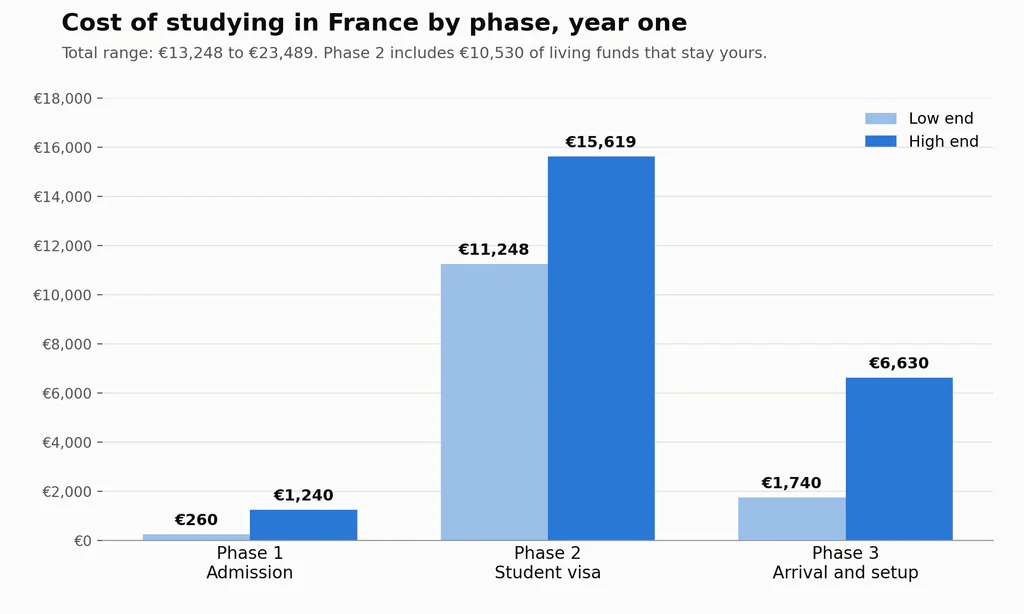
How to read that range
Very little of that range is money handed over to an authority. The €10,530 in living funds stays yours. That sum covers your rent, your food and your metro pass once you land, so avoid counting it a second time against the Phase 3 table. The €350 to €1,600 deposit comes back to you at the end of the tenancy, and tuition of €398 to €3,950 buys the diploma itself. Strip those three out and what actually vanishes into charges, tests, taxes, translations, bank margins, airfares and kitting out a flat sits between roughly €1,120 and €4,460.
Two caveats. Those tuition figures assume a public university, whereas private business schools and a good many engineering schools ask for €6,000 to upwards of €18,000 a year. The range also stops at twelve months. A second year means tuition again, the CVEC again, €150 for the permit renewal, and another round of evidence that you can pay for it.
Typical yearly tuition, level by level
National rates for the 2026 to 2027 year at public institutions supervised by the Ministry of Higher Education.
Sources: Campus France, tuition fees in France; Service Public, cost of enrolment, in French.
| Level of study | Yearly fee, students from outside the EU | Yearly fee, EU, EEA and Swiss students |
| Licence, BUT or licence professionnelle | €2,902 | €178 |
| Master | €3,950 | €255 |
| Doctorate | €398 | €397 |
| Engineering degree, most public schools | Check the school | €630 |
| Engineering degree, Écoles Centrales and Mines Nancy | Check the school | €2,620 |
| Private institutions, including business schools | €6,000 to €18,000 or more | €6,000 to €18,000 or more |
Read the doctorate row twice, because it is correct. Doctoral programmes fall outside the differentiated fee regime entirely, which leaves a non European PhD student paying the same €398 as a French one.
Settle these six points first
- Decide how you intend to stay on before you decide what to study. A general licence shuts the RECE route. A master or a licence professionnelle opens it, one time only.
- Check the deadline for your entry route today. A first year licence closes on 15 December, and there is no second round.
- Create the evidence trail before the first transfer leaves home. Files are rarely rejected because the savings were invented. They are rejected because nothing on paper explained where the balance came from.
- Assume you will pay the full differentiated tuition rate, because exemptions are capped at 30 percent per university and that cap keeps falling.
- Apply for the Visale guarantee early, and count the deposit plus the first month of rent as one payment, not two.
- Put the validation deadline in your calendar the day you land. Three months on the ANEF portal, €150, and missing it undoes everything the visa was for.
Read this page as background, not as immigration advice. France revised its study rules, its taxes and its money thresholds repeatedly through 2026, and further revisions are signalled, so check your own situation against France Visas, Service Public, campusfrance.org and the fee schedule of the institution you are applying to before any payment or appointment. Unlike several other destinations, France keeps no public register of immigration advisers. Giving paid legal advice on immigration is a regulated activity carried out mainly by an avocat enrolled at a French bar, and the Conseil National des Barreaux publishes a searchable national directory. Approved non profit associations advise foreign students free of charge, and the international office at your own institution is usually the quickest place to begin.