
Yes, a Kenyan student can get a 100% scholarship to study in the USA, but only through a few routes, and every one is competitive. The most realistic are:
- For a bachelor’s: need-based aid at the small group of wealthy universities that meet full need for international students, plus Kenyan programs that prepare and place top KCSE students.
- For a master’s: Fulbright, a few foundation programs and some university fellowships.
- For a PhD: a funded position, which is the most common full award of all.
This guide covers full scholarships in USA for Kenyan students route by route, including who qualifies and what a “full” award actually pays for. It’s part of our series on studying in the USA from Kenya. If you’re looking at loans instead, see our guide to student loans for Kenyans studying in the USA.
What does a “full scholarship” actually cover?
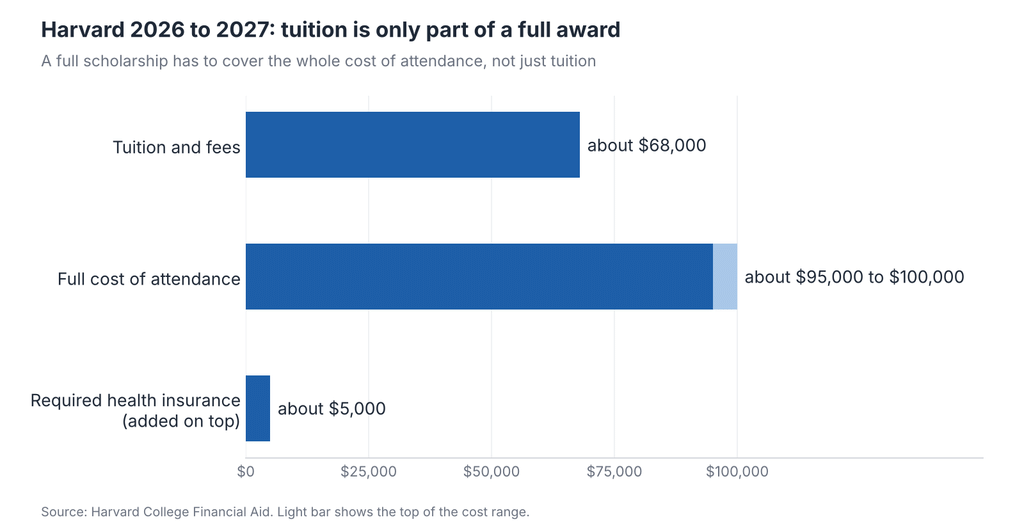
At the best US universities, a full award covers your whole cost of attendance, not just tuition. That matters, because tuition is only part of the bill. At Harvard, for example, the 2026 to 2027 cost of attendance is about $95,000 to $100,000, plus about $5,000 for required health insurance. Tuition and fees are about $68,000 of that.
A true full award normally pays for:
- Tuition and fees
- Housing and food on campus
- Books and personal costs
- Health insurance, at schools that include it
- Often a travel allowance for flights between Kenya and the US
Even then, two costs usually stay with you:
- A student contribution. Most need-based packages expect you to earn a few thousand dollars a year from a campus job.
- Getting there. Application and test fees, your passport, the $185 visa fee and the $350 SEVIS fee usually come before any aid is paid.
Watch out for “full tuition” awards. They cover tuition only, which can leave you $20,000 or more a year short, because housing, food and insurance are still yours to pay. That gap also matters at the visa interview, because you must show how you’ll pay the rest.
Which universities give full scholarships in USA for Kenyan students?
For a bachelor’s, ten US universities are both need-blind for international students and meet 100% of demonstrated need. Need-blind means asking for aid can’t hurt your chance of admission. Meeting full need means that if you get in, they cover whatever your family can’t pay.
| University | What its own page says | Good to know |
|---|---|---|
| Harvard | Need-blind, 100% need met, same aid for international students | Expected parent contribution is zero for families earning under $100,000 |
| Yale | Need-blind regardless of citizenship | Full need met |
| Princeton | Need-blind, full need met for international students | Princeton gives aid as grants, not loans |
| MIT | Need-blind and full need | Requires SAT or ACT scores |
| Amherst | Need-blind for international applicants, full need met | One of the few that also treats international transfers the same way |
| Dartmouth | Need-blind for international students, full need met | Need-blind for internationals since the Class of 2026 |
| Bowdoin | Need-blind, full need met without loans | Aid documents due within 7 days of admission. No aid for international transfers |
| Brown | Need-blind for international first-years from the Class of 2029 | Transfers are still need-aware |
| Notre Dame | Need-blind for international undergraduates | Meets full demonstrated need |
| Washington and Lee | Full need met through grants and work, no loans | About 44 first-years a year win the full-ride Johnson Scholarship |
Admission is the hard part. These are some of the hardest universities in the world to get into, and international applicants compete for a small number of places. Treat them as reach schools. We’d apply to a few and fill the rest of your list with universities that give merit awards.
Other universities that can fund a Kenyan undergraduate
Outside those ten, you have two more routes to a large or full award.
Need-aware universities that still meet full need
Many wealthy universities look at whether you need aid when deciding on your application, but cover your full need if they admit you. Johns Hopkins, for example, says it is need-aware for international aid applicants but meets 100% of demonstrated need for everyone it admits. Penn and Cornell say much the same. Smaller liberal arts colleges, such as Whitman and Denison, do too.
Asking for aid makes admission harder at these schools, but it doesn’t rule you out. You have to apply for aid when you apply for admission. Many of them won’t consider an international student for aid later if you didn’t ask at the start.
Merit scholarships
Some universities give awards for strong grades, whatever your family’s income. A few reach full tuition. George Washington University, for instance, considers every strong international first-year for a Presidential International Scholarship that can cover full tuition, with no separate form. Many state universities, such as Iowa State, give automatic merit awards based on your grades and test scores.
Merit awards rarely cover housing and food, so you’ll usually still need family money or other funding for the rest. Check exactly what each award pays before you rely on it.
Kenya-only routes to a full scholarship
These Kenyan programs don’t pay your fees themselves. They prepare strong students, often from poor families, and help them win full aid from US universities. For a bright student who can’t afford an agent or test fees, they’re the best start.
KenSAP (Kenya Scholar Access Program)
KenSAP picks top KCSE graduates low-income families and runs 15 weeks of residential training, mainly SAT preparation and help with US applications. It keeps supporting students after admission, including with immigration and travel. Media reports put the intake at about 20 students a year, chosen from the very top KCSE scorers. Check KenSAP’s own site for the application dates.
Equity Leaders Program
Equity Group Foundation invites top KCSE scorers, including Wings to Fly and Elimu alumni, into paid internships at Equity Bank. Interns who want to study abroad can join its college counseling program. By August 2025, the foundation said 1,098 of its scholars had won admission and full scholarships at global universities, 128 of them in that year’s cycle alone.
EducationUSA advising in Nairobi
EducationUSA, run with the US Embassy, gives free advice on US applications. In some years the embassy has also run an Opportunity Funds program that pays application, test, visa and travel costs for a small group of high-achieving, low-income students. Ask the EducationUSA center whether it’s running for your year.
Apply only through each program’s own website or office. If anyone asks for a fee for a place in KenSAP or a “guaranteed” US scholarship, walk away.
Full scholarships for a master’s degree
Full master’s funding is rarer than PhD funding, because most US master’s programs expect students to pay. These are the main full awards open to Kenyans.
Fulbright Foreign Student Program
Fulbright is the US government’s main scholarship for graduate study, and Kenyans apply through the US Embassy in Nairobi, not through a university. It usually covers tuition, living costs, travel and health insurance.
Two rules make it different. You study on a J-1 exchange visa, not an F-1. And because the US government funds it, you’re normally subject to a two-year home-country rule, so you must live in Kenya for two years in total before you can get most US work visas or a green card. Fulbright suits people who plan to come home.
Mastercard Foundation Scholars at UC Berkeley
Berkeley’s program now funds master’s students from Africa only. Through 2030, it plans to support more than 200 master’s students, inviting eligible applicants to apply after they apply for admission. Not every Berkeley master’s program is eligible, so check the list first. It doesn’t fund undergraduates or PhDs.
University fellowships and assistantships
Some master’s students win department fellowships or work as teaching or research assistants. These can come with a tuition waiver and a stipend, the same way PhD funding does. They’re more common in research-based master’s programs in science and engineering than in professional ones like business or data analytics. Ask each department directly whether master’s students can get assistantships, and how many do.
A funded PhD: the most common full award
In many US PhD programs, especially in science, engineering and some social sciences, most admitted students are fully funded. The funding usually has three parts:
- A tuition waiver, so you pay no tuition
- A stipend for living costs, paid for work as a teaching or research assistant, or as a fellowship
- Health insurance, fully or mostly paid
Stipends differ by university and city. The University of Arizona, for example, sets a 2026 to 2027 minimum of $25,654 for the academic year, or $33,350 for twelve months, and pays the student health insurance premium for its graduate assistants. Many programs pay more than their university’s minimum.
An assistantship is a job of about 20 hours a week, which is also the most F-1 students may work on campus during term. So the stipend is usually your only income. Check whether funding is guaranteed for all five or six years or only the first, and whether summer is paid.
An offer of admission with no funding is a warning sign at PhD level. It usually means the department didn’t rank you highly, and you’d need to show the full cost from your own money for the visa.
For working professionals: the Humphrey Fellowship
If you already have a career, the Hubert H. Humphrey Fellowship offers a fully funded year in the US, but no degree. It gives 10 months of non-degree graduate study and professional development to mid-career professionals from selected countries. You need a bachelor’s degree, at least five years of full-time work and little or no time in the US already.
You’re nominated through the US Embassy, and the deadline differs by country. Like Fulbright, it uses the J-1 visa. The program expects you to return home. Check with the embassy that Kenya is on this year’s country list. Choose it to grow in your current field. Don’t treat it as a route to a US degree or job.
Can HELB or county bursaries pay for US study?
Not in any useful way today. HELB’s undergraduate loans are for students admitted to universities in Kenya and the East African Community. The government talked in 2016 about opening HELB loans to Kenyans studying abroad, but there’s no clear HELB product for US study now. If you want to try, ask HELB directly and get any answer in writing.
County and CDF bursaries are usually small and aimed at local fees. Even when one helps, it won’t come close to a US bill. Where they can help is with the costs before you leave, such as test fees, a passport or the visa fee. Ask your county education office or your ward’s bursary committee what they’ll consider.
Using a scholarship for your visa, and spotting fakes
A scholarship counts as proof of funds
Your university uses your award to issue the I-20, the form you need for the visa. University aid is usually written straight onto the I-20. For an outside award, you’ll send the university an official letter on the sponsor’s letterhead that states the amount and how long it lasts. The University of Illinois, for example, asks organizations for a signed sponsorship letter detailing amounts and length of sponsorship.
If the award doesn’t cover the full cost on your I-20, you must show the rest in bank statements or sponsor letters. Take the award letter and your I-20 to the Nairobi interview, and be ready to explain who pays for what.
How to spot a scholarship scam
The US Federal Trade Commission warns that real scholarships never charge a fee to apply or to receive the money. Treat these as red flags:
- A “guaranteed” scholarship, or money back if you don’t win
- A processing, registration or “tax” fee before the award is paid
- A message saying you’ve won something you never applied for
- Requests for your bank or M-Pesa details to “hold” an award
- A full scholarship offered before you’ve been admitted to any university
Check any offer on the sponsor’s or university’s own website, or ask EducationUSA in Nairobi before you pay anyone.
Scholarship calendar for a 2027 or 2028 start
Most full awards are decided with your admission, so the aid deadline is usually the same as, or a few weeks after, the application deadline. Use this as a planning guide and confirm exact dates on each official page.
| When | Bachelor’s | Master’s and PhD |
|---|---|---|
| January to March | Apply to KenSAP after KCSE results. Top scorers may be invited into the Equity program | Research programs and professors. Ask about Fulbright’s next cycle at the US Embassy |
| April to August | Prepare for the SAT if needed, and draft essays | Take the GRE or GMAT if needed. Draft your statement of purpose |
| October | Most financial aid forms, such as the CSS Profile, open | Request references and transcripts |
| November | Early deadlines, usually November 1 to 15, with aid forms due soon after | Some PhD and fellowship deadlines start, and Berkeley’s admissions dates also set the Mastercard timing |
| December to January | Regular deadlines, usually January 1 to 15 | Most PhD and many master’s deadlines |
| March to April | Universities send decisions and aid offers | Departments send funding offers. Compare stipends and length of funding |
| May 1 | Usual deadline to accept a first-year offer | April 15 is a common date to accept graduate funding |
Frequently asked questions
Where do I apply for full scholarships in USA for Kenyan students?
There’s no single application. For a bachelor’s, you ask each university for need-based aid when you apply for admission. Fulbright goes through the US Embassy in Nairobi, and a funded PhD comes from the department that admits you. If you’re a top KCSE scorer, apply to KenSAP too.
What KCSE grade do I need for a full scholarship?
There’s no fixed grade, but the full-need universities and programs like KenSAP draw from the very top of KCSE, usually A or A-. Merit awards at less selective universities can start lower. West Virginia, for example, lists B+ as its KCSE minimum for scholarships.
Is a full scholarship the same as a full ride?
People use “full ride” for an award that covers everything, not just tuition. That includes housing and food. “Full tuition” covers only tuition. Always read what the award letter actually lists.
Can I get a scholarship after I arrive in the US?
It’s hard. Many universities only consider international students for aid if they asked when they applied, and most scholarships are decided before you get your I-20. Plan to have your funding fixed before you travel.
Do I have to repay a US scholarship?
No. Grants and scholarships aren’t repaid. A loan is, so check that your aid package doesn’t include loans. Some awards, like Fulbright, come with a duty to return to Kenya instead.
Are scholarships for Kenyan students taxed in the US?
Sometimes. US tax rules can treat the part of a scholarship that pays for housing and food as taxable income, and Kenya has no US tax treaty to reduce that. Ask your university’s international office how it handles this for your award.
Is ISP or the Kenya Airlift a scholarship?
No. It’s a paid program that helps with admissions and loan applications. Read the loans guide linked at the top of this page before you pay any fee.
More guides in this series
- Study in the USA from Kenya: the complete guide
- KCSE and Kenyan degree requirements for US universities
- Student loans to study in the USA from Kenya
- F-1 visa interview in Nairobi: questions and denial reasons
- OPT for international students: working in the USA after graduation
- Best courses to study in the USA for international students
This guide gives general information for Kenyan students. Scholarship rules, amounts and deadlines change every year, so confirm everything on the official page before you apply, and never pay anyone to “guarantee” a scholarship.