
Yes, you can find student loans to study in USA from Kenya, but the options are narrower and more expensive than most guides admit. US government loans are closed to you, the best-known no-cosigner lender has paused new loans, and with any dollar loan, a family earning in shillings takes on exchange-rate risk.
In practice, Kenyans fund US study with a loan in one of four ways:
- A no-cosigner loan from an international lender, mainly for master’s students
- A Kenyan bank or SACCO loan, usually against land, a salary or a fixed deposit
- A US private loan with a US citizen or permanent resident as cosigner
- A paid program such as the International Scholars Program, which helps you apply for loans and admission
This is part of our series on studying in the USA from Kenya. Before borrowing, look at full scholarships for Kenyan students, since scholarship money never has to be repaid.
Why US government loans aren’t an option
US federal student loans are only for US citizens and certain eligible non-citizens, such as green card holders and refugees. Students on F-1 or J-1 visas don’t qualify. The University of Washington, for example, says students on F-1, F-2, J-1, J-2 and G visas are not eligible for federal student aid and must show they can cover their costs.
US private loans need a US cosigner
US banks and private lenders will lend to international students, but almost always only with a cosigner who is a US citizen or permanent resident with good US credit. The University of Massachusetts tells international students they can apply for an alternative loan if they can get a US citizen or permanent resident cosigner.
This can work if you have a close relative settled in the US. Make sure they understand that they’re fully liable if you can’t pay, including if you have to leave the US before you find work.
No-cosigner student loans to study in USA from Kenya
MPOWER Financing and Prodigy Finance both built their business on international students without a US cosigner. Both are useful, but neither is a simple answer for Kenyans in 2027.
| MPOWER Financing | Prodigy Finance | |
|---|---|---|
| Status now | Paused new loans for 2026, waitlist only | Lending, but can’t support some schools for the Fall 2026 intake |
| Who it lends to | Bachelor’s students in their last 24 months, and master’s students in their last 30 months | Master’s students only |
| Amount | $2,001 to $100,000 in total | Set by your program’s cost, at listed schools only |
| Interest | Fixed, from 9.99% (10.89% APR) with autopay | Variable. Its own example shows 13.26% APR |
| Fees and in-school payments | Interest-only payments while studying | A 4.2% admin fee added to the loan, a $500 processing fee and $100 a month while studying |
What this means if you’re Kenyan
- First-year undergraduates can’t use either. MPOWER only lends in the last two years of a bachelor’s degree, and Prodigy doesn’t lend for bachelor’s degrees at all. So neither can fund the start of a US bachelor’s.
- Only some schools qualify. Both lend only for programs on their lists, so check your exact program before you apply to a university.
- The cost is high. Prodigy’s own example of a $40,000 loan over 15 years shows total repayments of about $116,600, nearly three times what was borrowed.
MPOWER also partnered with Ecobank in 2024 so Ecobank customers in Africa can start an MPOWER application through Ecobank’s digital banking. If MPOWER reopens, check its school list and terms again. Until then, don’t build a plan around a lender that isn’t lending.
Kenyan bank and SACCO loans
For many Kenyan families, the realistic loan is a local one, taken by a parent rather than the student. Banks and SACCOs lend in shillings against something they can recover: land, a salary, a fixed deposit or your savings with the SACCO.
Bank education loans
A few Kenyan banks have loans for study abroad. Bank of Baroda (Kenya), for example, offers an education loan for study in Kenya or abroad that covers up to 80% of costs, with a limit of KSh 10 million and up to 10 years to repay. Others lend through general personal, salary or property-backed loans instead of a named education product.
KSh 10 million is about $77,000, which would cover one or two years at many US universities, not a whole degree. Ask every bank what security it needs, whether the rate can change, and whether repayments start straight away or after you graduate.
SACCO loans
SACCOs usually tie loans to how much a member has saved and to guarantors from the same SACCO. They can be cheaper than bank loans and quicker to arrange. But SACCOs size them for Kenyan costs, so they rarely cover more than part of a US year. If guarantors sign for you, their own savings are at risk if repayments stop.
Secured or unsecured?
Secured loans, backed by a title deed or deposit, are larger and cheaper, but the family can lose the asset if it stops paying. Unsecured loans, backed only by a salary or guarantors, are smaller and cost more. Whichever you choose, your parents usually pay every repayment while you’re studying, since F-1 students can only work limited hours on campus.
How the International Scholars Program (Kenya Airlift) works
The International Scholars Program, also known as the Kenya Airlift Program, is a paid program, not a scholarship and not a lender. It helps Kenyan graduates apply for US master’s programs, then helps them apply to outside lenders for loans to pay for them. Its own SACCO, The Airlift Sacco, can finance relocation costs for some students.
Two options
The program runs a regular and a parallel option. The regular option is for stronger applicants and needs a GMAT or GRE score. The parallel option doesn’t require the test, but some parallel students are only admitted on condition they bring a cosigner. The program’s parallel option onboarding agreement sets out these rules:
- Parallel students need a GMAT score of 550 or GRE score of 310 to move to the regular option, with two attempts paid by the student.
- Students who joined with a cosigner because their GPA was below 3.0 can’t take the test to switch.
- The Airlift Sacco won’t fund relocation costs for parallel students. They pay those themselves.
Fees you won’t get back
The agreement lists three fees that aren’t refunded if you leave the program for any reason:
| Fee | Amount |
|---|---|
| SACCO registration | $100 |
| Initial consultation | $1,000 |
| Final consultation, if your visa is issued | $500 |
The program also charges a penalty of at least $30 on late payments under the plan in the program handbook.
What it doesn’t guarantee
The agreement says joining doesn’t guarantee a US visa, passing the GMAT or GRE, admission to the university you want, a student loan, a scholarship or assistantship, or a job after graduation.
The cosigner rule
If you’re a parallel student who needs a cosigner and your cosigner refuses to sign or fails the lender’s credit check, you’re withdrawn from the program and lose the fees above. Before you pay anything, make sure your cosigner has agreed in writing and knows what the lender will check.
Where the loan money comes from
The program itself doesn’t lend for tuition. The money comes from outside lenders, and MPOWER has been described as its lending partner. Since MPOWER has paused new loans for 2026, ask the program in writing which lender would fund you this year, and on what terms, before you pay the $1,000 consultation fee.
Questions to ask before you pay any program or lender
Get the answers to these in writing and keep them. A genuine program or lender will reply clearly.
☐ Which lender will actually fund your loan this year, and is it lending to Kenyans now?
☐ Does the lender cover your exact university and program?
☐ What’s the interest rate, is it fixed or variable, and what’s the total you’ll repay?
☐ What fees are added to the loan, and what do you pay upfront?
☐ Do you pay anything while you’re studying?
☐ Which of your fees are refundable, and when?
☐ What happens to your money if you’re refused admission, a loan or a visa?
☐ Does your cosigner need US credit, and what exactly will they be checked on?
☐ Will the loan letter be ready in time for your I-20 and visa interview?
☐ What happens to repayments if you can’t find work in the US after graduating?
Be careful with any offer that promises a visa, admission or a loan, or that asks you to pay before telling you which lender is involved.
Using a loan as proof of funds for your visa
A loan can count toward the money you show for your I-20 and visa, but only once it’s actually approved. The University of Illinois, for example, accepts student loans that are “fully sanctioned” but not ones approved only in principle, and won’t accept land deeds as proof of funds at all.
So plan around these points:
- Get the final approval letter early. A pre-approval or a “you qualify” email usually isn’t enough for the university.
- Turn land into cash or a loan. A title deed alone isn’t proof of funds. If the plan is to borrow against land or sell it, finish that and show the money or the approved loan.
- Match every figure. The amounts on your I-20, loan letter and bank statements should line up.
- Be ready to explain it. At the Nairobi interview, you may be asked who pays, how the loan will be repaid and what you’ll do after your degree.
Keep the plan simple enough that you can explain it yourself. Know your own numbers, not just your agent’s.
The exchange-rate risk, in shillings
A dollar loan has to be repaid in dollars. If you come home and earn in shillings, or your parents repay, every fall in the shilling makes the loan more expensive.
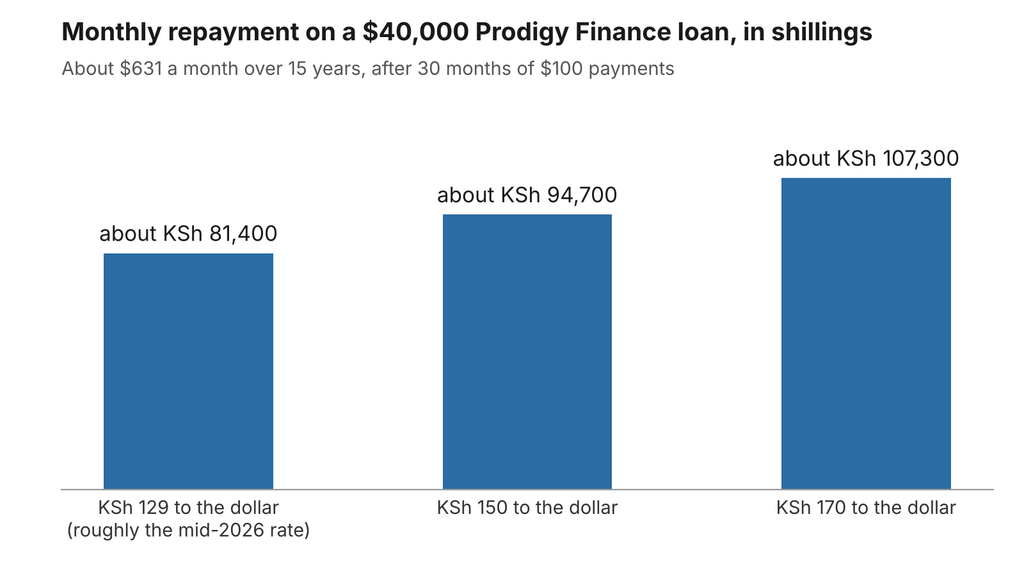
Take Prodigy Finance’s own example: a $40,000 loan repaid over 15 years at about $631 a month, after 30 months of $100 payments. At three exchange rates, that monthly payment costs this much in shillings:
| Exchange rate | Monthly repayment in KSh | Total over 15 years in KSh |
|---|---|---|
| KSh 129 to the dollar, roughly the mid-2026 rate | about 81,400 | about 14.7 million |
| KSh 150 to the dollar | about 94,700 | about 17.0 million |
| KSh 170 to the dollar | about 107,300 | about 19.3 million |
That’s before the in-school payments and fees.
When a dollar loan makes sense
A dollar loan is easiest to repay if you earn in dollars, which usually means working in the US after graduating. That depends on OPT, which lasts 12 months or up to 36 for STEM degrees, and then on winning an H-1B work visa or another route. Both have become less certain, so read our guide to working in the USA after graduation before you borrow on the assumption of a US job.
We’d only borrow what you could still repay if you had to come home and work in Kenya.
Frequently asked questions
Can I get student loans to study in USA from Kenya without a cosigner?
Only from a few specialist lenders, and in 2026 the choice is thin. MPOWER has paused new loans, and Prodigy lends only for master’s programs at schools on its list. Check directly with each lender whether it’s lending to Kenyans for your program this year.
Can I get a loan for a US bachelor’s degree?
It’s hard. Neither main no-cosigner lender funds the first two years of a bachelor’s. Most families use savings, a Kenyan bank or SACCO loan, or a US cosigner, and many students look for scholarships or start at a cheaper community college.
Does HELB lend for US study?
Not in any clear way today. HELB’s loans are for Kenyan and East African universities. The scholarships guide linked at the top of this page covers what local funding can help with.
Is the International Scholars Program a scam?
It’s a real program, but it’s a paid service, not a scholarship. Its own agreement says it doesn’t guarantee a visa, admission, a loan or a job, and several of its fees aren’t refundable. Read the agreement in full before you pay.
Can I repay a US loan from Kenya?
Yes, but you’ll pay in dollars, so your cost in shillings rises if the shilling weakens. Most lenders also expect regular payments whether or not you’ve found work.
Will a loan hurt my visa chances?
A properly approved loan is accepted proof of funds. Problems come from vague plans, unapproved loans or figures that don’t match. Make sure you can explain how the loan will be repaid.
More guides in this series
- Study in the USA from Kenya: the complete guide
- KCSE and Kenyan degree requirements for US universities
- Full scholarships in the USA for Kenyan students
- F-1 visa interview in Nairobi: questions and denial reasons
- OPT for international students: working in the USA after graduation
- Best courses to study in the USA for international students
This guide is general information, not financial advice. Loan terms change often, so confirm every rate, fee and condition with the lender or program in writing before you sign, and consider speaking to an independent financial adviser.