
More Kenyans now study in the US than at any point in the last ten years. The Institute of International Education counted 5,337 Kenyan students at US colleges in 2024/25, up from 4,507 a year earlier, and almost half of them were undergraduates.
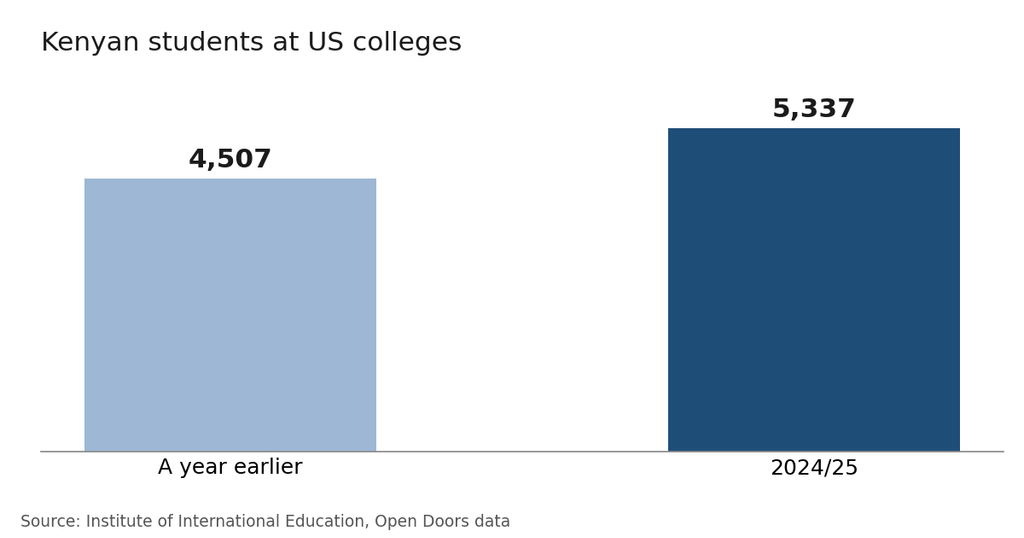
Kenyan students at US colleges, 2024/25 and a year earlier.
Guides in this series
- KCSE and Kenyan degree requirements for US universities
- Full scholarships in the USA for Kenyan students
- Student loans to study in the USA from Kenya
- F-1 visa interview in Nairobi: questions and denial reasons
- OPT for international students: working in the USA after graduation
- Best courses to study in the USA for international students
- Cost of studying in the USA
The rules for studying in the US changed fast in 2025 and 2026. Almost every student now has to attend an in-person interview, and officers check social media. A federal court has paused a rule that would have capped student stays at four years. The government has also proposed making schools pay $70,000 before a student can start the work year after graduation. Most guides on “study in USA from Kenya” were written before these changes, so this one starts from where things stand in October 2026.
This guide is for Kenyan students and parents planning a bachelor’s, master’s or PhD in the US. It covers entry grades with KCSE or a Kenyan degree, full scholarships and loans, the F-1 visa at the US Embassy in Nairobi, work during and after study and what a US degree is worth back home. Each topic has a deeper article in this series, linked as you go.
Kenya to the USA at a glance
| What you need to know | The answer for Kenyans |
|---|---|
| Visa you need | F-1 student visa, applied for at the US Embassy in Gigiri, Nairobi |
| Visa application fee | $185, not refunded even if you’re refused |
| SEVIS fee | $350. Kenyans can’t pay it by credit card, so they use Western Union or a check |
| How long a Kenyan F-1 visa lasts | Up to 60 months with multiple entries and no issuance fee |
| Travel ban | Kenya isn’t on the list. Neighboring Tanzania is |
| Visa bond | Doesn’t apply to students. Kenya isn’t on the visitor visa bond list |
| Entry grade for a bachelor’s | Often a KCSE C+ or better, with no foundation year |
| Work while studying | Up to 20 hours a week on campus during term |
| Work after graduating | 12 months of Optional Practical Training (OPT), plus 24 more months for approved STEM degrees |
| Health screening | Many universities require a TB test from students born in Kenya |
| Full cost of year one | About $35,800 to $117,200, depending on the school |
What are the requirements to study in the USA from Kenya?
The US has no national entry grade. Each university sets its own, and many publish a page just for Kenyan applicants. The big difference from the UK is that a good KCSE result can take you straight into year one of a bachelor’s degree, with no foundation year first.
Bachelor’s degree with KCSE
Most universities convert your KCSE grades into a US grade point average (GPA) and read them alongside your essays and teacher letters. Minimums vary a lot:
- West Virginia University lists C+ as its KCSE admission minimum and B+ for scholarships.
- Western Kentucky University asks for a KCSE C+ in academic subjects for first-year students.
- The University of Northern Iowa asks for a B (8 points) and an English test score, though it may admit strong students on condition that they take English classes when they arrive.
The most selective universities, the ones that give full scholarships, expect A or A minus results plus strong essays and activities. Many universities no longer require the SAT, but a good score can still help with scholarships.
A note for younger readers. Kenya is moving from KCSE to the Competency-Based Curriculum, and the first CBC cohort finishes Grade 12 in 2028. US universities haven’t yet published how they’ll read the new Grade 12 results, so ask each admissions office directly if you’re in that group.
Master’s degree with a Kenyan bachelor’s
A four-year Kenyan bachelor’s degree is usually accepted as equal to a US bachelor’s. For full admission, the University of Illinois asks Kenyan graduate applicants for a Second Class Upper or a 60% average, and it doesn’t ask for an English test score from applicants with a Kenyan degree earned in the last five years. Many universities take a Second Class Lower for some programs, especially if you have work experience, so check each program’s page before you rule yourself out.
PhD
Most US PhDs admit you straight from a bachelor’s or a master’s degree, and many pay you. Strong programs usually offer a tuition waiver plus a monthly stipend in return for teaching or research work. That’s why a funded PhD is often the most realistic “full scholarship” for Kenyan graduates.
English
There’s no single rule. Some universities, like West Virginia, accept Kenyan citizenship as proof of English. Others ask everyone from Kenya for TOEFL, IELTS or Duolingo. Book a test only after you’ve checked each school’s own page.
Our guide to KCSE and Kenyan degree requirements for US universities has university-by-university minimums, the KCSE-to-GPA conversion and what to do with a lost KCSE certificate.
When are the US intakes, and which suits a KCSE candidate?
US universities have two main intakes: fall, which starts in August or September, and spring, which starts in January. Fall is the main one, with the most courses and almost all the scholarship money.
The timing is awkward for KCSE students. Kenya’s Education Ministry released the 2025 KCSE results on January 9, 2026, while many US deadlines for an August start fall between November and mid-January. Loyola University Maryland, for example, closes early applications on November 15 and regular applications on January 15, with a spring deadline of October 15.
So most Kenyan applicants either apply in Form Four using their school results and send KCSE later, or wait a year and apply with KCSE results in hand. The second route is common for students aiming at full scholarships, because it gives time for tests, essays and an early application.
Timeline for a student sitting KCSE in November 2026
| When | What to do |
|---|---|
| June to September 2026 | Shortlist universities, check each one’s Kenya page, book any English test or SAT |
| September to October 2026 | Write essays, ask teachers for letters, prepare a parent’s bank statements |
| November 1 to 15, 2026 | Early deadlines at many universities, using Form Three and Four results |
| November 2026 | Sit KCSE |
| Mid-January 2027 | KCSE results out. Send them to every university you applied to |
| January 15, 2027 | Common regular deadline for an August 2027 start |
| March to April 2027 | Admission and scholarship decisions arrive |
| May 1, 2027 | Usual deadline to accept an offer and pay a deposit |
| May to June 2027 | Receive your Form I-20, pay the SEVIS fee, book your visa interview |
| July 2027 | Visa interview in Nairobi |
| August 2027 | Classes start. You can enter the US up to 30 days before your start date |
Spring entry works for some students who miss the fall round, but fewer universities offer it to first-year students, and scholarships are scarcer.
How do I apply to US universities from Kenya?
You apply to each university directly. No Kenyan body comes between you and the school, and you don’t need a government letter before you apply. Here is the order most Kenyan applicants follow.
- Check the school is allowed to take international students. Only schools on the Study in the States school search list can issue the Form I-20 you need for a visa. If a college isn’t there, stop.
- Apply online. Many universities use the Common App, a single form you can send to several schools. Others use their own portal. Application fees are usually charged per school, and some schools waive them for students who can’t pay.
- Send your academic records. That means your KCSE certificate or result slip, school transcripts and university transcripts if you’re applying for a master’s. Some schools also ask for a credential evaluation, a report from a US agency that converts your grades.
- Add essays, letters and test scores. Most schools want a personal essay, one or two teacher or lecturer letters and an English score if you aren’t exempt.
- Show how you’ll pay. Many schools ask for a parent’s bank statement or a sponsor letter with the application, not just after you’re admitted. Our cost guide explains what counts.
- Accept an offer and pay the deposit. Once you accept, the school issues your Form I-20, and you can start the visa process.
Can I get my deposit back if my visa is refused?
Sometimes, but only if the school’s policy allows it. Montclair State University, for example, charges a $1,000 deposit that it refunds after a visa refusal if you used its I-20 and paid the SEVIS fee, as long as you ask before its add/drop deadline. Other schools keep part or all of it. Read the refund rules before you pay, and keep your refusal letter.
Free help in Nairobi
The US State Department funds an EducationUSA advising center in Nairobi that offers advising appointments, group sessions and student memberships. It’s the official place to ask about schools, tests and scholarships, and it doesn’t charge commission the way some agents do.
How much does it cost to study in USA from Kenya?
A first year in the US costs roughly $35,800 to $117,200 once you add tuition, living costs, health insurance, visa fees and setup costs. That’s about KSh 4.7 million to KSh 15.2 million at the Central Bank of Kenya’s indicative rate of around KSh 130 to the dollar. The range is wide because tuition alone costs from about $11,700 at a community college to $68,600 at a private university.
We’ve broken every figure down by phase, with a calculator, in our guide to the cost of studying in the USA. Here we cover only the costs that differ for Kenyans.
Costs only a Kenyan applicant pays
| Item | Cost | Notes |
|---|---|---|
| Kenyan passport | KSh 7,550 to 12,050 | The Directorate of Immigration’s service charter lists 34 to 66 pages and 14 working days |
| US visa application fee | $185 (about KSh 24,000) | Paid before you book the interview |
| SEVIS fee | $350 (about KSh 45,500) | Card payments aren’t accepted for Kenyan students, so pay through Western Union Quick Pay, a money order or a check drawn on a US bank |
| Travel to Nairobi | Varies | The embassy in Gigiri is the only place in Kenya that interviews student visa applicants |
| KNEC certification letter | Varies | Only if your KCSE certificate is lost, since KNEC issues a letter instead of a new certificate |
| TB test | Varies | Some universities want it done before you arrive, others test you on campus |
Paying fees from Kenya
Most US universities don’t want you to wire money straight into their bank account. The University of Rochester, for example, says it can’t accept direct wire payments and asks international families to pay through a payment platform instead. Your school’s billing office will tell you which one it uses.
Kenyan families should watch for three things. First, the shilling can move between the day you’re admitted and the day you pay, so a budget made in shillings in January can fall short by August. Second, banks set daily and yearly limits on large foreign transfers, so ask yours early. Third, keep every transfer receipt, because the visa officer may ask where the money came from.
When you send money from Kenya, also compare the full cost of each transfer, including the exchange rate, not just the fee.
Scammers target international students with fake fee demands. Only pay through the methods listed on your university’s own website.
Can I get a 100% scholarship to study in the USA?
Yes, but only a small number of Kenyans get one each year, and almost all of them plan for it at least a year ahead. US government student aid isn’t open to international students, so full funding comes from universities themselves or from a few private programs.
By level of study
- Bachelor’s. The best chance of a full ride is at the handful of universities that admit international students without looking at their ability to pay and then meet their full financial need. Dartmouth, for example, extended this need-blind policy to all international citizens from the Class of 2026 and includes a travel allowance. Admission at these schools is extremely competitive, and most applicants need an A or A minus. Other universities offer partial merit scholarships for B+ and above.
- Master’s. Full scholarships are rarer. The main routes are government awards such as Fulbright, university fellowships and graduate assistant jobs that cover tuition. The Mastercard Foundation’s program at UC Berkeley now funds master’s students only, not PhDs.
- PhD. This is the level where full funding is most common, through a tuition waiver and a monthly stipend for teaching or research.
Routes just for Kenyans
- Kenya Scholar Access Program (KenSAP). Each year it picks 15 to 20 high-achieving KCSE graduates with financial need and trains them for 15 weeks for the SAT and US applications.
- Equity Leaders Program. Top KCSE scholars join a paid internship and get college counseling. By August 2025, the program said 1,098 of its scholars had won admission and full scholarships at global universities.
- EducationUSA in Nairobi. Its Opportunity Funds program helps strong students who need money for the upfront costs of applying, such as tests and fees.
Does a full scholarship cover living costs?
Often, but not always in full. Need-based aid at the richest universities usually covers tuition, housing and meals, and some add travel. Many still expect you to cover part of the cost through work. Dartmouth, for instance, builds in about $2,450 a year from term-time work and a $1,500 summer work contribution after year one. Read every award letter for health insurance, flights, books and summer housing.
Don’t plan on Higher Education Loans Board (HELB) loans or county bursaries covering US study unless they confirm it in writing.
For every award by level, deadlines and how to write a need-based aid application with farm, business or chama income, read our guide to full scholarships in the USA for Kenyan students.
Can I get a loan to study in the USA from Kenya?
Yes, but your choices are narrow. Kenyans can’t borrow from the US government’s student loan programs, so the options are Kenyan banks and SACCOs, which usually want collateral, and a few US lenders that lend to international students against their future earnings.
Unsecured loans, with no collateral or cosigner
MPOWER Financing is the best-known lender of this kind for Kenyans. Its Kenya page says Kenyan students can borrow up to $100,000 in total with no cosigner or collateral at approved US and Canadian schools, with rates from 9.99%. The same page also says it has reached its funding limit and isn’t offering new loans for 2026, only a waitlist. That shows how fragile this route is, so never build your whole plan on one lender.
A loan approval letter can count as proof of funds for your Form I-20 and your visa interview, as long as it names you, your school and the amount.
What is the International Scholars Program (Kenya Airlift)?
It’s a paid program that helps Kenyan graduates apply for US master’s degrees and find loans from outside lenders. It isn’t a scholarship, and its own agreement says so clearly. The parallel option onboarding agreement on its website says that:
- joining doesn’t guarantee a visa, admission, a loan, a scholarship or a job
- fees of $100 for SACCO registration, $1,000 for the first consultation and $500 if a visa is issued aren’t refunded if you leave
- a parallel option student whose cosigner refuses to sign, or fails the lender’s credit check, is withdrawn without a refund of those fees
- parallel option students don’t get relocation financing from the program’s SACCO
Before you pay, read the full agreement for your option, compare its fees with what EducationUSA offers free, and ask which lender will make the loan.
Our guide to student loans to study in the USA from Kenya covers lender terms, Kenyan bank and SACCO loans and what to ask any loan program before you pay.
Is the community college route cheaper?
Usually, yes. A community college is a two-year public college, and many accept international students on an F-1 visa. You study the first two years of a bachelor’s there, earn an associate degree, then transfer to a university for the last two years. This is often called the 2+2 route.
In our cost guide, a year’s tuition at Santa Monica College came to about $11,700, against $43,000 or more at a large public university. Entry requirements are also usually lower than at universities.
Some colleges make the move to a university simpler. Seattle Colleges, for example, says its international students are guaranteed conditional admission to up to two universities and can still apply anywhere else.
There are trade-offs to weigh first:
- Scholarships for community college students are small, and few cover living costs.
- Some programs, like nursing, may not be open to F-1 students at a given college.
- Work time after study is counted by level of study, so ask the school how its associate degree affects your OPT before you enroll.
- Some visa officers ask why you chose a community college, so be ready to explain your transfer plan clearly.
Can I get a US-accredited degree without leaving Kenya?
Yes. United States International University Africa (USIU-Africa) in Nairobi is accredited by both Kenya’s Commission for University Education and the WASC Senior College and University Commission (WSCUC), one of the US bodies that accredits Stanford and the University of California. The university says it’s the only WSCUC-accredited university in Africa.
That has two advantages: you pay Kenyan fees and can live at home, and credits from an accredited university are easier to transfer if you later move to a US university.
Online degrees from US universities are the other option. You need no visa while you study from Kenya. But if the program asks you to spend any time on its US campus, the State Department says you must get a student visa for that part, because study toward a US degree isn’t allowed on a visitor visa.
The trade-off is that studying in Kenya, at USIU-Africa or online, doesn’t give you an F-1 visa or OPT work time in the US. It suits students who want a US-style degree without the US cost, not those who want US work experience.
How do I choose a genuine agent in Kenya?
You don’t need an agent to apply to a US university. You apply to the school yourself, and EducationUSA in Nairobi gives free advice. If you still use an agent, check these four things before you pay.
- The school is real and certified. Search it on the federal school list. An agent who pushes a college that isn’t listed is wasting your money.
- Your I-20 comes from the school. Only a school’s own international office issues a Form I-20, and it’s linked to your record in a federal database. Never accept an I-20 from an agent who “processed” it.
- Fees are paid to the right place. Pay tuition and deposits only through the school’s own payment page. Pay the SEVIS fee only on FMJfee.com, which the Department of Homeland Security calls the only federal website certified to collect it.
- Nobody can guarantee a visa. Only a consular officer decides. A “guaranteed visa” promise is a warning sign, and so is anyone who offers to fake bank statements or documents. Fraud can lead to a permanent refusal.
In the US, only licensed lawyers and people on the Justice Department’s list of recognized organizations and accredited representatives may give immigration advice. A Kenyan agent can help with applications, but they aren’t immigration advisers.
How does the F-1 visa process work in Nairobi?
Once your school sends your Form I-20, you apply for an F-1 visa at the US Embassy on United Nations Avenue in Gigiri, Nairobi. It’s the only place in Kenya that interviews visa applicants.
The steps in order
- Fill in Form I-901 online and pay the $350 SEVIS fee at least three working days before your interview. Kenyans can’t pay this fee by card, so pay with the Western Union coupon the form gives you, or by money order or US-bank check.
- Fill in the online visa form (the DS-160) and upload your photo.
- Pay the $185 visa application fee and book your interview.
- Set your social media accounts to public. The State Department tells all F, M and J applicants to set every social media profile to “public” or “open” so officers can review them.
- Attend the interview with your passport, I-20, DS-160 page, fee receipt, academic papers and proof of funds.
- If you’re approved, you get your passport back with the visa inside, usually within days. Some cases go into extra checks first.
Almost everyone now has to attend in person. Since October 1, 2025, the State Department has said that all visa applicants, including children under 14, generally need an in-person interview, with only narrow exceptions that don’t cover students. Book as early as you can, since you can get a student visa up to 365 days before your course starts.
Is Kenya on the travel ban or visa bond list?
No. This confuses many Kenyans because two neighboring countries, Tanzania and Uganda, appear on one or both of these lists. The presidential proclamation that took effect on January 1, 2026 suspends student visas for nationals of 38 countries and Palestinian Authority travel documents. Tanzania is on that list. Kenya isn’t.
The visa bond is a separate rule that makes some visitors pay up to $15,000 before getting a tourist visa. It covers only B-1/B-2 visitor visas, not student visas, and Uganda and Tanzania are on the list while Kenya isn’t. This matters for families too, because parents visiting for a graduation use visitor visas.
If you’re from another country but live in Kenya, you can apply in Nairobi, but you need to be able to prove you live in Kenya. Your nationality, not where you live, decides whether the travel ban applies to you.
How many Kenyan student visas get refused?
The exact figure isn’t public. The department publishes refusal rates by nationality only for visitor visas. For Kenya, its adjusted refusal rate for B visas in 2025 was 68.23%. The high F-1 refusal rates for Kenya that circulate online, such as 74%, come from private analyses, not from an official published rate.
One of the most common grounds for refusal is section 214(b) of US immigration law. The State Department explains that a 214(b) refusal means you didn’t show you qualify for the visa, or didn’t show strong ties, such as a job, a home or family, that will take you back home. It isn’t permanent, and you can reapply once your circumstances or evidence change, but the $185 fee isn’t refunded.
For interview questions, Kenyan proof of funds and the most common reasons for refusal at the Nairobi embassy, read our guide to the F-1 visa interview and denial reasons in Nairobi.
How many years does the USA give for a student visa?
Two different things control your time in the US, and mixing them up can put your status at risk.
The visa in your passport. For Kenyans, an F-1 visa can be valid for up to 60 months with multiple entries, as shown in the table at the top of this guide. That date only decides how long you can use the visa to travel to the US. It doesn’t decide how long you may stay.
Your permission to stay. When you land, a border officer admits you and creates an arrival record called the I-94. Right now F-1 students are admitted for “duration of status”, which means you may stay as long as you’re a full-time student or in approved work training, plus 60 days to leave or start the next step. Your visa can even expire while you’re in the US, as long as you keep your status. You’d only need a new visa if you leave and want to come back.
The four-year rule, and why it’s on hold
On July 17, 2026, the Department of Homeland Security published a final rule to end duration of status. Under it, students would be admitted only until the end date on their I-20, up to a maximum of four years, with 30 days to leave instead of 60. Anyone needing longer, such as a PhD student, would have to apply for an extension.
The rule would also limit changes. Undergraduates couldn’t change their major or transfer in their first year. Graduate students couldn’t change their major at all. And after finishing one degree, you could only start another at a higher level.
It was due to start on September 15, 2026, but a federal court in Massachusetts put it on hold the day before, so duration of status still applies for now. The case isn’t over and the government can appeal, so plan as if the rule could return.
Moving from one degree to the next
Under the current rules, you can move up from a bachelor’s to a master’s, or a master’s to a PhD, by getting a new I-20 from your next school, without going home in between. The same visa can still be used for travel if it hasn’t expired.
Before you fly: health forms, TB tests and vaccines
US universities, not the visa, decide most health checks. The one Kenyans are most likely to meet is TB screening, because Kenya is on the high-incidence list most universities use.
- TB tests. The University of North Carolina lists Kenya among the countries whose students must show a TB test done within 12 months before classes start, and accepts a skin test only if it was done in the US. Texas A&M accepts only a TB blood test, done within six months of the semester, and a past BCG vaccine doesn’t excuse you. Some schools block class registration until you’re cleared. Read your own school’s health page before you book a test in Nairobi.
- Vaccines. Many universities ask for proof of shots such as measles, mumps and rubella. Bring your vaccination card. The University of New Mexico notes that any missing dose can be given in the US.
- Health insurance from day one. The University of New Mexico also says international students must have health insurance for their whole stay, even before classes begin. If your school’s plan starts later, buy short-term insurance for the gap.
- Ebola checks. Kenya confirmed Ebola cases in October 2026, and the State Department raised its Kenya travel advisory to Level 3. From November 3, 2026, airlines will also ask every passenger flying to the US to confirm they haven’t been in DR Congo in the previous 21 days. Check your airline and your school for any new health rules before you fly.
Pack your passport, visa, signed I-20, SEVIS receipt, admission letter and proof of funds in your hand luggage. A border officer can ask for any of them when you land.
Can international students work in the USA while studying?
Yes, but mostly on campus, and only part-time during term. F-1 students may work up to 20 hours a week on campus while classes are running and full-time during official breaks. You don’t need a separate permit for a campus job, but every job counts toward the same 20 hours.
Can international students work off campus?
Not in your first year, and only in narrow cases after that. There are three routes:
- Curricular Practical Training (CPT). This is paid or unpaid training that’s part of your course. In August 2026 the government told schools to approve it only when the training is required for every student in the program, not as an elective internship. Universities have challenged this in court, with a hearing set for November 6, 2026, but it applies for now.
- Economic hardship permission. After one full academic year, a student hit by a sudden money problem they couldn’t control, such as a sponsor’s death or a collapse in the shilling, can ask the school and then USCIS for permission to work off campus.
- Optional Practical Training (OPT). Mostly used after graduation. It’s covered further down.
Working anywhere else without permission, including cash jobs, deliveries or online work for a US company, breaks your status and can end your studies.
How much does an on-campus student job pay in the US?
It depends on the school and the state. The University of Virginia, for example, pays undergraduate student workers $13 to $29 an hour and graduate students $13 to $35, with a 20-hour weekly limit. Library, dining and front-desk jobs are usually near the bottom of a school’s range, while lab or tutoring jobs pay more.
At $15 an hour, 20 hours a week comes to about $300 a week before tax, or roughly $9,000 over a 30-week academic year. That helps with daily costs, but it won’t pay tuition, and campus jobs aren’t guaranteed. Schools also won’t count expected job income as proof of funds for your I-20.
For the exact work-hour rules and how they compare with the UK, Canada and Australia, read our guide to student visa work hours.
How do I keep my F-1 status once I arrive?
Your school’s international office, through its designated school official (DSO), reports your enrollment to the government every term, and a problem on that record can end your status.
In August 2025 the US Embassy in Nairobi used its social media accounts to warn Kenyan students that skipping classes or leaving a program without telling the school could cost them their visa and future travel to the US. These are the rules that matter most:
- Check in with your school as soon as you arrive, and by the start date on your I-20.
- Stay full-time every term. For undergraduates that usually means 12 credits a semester. Get the DSO’s written approval before you drop below that. Hostos Community College in New York, for example, says you need authorization before registering for less than a full course load, and that you have to report address changes within 10 days.
- Tell the DSO before you change anything on your I-20, such as your major, degree level, school or funding.
- Don’t work without permission. See the work section above.
- Ask for an extension before your I-20 end date if you need more time.
- Get a travel signature on your I-20 before you leave the US for a trip.
If you fail a course or fall behind, talk to the international office first, not after the term ends. Our guide on what happens to your student visa if you fail a module compares the US rules with the UK, Australia and Canada.
Can I bring my family to the USA as a student?
Yes. Unlike the UK, the US lets students at every level, including undergraduates, bring a husband or wife and unmarried children under 21 on F-2 visas. Each family member needs their own I-20 from your school and their own visa interview, but they don’t pay the SEVIS fee.
Penn State, for example, says F-2 family members can’t work in the US, and a spouse may only study part-time. Children may attend school full-time from kindergarten to Grade 12. So you or your sponsor have to pay for your family’s whole stay.
Schools add a fixed sum for each dependent to the money you need to show. Southern Maine Community College, for instance, asks for $26,777 for the student plus $7,000 for each spouse or child. Each family member also needs health insurance.
If both spouses want to study full-time, each needs their own F-1 visa.
What is life in the USA like for Kenyan students?
The US is huge, so life depends heavily on where you study. The Open Doors data cited above shows the states that took the most Kenyan students in 2024/25 were Washington, Texas, New York, Massachusetts and Illinois. Wherever you go, look for a Kenyan or African student association on campus. It can make the first months much easier.
A few things surprise most new arrivals from Kenya:
- The cold. Winters in the north and Midwest are far colder than anything in Kenya, and you’ll need a proper coat, boots and gloves. Southern states such as Texas are much milder.
- Distances and transport. Outside big cities, buses are rare and many students rely on campus shuttles, bikes or rides from friends.
- Credit history. You arrive with none, so landlords may ask for a bigger deposit. A first year in student housing avoids most of this.
- Teaching style. Classes expect you to speak up, and your grade often includes participation, homework and group projects, not just a final exam.
Register with the Kenyan Embassy
The Embassy of Kenya in Washington, DC has an Education Attaché for Kenyan students in the US. It asks students to register by email with their name, contacts, university, state, course and year of study. Registering means the embassy can reach you in an emergency and help with documents such as a replacement passport.
Can international students stay and work in the USA after graduation?
Yes, for a while. The main route is Optional Practical Training (OPT), which lets F-1 graduates work in a job related to their degree for up to 12 months at each degree level. Graduates of approved STEM degrees can add 24 more months, so up to three years in total. You apply to USCIS, usually around the time you finish, and you must be employed in your field for most of that time.
The proposed $70,000 OPT fee
On October 8, 2026, the government proposed that schools pay $70,000 before recommending a student for a first OPT period and $30,000 for each one after, including the STEM extension. It’s only a proposal. Comments close on November 9, 2026, and OPT rules haven’t changed. Courts may be asked to block any final version, but if it’s finalized, many schools may limit or stop OPT. Kenyans starting a degree in 2027 should ask each school how it would respond before accepting an offer.
From OPT to a work visa
Most graduates who stay longer move to the H-1B work visa, which needs an employer sponsor and, at most employers, a place in an annual lottery. From the 2027 season, that lottery is weighted by salary. The government’s own figures show a job at the lowest wage level now has about a 15% chance of selection, against over 61% for the highest. New graduates often start at the lower levels, so their odds are lower. Universities and non-profit research bodies are exempt from the lottery, which makes them a realistic first employer.
Our guide to OPT for international students covers filing windows, unemployment limits, the H-1B changes and other routes.
Which course is best to study in the USA for a job?
If you want to work in the US after graduating, choose a degree on the government’s STEM list. Only those degrees get the extra 24 months of OPT, which gives you up to three years of US work experience and more than one chance at the H-1B lottery.
The list goes by each program’s official code, not its name. Every field in engineering, biological sciences, mathematics and physical sciences is included, plus some related fields chosen code by code. So a “business analytics” master’s can be STEM at one university and not at another. Ask each school for the program’s code in writing before you accept.
A few points for Kenyans weighing popular choices:
- Medicine. In the US, medicine is a graduate degree taken after a bachelor’s, and each medical school sets its own policy on international applicants. Check this before you plan a pre-med bachelor’s.
- Nursing. Some colleges don’t admit F-1 students to nursing at all, so check before you apply.
- Law. A one-year LLM is the usual route for Kenyan lawyers. Practicing in Kenya still depends on Kenyan admission rules.
- Business, arts and social sciences. These can be excellent degrees, but most aren’t STEM, so you’d get only 12 months of OPT.
For STEM checks, courses that rarely lead to sponsorship and the best-value options, read our guide to the best courses to study in the USA for international students.
Is a US degree recognized in Kenya?
Yes, if it comes from an accredited university. Kenya’s Commission for University Education (CUE) recognizes and equates foreign degrees on request. Its rules say the qualification and the university must both be accredited and recognized, and you must have met the entry requirements for a similar program in Kenya. Recognition is a paid service, and you may need it for some jobs and for further study in Kenya.
Two practical steps help later:
- Keep your KCSE certificate or your Kenyan bachelor’s papers safe, since CUE checks that you met the entry requirements.
- Avoid unaccredited “universities” that sell quick degrees. A US school being allowed to take international students isn’t the same as being accredited, so check both.
Scholarships that require you to come home
Some government-funded awards, including Fulbright, bring you on a J-1 exchange visa instead of an F-1. J-1 visitors whose programs are funded by the US government or their home government are generally subject to a two-year home-country rule. That means you must live in Kenya for two years in total before you can get most US work visas or a green card, unless you get a waiver. Read the award terms carefully if you hope to stay in the US afterward.
Is the USA better than the UK, Canada or Australia for Kenyans?
It depends on what you need most. The US stands out on two points: full need-based scholarships for strong undergraduates, and direct entry with KCSE. It’s weaker on cost for students without a scholarship, and on how clear the path to staying is.
| What matters to you | Where the USA stands |
|---|---|
| Starting a degree straight after KCSE | Strong. Many universities admit KCSE students to year one, while many UK universities, such as Manchester, ask KCSE students to do a foundation year first |
| Full scholarships for a first degree | Strongest of the main destinations, through need-based aid at the richest universities |
| Length of a bachelor’s | Usually four years, longer than the UK’s three |
| Cost without a scholarship | Among the highest, especially at private universities |
| Bringing a spouse and children | Allowed at every level, but they can’t work |
| Work after study | Up to 12 months, or 36 for STEM, with a proposed fee and a weighted work-visa lottery adding uncertainty |
| Stability of the rules | Low in 2025 and 2026, with several major changes before the courts |
Compare the details country by country in our guides to studying in the UK, Canada, Australia and New Zealand from Kenya.
Your 12-month plan from Nairobi
This plan works backward from an August start. If you’re applying for a master’s or PhD, follow the same order. Many graduate deadlines fall between December and February.
| Month | What to do |
|---|---|
| 12 months before | Decide your level and field. Check that your target programs are STEM-listed if you want to work in the US. Register with EducationUSA Nairobi |
| 11 months | Shortlist 8 to 12 schools across reach, match and safe choices. Read each one’s Kenya page, fees and aid policy |
| 10 months | Book an English test and the SAT or GRE only if your schools need them. Apply for a passport if you don’t have one |
| 9 months | Draft essays. Ask teachers or lecturers for letters. Gather KCSE or degree papers, and a KNEC letter if a certificate is lost |
| 8 months | Prepare money papers: bank statements, sponsor letters, SACCO or land documents. Make sure every figure is explained |
| 7 months | Send early applications, usually due November 1 to 15 |
| 6 months | Send regular applications, usually due January 1 to 15. Apply for outside scholarships |
| 4 to 5 months | Compare offers and aid. Ask each school about deposit refunds and how it would handle the proposed OPT fee |
| 3 months | Accept one offer by May 1 and pay the deposit. Get your I-20 and check every detail on it |
| 2 to 3 months | Pay the SEVIS fee by Western Union or check. Fill in the DS-160, pay the $185 fee and book your Nairobi interview. Make social media public |
| 1 to 2 months | Attend the interview. Do TB tests and vaccines your school asks for. Buy health insurance that starts on arrival |
| Final month | Book flights for no more than 30 days before your start date. Pack documents in hand luggage. Register with the Kenyan Embassy in Washington once you land |
Frequently asked questions
Is the SAT compulsory for Kenyan students?
No, not at most universities. Many US universities are now test-optional, and some, such as Loyola University Maryland, don’t need it for admission or scholarships. A strong score can still help at very selective schools and for merit awards, so check each school’s testing policy.
Can I study in the USA with a C plain in KCSE?
It’s harder, but not impossible. Many universities ask for C+ or higher. With a C plain, look at community colleges, which often have lower entry requirements, and plan to transfer to a university after two years. A good diploma from a Kenyan college can also strengthen a later application.
Can I study in USA from Kenya for free?
Yes, through a full need-based scholarship at a wealthy university, a fully funded PhD or a program such as KenSAP or Equity’s college counseling. Even with a full award you’ll usually still pay for tests, a passport, visa fees and sometimes flights.
How long does the US student visa take in Kenya?
The longest part is usually the wait for an interview date at the Nairobi embassy, which changes through the year. Check the State Department’s visa appointment wait times for Nairobi before you plan. Many students hear the decision at the interview, but some cases need extra checks that add weeks.
Do Kenyan students pay tax in the USA?
If you earn money in the US, such as from a campus job, you’ll usually pay US income tax on it. Kenya isn’t on the IRS list of countries with a US income tax treaty, so Kenyans can’t claim treaty savings that some students get. F-1 students must also file a short form, Form 8843, for each year they’re in the US, even with no income.
What happens if I fail a course?
Failing one course doesn’t end your visa by itself, but falling below a full course load without approval, or not making progress, can. Talk to your international office early. The status section above links to our full guide.
Can I change from a tourist visa to a student visa in the US?
It’s possible in some cases, but risky and slow. The State Department says you can’t start studying until USCIS approves the change, so most Kenyans should apply for an F-1 visa in Nairobi instead.
Everything on this page is general information for Kenyans planning to study in the USA, and it isn’t legal or immigration advice for your own case. US visa rules, fees and court rulings changed several times in 2025 and 2026, so check every figure on the official pages linked above before you pay or apply, and ask your university’s international office about your own situation.