
You can study in New Zealand from Kenya for a first year that starts at about NZ$58,600 at the cheapest university and climbs past NZ$75,000 at the most expensive one. However, most of that money is tuition and living money you spend on yourself, and the gap between universities is wider than most people expect. The cheapest bachelor’s degree we found for 2027 is a Bachelor of Arts at the University of Waikato at NZ$34,063 a year.
This guide is written for Kenyans. It covers which universities cost least, which courses suit a Kenyan budget and career, the scholarships Kenyans can actually get, how to show your money from a Kenyan bank account, and why New Zealand often works out cheaper than Australia. If you want every fee line priced phase by phase, our cost of studying in New Zealand guide does that, so this one doesn’t repeat it.
But first, use the checker below to estimate the money you’d need to show Immigration New Zealand, using only figures from this guide. It’s a budgeting tool, not an official calculator, so confirm every fee and rule on the official pages before you pay anything.
Kenya to New Zealand funds checker
2027 feesPick a course to see the money you show Immigration New Zealand, what your first year and whole course cost, where the same subject costs less, and how it compares with Australia.
Your course
Show figures in Kenyan shillings
Money to show Immigration New Zealand
NZ$0
The numbers a Kenyan applicant needs first
| What you pay or show | 2027 figure | Where it comes from |
| Student visa fee | NZ$850 | Immigration New Zealand |
| Living money you must show each year | NZ$20,000 | Study with New Zealand |
| Cheapest bachelor's tuition we found | NZ$34,063 a year | University of Waikato |
| Most expensive business degree in our sample | NZ$51,020.40 a year | University of Auckland |
| PhD tuition if you live in New Zealand | NZ$8,550 a year | Massey University |
| Paid work while you study | Up to 25 hours a week, full time in holidays | Study with New Zealand |
| Work visa after you graduate | Up to 3 years, from NZ$1,670 | Immigration New Zealand |
To see any of these in shillings, multiply the New Zealand dollar figure by the selling rate your bank quotes you that day. Use your bank's rate, not the one you see on a news site, because your bank's rate is the one you'll actually pay.
Can Kenyans get a Manaaki scholarship in 2027?
Not for a full degree. The official Manaaki eligible countries page lists only Pacific and Asian countries for undergraduate, master's and PhD scholarships, and Kenya isn't on that list. Many websites still tell Kenyans to apply, because African countries were eligible in earlier rounds. Check the official page before you pay anyone to prepare a Manaaki application for you.
Kenyans can still apply for one smaller award. The Thematic Short Term Training Scholarships name Kenya as an eligible country, but they aren't degree places. Here's what they are:
- Courses last two to four weeks, in New Zealand or online.
- They're for mid and senior level professionals, not school leavers.
- Themes include public health management, trade policy, good governance, renewable and geothermal energy project management, and food and agribusiness value chains.
- Your employer must endorse you, and the New Zealand Embassy or High Commission runs a closed nomination process.
So if you work in a ministry, county government, energy company or agribusiness, ask your employer about these courses. If you're applying for a degree, plan your money around the university scholarships later in this guide.
New Zealand's eight universities, ranked by what a degree costs in 2027
If you want to study in New Zealand from Kenya on the lowest fees, the University of Waikato is the cheapest place we found for a bachelor's degree, and the University of Auckland is the most expensive. Every figure below is the university's own estimate for one year of full-time study (120 points) for an international student, taken from its official fee page in October 2026.
| University | Main city | Cheapest bachelor's we confirmed | Business or commerce degree |
| University of Waikato | Hamilton | BA in most majors, NZ$34,063 | Bachelor of Business, NZ$40,165 |
| Massey University | Palmerston North | BA or BSc from NZ$35,250 | Bachelor of Business, NZ$39,230 |
| University of Canterbury | Christchurch | BA, NZ$36,410 | BCom, NZ$39,590 |
| Lincoln University | Lincoln, near Christchurch | BCom (Agriculture), NZ$37,000 | Same degree, NZ$37,000 |
| Victoria University of Wellington | Wellington | Humanities and social sciences, NZ$37,483.20 on average | Commerce, NZ$39,798 on average |
| University of Otago | Dunedin | Bachelor of Arts and Commerce, NZ$41,000 | BCom in Accounting, NZ$44,520 |
| AUT | Auckland | Computer and Information Sciences, NZ$43,900 plus a NZ$1,259.67 student levy | Check AUT's 2027 fee list |
| University of Auckland | Auckland | Nursing, NZ$44,959.10 | BCom, NZ$51,020.40 |
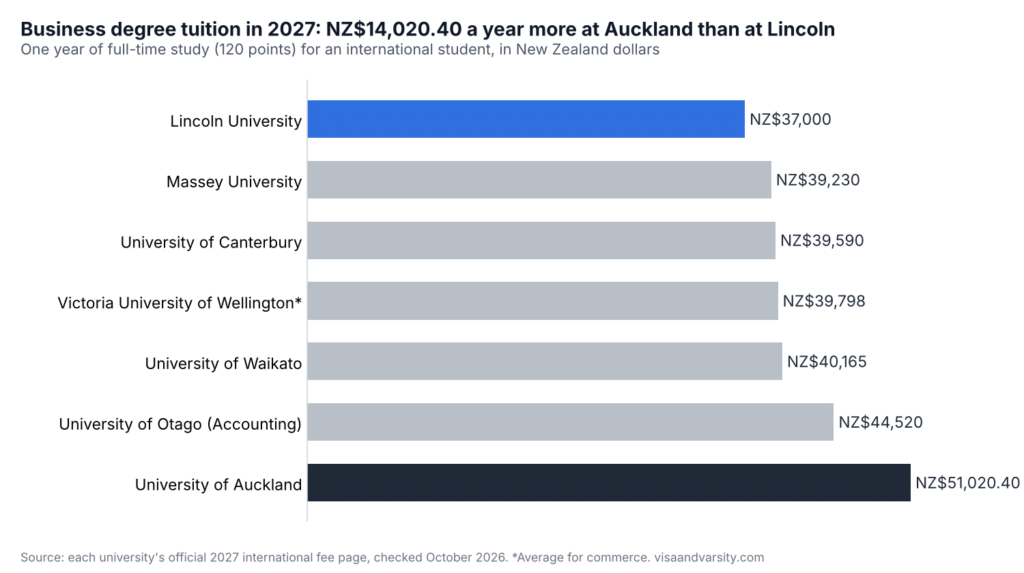
The business column shows how much the choice of university matters. A commerce degree at Lincoln costs NZ$37,000 a year, while the same kind of degree at Auckland costs NZ$51,020.40. That's NZ$14,020.40 a year, or about NZ$42,000 across a three-year degree before any fee rises.
Universities also raise their fees every year, so don't budget years two and three at the first-year price. Canterbury publishes its BA at NZ$34,880 for 2026, NZ$36,410 for 2027 and NZ$38,230 for 2028, which is a rise of about 4 to 5 percent a year. Waikato's BA rose about 5 percent between 2026 and 2027. A safe habit is to add 5 percent for each later year of your course.
Which university fits which student
- Cheapest arts and social science degree: Waikato, where a BA in history, English, sociology or political science costs NZ$34,063.
- Agriculture and agribusiness: Lincoln and Massey, which both teach farm business and agricultural science.
- Engineering: Victoria University of Wellington, Canterbury and Waikato charge NZ$49,237.20 to NZ$50,762 a year, the lowest engineering fees we found.
- Government, law and policy in the capital: Victoria University of Wellington.
- Biggest city and highest fees: the University of Auckland and AUT, both in Auckland.
- Lowest living costs of the big university cities: Otago in Dunedin, which estimates its students' yearly living costs at NZ$18,000 to NZ$21,000.
Seven ways to get a New Zealand qualification for less
The cheapest route isn't always the cheapest university. You can change your bill by more than NZ$10,000 a year through your choice of subject, level of study and program length.
1. Pick a cheaper subject inside the same degree. New Zealand universities charge by subject, so you can pay different amounts for the same degree. At Waikato, a BA in history costs NZ$34,063 a year, while a BA in psychology costs NZ$44,343. That's NZ$10,280 a year for the same degree name.
2. Pick a cheaper university for the same subject. A business degree costs NZ$39,230 at Massey and NZ$51,020.40 at Auckland, as the table above shows.
3. Do a PhD and pay domestic fees. International PhD students who live in New Zealand pay the local rate. At Massey that's NZ$8,550 for 2027, and at Waikato it's NZ$8,021 to NZ$8,519. You can research abroad for up to 12 months in total and keep that rate.
4. Choose a one-year master's over an 18-month one. Waikato's Master of Business costs NZ$43,239 for 120 points and NZ$64,859 for 180 points. The shorter one saves you NZ$21,620 in tuition and six months of rent.
5. Look for the lowest-priced master's in your field. Massey's Master of Resource and Environmental Planning costs NZ$37,000 for 2027, and its Master of Business Studies costs NZ$41,040.
6. Use a foundation course if your KCSE grades fall short. Waikato's accelerated Certificate of Attainment in Foundation Studies costs NZ$14,748, and its standard version costs NZ$29,497. Massey's one-year Certificate in Foundation Studies costs NZ$32,800. Ask each university whether your KCSE results give you direct entry before you pay for a foundation year.
7. Live in a cheaper city. Study with New Zealand quotes the University of Otago's living cost estimate for Dunedin at NZ$18,000 to NZ$21,000 a year, against NZ$20,000 to NZ$27,000 in Auckland and Wellington.
One warning about the shortest routes: your choice of level decides your rights after you graduate. A postgraduate diploma at level 8 can lead to a Post-Study Work Visa if you study full time for at least 30 weeks, but it doesn't always let your spouse work, as the next section explains.
The best courses for Kenyan students, and the cheapest place to take each
The best course for a Kenyan student does three things: it fits your budget, it leads to a work visa after you graduate, and it lets your family come with you if you're married. Many Kenyan postgraduates miss the third point.
Immigration New Zealand lets your partner get an open Partner of a Student Work Visa only if you study one of these:
- a master's or doctoral degree (level 9 or 10)
- a level 7 or 8 qualification named for a role on the Green List
- a level 7 or 8 qualification on the list of qualifications eligible for a Post-Study Work Visa
When your partner holds that visa, your school-age children can get Dependent Child Student Visas and study as domestic students, without paying international school fees. For a Kenyan family, that rule can be worth more than any tuition discount.
| Course area | Cheapest 2027 fee we confirmed | Where | Why it suits a Kenyan student |
| Teaching | NZ$35,610 a year | Canterbury, Bachelor of Teaching and Learning | Low fee band, and teaching degrees can lead to registration |
| Agribusiness and horticulture | NZ$35,250 a year | Massey, Bachelor of Horticultural and Plant Systems | Farm and food skills that transfer to Kenya's tea, flower and dairy sectors |
| Business and commerce | NZ$37,000 a year | Lincoln, BCom (Agriculture) | Cheapest commerce degree we found |
| Nursing | NZ$43,570 a year | Massey, Bachelor of Nursing | Leads to professional registration; check the Green List for your exact degree |
| Computing and IT | NZ$43,900 a year plus levy | AUT, Computer and Information Sciences | Skills that travel well if you return home |
| Engineering | NZ$49,237.20 a year on average | Victoria University of Wellington | Engineering degrees can lead to registration; the most expensive area on this list |
| Any research field | NZ$8,550 a year | Massey, PhD at domestic fees | Lowest tuition in the country, and your partner can work |
Before you choose a level 7 or 8 course for its family rights, open the Bringing family if you have a student visa page and check that your exact qualification is named. A course in the right subject that isn't on the list won't count.
Scholarships a Kenyan student can actually apply for
Most New Zealand scholarships open to Kenyans are partial tuition credits from the universities themselves, usually around NZ$10,000 off your first year. They rarely cover living costs, so you still need to show the NZ$20,000 living money for your visa.
| Scholarship | Value | Who it's for | How to apply |
| University of Otago Vice-Chancellor's Scholarships for International Students | NZ$10,000 off tuition | New international bachelor's students starting full time | No separate form; Otago assesses you when you apply |
| University of Otago Coursework Master's Scholarship | NZ$10,000 off tuition | Students starting a coursework master's, except the MBA | Check the Otago page for dates |
| PhD at domestic fees | Saves tens of thousands a year compared with international rates | International PhD students living in New Zealand | Automatic once you're enrolled and living there, at Massey, Waikato and other universities |
| Manaaki Thematic Short Term Training Scholarships | Short course costs | Kenyan professionals nominated through their employer | Closed nomination through the New Zealand mission |
Other universities publish their own awards each year, and the amounts change. Check Waikato's scholarships, Massey's scholarships and awards and Canterbury's scholarships when you apply. The government's Study with New Zealand scholarship search lets you filter by nationality, so set it to Kenya and you'll see only the awards you can win.
Three habits improve your chances:
- Apply early. Some awards, such as Otago's, are assessed automatically when you apply, so a complete application matters.
- Apply to two or three universities. A NZ$10,000 award at a dearer university can still cost you more than no award at a cheaper one, so compare the net fee.
- Keep your award letter. A scholarship letter can form part of your proof of funds for the visa.
Proof of funds from a Kenyan bank account
You must show that your first-year tuition is paid and that you hold NZ$20,000 for each year of living costs, or NZ$1,667 a month for a course shorter than a year. You also need an onward ticket, or enough money for one. Immigration New Zealand sets these rules on its student fund requirements page.
| Example course in 2027 | First-year tuition | Living money | Total before the ticket |
| Waikato BA in history | NZ$34,063 | NZ$20,000 | NZ$54,063 |
| Massey Bachelor of Business | NZ$39,230 | NZ$20,000 | NZ$59,230 |
| Auckland BCom | NZ$51,020.40 | NZ$20,000 | NZ$71,020.40 |
| Massey PhD at domestic fees | NZ$8,550 | NZ$20,000 | NZ$28,550 |
If you prepay a university hall of residence, that payment reduces the living money you need to show, so it's worth asking your university whether it offers this.
Problems that are common for Kenyan applicants
Kenya isn't part of Immigration New Zealand's Funds Transfer Scheme, which Immigration New Zealand offers to applicants from six Asian countries. So you have to prove your money with your own documents, and these are the issues we'd fix first.
- Money in a SACCO or chama. Immigration New Zealand lists bank statements and fixed deposits as evidence. If you keep your savings in a SACCO, move them into a bank account in your name, or your sponsor's name, at least three months before you apply.
- Money on M-Pesa. A mobile money balance isn't a bank statement. Move it into a bank account early, so the statement shows the money building up over time.
- Harambee or family contributions. A large deposit just before you apply looks unexplained. Keep a short letter from each main contributor, a copy of their ID, and the transfer records.
- A parent or relative paying. Your sponsor fills in the Financial Undertaking for a Student (INZ 1014) form and shows their own statements.
- Land or a title deed. A plot isn't money you can spend in New Zealand, so it doesn't replace the cash figure. If you plan to sell land to fund your study, sell it early and bank the proceeds.
- A falling shilling. Immigration New Zealand assesses your money in New Zealand dollars. If you hold shillings, keep a margin of around 10 percent above the target, so you still have enough if the shilling weakens before the day you apply.
Our New Zealand cost guide lists the full set of documents Immigration New Zealand accepts and the two kinds of evidence it rejects.
Living costs and housing for a Kenyan student
Immigration New Zealand asks you to show NZ$20,000, and that's a sensible amount to plan around. The government's Study with New Zealand site gives these typical costs:
| Cost | Typical amount |
| Room in a shared house | From NZ$140 a week |
| Catered hall of residence | Up to NZ$484 a week |
| Groceries | NZ$80 to NZ$120 a week |
| Public transport | Up to NZ$37 a week |
| Electricity in a private house | NZ$200 to NZ$300 a month |
| Mobile phone plan | About NZ$19 a month |
| Unlimited wifi for a shared flat | About NZ$90 a month |
Here's what that means for a careful student in a shared house. Take the cheapest room, the lowest food figure and full transport, and split power and wifi three ways with two flatmates. That comes to about NZ$284 a week, or roughly NZ$14,750 a year, before clothes, books, a winter coat or a trip home. The gap between that and NZ$20,000 is your cushion, and you'll need it in your first months.
City matters more than anything else on this list. The University of Otago estimates NZ$18,000 to NZ$21,000 a year in Dunedin, while Victoria University of Wellington and the University of Auckland estimate NZ$20,000 to NZ$27,000.
Choosing where to live
- A hall of residence costs up to NZ$484 a week if catered, but it includes meals and suits a first year. Paying for it before you apply also cuts the living money you have to show for your visa.
- A shared flat is the cheapest choice after your first year. A landlord can ask for a bond of up to four weeks' rent, which Tenancy Services holds and returns when you leave.
- Book from Kenya only through your university. Don't send a deposit to a private room you found online until you're in New Zealand and have seen it.
New Zealand houses are colder than most Kenyan homes, and the cheapest rooms are often the coldest. Budget for a heater and a warm duvet in your first week, especially if you're heading to Dunedin or Christchurch.
How to apply to study in New Zealand from Kenya, step by step
You apply to the university first, then for the visa online, and you can do all of it from Kenya without visiting an embassy. Work backwards from your start date, because two Kenyan documents, the medical and the police certificate, can each take weeks.
1. Choose your intake. New Zealand's academic year starts in late February, with a second intake in July. At Lincoln, for example, Semester 1 starts on 22 February 2027 and Semester 2 on 19 July 2027. KCSE results usually come out in January, so a school leaver who waits for results will find July far more realistic than February.
2. Check the entry rules for your qualification. Each university decides how it treats KCSE grades or a Kenyan degree, and whether you need a foundation year first. Ask the international office in writing, and keep the reply.
3. Apply directly to the university online. You don't need an agent. If you do use one, check that they're licensed before they give you any visa advice, and read the government's notes on choosing an education agent.
4. Accept your offer and pay your tuition. Immigration New Zealand can approve your visa in principle first, but it needs an unconditional offer of place before it gives you the final approval.
5. Book your medical in Nairobi. Kenya isn't on New Zealand's list of low tuberculosis countries, so a stay of more than six months needs a chest X-ray, and a stay of more than 12 months needs a medical examination as well. Both certificates must be less than three months old when you apply, and you get them from a panel physician Immigration New Zealand approves. The rules are on the X-ray and medical examination page.
6. Get your DCI police certificate. If your total stay will be 24 months or longer, you must send a police certificate with your application. Kenyans apply for the Police Clearance Certificate, often called the certificate of good conduct, on eCitizen. Immigration New Zealand now expects police certificates upfront and won't usually chase a missing one. If it's missing from an offshore application for a stay over 24 months, your visa is likely to be declined.
7. Prepare your funds evidence. Use the checklist in the proof of funds section above.
8. Apply for the Fee Paying Student Visa online. Immigration New Zealand no longer accepts paper applications for this visa, and its visa page says processing is busiest between October and March. Pay the NZ$850 fee by card.
9. Add your partner at the same time, if they qualify. A partner can apply for the Partner of a Student Work Visa alongside you, but they're only granted it after your student visa is approved.
10. Arrange insurance and fly. Your visa needs acceptable health and travel insurance. Universities such as Waikato and Auckland offer the Studentsafe policy and bill it with your fees.
If you're aiming for February 2027, you're already in the busy season, so apply this month. For July 2027, aim to have your offer by March and your visa application in by April.
New Zealand or Australia: which is cheaper and better for a Kenyan student?
For most Kenyans, New Zealand costs less to get into and less to stay in after graduation, and it's far kinder to married students. Australia's tuition can look similar or even lower, but its visa charges, its living money rule and its graduate visa all cost more, and they're priced in a stronger currency.
| What a Kenyan applicant faces | New Zealand | Australia |
| Student visa fee | NZ$850 | AUD 2,500 |
| Living money to show each year | NZ$20,000 | AUD 29,710 |
| Travel money to show from Kenya | An onward ticket, or enough money for one | AUD 2,500 for East and Southern Africa |
| Bringing your spouse | Open work visa for partners of master's and PhD students and eligible level 7 or 8 students | Most new applicants can't bring a partner or children since 2 October 2026 |
| Work during term | 25 hours a week | 48 hours a fortnight |
| Work visa after a bachelor's degree | Up to 3 years | 2 years |
| Graduate work visa fee | From NZ$1,670 | AUD 5,750 |
| Cheapest bachelor's tuition we found | NZ$34,063 a year at Waikato (2027) | AUD 31,800 a year at Federation University (2026) |
Why New Zealand usually works out cheaper
- Lower government charges. The student visa and the graduate work visa together cost NZ$2,520 in New Zealand. In Australia the same two visas cost AUD 8,250.
- A lower funds requirement. You show NZ$20,000 instead of AUD 29,710, plus AUD 2,500 in travel money from Kenya. That's money your family has to raise and keep in a bank before you even fly.
- A cheaper currency. An Australian dollar has bought more New Zealand dollars for many years, so each Australian figure costs more shillings than the same number in New Zealand dollars. Check today's rates with your bank before you compare.
- Your spouse can earn. A Kenyan doing a master's in New Zealand can bring a partner who works full time and children who attend school as domestic students. In Australia, most new students can't bring family at all now.
- More time to find work after graduation. Three years to find work in New Zealand, against two in Australia after a bachelor's, gives you more time to earn back what you spent.
Where Australia still wins
Australia has more universities, more cities and a bigger job market, and its cheapest bachelor's tuition is a little lower in raw numbers. Its health cover is also cheaper, from AUD 643 a year against NZ$899 for New Zealand's Studentsafe policy. If you're single, have a strong budget and want the widest choice of cities, read our cost of studying in Australia guide before you decide. Both countries count work hours differently, and our guide to student visa work hours explains how.
A sample first-year budget for a Kenyan student
To study in New Zealand from Kenya on a BA in history at Waikato, budget about NZ$58,600 to NZ$61,300 for the first year. Swap in a different course or university and only the tuition line changes much.
| Item | Low | High | Notes |
| Tuition, Waikato BA in history | NZ$34,063 | NZ$34,063 | Waikato 2027 estimate |
| Living costs | NZ$20,000 | NZ$20,000 | The visa minimum, which you spend on yourself |
| Student visa | NZ$850 | NZ$850 | Immigration New Zealand |
| Studentsafe insurance, full year | NZ$899 | NZ$899 | The rate the University of Auckland lists; confirm your own university's price |
| Medical and chest X-ray in Nairobi | NZ$150 | NZ$450 | Our estimate; the panel physician sets the price |
| English test, one sitting | NZ$300 | NZ$480 | Our estimate; skip if your university accepts your KCSE English |
| Flight from Nairobi | NZ$1,500 | NZ$3,000 | Our estimate for a one-way ticket |
| Bond and two weeks' rent in advance | NZ$840 | NZ$1,500 | Six weeks of rent at NZ$140 to NZ$250 a week; your landlord should return the bond |
| Total | NZ$58,602 | NZ$61,242 |
The same plan at Auckland's BCom would add NZ$16,957.40 in tuition, which lifts the total to roughly NZ$75,600 to NZ$78,200. The DCI police certificate fee is small next to these figures, so check the current amount on eCitizen. Most universities also charge a student services fee or levy, such as AUT's NZ$1,259.67 a year, so add your university's figure once you have an offer.
Only about NZ$3,700 to NZ$5,700 of the total is truly gone: the visa, insurance, medical, English test and flight. You spend the rest on your degree and your daily life, and you get the bond back. For a version that works in your own currency, use our study abroad cost calculator.
Quick answers for Kenyan students
How much does it cost to study in New Zealand from Kenya?
About NZ$58,600 to NZ$61,300 for the first year on the cheapest bachelor's we found, a BA at Waikato. A business degree at the University of Auckland pushes that to around NZ$75,600 to NZ$78,200.
Which is the cheapest university in New Zealand for international students?
On 2027 fees, the University of Waikato, where a BA in most majors costs NZ$34,063 a year. Massey follows, with a BA or BSc from NZ$35,250.
Can I get a full scholarship to New Zealand from Kenya?
Not through Manaaki for a degree, since Kenya isn't on the current eligible list. The nearest thing to free tuition is a PhD at domestic fees, about NZ$8,550 a year at Massey, plus any research scholarship your university offers.
How much money do I need in my bank account?
Your first-year tuition, paid, plus NZ$20,000 for living costs and an onward ticket or the money for one. For a Waikato BA, that's NZ$54,063 before the ticket.
Can I bring my husband or wife?
Yes, with work rights, if you study a master's or PhD, or an eligible level 7 or 8 qualification. Your partner applies for the Partner of a Student Work Visa at the same time as you.
Can I work while I study?
Yes, up to 25 hours a week during term and full time in scheduled holidays. Don't count on that pay to meet the funds rule, because you need to show the money before you travel.
Is New Zealand cheaper than Australia for Kenyans?
Usually, yes. The visa costs NZ$850 against AUD 2,500, the living money rule is NZ$20,000 against AUD 29,710, and the graduate work visa costs from NZ$1,670 against AUD 5,750.
This guide is general budgeting information, not immigration advice, and it promises no visa, job or residence. Fees and rules were checked on official government and university pages in October 2026, and they change often. Confirm every figure with Immigration New Zealand and your university before you pay anything. Only a licensed immigration adviser or an exempt person can give you advice about your own case.