
A student from Uganda, Zambia or Bangladesh pays no tuition at an Austrian public university. They pay only the students’ union fee of €26.20 a semester. A Kenyan, Nigerian, Indian or Pakistani student in the same lecture hall pays €726.72 a semester on top. That gap comes from one annex to an Austrian regulation, and it’s the first thing that shapes the cost of studying abroad in Austria for anyone from Africa or South Asia.
This guide takes you through the money in the order you’ll spend it: choosing a course, getting an admission letter, applying for the student residence permit, and setting up in Austria. Each stage has its own cost table in euros (EUR), and the last section adds them up and shows how much of the total you really lose to charges.
Austrian fees and money rules change most years, and several changed in 2025 and 2026. So confirm every figure on the official page linked beside it before paying anything. Where no official page gave a number, we mark the figure “Our estimate”.
A quick note on the links. Most of our sources are Austrian government or university pages in English. A few, such as the regulation that lists the tuition-free countries, exist only in German, so you may want your browser’s translate button for those.
Cost of Studying Abroad in Austria Calculator
Use this calculator to build a first-year budget from your own choices. Pick your passport country, your age and where you’ll study, then add your rent and flight if you know them. Your passport decides whether you pay tuition at a public university and which embassy you apply at, so start there. Every figure comes from the cost tables in this guide, and the low, middle and high setting shows how far your total can move.
This is a budgeting tool, not immigration advice. Austrian fees changed in 2025 and 2026, so check every figure with OeAD, your embassy and your university before you pay.
Your situation
Show costs in your own currency
Estimated cost for your first year
€0
Austria’s 2025 and 2026 changes, with dates
Many pages on the cost of studying abroad in Austria still quote older fees, so read this first.
- 1 July 2025, higher consular fees. Austria’s consular fee schedule, the Konsulargebührengesetz in force from 1 July 2025, sets the fee for a long-stay entry visa (Visa D) at €195 and the embassy stamp on a foreign document at €80.
- 2026 residence permit fee. OeAD, Austria’s government agency for international students, now lists one application fee of €218 for the student residence permit. Some university pages still show the older €160, so don’t budget from those.
- 2026 money you have to show. The monthly amounts for 2026 are €722.58 for students under 24 and €1,308.39 from age 24, with a rent allowance of €386.43 a month.
- 2026 student health insurance. The Austrian Health Insurance Fund (ÖGK) charges students who insure themselves €78.84 a month in 2026.
- 21 January 2026, new TOEFL scale. TU Wien accepts 4.5 on the new TOEFL scale for tests taken from that date, or 87 on the old one.
- Winter semester 2026/27, students’ union fee. The University of Graz confirms the fee rose to €26.20 a semester from winter 2026/27.
- 2026, Vienna transport. The Academy of Fine Arts Vienna says the semester ticket is being replaced by an annual youth ticket for everyone under 26 at €300.
Step 1: Choose a course that leaves you a job-search year in Austria
Two offices decide what happens after you graduate. The residence authority in your city (MA 35 in Vienna) decides on your permit, and an employer applies for any work permit. The good news is simple. After you complete a degree program in Austria, you can apply for a one-time renewal of your student permit for twelve months to look for work or start a business, or switch straight to the Red-White-Red Card, Austria’s main work and residence permit.
After your degree, what each level allows
Austria doesn’t run a separate graduate visa. The job-search year is an extension of the student permit itself, and OeAD lists it for graduates who completed their studies successfully.
| Level or type of study | Job-search time after graduation | Other conditions |
|---|---|---|
| Bachelor’s degree | Up to 12 months, once | You apply to the residence authority in Austria before your student permit expires |
| Master’s or diploma degree | Up to 12 months, once | Same one-time renewal. You can’t use it again after a later degree |
| Doctoral or PhD studies | Up to 12 months, once | Your supervisor can confirm progress instead of the usual credit count |
| University course of at least 40 ECTS credits | No graduate rule found | The permit covers these courses, but the pages we read tie the job-search year to completed degree studies |
| University preparation course (German and entrance exams) | None | It leads into a degree. It doesn’t count as one |
From there, the Austrian Business Agency, which runs the government’s immigration guide, explains that a graduate of an Austrian university can apply for a Red-White-Red Card for graduates within twelve months of graduating. The salary has to match the relevant Austrian collective agreement, and for the first two years the card ties you to one employer.
Seven rules that cost applicants money
Read this table before you accept a place. Each row comes from an official page, and missing any one of them can cost you money or a semester.
| Point to check | Why it matters to you |
|---|---|
| The age 24 line | The money you show depends on your age. Under 24 you show €722.58 a month, and from 24 you show €1,308.39. The pages we read set the amount by age, so if you turn 24 during your studies, plan for the higher figure at your next renewal |
| 16 credits a year | To renew your permit, you show eight semester hours or 16 ECTS credits for each academic year. That’s a low target, but a student who spends year one only on German exams can miss it |
| Renewal timing | You can apply no earlier than three months before your permit ends. If you apply after it ends, the authority treats it as a first application, and you may have to apply again from home |
| The 20-hour limit | You can work up to 20 hours a week, but only after your employer gets you a work permit from the Public Employment Service (AMS). Working without it breaks the rules even for a small job |
| A Higher National Diploma | The University of Vienna says an HND from African countries doesn’t meet the requirements for a master’s, so Nigerian and Ghanaian HND holders need a full bachelor’s degree |
| Medicine | Non-EU applicants can get at most 5 percent of human medicine places, and the MedAT entrance test costs €110 |
| The preparation course | Once you’re in the Vienna preparation course, you can’t drop out to take German elsewhere. The University of Vienna warns this can cost you your residence permit |
If any row applies to you, email the admissions office of your university before you pay for anything else.
“My German is weak. Can I start with a language course and move into a degree while studying abroad in Austria?”
Yes, and many students do. The student permit covers the university preparation programs (Vorstudienlehrgänge), which are courses where you pass German and any other supplementary exams your admission letter lists. In Vienna that’s the VWU, and you get up to four semesters to pass all your supplementary exams. To get a place, you first need an admission letter with conditions from a university, and the course itself costs €612 a semester for winter 2026/27 when you take it at the VWU directly.
So the sequence works like this; preparation course, then bachelor’s, then master’s, with the same permit renewed each year. But the job-search year after graduation only comes once. A second master’s won’t give you a second year to look for work.
If you have no German at all, we’d look hard at English-taught programs first. Each German exam you don’t need can save you a semester or more of rent.
Step 2: Get your admission letter
Each university’s admissions office decides who gets in, and you apply to each one separately. Public universities don’t charge an application fee on the pages we checked, but some universities of applied sciences (Fachhochschulen, often called FHs) and private universities take a deposit. The document the embassy will read is your admission letter, the Zulassungsbescheid. That’s simply the official decision that the university has admitted you.
Checking that your school in Austria is accredited
Austria has no single public register for students to search, so use two official sources. Study in Austria, OeAD’s official website, lists 23 universities, 21 universities of applied sciences, 19 private universities and 14 teacher education colleges. AQ Austria, the national accreditation agency, publishes the results of every accreditation it has completed for FHs and private institutions.
If a school you’re considering appears on neither, ask hard questions before you send money. The residence permit covers studies at public universities, FHs, accredited private universities and teacher colleges, so an unaccredited school can leave you with no permit at all.
None of the official pages we read set a national cap on international students, apart from the medicine quota above. But applicants educated in India, Pakistan or Bangladesh do need one extra step before they apply, and we explain it below.
Legalization: what your certificates need, country by country
Austrian universities won’t look at your file until you’ve had the right official stamps put on your documents. The University of Vienna puts it bluntly: applying without the required legalization is “not possible”. Legalization just means getting official stamps that prove a certificate is genuine. The Austrian education ministry’s list sorts countries into three groups, and the FH Campus Wien copy of that list gives these results for the countries most of our readers come from.
| Where your certificates come from | What Austria asks for |
|---|---|
| India | An apostille, which is one certificate from India’s own authorities |
| Kenya, Uganda, Zambia | Full diplomatic legalization; stamps from your own ministries, then the Austrian embassy for your country |
| Nigeria, Ghana | Full diplomatic legalization. In Nigeria you first get the education and foreign affairs ministries to stamp the documents, then book verification at VFS Global |
| Pakistan, Bangladesh | Full diplomatic legalization, through the Austrian embassy in Islamabad or New Delhi |
TU Wien explains that for full legalization you report to the Austrian embassy in the country where your documents were issued. Documents in English don’t need translating for the university. Anything in another language needs a sworn translation into German or English, done after the stamps, because the stamps need translating too.
For Nigerian documents, the Austrian Embassy in Abuja now takes verification by appointment only at VFS Global in Abuja and Lagos. The same page warns about fake “Certificate of no international criminal record” emails. The embassy doesn’t issue that document, and it takes fees only in cash at its own counter, so ignore anyone who asks for a transfer.
“I studied in Pakistan. What’s this competence check?”
It’s a test you take before you apply. The University of Vienna says the competence check at VFS Education Services is mandatory for anyone whose previous education was in Bangladesh, India or Pakistan. VFS checks your passport and documents in person, then tests you in English, mathematics, biology, chemistry, history or geography, and physics, plus German for German-taught programs. It costs about €160 for Vienna and about €100 for the University of Graz version, which you pass with at least 50 percent.
The test doesn’t help if your grades are below the university’s cutoffs, because the University of Vienna rejects those applications whatever the result. Its published minimums for a bachelor’s are;
- India: a 12-year school certificate with at least 70 percent of the maximum marks.
- Pakistan: 990 to 1,100 points on the 12-year certificate, or two years of university with a CGPA of 3.2 out of 4.0.
- Bangladesh: the Higher Secondary Certificate alone isn’t enough. You need two years of university with at least 80 percent or a CGPA of 3.75, or a bachelor’s of at least four years.
For a master’s, Vienna sorts universities by the sections of the ENIC NARIC AUSTRIA classification. An Indian bachelor needs at least three years and 60 percent from a Section 1 or 2 university, or 80 percent from a Section 3 state university. A Pakistani bachelor needs four years and a CGPA of at least 3.5 from a Section 1 university or a recognized public Section 2 university. A Bangladeshi bachelor needs four years and a CGPA of at least 3.75, or 80 percent, from a Section 1 university. So check your CGPA against these numbers first, then book VFS. Doing it the other way round wastes €100 to 160.
Deadlines for Austria Universities, and when the letter arrives
The general deadlines are 5 September for the winter semester and 5 February for the summer semester, unless a university sets its own. Many do. The University of Vienna takes applications from non-EU applicants for summer 2027 from 16 November 2026 to 7 January 2027, with no grace period. Programs with entrance exams, and master’s programs with a selection procedure, take applications once a year in spring.
The general deadline is far too late for a visa. OeAD tells you to apply for the residence permit at least three months before you plan to enter, and ideally six. Add the weeks a university needs to process your file, and you want your application in by late winter for an October start.
Uganda, Zambia and Bangladesh: how the tuition exemption works
Austria’s Tuition Fee Regulation (Studienbeitragsverordnung) has an annex of 46 countries whose citizens are exempt from tuition at public universities and teacher colleges. Uganda, Zambia and Bangladesh are all on it, along with Tanzania, Rwanda, Malawi, Ethiopia and Nepal. Kenya, Nigeria, Ghana, India and Pakistan aren’t. The University of Innsbruck says the exemption applies automatically, with no application needed, and that you must report any change of citizenship straight away.
Three details matter here.
- It’s about your passport. Where you went to school doesn’t matter. A Ugandan citizen raised in Nairobi is exempt, and a Kenyan who studied in Kampala isn’t.
- It covers public universities and teacher colleges. The annex refers to the Universities Act and the University Colleges of Teacher Education Act. FHs and private universities set their own fees, so a Zambian student at an FH should expect the FH’s non-EU fee unless the FH confirms an exemption in writing.
- Bangladesh’s status may change. Bangladesh is preparing to leave the United Nations group of least developed countries. Austria’s annex hasn’t changed since the amendment in force from 1 October 2022, and it still lists Bhutan, which is no longer on the UN’s current list of 44 least developed countries. So the Austrian ministry, not the UN, decides when a country comes off the annex. Bangladeshi students should check the annex each semester.
Exempt students still pay the students’ union fee, the ÖH fee, every semester. TU Wien notes that without it, no admission or continuation will be granted, and the deadlines are 31 October for winter and 31 March for summer.
Phase 1 costs: admission
| Item | Typical cost in EUR | In your local currency | Why it is on this list |
|---|---|---|---|
| IELTS or TOEFL fee | €180 to 280 | Our estimate. The IELTS and TOEFL owners set the price, and it differs in Nairobi, Lagos, Delhi and Dhaka | |
| Legalization or apostille of certificates | €40 to 400 | Our estimate. The Austrian embassy charges €80 for each stamp it adds, and your own ministries charge on top. Indian students pay less with an apostille | |
| Document verification in Nigeria | €0 to 150 | Our estimate. Only Nigerian applicants book this at VFS, and VFS doesn’t publish the amount on the embassy page | |
| VFS competence check | €0 to 160 | Only if your education was in India, Pakistan or Bangladesh. VFS charges about €100 for Graz and €160 for Vienna | |
| Sworn translations | €0 to 300 | Our estimate. You only pay if a document isn’t in German or English | |
| Courier or certified copies | €0 to 100 | Our estimate. Some universities want notarized copies or originals sent by registered mail | |
| MedAT entrance test | €0 to 110 | Only for medicine applicants. The medical universities set the €110 fee | |
| Bank charges on payments abroad | €0 to 30 | Our estimate. Your bank sets these for each card or transfer payment | |
| Application deposit | €0 here | FHWien takes €200 and Webster Vienna €1,000, but they credit it to your tuition, so it isn’t an extra cost | |
| Phase 1 subtotal | €220 to 1,530 | All the rows above, added together |
Step 3: Apply for the student residence permit
The residence authority in Austria decides on your permit, but you hand in the application at the Austrian embassy that covers your country, in person and by appointment. The permit’s official name is Aufenthaltsbewilligung Student, the Residence Permit Student. It costs €218, paid at submission and not refunded if you withdraw or the authority says no. It normally lasts 12 months, and you renew it in Austria each year.
Which embassy handles your country
Many budgets go wrong at this point, because an Austrian embassy in another country covers several of our readers’ home countries.
| Your country | Where you apply | What it means for you |
|---|---|---|
| Kenya | Austrian Embassy Nairobi | Book an appointment. You pay fees in cash in Kenya shillings |
| Zambia | Austrian Embassy Nairobi | The Nairobi embassy also covers Zambia, so you travel to Kenya to apply |
| Uganda | Austrian Embassy Addis Ababa | Uganda is in Addis Ababa’s area, and the embassy asks you to book a residence permit appointment by email |
| Nigeria | Austrian Embassy Abuja | Appointments for residence permits are online or by email only |
| India | Austrian Embassy New Delhi | The embassy warns of long waits for appointments and says to book early |
| Bangladesh | Austrian Embassy New Delhi | New Delhi covers Bangladesh, so you need an Indian visa as well as the trip |
| Pakistan | Austrian Embassy Islamabad | Legalization goes through VFS. The embassy says it doesn’t work with agents |
For a Zambian or a Bangladeshi student, this trip adds a real line to the cost of studying abroad in Austria. And you may have to make it twice, because you collect the Visa D at the same embassy after a positive decision. Ask the embassy by email whether it can post the visa or whether you need to come in.
Your document list
OeAD lists these items for a first application;
- your passport, with a copy of every page
- a biometric photo, 3.5 by 4.5 cm, no older than six months
- the signed application form
- your admission letter
- proof of funds for 12 months
- proof of accommodation for at least three months, such as a student residence contract
- proof of health insurance covering all risks
- a police clearance certificate no older than three months, legalized and translated
- a declaration of your regular expenses, such as loans you’re repaying
OeAD recommends German for your documents, though it accepts English in some cases. So a Kenyan certificate of good conduct or a Nigerian police character certificate may need a sworn German translation after it’s legalized. Ask your embassy before you pay a translator.
The money test: €722.58 or €1,308.39 a month
The residence authority of Austria checks whether you can live without help from the Austrian state, so get this part right before anything else. For 2026, you must show €722.58 a month if you’re under 24 and €1,308.39 a month from age 24, for twelve months in advance. That works out at €8,670.96 for a student under 24 and €15,700.68 for a student aged 24 or older.
Rent changes the figure. The monthly amounts include €386.43 for housing, and if your rent is higher, you must show the difference as well. Say you’re 22 and you’ve booked a €550 room in Vienna. Your rent is €163.57 above the allowance, so you need €886.15 a month, or €10,633.80 for the year. At 25 with the same room, you’d need €17,663.52.
One more warning on the under-24 figure. OeAD and the Academy of Fine Arts Vienna give €722.58, but the Interior Ministry’s migration portal lists €777.58 for persons below the age of 24. We couldn’t settle which one the authority uses for your case. So if you’re under 24, we’d hold at least €9,330.96, the higher figure for twelve months, plus any rent difference.
What counts as proof of funds to study in Austria
- Money in your own name. OeAD accepts a savings book or bank account abroad in your name, as long as you can use it from Austria.
- A scholarship award letter that states the amount and period.
- A liability declaration (Haftungserklärung). A person or organization promises to cover your costs. It has to be certified by an Austrian notary or an Austrian court and valid for at least five years, and the person signing must prove they can afford it.
“The savings are in my mother’s account in Lagos. What now?”
Move them before you apply. OeAD asks for funds in an account in your name, so a parent’s statement doesn’t count as your money on its own. Transfer the money into your own account in good time, and keep the transfer slips that show where it came from, because the authority can ask for a declaration on the origin of funds.
Two more habits help. Print the bank statement close to your appointment, so it shows your current balance. And don’t show exactly the minimum, then pay the permit fee, the flight and the deposit from the same account. Keep a margin above the figure you need.
“My uncle lives in Vienna. Can he sponsor me instead?”
He can, through a liability declaration. But it’s a serious legal promise. He signs before an Austrian notary or court, he stays liable for at least five years, and he must show income that covers your costs. Signing one he can’t afford is an administrative offense under Austrian law. Ask him to talk to the notary about his own income before he agrees.
Two layers of health cover
You need two kinds of cover, one after the other. For your entry, OeAD asks for travel health insurance valid in Austria with cover well above €30,000, including repatriation. After you arrive and enroll, you can take out the ÖGK’s student self-insurance at €78.84 a month in 2026. You can send a written statement of intent to take it out with your permit application.
The self-insurance has conditions. You need to be an ordinary student with no other statutory cover and an income below €15,000 a calendar year, within your program’s planned length plus four semesters. You also have to send the ÖGK your enrollment confirmation by 31 December each year, or you risk losing cover.
Private insurance is allowed, but OeAD says it must have no waiting periods, no cost caps and no excluded risks, and the insurer must pay Austrian doctors directly. So read the policy wording for caps and exclusions, and ask the insurer for a written statement before you buy.
IELTS, TOEFL and German levels by university
Each university sets its own language rule, and the residence authority doesn’t test you again. These are real examples;
- TU Wien, English-taught master’s: IELTS Academic 6.5, or TOEFL iBT 87 (4.5 on the new scale), with tests valid for two years.
- WU Vienna, English-taught bachelor’s: IELTS Academic 6.0, TOEFL 4.5 on the new scale, or PTE Academic 70, at B2 level.
- WU Vienna, master’s: IELTS Academic 7.0 or TOEFL 5 on the new scale, at C1 level.
- University of Vienna, German-taught programs: German at A2 to apply, then C1 before admission, usually through the preparation course.
“Kenyan and Nigerian degrees are taught in English. Why isn’t that enough?”
Because TU Wien and WU only accept English-taught degrees from a short list of countries. TU Wien accepts an English-taught degree instead of a test only from the EU, the EEA, Switzerland, the UK, the USA, Canada, Australia and New Zealand. WU uses a similar country list for its master’s programs. Degrees from Kenya, Nigeria, Ghana, Uganda, Zambia, India, Pakistan and Bangladesh aren’t on either list, so an English-medium letter from your university won’t replace the test. Other universities may differ, so ask the admissions office for your program in writing.
Working while you study
You can work up to 20 hours a week, but not freely. Your employer has to apply to the AMS for an employment permit (Beschäftigungsbewilligung) before you start, even for a small job, and the AMS gives it without a labor market test as long as the job doesn’t put your studies at risk. So if a café asks you to start tomorrow, it can’t legally put you to work yet.
We’d plan the first year with no job income at all, especially if you don’t speak German yet, and treat any job as a bonus.
How long you’ll wait
The authority should decide within 90 days once your file is complete, and that time can grow by another 90 days if it asks for more documents. After a positive decision, you apply for the Visa D within three months. It’s valid for four months, and you collect your permit card in Austria within six months of the decision.
The Visa D costs €195. The fee schedule lets the embassy waive it for students where Austria and your country treat each other’s students the same way, but that’s at the embassy’s discretion, so budget for it. New Delhi already warns of long waits for appointments. So book your appointment as soon as you have the admission letter.
Phase 2 costs: student visa to Austria Schools
| Item | Typical cost in EUR | In your local currency | Category | Why it is on this list |
|---|---|---|---|---|
| Student permit application fee | €218 | Standard | OeAD lists this fee, and you lose it if you withdraw or the authority says no | |
| Visa D to enter and collect the permit | €0 to 195 | Standard | Austria’s consular fee schedule sets €195. The embassy can waive it for students in some cases | |
| First-year tuition and ÖH fee at a public university | €52.40 to 1,505.84 | Standard | Ugandan, Zambian and Bangladeshi students pay only two ÖH fees. Others pay €726.72 a semester plus the ÖH fee | |
| Living money shown for 12 months | €8,670.96 to 15,700.68 | Standard | Under 24 at the low end, 24 and over at the high end. You keep it, and you spend it on rent and food | |
| Police clearance certificate | €5 to 40 | Often missed | Our estimate. Your own police service sets the fee, and you need one no older than three months | |
| Legalizing and translating the police certificate | €80 to 250 | Often missed | Our estimate. The embassy stamp alone costs you €80, before a sworn translator’s fee | |
| New passport or renewal | €30 to 100 | Often missed | Our estimate. The authority won’t give you a permit longer than your passport | |
| Travel health insurance for entry | €20 to 60 | Often missed | Our estimate. OeAD asks you for cover well above €30,000 until the ÖGK takes over | |
| Travel to the embassy | €0 to 900 | Often missed | Our estimate. Zambians travel to Nairobi, Ugandans to Addis Ababa and Bangladeshis to New Delhi, sometimes twice | |
| Bank charges and exchange margin | €100 to 500 | Often missed | Our estimate for moving €10,000 to 17,000. Your bank and any transfer service set the margin | |
| Bank letters and statements | €0 to 30 | Often missed | Our estimate. Some banks charge you for a stamped statement | |
| Phase 2 subtotal | €9,176.36 to 19,499.52 | Counts tuition, plus the living money that stays yours |
Step 4: Your first weeks in Vienna, Graz or Innsbruck
Three offices handle most of what you do in your first month: your local registration office, the residence authority and the ÖGK. Two of their deadlines are short, so plan them before you fly.
Papers for the border and your first week
Show your passport with the Visa D at the border. In your hand luggage, keep your admission letter, your travel insurance certificate, your rental contract or student residence confirmation, your bank statement or scholarship letter, and your legalized certificates. You’ll need several of them again within days.
Deadlines that start when you arrive
Register your address within three working days. OeAD says you must register your residence within three working days of arrival. You get a stamped registration confirmation, the Meldezettel, and you need it to collect your permit.
Collect your permit card. In Vienna you go to MA 35, the city’s immigration office, with your passport, the Meldezettel and your final admission confirmation. In Graz it’s the Styrian provincial government office, and elsewhere it’s the district authority or the city.
Enroll and pay the semester fees. Pay the ÖH fee, and tuition if you owe it, by 31 October for winter. Your enrollment confirmation is what the ÖGK needs.
Sign up for the ÖGK self-insurance as soon as you’re enrolled, so you have no gap after your travel insurance ends.
Put your renewal in your calendar. Put the date three months before your permit expires in your phone. Apply in that window, with your 16 credits, a new enrollment confirmation and a fresh bank statement. You pay the €218 fee again.
Finding a room in Vienna or Graz
We’d start with a student residence, because you can book one before you fly. WU Vienna’s housing page shows the range in Vienna: OeAD rooms from €330 a month, ÖJAB from €335, and newer private residences from about €670. In Graz, the university says a dorm room starts at about €300 a month.
For a private flat, WU says to expect a deposit of at least three months’ rent, and it warns that private leases often last five years, with no move out in the first year. Read the notice terms before you sign. A student residence usually takes a smaller deposit and returns it at the end, minus cleaning and any damage.
Two Austrian rules can save you money:
- Broker fees. Since 1 July 2023, you pay the broker only if you hired the broker yourself. If a landlord’s agent asks you for a commission, say no.
- The ORF contribution. This is a household charge for public broadcasting, €15.30 a month for each main residence, whether you own a TV or not. One registered adult at the address pays it. In a shared flat, agree who pays before the first bill arrives.
Rental scams follow the usual pattern. The “landlord” is abroad, wants a deposit before a viewing, and pushes you to decide today. Never pay before you’ve seen a signed contract and checked the address, and book through the official residence providers your university lists where you can.
Winter is the other cost students from warm countries forget. Vienna gets cold, so you’ll need a warm coat, boots and gloves from November. And if you’re under 26, Vienna’s annual youth ticket costs €300 for the whole year.
Phase 3 costs: arrival and setup
| Item | Typical cost in EUR | In your local currency | Category | Why it is on this list |
|---|---|---|---|---|
| Flight to Vienna, one way | €400 to 900 | Standard | Our estimate from Nairobi, Lagos, Delhi or Dhaka. Book early, because September flights fill up | |
| Short stay before your room is ready | €0 to 400 | Standard | Our estimate. Zero if your residence lets you move in on arrival | |
| Airport to your city | €5 to 15 | Often missed | Our estimate. Train fares from Vienna airport differ by train | |
| Rental deposit | €0 to 2,000 | Often missed | WU tells you to expect three months’ rent for a private flat, and your landlord should return it. The range is our estimate | |
| First month of rent | €0 extra | Standard | It’s inside the living money you proved for the permit, so we don’t count it again | |
| Broker commission | €0 | Often missed | Since July 2023 you pay only a broker you hired yourself | |
| ÖGK student self-insurance, 12 months | €946.08 | Standard | 12 months at the ÖGK’s 2026 rate of €78.84 | |
| ORF contribution, 12 months | €0 to 183.60 | Often missed | €15.30 a month if you’re the one registered adult paying for your address | |
| Annual transport pass | €300 to 470 | Standard | €300 for the Vienna youth ticket if you’re under 26. Our estimate for older students and other cities | |
| First semester of the preparation course | €0 to 612 | Often missed | Only if your admission letter requires German exams. The VWU sets €612 a semester | |
| Austrian SIM and first month | €10 to 30 | Often missed | Our estimate. Prepaid plans from Austrian networks | |
| Home contents insurance | €0 to 100 | Often missed | Ask your landlord whether the building cover includes your things. Yearly figure is our estimate | |
| Bedding, kitchen items and small furniture | €100 to 400 | Often missed | A furnished residence room means you spend less. The range is our estimate | |
| Winter coat, boots and gloves | €100 to 350 | Often missed | Our estimate, for students arriving from warm countries | |
| Phase 3 subtotal | €1,861.08 to 6,406.68 | All the rows above, added together |
What the cost of studying abroad in Austria comes to in year one
| Phase | Typical cost in EUR | In your local currency |
|---|---|---|
| Phase 1, admission | €220 to 1,530 | |
| Phase 2, student visa | €9,176.36 to 19,499.52 | |
| Phase 3, arrival and setup | €1,861.08 to 6,406.68 | |
| Total | €11,257.44 to 27,436.20 |
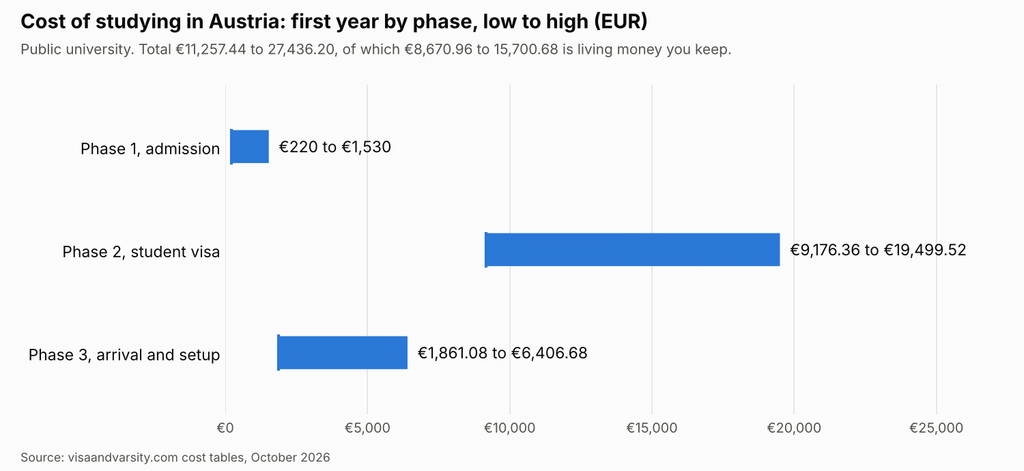
These totals assume a public university. At an FH or a private university, swap in the tuition from the table further down.
Money you spend versus money you keep
You lose far less than the total suggests. Start with the living money, €8,670.96 to 15,700.68. It stays yours, and you spend it on your own rent and food during the year. Take it out, and €2,586.48 to 11,735.52 is left.
Next, tuition and the ÖH fee, €52.40 to 1,505.84, go to the university and the students’ union. You can’t avoid them, but they pay for your teaching and your degree. Take them out too, and €2,534.08 to 10,229.68 remains. Finally, your landlord should return a deposit of up to €2,000 when you leave, as long as the room is clean and undamaged.
What’s left, about €2,534.08 to 8,229.68, is the money truly lost to charges: the permit and visa fees, legalization, the English test, translations, travel to the embassy, bank margins, insurance, the flight and setting up a room. The ÖGK’s €946.08 is the biggest fixed item, and the embassy trip is the most uneven. A Kenyan student who lives in Nairobi might spend nothing on it, while a Bangladeshi student flying to New Delhi twice could spend €900.
The total covers one year. It leaves out:
- a second year of tuition and living money, plus another €218 for each renewal
- family members, who need their own permits and more money shown
- the job-search year after graduation, which needs a renewal fee and fresh proof of funds
- a refusal, which costs you the €218 and whatever you spent on legalization and travel
- higher rent in Vienna if you can’t get a residence room, which also raises the money you have to show
Tuition by institution type
Of everything in the cost of studying abroad in Austria, tuition varies most by type of institution. Public universities charge one national rate, while FHs and private universities set their own. These are real figures from official pages.
| Institution and level | Yearly tuition | Notes |
|---|---|---|
| Public university, citizens of the 46 annex countries such as Uganda, Zambia and Bangladesh | €52.40 | Two ÖH fees of €26.20. No tuition at public universities |
| Public university, other non-EU citizens such as Kenya, Nigeria, India and Pakistan | €1,505.84 | €726.72 a semester plus the ÖH fee. The same rate applies to bachelor’s, master’s and doctoral studies |
| FHWien der WKW, bachelor’s or master’s | €2,052.40 | €1,000 a semester plus ÖH fees, with a €200 deposit credited to your fees |
| FH Technikum Wien, bachelor’s or master’s | €6,052.40 | €3,000 a semester for third-country students, plus the ÖH fee |
| Webster Vienna Private University, bachelor’s | €24,068 | Full-time flat fee for 2026/27, plus the ÖH fee |
| Webster Vienna Private University, master’s | About €15,840 | €31,680 for most 36-credit programs, so roughly half each year |
| Vienna preparation course (VWU) | €1,224 | €612 a semester, only while you pass German and other supplementary exams |
The public university rate is low, but the money you show and Vienna rent make up most of your real cost. If you’re weighing Austria against its neighbor, our breakdown of what studying in Germany costs uses the same three phases, so you can set the totals side by side.
A last check on your budget
- Check your passport against the annex. If you’re Ugandan, Zambian or Bangladeshi, a public university saves you €1,453.44 a year in tuition.
- Check your grades before VFS. Indian, Pakistani and Bangladeshi applicants should compare their CGPA with the university’s minimum before paying for the competence check.
- Find your embassy first. Price the trip to Nairobi, Addis Ababa or New Delhi before you set your budget.
- Hold the money in your own name, and hold the higher under-24 figure if you’re unsure which one the authority will use.
- Put every deadline in your calendar: three working days to register, 31 October for fees, 31 December for the ÖGK, and three months before expiry for renewal.
- Compare whole countries. Our Poland guide and Sweden guide follow the same structure, and our study abroad cost calculator lets you put your own numbers in.
Austria study costs: short answers
What does the cost of studying abroad in Austria add up to in year one?
On our figures, €11,257.44 to 27,436.20 at a public university. Most of that is living money you keep, and only about €2,534.08 to 8,229.68 is lost to fees and charges.
Do Ugandan, Zambian or Bangladeshi students pay tuition in Austria?
Not at public universities. Citizens of those three countries and the other 43 annex countries pay only the €26.20 ÖH fee each semester. Kenyan, Nigerian, Indian and Pakistani students pay €726.72 a semester on top.
How much money must I show for an Austrian student permit?
For 2026, €722.58 a month under 24 or €1,308.39 a month from 24, for twelve months. That’s €8,670.96 or €15,700.68, plus extra if your rent is above €386.43 a month.
Can I stay in Austria after graduation to find a job?
Yes, once. After you complete your degree, you can renew your student permit for twelve months to look for work or start a business, or apply for a Red-White-Red Card if you already have a suitable job offer.
We wrote this guide to help you plan, not to advise on your own application, so treat it as general information rather than immigration or legal advice. Austrian fees and money amounts changed in both 2025 and 2026, so confirm every figure with OeAD, your Austrian embassy and your university before you pay. We found no Austrian register or licensing system for immigration consultants. Regulated legal advice comes from lawyers, who are listed by the Austrian Bar (ÖRAK), and the embassies in Islamabad and Abuja warn that they don’t work with agents or take payments by transfer. Be wary of anyone who promises you a permit.