
From the student Visa rules of UK, Australia, the US and Canada, none of them says that failing one module would end your Visa. What each government checks is whether you’re still enrolled, studying at the right load, and on track to finish on time.
Why failing is not the real problem
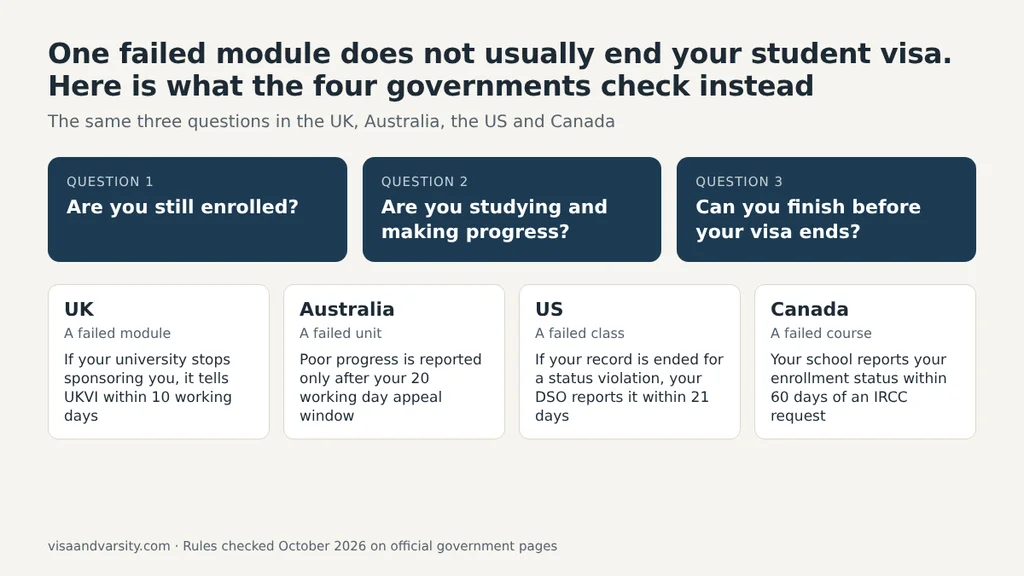
The UK, Australia, the US and Canada all check the same three things. Are you still enrolled? Are you studying and making progress? Can you finish before your visa ends?
A failed module only causes trouble if it changes one of those answers. For example, you might need extra time and finish after your visa ends. Or your school might suspend you, put you on a lighter study load, or you might take a long break. That’s when your school may have to report you to immigration, and when the visa rules come in.
Each country also has its own name for a single course. The UK calls it a module, Australia a unit or subject, the US a class, and Canada a course. So when this guide talks about what happens if you failed a module, student visa holders in Australia, the US and Canada can read unit, class or course instead.
What Happens to Your Student Visa If You Failed a Module in UK
In the UK, your university has the biggest say in what happens next, because it sponsors your visa. It gave you a Confirmation of Acceptance for Studies (CAS), the reference number you used to apply. It also reports to UK Visas and Immigration (UKVI), the part of the Home Office that runs Student visas.
None of the rules we checked say that one failed module breaks your visa. Your visa conditions are about three things; not claiming government benefits, keeping to the work limits, and studying only with your sponsor. What counts is whether you keep taking part in your course. If you stop, and you don’t start again within 60 days of your university first contacting you, your university must stop sponsoring you. However, It can make an exception only in unusual cases, such as a serious illness or injury that may have stopped you from studying. The same usually happens if you take a break of more than 60 days. In both cases, your university tells the UK Visas and Immigration office within 10 working days.
Once your university stops sponsoring you, the Home Office can cancel your visa. If it wasn’t your fault, the Home Office normally gives you 60 days to find a new sponsor or leave the UK. But if you stopped going to classes and your university couldn’t reach you, the Home Office normally cancels your visa straight away.
Resits and repeats
If you failed a module, your university may offer you a resit, this is taking the exam or assessment again,or a repeat, which is taking the whole module again. This is where universities handle things most differently.
UKVI lets your university keep sponsoring you during a resit or repeat, as long as it needs you to attend classes or stay in contact. If the university won’t need you within 60 days of the next term starting, it should stop sponsoring you. You may then have to leave the UK and come back later on a new CAS. If your visa ends before the repeat finishes, apply to extend it before it runs out. And because it’s a repeat, you can extend your visa for it even though it isn’t a higher-level course, which the Immigration Rules normally require.
Some universities are strict about this. At Sheffield, if you resit without going to classes, the university reports your absence and the Home Office cancels your visa. Edinburgh Napier counts every extra attempt it allows towards UKVI’s limit. So before you agree to resit without classes, ask your university’s international student advice team whether it will keep sponsoring you. Their answer tells you whether you can stay in the UK while you prepare.
One more thing to check. Some universities are “probationary sponsors”, which means they were only recently given a sponsor license and have not yet passed their first yearly Home Office check. If you’re not sure whether yours is one, ask. For these universities, the Immigration Rules and UKVI’s guidance describe the limit on attempts in slightly different words. The Rules are the law, so if the two disagree, the Rules apply.
Australia: what happens if you fail a unit
Australia leaves most of the decision to your education provider. Under visa condition 8202, you have to stay enrolled and keep up a “satisfactory” attendance and progress, but it’s your provider who decides what satisfactory means, so one failed unit doesn’t break your Student visa (subclass 500) on its own.
Your provider puts your course details on a CoE (Confirmation of Enrolment) in PRISMS, which is the government database for international students. The National Code also says they must have a written progress policy and an intervention strategy. That’s just a plan to help students who are struggling. If you’re doing an English, school or foundation course, they also have to track your attendance, and the minimum is 80%.
Every provider handles this a bit differently. Southern Cross University, for example, sends you a written notice after one failed unit. It asks you to meet an adviser if you fail half your units in one study period, or fail the same unit twice. If you get invited to a meeting like that, go. It’s a good time to ask for a longer CoE, before your end date turns into a problem.
Your provider can’t just report you straight away. They have to give you written notice and 20 working days to appeal first. After that, the ESOS Act (Australia’s law for overseas students) says they must report you quickly. Monash, for instance, has to report an exclusion for poor progress to the Department of Education.
If you need more time, your provider can extend your course for compassionate or compelling reasons, or while you’re on an intervention strategy. But Home Affairs doesn’t extend Student visas, so a longer course means applying for a new visa, and from October 2, 2026, most students have to apply from outside Australia. The exception only covers up to 12 extra months past your original end date, and only with the same provider.
One more thing. If you stop attending without an approved deferral, Home Affairs may think about cancelling your visa. So don’t just disappear, talk to your provider’s international student team first, since they’re the best people to ask.
US: what happens if you fail a class
The US sets the most precise course-load rule of the four, so a failing grade matters less than what you do next.
One quick note on which rules apply. A new rule was supposed to end “duration of status” on September 15, 2026, but a federal court paused it on September 14. USCIS (the agency that decides extensions) says it’s using the previous rules for now. The online Code of Federal Regulations already shows the new text, so don’t get confused if you read it there. This section is based on the rules as they stood on September 1, 2026.
You’re in F-1 status, and your DSO (designated school official) looks after your record in SEVIS, the government’s student database. None of the F-1 rules we checked counts a failed class as a status violation, but you have to study full-time, which for undergraduates means at least 12 credit hours a term, and keep making normal progress. You fall out of status if you drop below full-time without your DSO’s approval first. The same happens if you don’t finish by the end date on your Form I-20 and don’t have a valid extension. However, please note; your DSO can’t extend your program because of academic probation or suspension. The new rule keeps that limit too.
If your school ends your record for a status violation, your DSO has to report it within 21 days, and you get no grace period. After that, you can ask USCIS for reinstatement within 5 months if you meet their conditions. Or you can leave the US and come back on a new I-20.
There is one narrow fix for academic trouble. Your DSO can approve a reduced course load for academic difficulty, but only once per program level. The allowed reasons are early trouble with English, not being used to US teaching methods, or being placed in a course at the wrong level.
Schools stick to these rules closely, for example Portland Community College won’t extend an I-20 for probation, though a student who fails a final-term class may be able to ask within 10 days of the end date. UMN Morris wants its approval before you withdraw from any class. So here’s the one thing I’d never skip; talk to your DSO before you drop a class, even one you’re failing.
Canada: what happens if you fail a course
Of the four governments, Canada’s says the least about grades. Under your study permit, you must stay enrolled at the DLI (designated learning institution) named on it and actively pursue your studies. IRCC (Immigration, Refugees and Citizenship Canada) explains that this means being enrolled each term, making progress, and taking no more than 150 days of leave, however, IRCC doesn’t mention grades at all.
Where you can get into trouble is a suspension; IRCC’s guide for schools lets your school report an “academic suspension” for poor performance. IRCC also treats you as non-compliant if you’re away from study for more than 150 days in a row, unless you change your status. You may then have to leave Canada and wait 6 months before you apply for a new study permit. Your school reports your enrollment status within 60 days whenever IRCC asks, which it does every March and November.
Schools in Canada also apply the rules differently. The University of Manitoba counts any academic suspension as time you’re not actively studying, which is stricter than IRCC’s own guide. At UNBC, if the university makes you withdraw and your appeal fails, you lose your classes. Since IRCC says nothing about grades, ask your international student advisor for your school’s academic standing policy in writing.
If you need more time, apply to extend your permit at least 30 days before it expires. If you applied in time and stayed in Canada, you can keep studying while you wait. If you stay at the same school and level, you don’t need a new provincial attestation letter. And if your permit has already expired, you have 90 days to apply to restore your status, but not if you have broken the study conditions.
The four countries side by side
USCIS raised some of its fees on October 16, 2026, though not the reinstatement or OPT fees shown here, so check the current fee before you file.
Sample scenarios on what to do when you fail a module in UK,Australia, US and Canada
These are sample cases. They show the order of steps, not a promised result.
A failed resit that turns into a repeat (UK)
- You fail an August resit, and you have to repeat the module in person next year.
- Ask whether your university will keep sponsoring you. It can if it needs you in classes.
- If the repeat ends after your visa does, apply to extend your visa before it expires. You pay a £558 fee plus the health surcharge.
- Your university must state on your new CAS that you’re repeating.
- If you get your results after January 1, 2027, the Home Office gives you an 18-month Graduate visa instead of 2 years.
A failed prerequisite before a final project (Australia)
- You fail a unit you need before your capstone (final) project.
- Ask your provider about its intervention strategy and a longer CoE.
- If your new end date is later than your visa end date, you need a new visa. You can apply from inside Australia only if you need up to 12 extra months with the same provider.
- Home Affairs won’t count the failed unit toward the study requirement for the graduate work visa.
Failing half your load in one term (US and Canada)
- In the US, keep a full load next term unless your DSO approves a lighter load in advance.
- If your school suspends you, it can end your record with no grace period. You can then seek reinstatement within 5 months, or leave, return on a new I-20 and pay the SEVIS fee again.
- In Canada, if your suspension lasts more than 150 days, IRCC treats you as non-compliant unless you change your status. You also can’t work off campus while you’re not studying.
Decision flowchart: what to do after a fail
Decision guide
What to do after a fail
Answer a few yes or no questions. You’ll get the next step for your country, with the official rule behind it.
See the whole flowchart
- Are you enrolled for next term? Yes: go to question 3. No: go to question 2.
- Has your school approved the time away as a leave, deferral or suspension?
- No: Urgent. Contact your international office today.
- Yes: Will the time away go past your country’s limit? (UK 60 days; Canada 150 days; US medical reduced load 12 months; Australia whatever your provider approves.)
- Yes: expect to lose your status, and plan to leave or change your status.
- No: stay in contact with your school, keep your evidence, then go to question 3.
- Will you study a full load? Yes: go to question 4. No: do you have written approval first?
- No: Urgent. Don’t drop anything yet.
- Yes: go to question 4.
- Can you finish before your visa and course end dates?
- Yes: keep studying.
- No: go to question 5.
- Will your school extend your end date for a reason the rules accept?
- No: ask about leaving and reapplying, and think about seeing an adviser.
- Yes: apply for an extension or a new visa before your current one ends.
General information, not immigration advice. Rules checked on official government pages in October 2026.
If you failed because of illness or a family crisis
Your school's "mitigating circumstances" (Most schools have a policy known as mitigating circumstances ) process can change how it records a fail. Still, immigration officials look at your enrollment and your dates. So use both routes, and keep every medical note or death certificate.
- UK. Your university does not have to report an absence it has approved, for example because you were ill. For serious illness, it may keep sponsoring you through a break of over 60 days, as long as you can still finish before your visa ends. Example from Edinburgh Napier: Napier normally stops sponsoring you after a break of over 60 days, even for illness. Ask your own university what it does in such situations.
- Australia. Your provider may defer or suspend your studies on compassionate grounds, and Home Affairs says an approved deferral isn't a breach.
- US. Your DSO may approve a medical reduced load for up to 12 months per level, with a note from a doctor or psychologist. Example from UMN Morris: a relative's illness doesn't qualify.
- Canada. Your school can approve leave of up to 150 days for illness, pregnancy or a death in the family. You can't work during that leave.
How failing could affect working after graduation
- UK Graduate visa. You must complete your course while you hold Student permission. If you apply before January 1, 2027, you get 2 years; from that date you get 18 months (3 years for PhD graduates). Example from Sheffield: Sheffield tells you to get your final results before your Student visa ends.
- Australia's Temporary Graduate visa (subclass 485). You need two academic years of study. Home Affairs doesn't count failed subjects or credit extra time. You must apply within 6 months of finishing.
- US Optional Practical Training (OPT). You need one full academic year in status, and English language students can't use OPT. If your end date moves, your filing window moves with it. The government has proposed a $70,000 OPT fee, but it isn't final.
- Canada's post-graduation work permit (PGWP). You need full-time study in each semester, except the last. IRCC sets the permit's length by your program's length.
First 48 hours: a checklist
- ☐ Don't drop or withdraw from anything yet.
- ☐ Write down your visa end date and your course end date.
- ☐ Read your result letter and note any appeal deadline. In Australia, you get 20 working days.
- ☐ Book a meeting with your international office, and send the email below.
- ☐ If illness or a family crisis affected your studies, collect evidence now.
- ☐ Ask whether your work rights change. In Canada, for example, you can't work off campus while you're not studying.
- ☐ If a scholarship pays for you, reread your agreement.
- ☐ Don't travel until you know your status.
What it can cost you
These are official government fees only, and you pay them only if your case needs them.
| Country | If you need… | Official fee | Do you get it back? |
|---|---|---|---|
| UK | A visa extension | £558 | No |
| UK | The health surcharge | £776 a year | No |
| UK | A Graduate visa | £937 | No |
| Australia | A new Student visa | AUD 2,500 | No |
| Australia | The extra charge for applying inside Australia | AUD 700, if it applies to you | No |
| Australia | A Temporary Graduate visa | AUD 5,750 | No |
| US | Reinstatement (Form I-539) | $470 on paper, $420 online | No |
| US | A new SEVIS record | $350 | No |
| US | A new F-1 visa | $185 | No |
| US | An OPT work permit | $520 on paper, $470 online | No |
| Canada | A study permit extension | CAD 150 | No |
| Canada | Restoring your status | CAD 396.25 | No |
| Canada | A post-graduation work permit | CAD 255 | No |
Tuition: if you repeat a module, you pay that tuition to your school, and your school sets the price. Repeating also means paying rent for the extra months, and that is the cost students most easily forget. Our guides to the cost of studying in Australia, the USA and Canada set out rent and living costs. Refunds: none of the official pages we read promises a refund of these fees. The UK health surcharge has its own refund rules.
A template email to your international office
Email template
Ask your international office before you change anything
Pick your country and the email switches to your visa's terms. Fill in the brackets right here, then copy it into your email.
Where are you studying?
- Replace every [bracket] with your own details, and delete the lines that don't apply.
- Click in the box and press Ctrl+A (Cmd+A on a Mac) to select it all. On a phone, press and hold, then tap Select all.
- Copy it into a new email, and paste the subject line too.
Send it to your international student office.
Send it to your university's international student advice team.
Send it to your provider's international student support team.
Send it to your DSO (designated school official) in the international student office.
Send it to your international student advisor.
Send it from your student email account, so the office can find your record quickly.
Attach your evidence if illness or a family emergency affected your studies, such as a medical note or a death certificate.
Keep a copy of their reply. A written answer is your proof of what your school told you.
When to speak to a licensed immigration adviser
Your international office knows your school's rules. That said, see a licensed adviser as well if:
- you receive a letter about cancelling your visa or ending your status
- your status has already ended
- you're close to a deadline, such as US reinstatement or Canadian restoration
- you want to switch to another visa
UK universities can't advise you on Graduate visa applications. You can get paid advice from:
- UK: registered advisers and solicitors.
- Australia: registered migration agents and lawyers.
- US: attorneys and accredited representatives. A notary isn't a lawyer.
- Canada: lawyers, Quebec notaries and licensed consultants.
If you failed a module: student visa questions
Will my school report me to immigration if I fail one module?
Usually not for one fail on its own. Schools report events such as you stopping study, taking a long break, being suspended or breaking your status conditions. In Australia, your provider reports unsatisfactory course progress only after you've had 20 working days to appeal. You can check this in UK Visas and Immigration's sponsor guidance, the National Code, the US reporting rule and IRCC's guide for schools.
Can I stay in the UK to resit an exam?
It depends on your university. Your university can keep sponsoring you if it needs you in classes or in contact during the resit. If it won't need you within 60 days of the next study period starting, it should stop. You may then need to leave the UK and return later.
Is academic probation a reason to extend my US I-20?
No. The F-1 rules don't accept delays from academic probation or suspension as a reason to extend your program. Your DSO can extend it only for compelling academic or medical reasons.
I need one more semester in Australia. Can I apply for a new visa without leaving?
Possibly. Since October 2, 2026, most students must apply from outside Australia. But one exemption covers students who need up to 12 more months past the original end date of their main course, with the same provider.
Does a failed course stop me from getting a PGWP in Canada?
Not by itself. IRCC asks that you studied full-time in each semester, and allows part-time study only in your last one. So if you drop to part-time after a fail, you could lose your PGWP eligibility. Talk to your school first.
Will repeating a year shorten my UK Graduate visa?
It can. If you apply before January 1, 2027, a Graduate visa lasts 2 years for most degrees. From January 1, 2027, it lasts 18 months. PhD graduates still get 3 years.
How we checked this guide
We took every rule and fee from government pages, and we read each page in full. University pages appear only as labeled examples.
This is general information, not immigration advice, and it doesn't promise you a visa or permit. Governments change their rules, and a court and a public comment period are holding up two of the US rules above. Confirm every detail on the official pages linked here, and with your school, before you act or pay!
Checked on October 16, 2026.