
Since 1 January 2026, a Polish national visa costs EUR 200 at consulates, up from EUR 135 in June 2024. Some guides to the cost of studying in Poland still print a much lower number, and one EU immigration portal page still lists EUR 80. The visa fee is only one change that makes older advice risky. Poland now limits foreign students to 50 percent of each university’s total student body, asks for proof of B2 level in the course language, and since 27 April 2026 takes residence permit applications online only.
The guide is built around four stages of the Poland student visa process. First you pick a course, then you win a place at a university, then you get the national visa, and last you land and collect your residence card. Money is in Polish zloty (PLN), the local currency, and euro prices are converted at the National Bank of Poland rate of 4.3789 on 8 October 2026.
Poland has one odd feature that most guides skip. You prove your money twice, first to the consulate and then to the permit office, so we cost both. After the three cost tables you will find the full total, a split between real charges and money you keep, housing prices, tuition by level, and short answers.
Rules and fees move, sometimes in the middle of a recruiting season. Check each figure with the Polish consulate that will take your file, and with the Office for Foreigners guidance on the online portal, before you pay anything. Where we could not settle a figure from an official page, the text says so.
Most official Polish pages exist only in Polish, so the source list at the end marks each language, and a browser can translate them for you.
The Cost of Studying in Poland Calculator
This calculator builds in every cost of studying in Poland, from the visa fee and tuition to flights and setup. Choose your course, enter your rent, and pick a low, middle or high estimate. You get one total, split into tuition, funds that stay yours, your deposit, and costs you never get back. Tick the boxes that fit you, then use the Summary and Phase tabs.
The figures come from official sources, last checked in October 2026. Fees change. This is a budgeting tool, not immigration or legal advice. Confirm your fees with your university and on the official pages under “Where the numbers come from” on the Summary tab.
Your situation
Show costs in your own currency
Estimated cost for your first year
PLN 0
What changed since 2025
Seven changes affect your costs or your plans.
- 1 January 2025. The monthly money test for a residence permit rose to PLN 1,010 for one student, up from PLN 776, and to PLN 823 for each family member, up from PLN 600.
- 1 July 2025. A 50 percent cap on foreign students, written confirmation from NAWA for foreign school certificates, and entrance exams or interviews began.
- 1 August 2025. A fixed list of language certificates that prove B2 took effect.
- 20 November 2025. A ministerial regulation of this date, explained on the government’s Zielona Linia portal, sets the work permit exemption for full time students at approved universities.
- 1 January 2026. A new consular fee table began, and the national visa now costs EUR 200.
- 27 April 2026. Online filing became the only route for temporary residence applications, and universities must now sign part of each student’s file online.
- 30 June 2026. The grace period ended for non public academic universities that needed approval to admit foreigners.
Step 1: Choose a course with your next move in mind
Poland links your chances after graduation to how you study and where you study, and far less to how long the course lasts. A three year bachelor’s and a six year long cycle degree lead to the same single permit. What matters is whether you study full time, at an approved university, and whether you plan your whole path before you start.
Post study work rights by level of study
A graduate of a Polish university can apply once for a 9 month residence permit to look for work or start a business. It cannot be extended and it cannot be repeated. The permit alone does not give you a job, but full time graduates may work without a work permit, while part time graduates need one.
| What you finish in Poland | What you get afterwards |
|---|---|
| Bachelor’s degree, full time | One 9 month permit that lets you look for work or start a business, with free access to jobs |
| Master’s degree, full time | The same single 9 month permit, with free access to jobs |
| Master’s degree, part time | Unclear. The official page says full time for this level, so ask the office before you enrol |
| Postgraduate course | The same 9 month permit |
| Doctoral school | The same 9 month permit after you finish |
| Polish language or preparatory year only | No degree title, so in our reading no graduate permit |
Doctoral candidates get faster visa handling and a first permit of 2 years and 6 months. For everyone, nine months after graduation is short, so begin the search in your last semester. If you find a job during the permit, you can ask to switch to a residence and work permit, which adds PLN 100 in stamp duty. A full time graduate of a Polish university skips the usual labour market test, but the employer must sign an annex.
The official pages we read state no age limit and no list of approved fields of study for this permit. We looked for both and found neither.
Small rules that cause big problems
Most problems start with small rules nobody mentions at a recruitment fair. Read these before you pay a tuition instalment.
- Full time or part time. Only full time students may work without a permit. Part time and extramural students are not exempt, and the same split decides job access after graduation.
- An approved university. Your permit and your work exemption both depend on the university. It must be on the Interior Ministry list or in an exempt group. Since 1 July 2025, non public academic universities need approval too. A school that mainly serves foreigners can be refused approval or banned for up to five years.
- Language proof. For anyone admitted on or after 1 August 2025, a consul may ask for a listed B2 certificate.
- School certificate recognition. Many applicants need a NAWA statement, explained in Step 2.
- The 50 percent cap. A university above the limit must stop recruiting foreigners until the share falls. A popular school can stop taking new foreign students.
- Arriving on another country’s visa. The 2025 rules restrict people who hold other Schengen visas from applying in Poland for residence and work. Apply for the right visa from home.
- One graduate permit. File it before the last day of your legal stay. You may even file before graduating if the date is still months away, and explain this in your request (Poznan office). If your graduation is delayed, the Opole office says you can suspend the case, but your stay is not legal once your visa or card expires.
- A reporting duty. If the reasons for your permit end, you must tell the governor within 15 business days or you may be refused later.
Can you stack courses?
Poland does not add permit lengths together the way some countries do. You can move from a bachelor’s to a master’s by extending your student permit, as long as you keep studying at an approved university, and later permits last 15 months or the academic year plus three months. Because the graduate permit can be granted only once, keep it for the end of your last course. Half of your student years count toward the five years that other applicants need for long term residence, though students themselves cannot apply for the EU long term permit.
Step 2: Get a place at a Polish university
Apply to the university before you think about the visa, because the paper it gives you is the main one in your file, and since 2025 it checks far more before it says yes.
Make sure the university may take you
A university must either appear on the Interior Ministry list or fall into an exempt group. The Ministry publishes four downloadable lists, one of them for study units. Exempt groups are public academic universities, military universities, state service universities, church run universities covered by a treaty or statute, and research institutes. The Poznan office says that if your school is on neither list, or has been banned, a study permit will be refused. A branch campus is not listed separately. An explanation from a government department, which is not a legal text, says it shares the approval of the parent university.
We found no national cap on student visas, and no cap on fee discounts. The only numerical cap is the 50 percent share per university.
New entry checks
The 2025 law added three checks. For a bachelor’s or a long cycle master’s, the visa can be issued only if you hold a written statement from the NAWA director confirming your right to apply, unless your certificate comes from an exempt system. A university may also add an entrance exam. For a master’s, you need your diploma plus the NAWA statement when the diploma does not already give access to second cycle study.
NAWA issues the statement free of charge through its online system, and gives no fixed waiting time. You upload scans of your certificate, transcript and passport, with certified translations unless a paper is in English, Russian, Ukrainian or Belarusian. NAWA says certificates from EU, OECD and EFTA states, from IB and European Baccalaureate programmes, and from countries with a recognition treaty (the page names China and Ukraine) need no statement. The Ministry of Science notice words the exemption more narrowly, so confirm with your university whether a treaty country certificate still needs the NAWA paper.
Language is the second check. You must show B2 in the language of instruction. For English, the regulation accepts IELTS 5.5, TOEFL iBT 72, PTE Academic 59, or a Cambridge B2 certificate. For Polish, it accepts a state certificate, a telc or ECL certificate, or a preparatory course of at least nine months. The B2 rule is the same at every level. The consulate asks for the certificate and the NAWA paper mainly from first year bachelor’s and long cycle students, and even with a certificate the consul may test whether your language is good enough.
The third check is the university’s own. Schools must verify candidates, including by interview, and tell the consulate if an admitted student never starts.
Documents, application fees and deadlines
Each university runs its own online system. At SGH, for instance, you register, upload papers, accept the offer, wait for the rector’s decision, pay tuition, and hand in originals after you arrive. Its 2026 main round for full time English programmes was open from 23 June to 23 July. Expect to upload your school certificate or diploma, transcripts, a passport copy and a language certificate. The consular checklist adds that earlier diplomas need to be legalised or have an apostille, so start that early.
Application fees are small but add up across several schools. They are in the Phase 1 table. What matters more is how tuition is collected. The University of Wroclaw says candidates must pay the first year in advance. Jagiellonian University asks for the first instalment within seven days of enrolment, and gives no fee reductions or exemptions in the first year of English programmes. NAWA scholarship holders are exempt from fees for English studies.
Your offer, your payment and the paper the consul reads
The key paper is an original certificate from the university, in the format set by a ministerial regulation of 23 September 2019, confirming that you are admitted. Next to it the consul wants proof that tuition is paid, or a university statement if the course is free. Ask how early you may pay. SGH lets you pay early for visa purposes if you request bank details.
Check the refund terms before you transfer anything. Medical University of Warsaw takes a EUR 1,000 confirmation fee for dentistry that is half refunded if you withdraw in writing before 15 July 2026, and it accepts only euro bank transfers, with the candidate paying every bank and conversion charge. Allow up to five days for it to confirm payment. We could not find any rule on what happens to tuition if the consulate refuses your visa, so ask each school to put its answer in writing.
Phase 1 costs: admission
| Item | Typical cost in PLN | In your local currency | Why it is on this list |
|---|---|---|---|
| English or Polish exam fee, one sitting | PLN 800 to 1,700 | Schools want proof of B2 level in the course language, and IELTS 5.5 or TOEFL iBT 72 is enough. The price is a planning figure, because each test centre sets its own | |
| Application fees for up to three universities | PLN 85 to 354 | Every university charges its own application fee: PLN 85 or 100 at SGH and EUR 23 or 27 at the University of Wroclaw, about PLN 101 to 118 | |
| NAWA recognition statement | PLN 0 | NAWA issues the recognition statement free of charge, so only the translations around it cost money | |
| Certified translations of certificates | PLN 150 to 700 | NAWA asks for certified translations unless a paper is already in English, Russian, Ukrainian or Belarusian. The range is our own guess | |
| Apostille or legalisation, and certified copies | PLN 50 to 450 | Some posts ask for diplomas to be legalised or apostilled, and your home country sets the price. Planning figure of ours | |
| Posting records and originals | PLN 100 to 400 | Old schools can be slow and may charge to post records. Planning figure of ours | |
| Confirmation payment toward tuition | PLN 0 here | Nothing extra here, because the money counts inside first year tuition in Phase 2. One example is EUR 1,000 for dentistry in Warsaw, half of it refundable before 15 July 2026 | |
| Phase 1 subtotal | PLN 1,185 to 3,604 | Sum of every row in this table |
Step 3: Get the Polish national visa for study
Poland uses two permissions, a national visa to enter and a residence permit inside the country, and each has its own fee and its own money test. Many guides cover only the visa. That is why the real cost of studying in Poland is higher than the first page of a consulate site suggests.
How the two stages fit together
The national visa, type D, lasts up to one year. You use it to enter and to start your course. Soon after you arrive you apply for a temporary residence permit, and that gives you a residence card. Our sources differ on that first permit. A technical university guide says it covers the length of your studies plus three months, up to three years, while the EU immigration portal still describes 15 months. Ask your university which applies.
Where and how to apply
You apply at a Polish consulate or at a visa centre it uses. The form is completed online, printed and signed, and your passport stays with the consulate while it works on the file. Some posts take the fee in cash at the counter, as the Georgia page explains, while others route payment through a centre such as VFS in India. Each post publishes its own checklist, and they differ, so work from the list of the post that will take your file, not from a general guide. Be careful with intermediaries. The Polish embassy in Amman states that an intermediary gives no preferential treatment and does not guarantee approval.
Papers to collect for the visa file
The India and Turkey checklists show the pattern. Expect to need:
- A passport under 10 years old, valid 90 days past the visa, with two blank pages.
- The signed application form and one recent photo.
- A covering letter that lists your documents.
- The university’s admission certificate and proof of tuition payment.
- Your last diploma, legalised or apostilled.
- Travel medical insurance of at least EUR 30,000 for the whole stay.
- Proof of housing for the full stay, such as a lease, a dormitory decision or a registration.
- Proof of funds, covered below.
- A language certificate, and in some posts a criminal record certificate.
- A flight reservation. A booking is enough, not a paid ticket.
Documents must be in Polish or English, and some posts want an original and a copy of each. The India checklist gives you 14 days after filing to add missing papers.
Proof of funds for the Poland student visa: what you must show and when
Most Polish student files stall over money, because different offices quote different numbers. Read this part twice.
Which number applies. Polish money tests are based on the social assistance income thresholds. Voivodeship offices set the figure for a student at PLN 1,010 a month after housing, and PLN 823 for each family member. Several consular pages still print older figures. The Kazakhstan page lists PLN 701 and 528 and cites a 2018 regulation, while two embassy pages quote a first two months total of PLN 1,086 and PLN 1,270. Your consulate decides what it accepts, but you will meet PLN 1,010 at the permit office a few weeks later, so plan around it.
How the total is built. The permit office multiplies the monthly figure by your months of stay, then adds return travel of PLN 200, 500 or 2,500 depending on where you come from, your tuition, and your housing costs. Housing costs mean rent and utilities, shown with a signed housing declaration or a dormitory certificate.
A worked example for a student from outside Europe: 12 months at PLN 1,010 is PLN 12,120. Add PLN 12,000 for a private room at PLN 1,000 a month and PLN 2,500 for the trip home, and you reach PLN 26,620. If tuition of EUR 4,200 (PLN 18,391) is not yet paid, the target becomes PLN 45,011. If you already paid it, you show the receipt instead.
What counts as evidence. The permit office accepts a certificate of funds from a bank in Poland or the EU issued within the last month, a credit card limit certificate, a scholarship letter, an employment certificate with the salary, or traveller’s cheques. Consulates vary. The India checklist accepts Polish bank certificates but says not from an Indian bank, while the Georgia page asks for a bank statement covering at least three months plus a certificate issued within a month. A NAWA scholarship exempts you from the funds test, but a scholarship that covers only tuition does not.
Where to keep the money. Because the permit office wants a Polish or EU bank, a home country statement may not be enough at that stage. Plan where the funds will be on the day you apply for the permit, and do not leave it to the last week. Transfers take days, and a certificate older than one month is not accepted.
Order of documents. A Poznan university lists as a common error a bank certificate issued before the proof of tuition payment. Pay tuition first, then ask the bank for the certificate.
You prove it twice. The consulate asks for funds when you apply for the visa. The permit office asks again, with fresh certificates and a housing declaration, when you file for the residence permit. Keep money available through both steps, and expect to pay for two sets of bank certificates. If you are weighing Poland against Germany, see how a blocked account answers the same question in the cost of studying in Germany breakdown.
Mistakes to avoid. Using the old PLN 701 figure. Leaving out housing. Showing tuition and funds in different currencies without a clear conversion. Letting a certificate age past one month. Names that differ between passport, bank and sponsor letter.
If someone else pays
A parent or relative can sponsor you, but the paperwork is heavy. The India checklist asks for a sponsor letter covering travel, living and housing, with the sponsor’s bank papers and proof of relationship. A parent’s letter must be notarised, and a third party’s letter must be notarised and legalised or apostilled. Names must match across every document. If your passport lists a parent’s name incompletely, fix it with a legalised birth certificate before you file, since affidavits are not accepted.
Health insurance: what the state gives and what you must buy
The student route does not enrol you in the state health fund automatically. The EU profile says non EU students must arrange private insurance or register with NFZ after arrival. At the visa stage you need the private travel policy described above. At the permit stage you need either a contract with the National Health Fund (NFZ) or a private policy covering all medical costs in Poland, valid on the day the permit is granted.
The NFZ route is cheap for students and rarely explained. Foreign students from outside the EU and EFTA pay on a fixed base of PLN 620, which makes the monthly contribution PLN 55.80, about PLN 670 a year, and they do not pay the penalty fee for gaps. Ordinary voluntary insurance is far dearer, with a minimum of PLN 845.67 a month from July to September 2026, so make sure you register under the student category.
You submit the application to the regional NFZ branch for your place of residence, with a university certificate of student status valid for 30 days, your passport, your visa or card, and proof of address. After you sign, you file form ZZA with ZUS and pay to a ZUS account. Students cannot add family members to this cover.
Coverage starts on the date set in the contract, not before you apply, so keep your travel policy until the NFZ cover is active.
Is paid work allowed for students?
Yes, if you study full time. Full time students at approved universities may work without a work permit, as may students doing a required internship. Part time students may not. The EU portal adds that your card shows an access to the labour market annotation. The official pages we read state no weekly hours cap, so ask your university before you rely on a full week of work.
Do not count future pay in your funds. Officers want to see money that exists before you travel, and the permit office asks again after you arrive.
Submit and wait
Embassy pages give a usual decision time of 15 days, which can rise to 30, and the same page says student visas may take up to 60 days. The India centre says usually 15 calendar days and sometimes 45. The India checklist warns that filing less than 60 days before travel is at your own risk. We found no official peak season figure. Our reading is that August and September are crowded, because many university rounds only close in July. SGH’s main round for full time English programmes, for example, was open until 23 July, so file the day your admission certificate arrives.
If a consul refuses the visa, you can ask for reconsideration, and that request costs EUR 200 again. The first fee is not returned.
Phase 2 costs: student visa
| Item | Typical cost in PLN | In your local currency | Category | Why it is on this list |
|---|---|---|---|---|
| National visa fee | PLN 876 | Standard | EUR 200 since 1 January 2026, converted at the NBP rate of 4.3789 on 8 October 2026. It was EUR 135 from June 2024, and a consulate keeps the fee even when the visa is refused | |
| Visa centre service fee, where used | PLN 0 to 250 | Often missed | Where an outside centre takes your file it adds its own charge, such as INR 1,026 in India. Our range covers other countries | |
| Tuition for year one at a public university | PLN 9,634 to 27,149 | Standard | The consulate asks for proof that tuition is paid. Fees start at EUR 2,200 for English Studies in Warsaw and reach EUR 6,200 for a finance master at SGH. Medicine costs far more, see the tuition table | |
| Living funds to show, 12 months | PLN 12,120 | Standard | Twelve months at PLN 1,010 a month. This money stays yours, and you use it for your daily costs | |
| Housing funds to show, 12 months | PLN 7,200 to 18,000 | Standard | The permit office counts housing on top of the monthly figure, and the University of Warsaw lists PLN 600 to 1,000 for a hall room and PLN 1,000 to 1,500 for a private room | |
| Return travel funds to show | PLN 2,500 | Standard | PLN 2,500 for the trip home when you come from outside Poland’s neighbours and the EU. You keep it | |
| Passport, new or renewed | PLN 0 to 700 | Often missed | The passport must be under 10 years old with two blank pages, so many students must renew. Price depends on your country | |
| Photos, printing and copies | PLN 30 to 100 | Often missed | One 35 by 45 millimetre photo from the last six months, plus a copy of every paper. Planning figure of ours | |
| Travel medical insurance, EUR 30,000 cover | PLN 300 to 1,500 | Standard | At least EUR 30,000 of cover for the whole stay, including repatriation. Planning figure of ours for one year | |
| Bank certificate and statements | PLN 0 to 150 | Often missed | A bank certificate must be issued within one month of filing, so a delay can force you to buy a new one | |
| Bank transfer fees and currency margin | PLN 150 to 1,000 | Often missed | Warsaw’s medical university makes the candidate pay all bank charges and conversion costs, and your own bank adds a margin | |
| Police certificate, where the post asks | PLN 0 to 250 | Often missed | Some posts ask for a criminal record certificate and others do not. Check your post’s list | |
| Consulate legalisation or certified copies | PLN 0 to 525 | Often missed | Certifying a copy or legalising a paper at a Polish consulate costs EUR 40 each, about PLN 175 | |
| Travel to the consulate or visa centre | PLN 0 to 1,200 | Often missed | Some countries have only one or two application points. Planning figure of ours | |
| Phase 2 subtotal | PLN 32,810 to 66,320 | Sum of every row in this table |
Step 4: Land, register and collect your card
Your visa lets you travel, but the border officer still decides whether to admit you, which is why your key papers stay on you and not in a checked bag. A chain of tasks then begins on the day you land.
Papers for the border officer
Keep these in your hand luggage:
- Your passport with the national visa.
- The university admission certificate and proof of tuition payment.
- Proof of funds. Polish embassy pages quote PLN 1,086 and PLN 1,270 for the first two months, plus return travel money, so have well above both with you.
- Your travel medical policy.
- Your housing proof, such as the lease or dormitory decision.
- Your return or onward ticket reservation.
The deadlines that start when you land
The first weeks follow a fixed order, because each step needs the one before it.
- Address registration. Stays over 14 days must be registered. Written registration applies once you stay beyond 30 days, and the office wants your lease, passport and visa or card.
- PESEL. A foreigner who stays over 30 days can get a PESEL free of charge when registering a temporary address.
- Online identity. The portal asks you to log in through the government login service and sign with a Trusted Profile, a qualified signature or a personal e signature. The official graduate permit page lists a PESEL and a Trusted Profile as the first requirements for filing, which is why, in our reading, steps one and two come first.
- University signature. You enter the university’s email, and the school fills and signs its part online. Without it, you cannot submit.
- The permit application. File through the portal before your legal stay ends. The portal advises you not to wait for the last day, because gathering documents takes time. Paper applications that did not reach the offices before 27 April 2026 were left without consideration.
- After you submit. Once an official approves the file, you can print a certificate that replaces the passport stamp. You may then be called for fingerprints. The law gives the office 60 days, and the period starts only when your file is complete. The card is collected in person, usually two to four weeks after approval.
Your file needs more than the form. A Poznan university lists the fee proof, insurance, funds documents, a housing declaration and the university letter. The stamp duty is PLN 340 and the card is PLN 50 or 100, as the Phase 3 table shows.
Housing in Poland: halls, rooms and deposits
Housing is the biggest controllable cost after tuition, and in Poland it is also the first step in your paperwork chain, because registration usually needs a lease. Halls are cheaper but places are limited. The University of Warsaw, for example, has 2,722 places in seven halls.
| Option | Monthly price in PLN | What to know |
|---|---|---|
| University of Wroclaw hall, place in a double room | PLN 720 to 870 | Prices from 1 October 2026 to 30 June 2027 |
| University of Wroclaw hall, single room | PLN 1,110 to 1,500 | Same price list |
| Jagiellonian medical college hall, standard double bed | PLN 805 | Up from PLN 740 before 1 October 2026 |
| Jagiellonian medical college hall, single room | PLN 1,680 | Up from PLN 1,530 on the same list |
| University of Warsaw halls, any room type | PLN 520 to 1,100 | EUR 120 to 260 across seven halls, converted by the university page |
| Private room in a shared flat, Warsaw | PLN 1,000 to 1,500 | Figure on the university cost page, updated June 2026 |
| Private flat for one, Warsaw | Up to PLN 2,500 to 3,000 | Same page |
Official living cost estimates differ a lot. The EU’s Poland profile gives EUR 330 to 430 a month for rent, food and transport, which is PLN 1,445 to 1,883, while a NAWA guide from 2023 says costs start at about EUR 600. The permit minimum of PLN 1,010 plus a hall or room at PLN 600 to 1,500 comes to PLN 1,610 to 2,510 a month. That is above the EU range and a little below the NAWA starting figure of PLN 2,627, so we plan on the permit minimum plus rent. Students also get half price travel on Warsaw public transport.
Deposits. The law caps a deposit at 12 times the monthly rent and says the landlord must return it within a month of you leaving, adjusted to the current rent but never below what you paid. NAWA says landlords often ask for about two months.
Be careful with occasional leases. Poland has a lease type called an occasional lease. It requires a notarial declaration that you will leave on demand, plus the name of another address with the owner’s written consent. In our view a new arrival rarely has such an address. Ask whether the lease is ordinary or occasional before you sign. Its deposit is capped at six times the rent.
Register before you pay. Ask whether the landlord will let you register your address. If not, your PESEL, your Trusted Profile and your permit file are all held up. This is our reading of how the steps link, and it is a good reason to prefer a landlord who agrees in writing.
Utilities. The permit office counts rent and utilities, meaning energy, gas, water, sewage and waste, as housing costs. Ask whether the advertised rent includes them. Never send a deposit for a place you have not seen.
Phase 3 costs: arrival and setup
| Item | Typical cost in PLN | In your local currency | Category | Why it is on this list |
|---|---|---|---|---|
| Single airfare to Poland | PLN 1,200 to 4,500 | Standard | Planning figure of ours. The price depends on your region and on how close to the October start you book | |
| Temporary stay, first one to two weeks | PLN 500 to 2,200 | Standard | Planning figure of ours for a hostel or short rental while you view rooms. Halls are limited, with 2,722 places across seven dormitories at Warsaw | |
| Landlord deposit, refundable | PLN 500 to 3,000 | Often missed | The law caps a deposit at 12 times the monthly rent, which few landlords reach. We assume one to two months, close to the two months NAWA reports | |
| First month of rent | PLN 0 here | Often missed | Already inside the housing funds in Phase 2, so we do not count it twice | |
| Residence permit stamp duty | PLN 340 | Often missed | PLN 340 stamp duty for a study permit. The portal quotes PLN 340 to 640 depending on permit type | |
| Residence card | PLN 50 to 100 | Often missed | Students pay a reduced PLN 50 for the card, though the portal quotes PLN 100. Confirm which applies to you | |
| Photo, scans and Polish translations for the permit file | PLN 100 to 500 | Often missed | Foreign papers need an official Polish translation, and the portal wants a digital photo plus scans of every passport page | |
| Health insurance for year one | PLN 670 to 2,400 | Standard | NFZ charges foreign students PLN 55.80 a month, about PLN 670 a year. A private policy costs more, and that range is ours | |
| Basic home setup and a first supermarket trip | PLN 500 to 2,000 | Often missed | Planning figure of ours, because many rooms come with little more than a bed | |
| Cold weather clothes | PLN 400 to 1,500 | Often missed | Planning figure of ours for a heavy coat, boots and warm layers, which matter more than most newcomers expect | |
| SIM card and first month of travel pass | PLN 80 to 250 | Often missed | Planning figure of ours for month one, and students pay half fare on Warsaw public transport | |
| Course materials and university extras | PLN 200 to 1,000 | Often missed | Planning figure of ours, and some programmes cost more | |
| Contents and liability insurance, optional | PLN 0 to 250 | Often missed | Optional. Planning figure of ours for contents and liability cover | |
| PESEL and address registration | PLN 0 | Standard | PESEL is free, and the Warsaw registration page lists no fee | |
| Phase 3 subtotal | PLN 4,540 to 18,040 | Sum of every row in this table |
Putting the three phases together: the real cost of studying in Poland
The table below adds the three phases for one student, single, studying one year at a public university with an English taught degree.
| Phase | Estimated cost in PLN | Estimated total in your local currency |
|---|---|---|
| Phase 1, admission | PLN 1,185 to 3,604 | |
| Phase 2, student visa | PLN 32,810 to 66,320 | |
| Phase 3, arrival and setup | PLN 4,540 to 18,040 | |
| Total | PLN 38,535 to 87,964 |
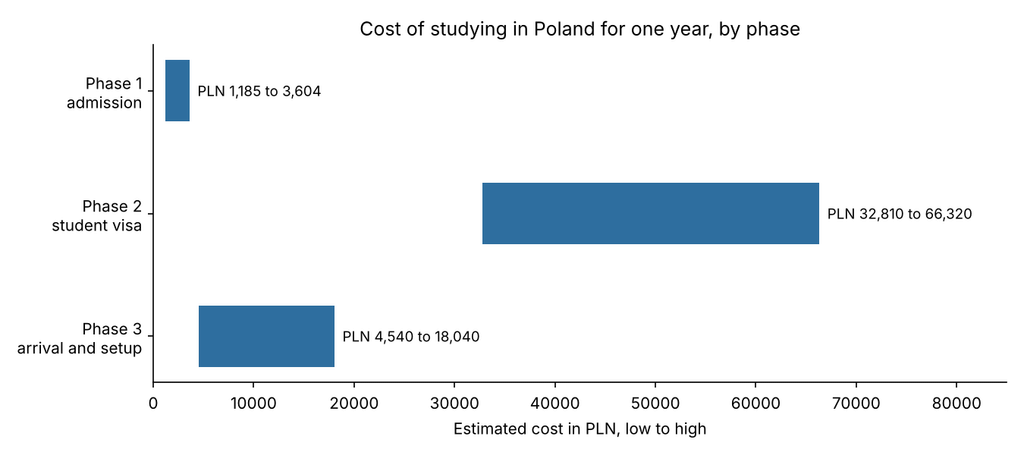
Bar chart of the cost of studying in Poland for one year in PLN, split into admission, student visa, and arrival and setup, with each low to high range labelled
That total of PLN 38,535 to 87,964 includes three kinds of money, so split them before you judge the real cost of studying in Poland.
Money that stays yours. The living funds, housing funds and return travel money total PLN 21,820 to 32,620. You spend living and rent money during the year, but none of it is a charge. If you remove it, the total falls to about PLN 16,715 to 55,344.
Tuition. First year tuition of PLN 9,634 to 27,149 pays for your qualification, not for a fee. Remove it too and PLN 7,081 to 28,195 is left.
Money you get back. The landlord should return the rent deposit of PLN 500 to 3,000 when you leave. Take that out as well and the sum genuinely lost to charges is PLN 6,581 to 25,195. That covers the visa fee, tests, translations, insurance, residence permit duties, flights and setup.
The high end adds every high estimate together, which rarely happens. Most students end up nearer the middle.
What is not in this total. One year only. Longer courses add tuition, rent, NFZ contributions and, for later years, a permit extension with new stamp duty. The total also leaves out the graduate permit, whose fee the official page does not state (we expect PLN 340, the usual rate for other permits, but confirm it), flights home, and any preparatory language year. Medicine and dentistry cost several times more, as the table below shows.
Tuition by level and type of university
Public and private universities set their own fees, which cannot be treated as one national price. The table uses fees we could read on official university pages for 2026/2027. We found no reliable fee table for a private university degree, so we show only the SWPS preparatory year for the private sector.
| Level and type | Typical yearly tuition for a non EU student | Note |
|---|---|---|
| Bachelor’s, English taught, public | EUR 3,800 to 5,000 (PLN 16,640 to 21,895) | Wroclaw lists EUR 3,800 to 4,200 for year one and SGH lists EUR 5,000 |
| Master’s, English taught, public | EUR 3,200 to 6,200 (PLN 14,012 to 27,149) | Wroclaw EUR 3,200 to 4,200 and SGH EUR 4,800 to 6,200 |
| Whole range at one large public university | EUR 1,000 to 5,500 (PLN 4,379 to 24,084) for most programmes | Warsaw lists a few outliers at EUR 8,000, 9,000 and 18,000 |
| Polish taught, full time, public | EUR 4,700 (PLN 20,581) at SGH | SGH, undergraduate and graduate. Warsaw University of Technology lists EUR 3,650 to 6,000 for Polish taught courses, but its decision does not say if that is per year |
| Psychology, long cycle, Warsaw | PLN 27,600 | Listed in zloty for non EU students |
| Health and sport degrees, public | EUR 2,860 to 6,860 (PLN 12,524 to 30,039) | Academy of Physical Education fee list for 2026/2027 |
| Medicine, English taught | EUR 16,000 (PLN 70,062) | Jagiellonian University, entry year 2026/27 |
| Dentistry, English taught | EUR 17,000 to 20,900 (PLN 74,441 to 91,519) | Jagiellonian EUR 17,000 and Medical University of Warsaw EUR 20,900 |
| Polish language preparatory year, private university | EUR 2,700 (PLN 11,823) | SWPS, 600 hours from 5 October 2026 to 30 June 2027 |
| Doctoral school, full time | No tuition, and a scholarship | NAWA guide dated December 2023, so confirm with the school |
Two notes. Full time Polish taught study at public universities is free only for certain groups, such as EU and EEA citizens and holders of Karta Polaka, so most non EU students pay for it as well. And fees often fall after year one, as the Wroclaw table shows, with year two and three about EUR 200 lower.
Before you pay anything
- Check the university first. Look for it on the Interior Ministry lists or in an exempt group, and ask whether it is near the 50 percent cap.
- Get the NAWA statement early. It is free, but waiting time is not stated.
- Match your language proof to the list. A certificate that meets B2 on the regulation is safer than a school letter.
- Plan for PLN 1,010 a month, not 701. Then add housing, return travel and tuition.
- Pay tuition before you ask the bank for a certificate. Order matters.
- Prove money twice. Keep the funds available for the permit stage.
- Join NFZ as a student. The student rate is PLN 55.80 a month.
- Do not sign a lease you cannot register. Your PESEL, Trusted Profile and permit all depend on a registered address.
- Use the graduate permit last. You get it once, for 9 months.
- Get every charge in writing, whether it is a deposit, a bank fee or a conversion cost.
- Set the total beside other countries. Our guides to the cost of studying in France, Italy and Japan use the same three phases, so you can compare the totals side by side.
Short answers to common money questions
What should you budget for the cost of studying in Poland?
For one year, our model puts the cost at PLN 38,535 to 87,964. Of that, PLN 21,820 to 32,620 is your own living, housing and travel money, PLN 9,634 to 27,149 is tuition, and PLN 6,581 to 25,195 goes on fees and setup. The spread comes from tuition, which depends on the course, and from rent, which depends on the city.
What proof of funds does Poland want from students?
Plan for PLN 1,010 for each month of stay, plus housing, return travel of up to PLN 2,500, and tuition. Some consulates still print PLN 701, so ask your post which figure it applies, then use the higher one to be safe.
How much is the visa fee for Poland?
The national visa fee is EUR 200, about PLN 876, and the consulate keeps it even if it refuses your visa. Some posts add a visa centre fee. We read no student discount on the pages we checked, so confirm that with your consulate.
Is health insurance required for students in Poland?
Yes, it is mandatory for all students. You need a travel policy of at least EUR 30,000 for the visa, then either NFZ cover or a private policy for the residence permit. Students outside the EU can join NFZ for PLN 55.80 a month.
Can students work in Poland?
Full time students at approved universities can work without a work permit. Part time students cannot. We found no official weekly hours cap, so check with your university.
What happens after graduation?
You can apply once for a 9 month permit, which lets you look for work or start a business. Full time graduates may work freely during it, and the permit cannot be repeated or extended.
Treat this guide as background reading, not as legal or immigration advice. Polish fees, thresholds and procedures change often, and some changed in 2026. Confirm every detail with the Polish consulate that will take your file and on the government’s own pages at gov.pl. As far as we could find, Poland has no licensing scheme or public register for immigration advisers or visa agents, so check the credentials of anyone who offers paid help, and note that the Office for Foreigners warns against dishonest intermediaries.
For regulated legal help, use a lawyer who is a member of the Polish Bar Council (adwokat) or of the National Chamber of Legal Advisers (radca prawny), which has a public list you can search by surname.